

The first sign that a PEO is on the table in Colorado is usually not a grand strategy memo. It’s a renewal notice that came back too high, a benefits renewal that’s eating margin, or a payroll setup that works fine until the company hires in another state and the admin load gets ugly. At that point, the question is not which vendor has the slickest demo. It’s which contract gives the company the most control over cost, compliance, and exit options over the next 12 to 36 months.
Table of Contents
- The Colorado PEO Decision You’re Actually Making
- What a PEO Actually Does and Why the Co-Employment Detail Matters
- How Big the Colorado PEO Market Really Is
- Colorado-Specific Compliance and Implementation Rules Buyers Overlook
- PEO Pricing Models and Service Tiers in Colorado
- The Contract Clauses That Determine Total Cost
- How to Shortlist, Compare, and Negotiate a Colorado PEO
- The One-Page Mental Model and Common Buyer Questions
The Colorado PEO Decision You’re Actually Making
A Colorado HR director usually starts this process because the current setup has become expensive, messy, or both. Benefits renewals keep climbing, payroll is split across states, or the internal team is spending too much time chasing paperwork that should be routine. That pressure makes a PEO look like a clean fix, but the decision is deeper than that.
Three choices drive the outcome
The first choice is service model fit. A growing company with 20 employees and simple needs should not buy the same structure as a 400-person employer with construction crews, remote hires, and multiple state registrations. The second is contract negotiation, because the rate on the proposal rarely tells the whole story. The third is benchmarking, which changes the negotiation from guesswork into a real comparison of pricing, service, and exit terms.
Practical rule: a buyer should treat the first PEO conversation like a commercial negotiation, not a vendor tour.
That mindset matters in Colorado because the market is broad enough to compare real options. It also matters because the wrong fit can create more admin than it removes. A provider can look strong on benefits and payroll, then turn weak on implementation support, worker classification guidance, or responsiveness once the deal is signed. A structured review of what a PEO is, and what it is not, belongs at the start, not after the sales cycle has already narrowed the field, so this overview of professional employer organizations is a useful starting point for buyers who want the concept straight before they get into pricing.
The takeaway is simple. In Colorado, the winner is usually not the biggest brand. It’s the provider whose contract, service model, and pricing structure fit the business after the first year, not just on day one.
What a PEO Actually Does and Why the Co-Employment Detail Matters
A PEO is more than outsourced payroll with a prettier sales pitch. It enters a co-employment arrangement where the PEO handles certain employer functions, while the client company keeps control of hiring, firing, pay decisions, culture, and day-to-day supervision. That split matters because it defines who carries responsibility when something goes wrong.
The PEO functions like a back-office co-pilot. It may handle payroll processing, benefits administration, certain tax filings, and workers’ compensation administration, while the client still runs the business and manages the employees. That division helps an HR leader, but it also means the legal structure deserves close review before anyone signs.
What buyers usually assume, and what they should verify
Many buyers assume a PEO will clean up every HR problem. It will not. Strategy, leadership decisions, employee relations, and industry-specific compliance still sit with the employer. A PEO can support the process, but it does not replace management judgment, especially when the company is dealing with leave, discipline, or a sensitive termination.
A basic comparison separates the options:
- PEO: co-employment, payroll, benefits, workers’ comp, and selected compliance administration.
- ASO: HR support without the same employer-of-record structure.
- Broker-only model: helps source benefits, but does not run the broader HR and payroll relationship.
That distinction is where a lot of sales conversations blur. A broker can help with benefits shopping, but a PEO is a much bigger operational shift. If you want the employer split explained clearly, review PEO co-employment explained.
The workers’ compensation piece deserves the same treatment. A buyer should understand how coverage works in plain English, so a practical reference like workers comp insurance explained can help confirm whether the PEO’s workflow fits the company’s risk profile.
By the end of the evaluation, the CEO should be able to answer one question clearly. Is this arrangement buying real administrative relief and risk control, or is it just moving tasks into a different mailbox?
How Big the Colorado PEO Market Really Is
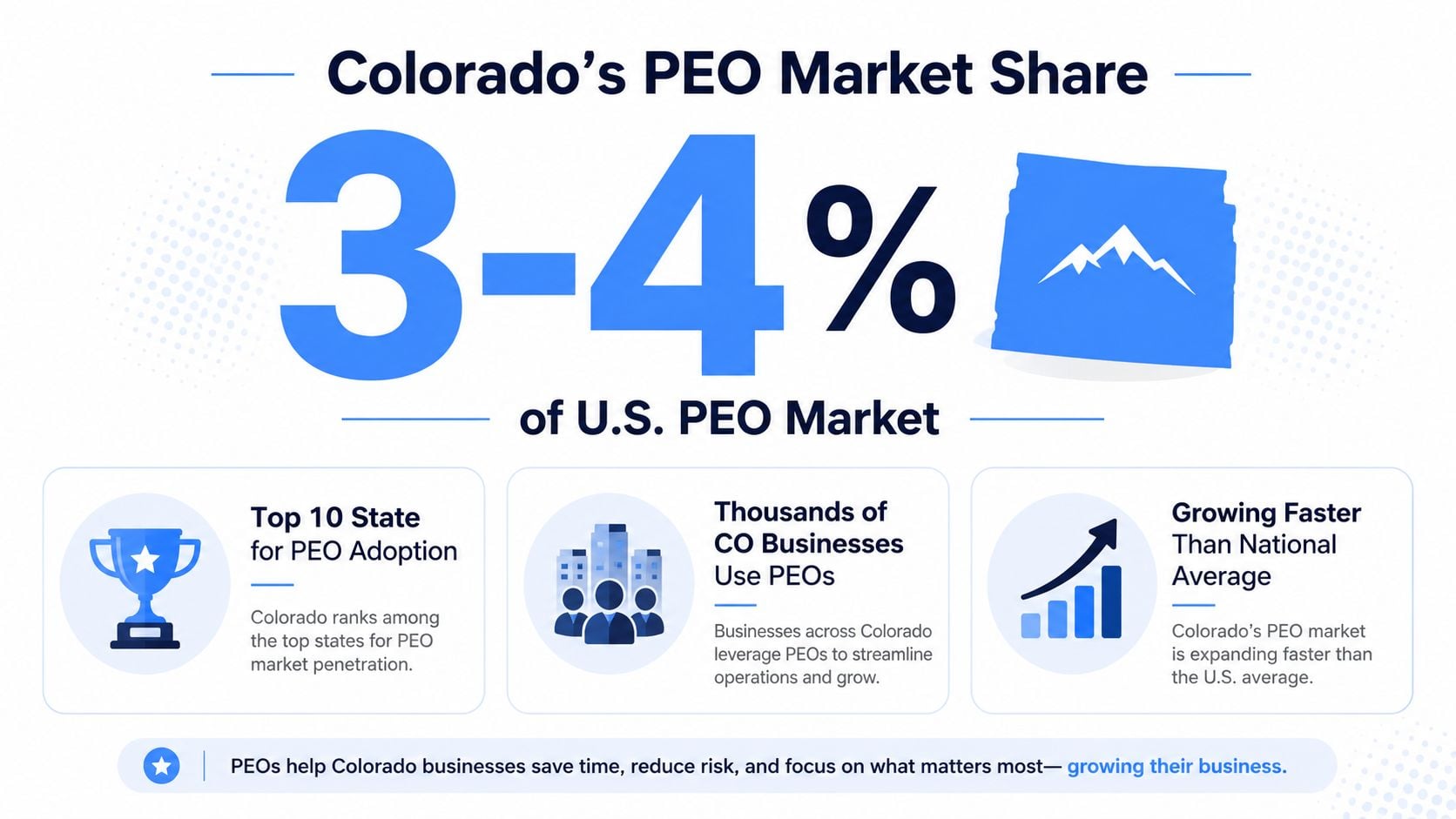
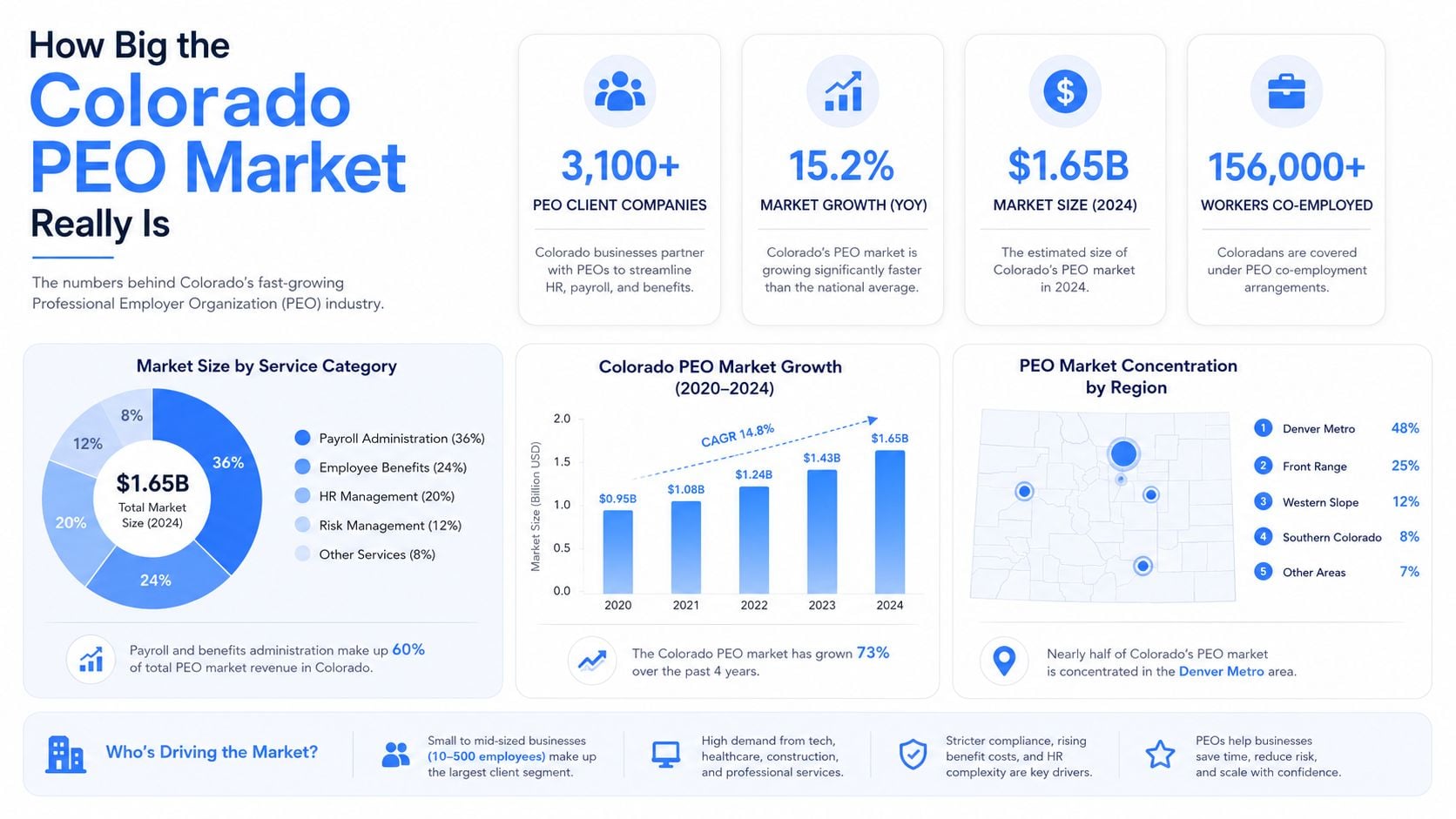
Colorado is a real PEO market, and buyers should treat it that way. NAPEO’s 2025 white paper estimates that the state accounts for about 3% of all PEO clients, or roughly 6,200 client companies (NAPEO white paper). That is enough volume to support serious competition, but not so much that buyers should expect every vendor to show up with the same contract terms or service model.
Why size changes leverage
The client mix matters as much as the headcount. NAPEO says half of PEO clients have 10 to 49 employees and 35% have fewer than 10 employees (NAPEO white paper). That profile fits Colorado well, because the state has a large base of small and growth-stage employers that feel payroll, benefits, and compliance pressure early. The national footprint is also substantial, with PEOs co-employing about 4.5 million workers at 200,000 companies (NAPEO white paper).
That scale changes how a buyer should read the market. It is a contract and pricing problem first, a vendor-shopping problem second. The more mature the market, the more likely a buyer can compare service tiers, ask for narrower terms, and push back on fee language that looks standard but shifts risk back to the client. For a clean directory view of the field, Colorado PEO directory is a useful starting point, and a broader list of professional employer organizations helps confirm how crowded the category really is.
Provider density gives buyers room to press. One Colorado directory lists 100 different PEOs operating in the state (Colorado PEO directory). That is enough competition to build a real shortlist, compare contract language line by line, and reject the first polished pitch that lands in the inbox.
The labor market points in the same direction. A ZipRecruiter Colorado page for a “PEO” role shows an average salary of $84,043 per year and a range from $60,500 at the 25th percentile to $105,200 at the 75th percentile (ZipRecruiter Colorado PEO salary page). That spread suggests Colorado can support a deep bench of HR and payroll talent, which matters because PEO service quality often comes down to the people assigned to the account, not the logo on the proposal.
The buyer takeaway is straightforward. Colorado gives employers both demand-side scale and supply-side choice, and that combination creates negotiating power. If you are comparing vendors, keep the contract front and center and use compliance advice from David J Greiner Law as a reminder that service promises mean little if the implementation and compliance terms are sloppy.
Colorado-Specific Compliance and Implementation Rules Buyers Overlook
Colorado is one of the states recognized as a PEO reporting state, which means the PEO is treated as the employer of record for state unemployment insurance reporting and tax filings (Deel state-by-state guide). That sounds administrative, but it is one of the cleanest places for a switch to go wrong. If the client keeps its old Colorado UI account open, duplicate filings and penalty notices can follow.
The transition point most teams mishandle
The account transition needs to be explicit. PEO Colorado states that the PEO assumes responsibility and liability for state unemployment taxes and reports under its own tax number, and the practical consequence is that the client may need to close any pre-existing Colorado UI account to avoid conflicts (PEO Colorado FAQ). That should be part of the implementation checklist, not something discovered after the first quarter filing.
If payroll moves into the PEO and the old UI account stays open, the client can create avoidable filing noise, and that is usually a self-inflicted problem.
A concrete example makes the risk obvious. A 120-employee Denver company switched payroll into a PEO but left the prior Colorado UI account active. The next quarterly cycle produced conflicting filings, which meant payroll and finance had to untangle a problem that should have been closed out before go-live. That kind of mistake burns time, and it can trigger avoidable notices.
Colorado buyers also need to think about workforce and compliance fit, not just payroll transfer. Companies with multi-state employees or industry exposure in construction, healthcare, cannabis, and tech should ask how the provider handles leave administration, workers’ compensation workflows, and other state-specific processes. A useful companion resource on keeping business operations clean under shifting rules is compliance advice from David J Greiner Law, especially for buyers who need a more formal view of regulatory discipline.
For a wider view of the compliance side, Colorado HR compliance resources can help buyers pressure-test whether a provider’s process matches the state’s operational load.
The checklist for Colorado is short, but it is not optional. Confirm who owns the UI account transition. Confirm who files under what EIN. Confirm how leave, workers’ comp, and industry-specific issues will be handled on day one, not after the first audit question.
PEO Pricing Models and Service Tiers in Colorado
A Colorado buyer can get burned by a clean-looking quote. The decision starts with the pricing model, then shifts to what service tier is included. PEO pricing in Colorado usually shows up as either a percentage of payroll or a per-employee-per-month fee, and those two structures react very differently as wages rise or headcount changes.
The math CFOs should run first
A U.S. Chamber explainer says small businesses typically pay 2% to 12% of gross payroll, or about $40 to $200 per employee per month. A Colorado guide says pricing commonly lands around 2% to 11% of payroll or roughly $1,000 per employee annually. Those figures are broad bands, not a quote, but they are enough to pressure-test any sales proposal.
A finance leader should run the math against actual payroll, not the rep’s headline rate.
| Pricing Model | Low Estimate | High Estimate | Annual Cost on $3.5M Payroll |
|---|---|---|---|
| Percentage of payroll | 2% | 11% | $70,000 to $385,000 |
| Per employee per month | $40 PEPM | $200 PEPM | $24,000 to $120,000 |
That example assumes a 50-employee company at $70,000 average pay, which creates $3.5 million payroll. At 2%, the annual fee comes to about $70,000. At 11%, it rises to $385,000. At $40 to $200 PEPM, the annual cost lands around $24,000 to $120,000. That spread is why buyers should read PEO pricing and cost structure before they accept a proposal at face value.
Service tier matters as much as fee structure
The next mistake is assuming all PEOs sell the same service. They do not. A full-service co-employment package is different from a stripped-down benefits arrangement with payroll support, and both are different from hybrid setups that sit closer to an ASO than a full PEO relationship.
The right question is simple, what does the company want off its plate, and what does it want to keep in-house? If the internal team already handles HR well but struggles with payroll and benefits administration, a lighter model may fit. If the team needs compliance support, workers’ compensation handling, and tighter payroll operations, the fuller package can justify a higher fee.
Why market size matters
Colorado is a market where provider density gives buyers options, but it also gives sales teams room to blur the differences. That makes contract terms and service tiers more important than branding. A small company with basic admin needs should not pay for a premium bundle it will never use. A growing employer with multi-state workers, benefits complexity, or heavier compliance exposure should not strip the package down just to save on the starting rate.
The practical test is this. If the provider cannot explain exactly which services sit inside the quoted fee, which items are pass-through, and which items can change at renewal, the quote is incomplete.
The Contract Clauses That Determine Total Cost
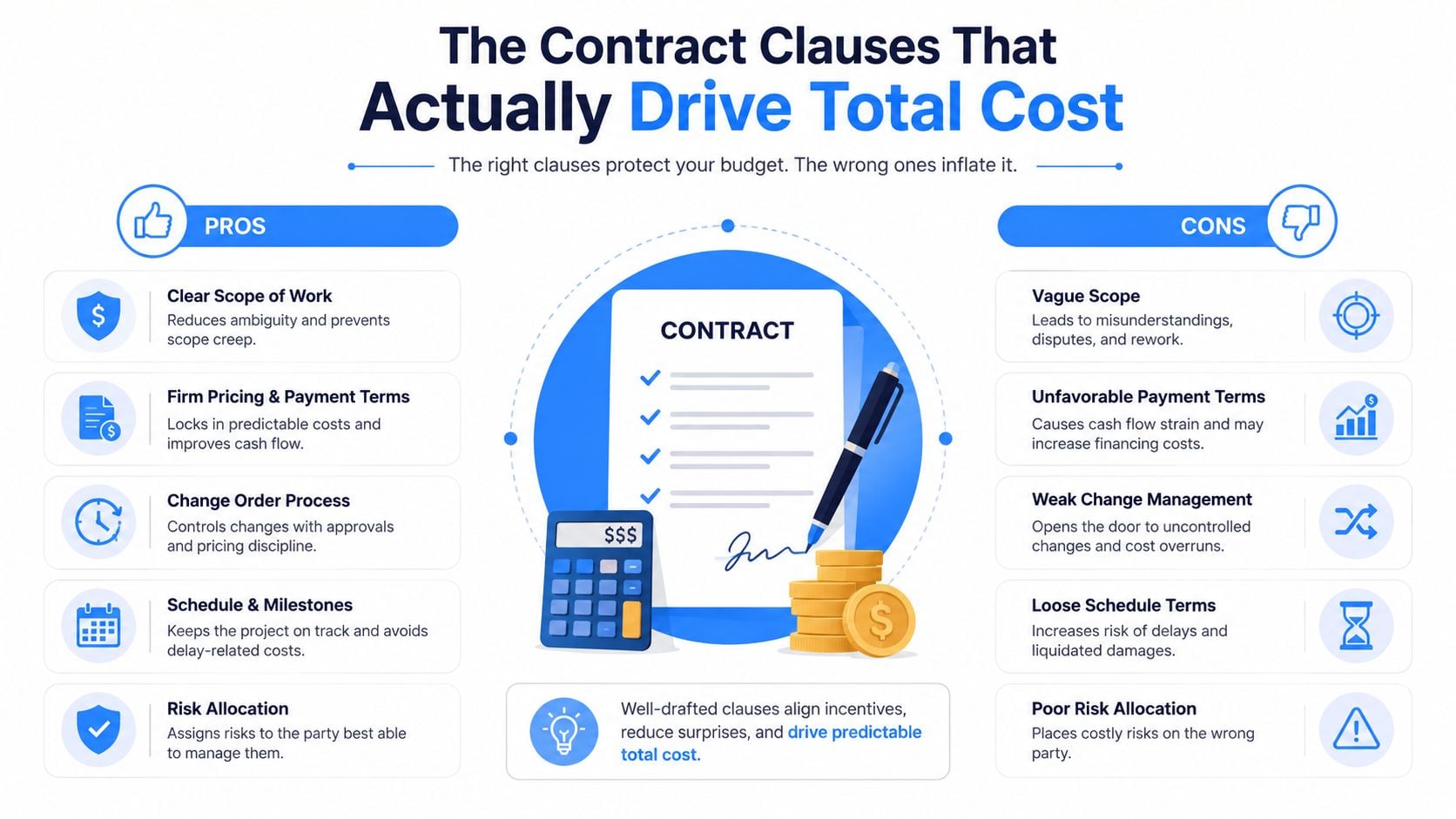
A low headline rate can be a trap. The cost of a PEO shows up in renewal language, fee escalators, implementation credits, and exit terms. Colorado buyers who focus only on the starting number usually miss the clauses that change the economics after the first year.
What to push for, and what to avoid
Do ask for fee caps. If the contract allows broad increases without a ceiling, the provider can claw back the savings later. A buyer should want the increase mechanics in writing, not just a promise from the sales rep.
Do lock the renewal window. If the agreement auto-renews without enough notice, the buyer loses negotiating power fast. Renewal timing should be visible, calendarized, and easy to exit from if service slips.
Do separate implementation credits from the main fee. If the deal falls apart, the company should know whether it keeps the credits or loses them. That detail sounds small until onboarding stalls and the provider keeps the money anyway.
Do read offboarding terms carefully. Termination and transition fees can wipe out the savings from a lower rate. If the company needs to leave, the contract should not punish it for getting out of a bad fit.
Don’t ignore liability language. Co-employment terms can be written in ways that sound balanced but still push real risk back to the client. The legal text needs review, especially when the company is in a regulated industry or running multi-state payroll.
The cheapest quote is often the most expensive agreement once the escalators, exit costs, and service gaps show up.
A lot of Colorado buying advice stops at “compare providers side by side.” That leaves out the clauses that control the bill. Buyers should compare who controls renewal pricing, who keeps implementation credits, what happens at termination, and how liability is assigned. Those terms decide whether the PEO keeps costs in check or becomes another fixed expense with a better pitch.
Colorado’s provider density makes this even more important. The market has enough competition for buyers to get real options, but it also gives sales teams room to hide bad terms inside a polished proposal. A smaller employer can overpay for a package it never uses. A growing employer can get squeezed later if the contract leaves pricing or exit language vague.
The practical rule is simple. If the contract terms are weak, do not sign just because the monthly fee looks lower. In many PEO deals, the clause package matters more than the sticker price.
How to Shortlist, Compare, and Negotiate a Colorado PEO
A solid Colorado PEO process can move in 30 to 60 days if the company stays disciplined. The first step is to define the must-haves before any demos start. That means industry fit, multi-state capability, benefits carrier access, workers’ comp appetite, and the technology stack the internal team can live with.
Build the shortlist from evidence, not sales decks
The shortlist should be three to five providers, not twelve. Colorado has enough market depth to compare real options, and buyers can use independent benchmarking instead of relying on whoever responds fastest. PEO Metrics is one option in that category, since it compares providers on pricing, benefits, contract terms, service model, compliance support, and industry fit rather than on a sales pitch.
A good request for proposal should force each finalist to answer the same questions in the same format:
- Pricing structure: percentage of payroll or PEPM, with all administrative fees shown separately.
- Contract terms: renewal language, rate-lock options, implementation credits, and exit provisions.
- Service scope: payroll, benefits, workers’ comp, HR support, and state-specific filing responsibility.
- Operational fit: industries served, multi-state support, and implementation timeline.
Then the negotiation should get specific. Ask for a rate lock, ask for a written implementation credit, ask what service-level commitment is available, and ask how the provider handles offboarding if the relationship ends. If a rep will not discuss those items clearly, that is a warning sign.
Decision rule: if two providers look similar on fee, choose the one with better contract protection and cleaner implementation terms.
Companies that negotiate well usually do one thing better than everyone else. They ask for the concession before the agreement is drafted, not after everyone has emotionally committed to the deal. That approach is especially useful in Colorado, where enough provider density exists to create a real comparison and enough demand exists to make vendors compete for serious accounts.
The One-Page Mental Model and Common Buyer Questions
The whole decision comes down to three layers, service model, pricing structure, and contract terms. Colorado-specific issues sit underneath those layers, especially UI account ownership, implementation cleanup, and market density. Buyers who benchmark three to five providers usually gain more bargaining power than buyers who rely on a single sales cycle.
How long does implementation take? It depends on payroll complexity, carrier moves, and how clean the data is. A simple setup can move quickly, while multi-state or highly regulated employers need a more careful transition.
Can a company switch PEOs mid-contract? Sometimes, yes, but the exit terms matter more than the desire to switch. That’s why the original contract needs review before anyone signs.
What happens to benefits during a transition? The answer depends on timing, carrier coordination, and whether the new provider can line up the move without a coverage gap.
Is a small company too small for a PEO? No. Smaller employers are common in the PEO market, including firms with fewer than 10 employees and firms in the 10 to 49 range (NAPEO white paper).
If Colorado leadership wants a cleaner way to compare providers, benchmark contract language, and avoid the usual pricing traps, visit PEO Metrics. It’s built for buyers who want independent comparison before they sign, not after they’ve already lost the upper hand.
