Breakdowns of PEO pricing models, fee structures, hidden costs, and long-term financial impact. Includes comparisons between percentage-of-payroll and per-employee pricing models.
Most businesses compare PEO admin fees and miss the full financial picture—leading to costly surprises after signing. This practical guide shows you how to build a comprehensive PEO acquisition cost modeling framework that captures actual costs, savings, risk transfers, and hidden expenses. You’ll learn to compare providers objectively, present data-backed recommendations to leadership, and verify ongoing value with a reusable analytical model that goes far beyond surface-level fee comparis…
PEO expense recognition timing determines whether you book costs when employees work, when invoices arrive, or when you pay—and getting it wrong distorts your P&L and budget reports. Proper accrual accounting requires matching PEO expenses to the period when services were performed, not when invoices are received or paid, ensuring accurate financial statements and GAAP compliance for audits and decision-making.
Most business owners accept PEO proposals without understanding if they’re overpaying because benefits cost structures are complex and lack transparency. This guide provides seven practical PEO benefits cost benchmarking strategies to help you break down bundled pricing, compare your costs against market rates, identify real value, and negotiate better contract terms during renewals instead of accepting per-employee fees blindly.
Most business owners accept PEO workers comp as a bundled payroll add-on without scrutinizing the structure—a costly oversight since it’s typically their largest insurance expense. This PEO workers comp insurance structure review explains how coverage is actually priced within PEO arrangements, where hidden costs accumulate, and when you’re unknowingly subsidizing other clients’ claims, helping you determine whether bundled coverage makes financial sense or if standalone insurance would bette…
Enterprise CFOs struggle with PEO impact on enterprise budgeting because traditional PEO invoices bundle payroll, benefits, compliance, and administrative costs into opaque line items that don’t map to standard general ledger categories. The real challenge isn’t tracking current spending—it’s accurately forecasting future costs, allocating expenses across departments, and explaining variances when a single PEO bill replaces what used to be a dozen separate vendor relationships and internal co…
Most business owners struggle to properly measure the financial impact of PEO workers’ comp because it requires evaluating a fundamentally different risk structure than traditional policies. This step-by-step guide shows you how to conduct a thorough PEO workers’ comp financial impact assessment by establishing your current cost baseline, identifying hidden cost drivers, evaluating PEO-specific variables like pooled risk pricing and claims management, and building an accurate projection model…
Most business owners using a PEO default to bundled pay-as-you-go workers comp financing, but that’s rarely the most cost-effective option. This guide reveals seven PEO workers comp alternative financing strategies that PEOs don’t typically advertise upfront, helping you match your financing structure to your cash flow needs, risk profile, and loss history—potentially saving thousands annually if you know what to negotiate for.
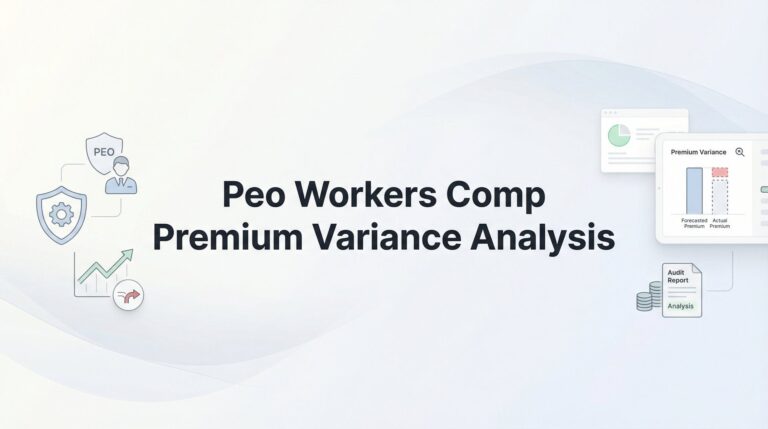
When your PEO workers comp premium variance analysis reveals unexpected cost fluctuations—like an 18% increase despite flat payroll—most business owners simply pay the bill without questioning it. Systematic variance analysis helps you identify the root causes of these premium shifts, catch costly billing errors before they compound, and build leverage for better contract negotiations with your PEO provider.

PEO workers comp deductible structures operate differently than standalone policies because you’re covered under the PEO’s master policy, where deductibles may be passed directly to clients, built into pricing, or tiered based on claims history. Understanding how your PEO workers comp deductible structure actually works—including who pays what per claim and when—is critical to avoiding unexpected invoices that can quickly exceed your anticipated premium savings, especially when small claims a…
Most businesses overpay on workers’ comp through their PEO because of common classification errors—like coding desk workers as general office instead of clerical, or classifying supervisors at the same rate as equipment operators. These misclassifications happen when PEOs use default categories rather than examining actual job duties, costing companies thousands annually. Strategic PEO workers’ comp payroll classification requires documentation of employee activities and understanding how to …
