
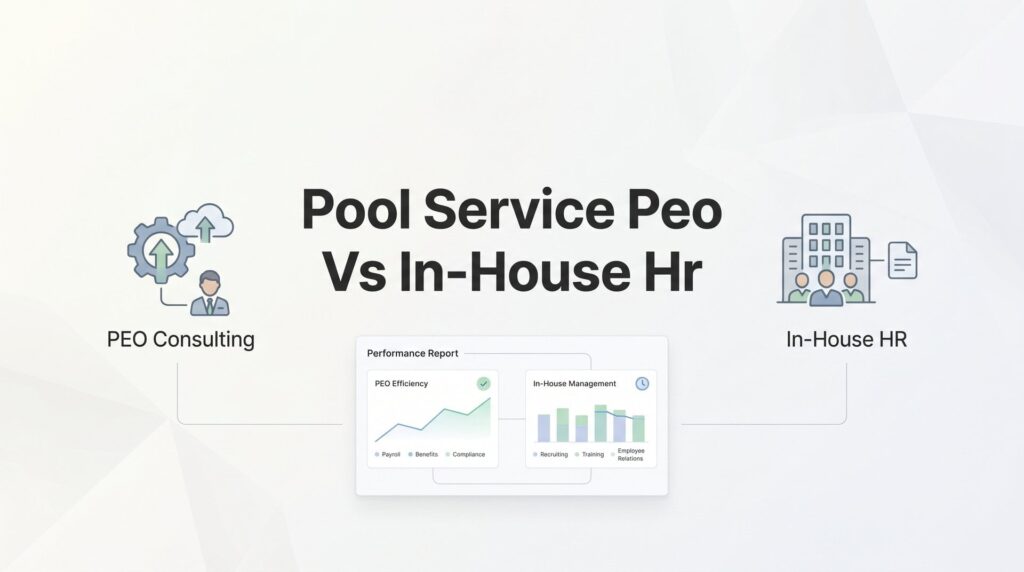
Pool Service-specific PEO context. For pool service companies, the PEO-vs-in-house HR decision is influenced by specialized HR expertise needs that are hard to hire individually. Pool service PEO-to-in-house crossover at 150–250 employees — service-industry economics flip earlier than construction.
Looking for the full Pool Service PEO guide? See our PEO for Pool Service Companies pillar page covering the complete industry profile — pain points, recommended PEOs, PEO economics, when each model wins, and a decision framework specific to pool service.
Top Pool Service HR & Compliance Pain Points
- Pool chemical handling compliance. Chlorine, muriatic acid, calcium hypochlorite, and algaecides require OSHA Hazard Communication compliance, EPA-registered pesticide handling for algaecides, and Department of Transportation regulations for vehicle transport.
- Electrocution and equipment risks. Pool equipment (pumps, heaters, salt-chlorine generators) creates electrocution risk during service. PEO safety programs include lockout/tagout protocols and structured electrical safety training.
- Vehicle accidents for service techs. Pool service techs drive 25K–50K miles annually across residential routes. Vehicle accidents are a top claim category. Fleet-safety programs reduce frequency.
- State pool service contractor licensure. Florida, California, Arizona, and several other states require pool service contractor licensure. Multi-state pool service requires per-state license management.
- Seasonal headcount swings in northern markets. Pool service in northern climates has dramatic seasonal swings — summer service, fall closing, winter maintenance, spring opening. PEO master plans handle the cycle.
PEO vs In-House HR for pool service companies
The pool service-specific crossover from PEO to in-house HR sits at Pool service PEO-to-in-house crossover at 150–250 employees — service-industry economics flip earlier than construction.
- Multi-state pool service licensure tracking
- Chemical handling compliance documentation
- Fleet management for service-tech vehicles
For the full PEO vs in-house HR analysis — cost math by company size, build-vs-rent framework, and M&A considerations — see our PEO vs in-house HR guide.
Recommended PEOs for pool service companies
- TriNet: service-industry strength; mobile-friendly platform for route-based pool service techs
- Paychex Employer Services: mid-market pool service with accounting integration and multi-state operations
- Insperity: commercial pool service (HOAs, hotels, municipalities) with multi-state operational depth
- Justworks: pool service companies with 25+ employees wanting modern HR tech
Pool Service PEO — Common Questions
How do PEOs help pool service companies with chemical handling compliance?
What's the workers' comp class code for pool service?
Does a PEO handle DOT compliance for transporting pool chemicals?
How do PEOs handle the seasonal cycle in northern-market pool service?
Should a pool service company in Florida or Arizona (year-round market) use a different PEO than seasonal markets?
Get a Free Pool Service PEO Comparison
We score 40+ PEOs against your specific pool service profile — mod rate, multi-state operations, compliance load. Free, delivered in 5–10 business days.
Get My Free Comparison