
Two Illinois PEO proposals land in the inbox on the same day. One looks cheap because the admin fee is low. The other looks expensive until the benefits package, workers' compensation handling, and implementation terms start to surface. By the time the finance team tries to compare them, the numbers no longer line up.
That's the normal buying experience, not a sign that the team missed something obvious.
A professional employer organization in Illinois isn't just another outsourced HR vendor. It changes how payroll is run, how benefits are delivered, how some liabilities are allocated, and how the company handles state-specific compliance. In Illinois, that evaluation gets more technical because the market is crowded, the legal structure is formal, and the contract can affect more than HR administration.
Table of Contents
- Why Your PEO Decision in Illinois Is Different
- Understanding the Co-Employment Model in Illinois
- Navigating Illinois-Specific Compliance and Risk
- The True Cost of a Professional Employer Organization in Illinois
- How to Evaluate and Compare Illinois PEO Providers
- Negotiating Your Illinois PEO Agreement
- Making Your Final PEO Decision
Why Your PEO Decision in Illinois Is Different
A common mistake in Illinois is to judge a PEO by the quoted admin fee and stop there. A CFO sees a lower per-employee price, the team assumes the comparison is done, and six months later the actual cost shows up in implementation charges, weak claims support, limited HR coverage, or a renewal structure that looked harmless in the first draft.
Illinois makes that mistake more expensive because the provider field is fragmented, employer profiles vary widely by region and industry, and proposals are rarely built on the same assumptions. A Chicago manufacturer with multishift workers, a healthcare group in the suburbs, and a software company hiring across Illinois can receive proposals that appear similar while assigning very different responsibilities, service levels, and risk back to the client.
This is an important difference to note. The decision is not just about outsourcing HR tasks. It is a financial and compliance decision shaped by Illinois payroll tax treatment, workers' compensation history, local labor practices, and the provider's ability to support employers in this state without routing every issue through a national service queue.
In practice, the Illinois market rewards careful comparison and punishes shorthand. Some firms keep onboarding fees separate. Others fold them into first-year pricing. Some include stronger HR guidance and leave the buyer with fewer execution gaps. Others advertise broad support, then limit access to senior people once the contract is signed. Exit language also matters more than buyers expect, especially if the relationship does not perform and the company needs a clean transition.
I tell finance teams to treat this as diligence, not benefits shopping.
That means comparing full operating cost, contract structure, service model, and Illinois fit. It also means looking at the local market before narrowing the field. For employers that want a narrower view of the metro area, this overview of Chicago-area PEO providers is a useful starting point.
One more Illinois-specific point gets missed in generic PEO discussions. State-level hiring credits, payroll tax treatment, and incentive eligibility can change the economics of a deal at the margin. A provider that can process payroll is easy to find. A provider that can explain how its structure affects your actual Illinois employment cost is harder to find.
Cheap-looking PEO quotes often win the first meeting and lose the spreadsheet review.
Understanding the Co-Employment Model in Illinois
A CFO usually sees the confusion show up in one question: if we sign with a PEO, who is the employer tomorrow morning?
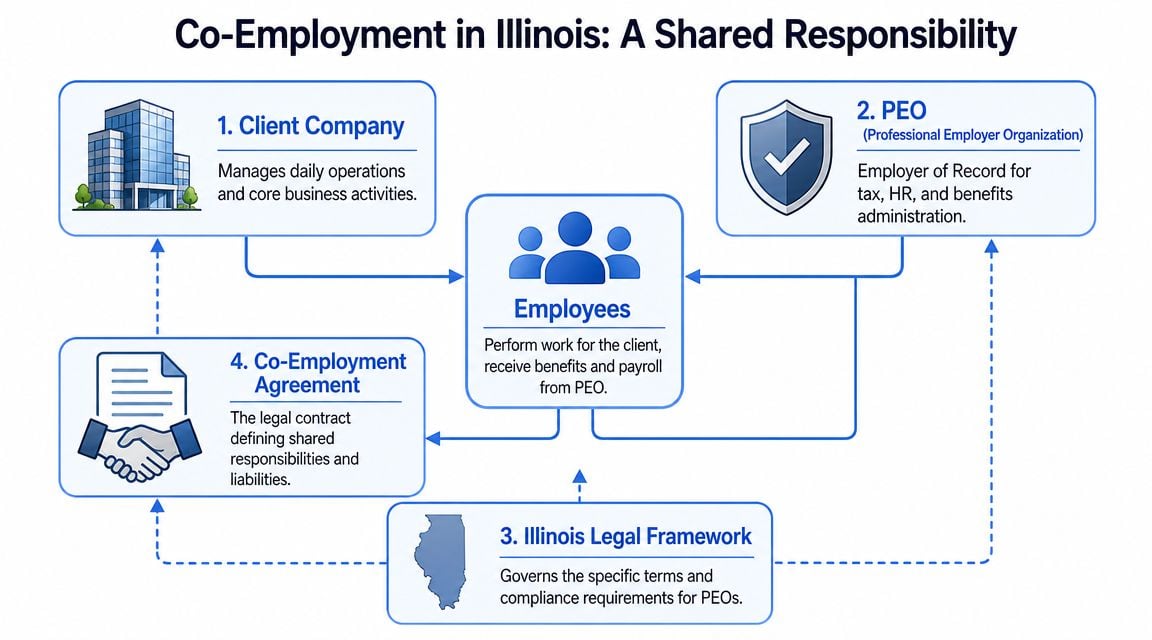
The answer in Illinois is straightforward. Your company still runs the workforce. The PEO becomes the co-employer for the administrative and insurance functions assigned in the agreement.
What co-employment changes
In practice, co-employment means the client company retains day-to-day management authority while the PEO takes on selected employer-side administrative duties. That usually includes payroll processing, tax withholding and filing, benefits administration, workers' compensation coverage, and parts of HR administration. The client still controls hiring decisions, job assignments, performance management, discipline, compensation strategy, and terminations.
That division matters because co-employment does not erase operating risk. If a plant manager in Joliet terminates someone badly, the PEO does not absorb that mistake just because it ran payroll. If the PEO misses a filing or mishandles a benefits enrollment task it agreed to own, that exposure sits on the provider side first, then gets sorted by the indemnity language and service agreement.
This is the point many Illinois buyers miss. A PEO does not replace management judgment. It replaces part of the back-office execution stack.
I tell clients to pressure-test the model with three contract questions before they talk about price:
Who directs the employee's daily work?
The client company does. Scheduling, supervision, coaching, and discipline stay with your managers.Which HR and payroll tasks are assigned to the PEO?
Only the tasks listed in the agreement. If it is not spelled out, assume there is room for dispute later.How is liability allocated when something goes wrong?
By contract language, insurance structure, and claim facts. Sales language is irrelevant once there is a dispute.
Illinois adds one more practical wrinkle. The state regulates employee leasing, so provider licensing and client entity setup can affect whether onboarding moves quickly or stalls in legal review. That tends to matter more with smaller Illinois employers that have recently formed entities, changed FEIN structures, or operate across multiple locations with inconsistent payroll records. A national provider may call the model standard. In Illinois, the paperwork and licensing side is less forgiving.
For a clearer breakdown of how duties are divided between the client and provider, this guide to PEO co-employment responsibilities is useful. Another area that stays with the employer is hiring judgment. Screening procedures still need to match the role, the industry, and the company's risk tolerance, which is why many teams also focus on mastering employment screening.
Read co-employment as shared administration with split liability, not a transfer of accountability.
Navigating Illinois-Specific Compliance and Risk
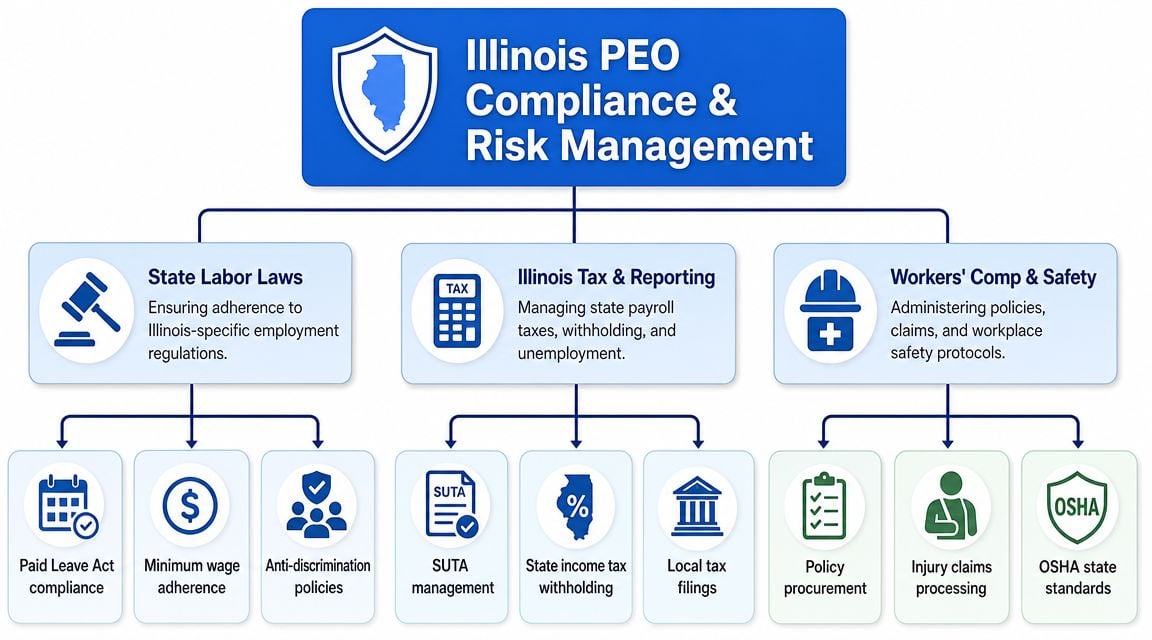
Illinois employers usually hire a PEO for administrative relief, but the bigger issue is risk control. The value shows up when the provider can execute accurately across payroll, workers' compensation, and state-specific employment rules while the client keeps managers disciplined.
Workers compensation and claims discipline
Workers' compensation is one of the first places weak PEO execution shows up. The policy itself matters, but the day-to-day process matters more. Injury reporting, claim routing, return-to-work handling, and job classification discipline all affect the client's experience.
A provider that promises broad coverage but can't explain claim intake workflows is creating future cost and operational friction. Illinois employers with field staff, production labor, or multiple worksites should ask who owns first notice of loss intake, how incidents are escalated, and whether the client will have direct visibility into open claims.
The wrong buying pattern is to assume “covered” means “well managed.” It doesn't.
Payroll taxes and incentive planning
Payroll administration in Illinois isn't just about issuing checks on time. It includes withholding, filing, local complexity, record accuracy, and handling edge cases during onboarding, terminations, and multi-location reporting. The technical risk rises when a business has employees in Chicago and elsewhere in the state, or when the company is planning expansion tied to incentives.
One often-missed issue is the Illinois EDGE payroll withholding credit for projects in “Underserved Areas.” The state identifies those areas using thresholds tied to poverty, SNAP participation, or unemployment, and employers should review how a co-employment arrangement may affect eligibility analysis, entity structure, and certification planning before hiring into those locations (Illinois EDGE Underserved Area guidance).
That's a real finance question, not a legal footnote. If the wrong entity is treated as the employer for withholding or documentation purposes, a company can create avoidable confusion around an incentive strategy.
A useful internal checkpoint is this:
| Issue | Weak approach | Better approach |
|---|---|---|
| Payroll setup | Accept the default setup flow | Review tax and reporting ownership before go-live |
| New site launch | Hire first, ask later | Confirm incentive implications before payroll begins |
| Multi-location hiring | Treat all worksites the same | Separate local compliance and reporting requirements |
Leave policies screening and day-to-day execution
A PEO can help administer leave policies and maintain consistent HR process, but it won't fix poor internal management. If frontline managers apply attendance rules unevenly, or if recruiting teams cut corners in hiring, the company still owns the operational damage.
That's why compliance work should start upstream. Hiring practices, documentation standards, and screening workflow all affect downstream leave disputes and termination risk. Teams tightening that front end can benefit from a practical guide to mastering employment screening, especially if recruiting is decentralized across departments.
For Illinois employers, the strongest providers are the ones that can connect policy administration to actual manager behavior. A polished handbook means very little if supervisors don't use it correctly.
Companies that want a structured review of state-specific exposure often use a PEO state employment law risk review before signing or renewing.
The True Cost of a Professional Employer Organization in Illinois
A CFO in Illinois gets two PEO proposals on the same day. One shows a low admin fee as a percentage of payroll. The other shows a clean per-employee monthly rate. Six months later, the cheaper proposal can end up costing more because health plan assumptions changed, workers' compensation handling created claims friction, or the agreement made exit expensive.
How Illinois PEO pricing is structured
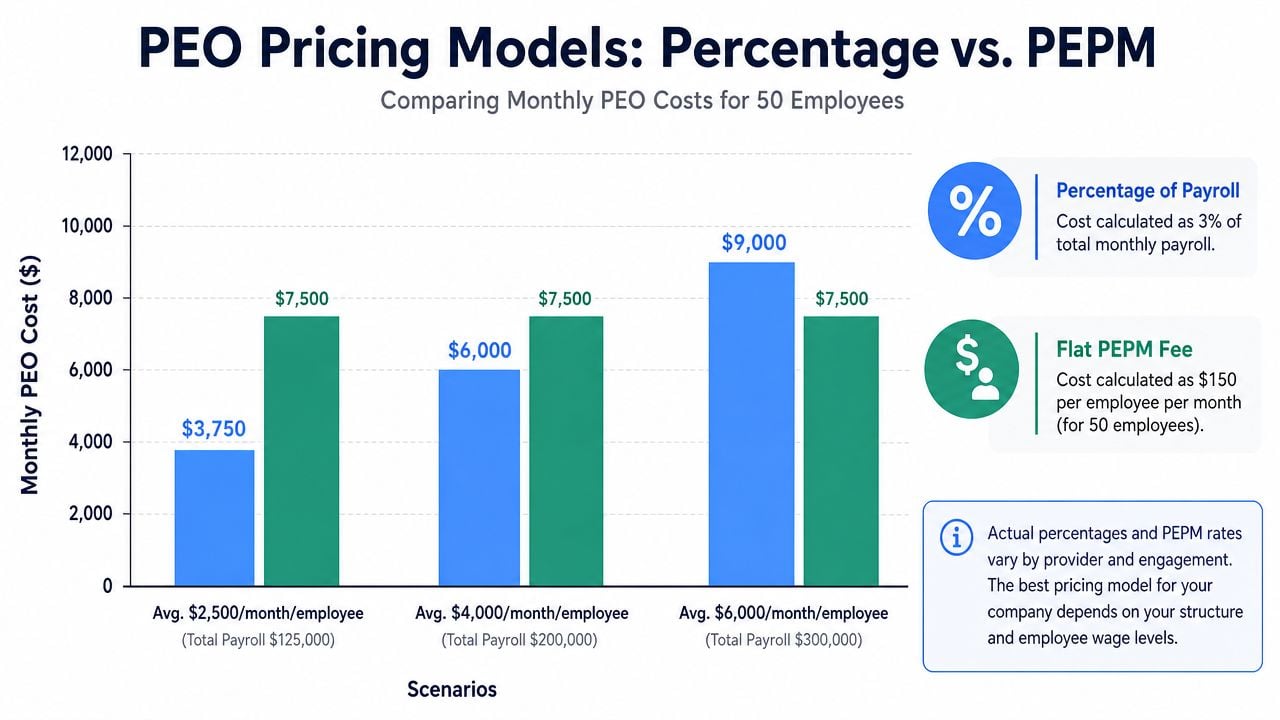
Illinois PEOs generally quote pricing in two formats: a fixed monthly fee per employee or a percentage of payroll.
Those labels are only the start. In Illinois, the actual cost picture shifts based on workforce mix, overtime exposure, bonus practices, benefits participation, class codes, and how much service your team will still handle internally. A manufacturer in Joliet with injury risk and variable hours should read the same proposal differently than a professional services firm in Naperville with high salaries and low claims activity.
The pricing model changes who absorbs growth and wage inflation.
A percentage-of-payroll model can look reasonable early, then get expensive if compensation rises or overtime spikes. A flat per-employee fee is easier to budget, but it can look rich for lower-wage teams with thin margins. Neither model is better on its own. The right answer depends on payroll shape and on what is included in the fee.
What belongs in total cost of ownership
The cleanest comparison is an annual employer-cost worksheet built around operating reality, not sales formatting. Include:
Administrative fees
Monthly charges, implementation fees, year-end fees, platform costs, and any minimums.Benefits economics
Employer contributions, plan design changes, employee participation assumptions, renewal terms, and whether the quoted rates are fully insured or subject to later adjustment.Workers' compensation structure
Coverage approach, claims handling process, payroll coding discipline, and how disputed claims will be managed with your supervisors in the field.Payroll tax and reporting workload
Tax filing responsibility is only part of the issue. The bigger question is what your payroll, finance, and HR staff still need to review, approve, and correct each cycle.Contract exit cost
Offboarding fees, data extraction, COBRA transitions, benefit runout issues, and the internal labor required to bring payroll and HR administration back in-house or move to another provider.
Illinois buyers often make expensive mistakes. They compare admin fees and treat the rest as background noise.
A practical comparison method
Use one model for every proposal. If Provider A quotes 3% of payroll and Provider B quotes $165 per employee per month, convert both into one annual worksheet and force the same assumptions into each line item. That includes wage growth, bonus plans, overtime, medical enrollment, workers' compensation handling, startup costs, and renewal language.
For a 50-employee Illinois company, the admin fee gap may look material at first glance. It often stops mattering once benefits contribution changes or claim administration differences are added. I have seen buyers save a small amount on paper and give it back through a rough implementation, weak service response, or a contract that made renewal negotiations one-sided.
Some companies also test whether every HR function belongs inside the PEO at all. That is why buyers compare bundled PEO pricing with narrower recruiting or hiring support options such as Hire Sense's plans.
Illinois adds another layer. The provider market is fragmented. Some firms are strong on benefits but weak on service in downstate locations. Others price aggressively to win Chicago-area business, then rely on contract terms, ancillary fees, or renewal changes to restore margin. A disciplined buyer uses a single cost model and pressure-tests what happens in year two, not just at signature.
For teams building that worksheet, this guide on how much a PEO costs is a useful framework for setting up the comparison correctly.
How to Evaluate and Compare Illinois PEO Providers
Once cost is normalized, provider quality becomes easier to see. At this point, many selections are won or lost.

National scale versus Illinois fit
A national PEO may offer broad infrastructure, established benefits administration, and stronger multi-state support. A regional provider may be more flexible, more reachable, and better attuned to local operating realities.
Neither profile wins automatically.
A company headquartered in Illinois but hiring nationwide may need scale and systems more than local familiarity. A business concentrated in Peoria, Rockford, or the Chicago suburbs may prefer a team that understands how the client operates. The key is whether the provider can support the company's operating model without forcing the client into a generic service lane.
This decision matters because the stakes are meaningful. NAPEO reports that businesses using a PEO grow twice as fast, have 12% lower employee turnover, and are 50% less likely to go out of business than comparable firms. NAPEO also reports that for firms with 10 to 99 workers, PEO worksite employees account for 15% of private-sector employment (NAPEO industry research data). That doesn't mean every PEO relationship performs equally well. It does mean the category is established enough that provider selection deserves serious scrutiny.
Service model and industry alignment
Service model often predicts satisfaction better than branding does. A dedicated contact who knows the account can solve problems faster than a rotating queue. That matters when payroll errors hit, terminations need review, or benefits issues affect employee trust.
Industry fit is equally important. Manufacturing, healthcare, staffing-heavy environments, professional services, and software businesses all create different pressure points. A provider that understands overtime-heavy operations will evaluate risk differently from one built around salaried office teams.
A short scorecard helps:
| Decision area | What to test |
|---|---|
| Service access | Dedicated team or pooled support |
| Industry familiarity | References and use cases relevant to the company |
| Technology | Payroll, HRIS, reporting, and integration workflow |
| Flexibility | Contract terms and exception handling |
What to ask in final presentations
By the finalist stage, the buyer should stop asking broad questions and start testing execution.
Show the support path
Ask who responds to payroll errors, leave questions, claims issues, and benefit escalations.Show the platform live
Dashboards and demos should reflect common workflows, not only polished admin screens.Show the contract assumptions
Have the provider identify what is included, excluded, and billable beyond the quoted scope.
A company narrowing local options can use a market scan of PEOs near me to widen or validate the shortlist before final meetings.
Negotiating Your Illinois PEO Agreement
The sales process usually ends with a benefits summary and a service agreement. That's the moment when buyers either protect themselves or give up their advantage.
Contract terms that deserve scrutiny
The first red flag is vague responsibility language. If the agreement says the PEO supports compliance but doesn't define what it administers, the client may discover later that key work still sits internally.
The second red flag is renewal structure. Automatic renewals, unclear notice windows, and open-ended fee adjustments create avoidable risk. Buyers should also read termination language carefully. A short sales cycle can hide a difficult exit.
Another problem area is implementation. If the onboarding plan is thin, the company may spend the first months cleaning payroll mapping, benefit eligibility errors, and employee communication mistakes. Those costs may not appear on the quote, but they are real.
Buyers should negotiate the contract they may need in a bad year, not the relationship they hope to have in a good one.
Concessions worth pushing for
Strong negotiation points aren't complicated. They're specific.
Admin fee protection
Ask for a multi-year fee lock or at least a clear limit on administrative increases.Implementation relief
Push to reduce or waive startup charges, especially if the client is moving quickly and bringing a clean census.Renewal visibility
Require early renewal notice and plain language on what can change.Service commitments
Request measurable response expectations for payroll, HR issues, and urgent escalations.Liability clarity
Make the provider identify where it accepts responsibility and where the client remains exposed.
Using competitive tension without wasting time
A buyer doesn't need ten quotes to negotiate well. Two or three serious alternatives are usually enough if the comparison is disciplined.
A realistic Illinois scenario looks like this. A company receives one strong proposal from a national PEO and one from a regional specialist. The national provider offers stronger systems. The regional provider offers better access and cleaner contract language. Instead of announcing a preferred vendor too early, the buyer sends both providers a short list of required revisions: fee protection, revised termination terms, a detailed implementation plan, and written scope clarification.
That process often reveals who wants the business and who only wants the logo.
One practical option during this stage is to use a neutral comparison service such as PEO Metrics, which reviews pricing, benefits, contract terms, and service model across providers so the buyer can negotiate from a documented side-by-side position rather than from sales decks alone.
Making Your Final PEO Decision
The Illinois PEO decision is bigger than outsourced payroll. It affects operating cost, compliance execution, manager accountability, employee experience, and contract risk.
That matters in a state with a large employer base and broad small-business activity. Paychex cites 1.3 million small businesses in Illinois employing 2.3 million people, equal to 43.6% of all workers in the state, which helps explain why PEOs are a mainstream option for Illinois employers rather than a niche solution (Paychex on Illinois PEO demand).
The strongest buyers don't ask, “Which provider has the lowest fee?” They ask four harder questions. What exactly changes under co-employment? Where does Illinois-specific compliance create exposure? What is the full annual cost once all moving parts are included? And does the agreement still work if service slips or the company needs to exit?
Those questions lead to better decisions than any polished presentation will.
If your team is comparing PEOs, renewing an Illinois agreement, or trying to gain an advantage before signing, PEO Metrics can help structure the comparison, benchmark pricing and contract terms, and narrow the field to providers that fit your workforce and operating model.
