
The search starts the same way for a lot of leadership teams. Someone types peo near me into Google, opens a few tabs, sees familiar logos, and starts booking demos. HR wants support. Finance wants predictability. Ownership wants the fastest path to better benefits and fewer compliance headaches.
That approach is understandable, but it's weak. A PEO isn't just another software subscription or local service vendor. It creates a co-employment relationship, which means the provider becomes jointly involved in payroll, tax administration, benefits, and employment law responsibilities. That changes the standard for due diligence. The right question isn't who has an office nearby. It's who can support the company's workforce, risk profile, contract requirements, and cost structure without creating surprises six months later.
Most bad PEO decisions don't happen because the provider was obviously wrong. They happen because the buyer compared demos instead of comparing operating models, contract language, implementation burden, and the total cost of switching.
Table of Contents
- Your 'PEO Near Me' Search Is Just the Starting Line
- Define Your PEO Requirements Before You Search
- Building a Smart Shortlist from Local and National Providers
- The Side-by-Side PEO Cost and Service Showdown
- How to Spot Red Flags in PEO Contracts
- Using Benchmarks to Negotiate a Stronger Agreement
Your 'PEO Near Me' Search Is Just the Starting Line
At 4:30 p.m. on a Thursday, the controller has three browser tabs open, a benefits renewal issue on hold, and a CEO asking for "two or three good PEO options by tomorrow." That is how a lot of searches for "PEO near me" begin. It is also how companies end up buying on convenience instead of economics, service capacity, and contract terms.
A local search has one real job. It gives you names to investigate.
That is useful, but it is not a screening method. Search results favor whoever invested in local SEO, paid listings, or fast sales response. None of that tells you how the provider handles workers' comp classification disputes, off-cycle payroll errors, multi-state notices, benefits renewals, or a service issue that lands on your CFO's desk at quarter close.
Geography also hides the main financial question. The right PEO is not the one with the closest office. It is the one whose service model, risk controls, and pricing structure fit your operating profile. A 40-person professional services firm in one state can survive with a very different setup than a 400-employee employer managing remote hiring, higher claims exposure, and multiple payroll tax registrations.
I have seen buyers make the same mistake repeatedly. They treat "near me" as if it means responsive, experienced, and lower risk. Sometimes it does. Often it just means nearby.
A provider with a local office may still outsource key functions, overload account managers, or push a contract that gives the client more responsibility than the sales process suggested. A larger national firm may feel less personal early on, yet deliver better implementation discipline, broader benefits buying power, and stronger support once the account is live. The trade-off is real. Some national firms feel bureaucratic. Some local firms are excellent. The point is to test operating fit, not assume it.
Buyers also get trapped by early pricing talk. A low admin fee can mask weaker service staffing, limited HR depth, narrower benefits options, or contract language that increases exit cost later. Before comparing proposals, it helps to understand the core service categories a PEO typically provides, because "full service" means very different things from one provider to the next.
The practical rule is simple: use local search to build the first list, then run a finance-grade review. If leadership would not approve a banking partner, broker, or payroll platform based on who appeared first in search results, they should not approve a PEO that way either.
The companies that make sound PEO decisions usually treat the process like procurement. They define what must be handled well, compare providers in the same format, pressure-test the agreement, and only then decide whether a local firm, a national firm, or a hybrid model makes financial sense.
Define Your PEO Requirements Before You Search
Most buyers start externally. The disciplined ones start internally.
The company needs its own decision framework before speaking with any provider. Without that, every demo sounds compelling, every proposal seems customized, and the team ends up reacting to the vendor's narrative instead of testing the vendor against business needs.
Current “peo near me” resources often treat providers as geographically interchangeable. That's the wrong lens. A contractor in Denver and a SaaS startup in Denver have different workers' comp exposure, compliance risks, benefits expectations, and payroll needs, as noted in Colorado PEO directory coverage that highlights the limits of geography-first selection.

Start with operating reality
A strong requirements document doesn't say “need payroll and benefits.” Every PEO says it handles payroll and benefits.
It should describe the company's real operating conditions:
- Workforce footprint: Single-state, multi-state, hybrid, or fully distributed. State complexity matters because payroll tax handling, leave rules, and registration support vary.
- Industry exposure: Construction, healthcare, hospitality, tech, professional services, and manufacturing don't carry the same risk profile.
- Benefits philosophy: Some employers want richer plan options to compete for talent. Others want cost control and fewer plan variations.
- Service expectations: A dedicated HR contact is different from a pooled service model. Both can work, but leadership should choose deliberately.
- Systems reality: If the company already uses a timekeeping tool, accounting platform, or HRIS, integration questions should be front and center.
A tech company may care about clean employee self-service, reporting, and onboarding workflow. A construction employer may care more about workers' comp management, job classification discipline, and support for field-heavy payroll operations. Treating those as the same buying process creates bad matches.
Build a scorecard before the first call
The easiest way to stay disciplined is to write a weighted scorecard and use it consistently. A practical version should include:
- Compliance fit: Which states need support, where the provider has depth, and whether the company needs specialized support around leave, wage and hour issues, or benefits compliance.
- Benefits fit: Whether the provider's medical options align with employee expectations and contribution strategy.
- Technology fit: What has to integrate, what can be replaced, and what the employee experience must look like.
- Service model fit: Dedicated contact, escalation path, implementation team, and payroll support process.
- Growth fit: Hiring plans, acquisitions, location expansion, or possible need for more complex support later.
A simple internal worksheet often does more to improve the outcome than another demo. Teams that want a structured way to map those criteria can use a broader PEO services overview as a checklist, then tailor it to their own operating model.
The best PEO fit usually isn't the one with the most features. It's the one that aligns with the company's actual risk, service, and workforce needs.
One more discipline matters here. Finance, HR, and operations should agree on the essential requirements in writing. If one group prioritizes low visible fees while another cares about service responsiveness, that tension needs to be resolved before proposals arrive.
Building a Smart Shortlist from Local and National Providers
A shortlist should be small enough to compare seriously and broad enough to create a competitive advantage. In practice, that usually means 3 to 5 qualified PEO providers, which aligns with the selection process described in NAPEO benchmarking summarized in this PEO industry selection guide.
Why a raw search result list is a poor shortlist
The search results mix large national firms, regional operators, local boutiques, lead-gen directories, and paid placements. Those are not equivalent options.
A better filter starts by removing any provider that can't clearly support the company's geography, employee profile, and service expectations. Then the team should sort remaining candidates by provider type, because the trade-offs are different.
For leadership teams that want a more disciplined intake process, BoloSign's guide on streamlined procurement is useful context. The same logic applies here. Standardize the questions first, then compare responses instead of sales energy.
Three provider types and their trade-offs
Large national PEOs with local sales offices
These providers usually bring stronger brand recognition, broader compliance infrastructure, and more mature platforms. They can be a strong fit for multi-state employers or companies that expect to grow across markets. The trade-off is that service can feel more standardized, and contract flexibility may be tighter.
Regional PEOs with concentrated state strength
These firms can work well for employers with a heavy footprint in a limited geography. They may know local labor dynamics and regional insurance markets well. The risk is that expansion can outpace the provider's comfort zone.
True local boutique PEOs
These groups often sell personal service, direct access, and hands-on support. Sometimes that's exactly right for a smaller company that values responsiveness over platform depth. The concern is whether the model scales when payroll complexity, compliance exposure, or reporting needs increase.
A useful gatekeeping list looks like this:
- Check formal credentials: Ask whether the provider holds relevant accreditation or certification and verify current status directly.
- Ask about state tenure: A provider may “serve” a state without having meaningful operating depth there.
- Request industry examples: Generic references aren't enough. Buyers should ask for examples from similar workforce types.
- Review implementation ownership: Sales teams often promise white-glove onboarding. The implementation team's structure matters more.
- Confirm the ongoing service model: Who handles payroll issues on a Tuesday afternoon after go-live matters more than who ran the demo.
For teams trying to sort provider categories and market coverage, a curated list of PEO providers can help frame the industry options before outreach begins.
The Side-by-Side PEO Cost and Service Showdown
Most proposal reviews fail because the buyer compares pricing pages instead of total operating impact.
A PEO proposal should be rebuilt into one spreadsheet, one checklist, and one question set. If the providers won't present information consistently, the buyer should do it for them.
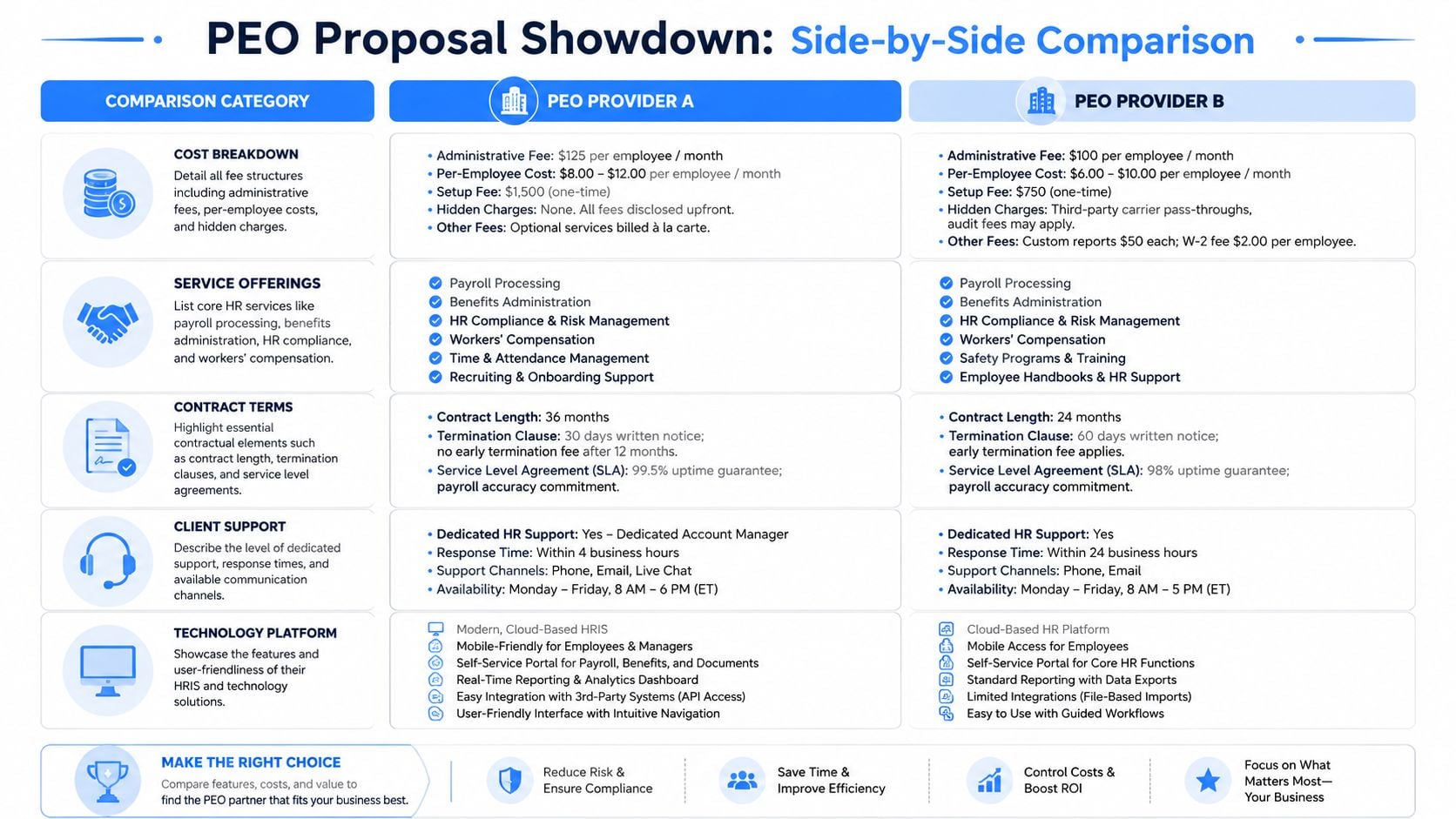
Force every proposal into the same format
Some PEOs price as a percentage of payroll. Others use a flat per-employee-per-month structure. Neither model is automatically better. What matters is whether leadership can see the full employer cost and the conditions under which that cost changes.
Buyers need to remember the underlying structure. A PEO is a co-employer, jointly responsible for payroll, tax compliance, and employment law obligations, so service quality and compliance depth are not side issues. They are core risk controls. When comparing providers, buyers should verify state compliance depth, review workers' compensation loss history, and confirm benefits plan compliance certifications such as ERISA and ACA, as outlined in ADP's overview of how PEO co-employment works.
A reliable comparison file should force every provider to answer the same questions:
- Pricing basis: Is the fee payroll-based or employee-based, and what triggers future adjustments?
- Included services: Which HR, payroll, benefits admin, compliance, and risk functions are included versus billed separately?
- Benefits assumptions: What employee contribution assumptions are built into the proposal?
- Tax handling: How are unemployment, local taxes, and payroll filings handled in practice?
- Workers' comp treatment: What assumptions sit under the quoted rates and classifications?
Buyers should ask every finalist to reissue pricing in a standardized template. Providers that resist transparency usually become harder partners after signature too.
Cost categories that buyers miss
The visible admin fee is rarely the whole picture. The expensive surprises usually live elsewhere.
Common blind spots include employee contribution differences, workers' comp assumptions, implementation labor, and support gaps that push work back onto internal staff. A proposal that looks cheaper on paper may create more manual work for payroll and HR every month.
A strong review should compare both employer-side and employee-side outcomes.
- Employer-side review: Administrative fee structure, workers' comp assumptions, tax treatment, implementation support, and any fees tied to changes, renewals, or off-cycle work.
- Employee-side review: Medical plan design, payroll deductions, user experience, support channels, and how cleanly open enrollment and onboarding will run.
- Service-side review: Named contacts, escalation path, support responsiveness, and who owns issues when payroll, benefits, and compliance overlap.
- Technology-side review: Employee app quality, reporting, approvals, manager functionality, timekeeping compatibility, and data export capability.
For finance teams that want a more structured lens on proposal math, this guide on how much a PEO costs is a useful companion when building the model.
PEO Vetting Checklist Side-by-Side Comparison
| Category | Evaluation Criteria | PEO A | PEO B | Notes / Red Flags |
|---|---|---|---|---|
| Pricing model | Percentage of payroll or flat employee-based fee | Watch for unclear adjustment language | ||
| Admin fees | What's included and what is billed separately | Flag add-on compliance or service charges | ||
| Benefits | Plan options, contribution structure, employee experience | Compare actual payroll deduction impact | ||
| Workers' comp | Classification handling, claims support, loss history review | Look for vague underwriting assumptions | ||
| Compliance support | State coverage depth, leave support, tax administration | Confirm support in every active state | ||
| Service model | Dedicated contacts, escalation path, payroll support | Sales promises should match service agreement | ||
| Technology | HRIS usability, reporting, mobile access, integrations | Request live workflow demos, not screenshots | ||
| Contract terms | Renewal, termination, fee increases, data access | Hidden friction often lives here | ||
| Implementation | Team structure, timeline, data migration, communication support | Weak onboarding creates avoidable disruption |
The practical test is simple. If leadership can't explain why one provider is better after looking at this table, the proposals haven't been normalized enough yet.
How to Spot Red Flags in PEO Contracts
A polished sales cycle can still end in a bad agreement. That's where a lot of companies get trapped.
The problem isn't usually an obviously abusive contract. It's vague language, missing protections, and clauses that don't get attention until the relationship goes sideways.

The sales process isn't the agreement
Most “peo near me” content focuses on benefits access and HR convenience. It rarely addresses the switching burden and contractual friction that show up during implementation or exit. For a mid-market company, hidden switching and implementation costs can represent 15% to 30% of year-one PEO fees, according to analysis of the hidden cost of PEO changes.
That matters because a contract can lock a company into those costs more than once. If the implementation disappoints and the employer wants out, the exit terms become operationally important very quickly.
A PEO agreement should be read like an operating document, not a formality after procurement.
A realistic review should involve HR, finance, and counsel. HR sees service risks. Finance sees pricing exposure. Legal sees liability language and renewal mechanics. One person alone usually misses something material.
Clauses that deserve immediate scrutiny
Start with plain-language searches inside the agreement. Some of the most important terms hide in routine sections.
- Renewal language: Auto-renewal isn't always a problem. Auto-renewal with vague pricing resets is.
- Fee increase language: “Market conditions” or similar broad wording should be narrowed.
- Termination rights: Notice periods, early termination penalties, and post-termination obligations need to be explicit.
- Indemnification: Liability allocation should be clear about whose mistake triggers whose responsibility.
- Limitation of liability: This section often matters more than the service summary.
- Data access and extraction: The company should know how payroll and employee data will be returned if the relationship ends.
- Service obligations: If response times or implementation support were promised, they should appear in writing somewhere enforceable.
One common pattern looks like this. The provider sells consultative support, clean onboarding, and easy offboarding if things don't work out. The agreement then includes a long notice period, weak service language, and ambiguous data-return obligations. That mismatch is where expensive disputes begin.
A thorough contract review framework can help buyers pressure-test these terms before signature. This PEO service agreement legal review guide is a useful checklist for that step.
The best defense is specificity. If a provider promises a rate lock, implementation support, service escalation, or a credit for missed commitments, the written agreement should reflect it. If it doesn't, the buyer should assume the promise isn't binding.
Using Benchmarks to Negotiate a Stronger Agreement
A familiar scenario plays out in final-round PEO negotiations. The buyer spends weeks comparing admin fees, payroll capabilities, and benefits access, then signs the proposal that looks close enough. Six months later, significant pain shows up in rushed implementation, slow issue resolution, renewal increases, or extra project work that was never priced clearly.
That outcome is usually avoidable.
The proposal should be treated as a draft business case, not a finished agreement. Buyers who negotiate well do more than ask for a lower fee. They use side-by-side benchmarks to test whether the provider is charging above market, shifting work back to the client team, or leaving expensive gaps in service language.
The practical question is simple. What is this provider asking the company to pay, accept, and risk compared with the other finalists?
Use comparison work to improve your position
Providers respond differently when a buyer shows organized evidence instead of general dissatisfaction. A CFO-approved negotiation file usually includes quoted pricing, implementation scope, support structure, renewal language, and any extra charges tied to multi-state hiring, off-cycle payrolls, benefits administration, or year-end work.
That gives the buyer a cleaner message:
Provider B priced implementation separately but committed named onboarding support and faster escalation. Provider A wrapped onboarding into the base fee, but the service scope is thinner. If Provider A wants to win, the contract needs to close that gap in writing.
That approach works because it is specific. No bluffing. No vague pressure. Just documented alternatives and a clear explanation of what needs to change.
The best negotiation points are rarely limited to headline price:
- Implementation support: Spell out who owns data migration, payroll setup, training, and issue resolution during go-live.
- Service response commitments: Ask for defined response windows, escalation paths, and named contacts for payroll or benefits issues.
- Renewal controls: Push for fee caps, a defined pricing formula, or at minimum written notice tied to any increase.
- Scope clarity: Identify which services are included versus billed separately, especially for compliance projects or special payroll requests.
- Transition assistance: Get written expectations for offboarding help, data delivery, and timing if the relationship ends.
One caution from experience. Buyers often chase a discount and give back far more in weak service terms. A provider that cuts fees but leaves onboarding vague may still be the more expensive option once internal HR, payroll, and finance teams absorb the cleanup work.
What strong buyers ask for before signing
Different stakeholders will push different points, and that is healthy. Finance should care about total cost predictability. HR should care about service execution. Operations should care about implementation burden and business continuity. If one of those voices is missing, the provider usually spots it and negotiates around the blind spot.
Use benchmarks to decide where to press and where to let go. If a provider is already competitive on base pricing but weak on renewal language, focus there. If pricing is high but service commitments are better than the field, ask whether the premium is justified and which terms can be tightened. A good final round is not about winning every point. It is about improving the terms that carry the most financial risk.
Teams that want a more structured pricing and contract comparison can use this PEO expense benchmarking analysis to sharpen final negotiation asks and separate cosmetic concessions from meaningful savings.
A strong agreement holds up after the sales process ends. That is the standard that matters.
