
Running a security guard company puts you in a category most payroll vendors aren’t designed for. You’ve got a high-turnover, shift-based workforce, elevated workers’ comp exposure, and in many cases, guards operating across multiple states with different licensing requirements. The administrative surface area is significant — and the wrong infrastructure decision can cost you in ways that don’t show up until something goes wrong.
The PEO vs. payroll company question comes up constantly in this industry, and it’s genuinely not a simple answer. They’re not interchangeable options at different price points. They’re fundamentally different operating models with different risk profiles, cost structures, and compliance capabilities. The right choice depends on your headcount, your comp situation, your geographic footprint, and how much HR complexity you’re willing to manage yourself.
This guide is for security firm owners who already have a basic sense of what a PEO is and are now trying to figure out which direction actually makes sense for their operation. We’ll cover the tools worth using to do that comparison properly.
PEO vs. Payroll Company: What Actually Differs for Security Firms
Before getting into the tools, it’s worth grounding the comparison in what actually changes when you’re running contract security — because the differences aren’t abstract.
A payroll company processes wages. That’s it. You handle workers’ comp through your own insurer, manage HR internally, deal with multi-state licensing on your own, and stay compliant with wage and hour rules without any guidance baked into the relationship. For a simple, stable operation, that’s fine. For a security firm with variable shifts, overtime exposure, and guards in multiple jurisdictions, it puts a lot of administrative and compliance weight squarely on you.
A PEO operates differently. Under a co-employment arrangement, the PEO becomes the employer of record for HR and tax purposes. That structure lets them pool workers’ comp risk across their entire client base, which often translates to better rates for high-risk industries like security. It also means they’re providing HR infrastructure: onboarding, offboarding, benefits access, compliance guidance, and multi-state HR support. The cost is higher than a payroll company — but you’re buying a meaningfully different bundle of services.
The co-employment piece is also where some security firm owners get cautious. Sharing employer-of-record status has legal implications, and not everyone is comfortable with that arrangement. That’s a legitimate consideration, not just a preference.
For operations running 20 or more guards, working across state lines, or dealing with workers’ comp rates that feel punishing, a PEO is usually worth a real evaluation. For smaller, single-location firms with stable headcount and existing comp coverage they’re satisfied with, a payroll company may be the cleaner, cheaper option. The tools below help you figure out where you actually land.
1. PEO Metrics
Best for: Security guard companies comparing multiple PEO providers side by side before committing
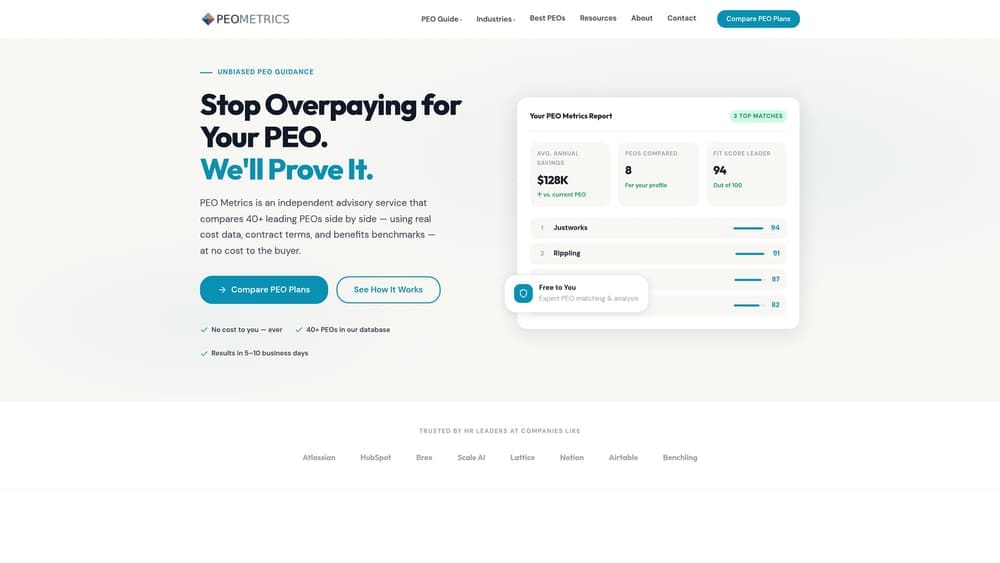
PEO Metrics is a structured comparison platform built for businesses that want real data on PEO providers without going through a broker with preferred vendor relationships.
Where This Tool Shines
The core problem with evaluating PEOs is that most comparison processes are broker-driven. You talk to someone who gets paid a commission when you sign with a specific provider. That’s not a neutral evaluation — and for a security firm where workers’ comp handling and multi-state compliance capabilities actually matter, the difference between providers is significant enough that you need unbiased data.
PEO Metrics structures the comparison around the factors that actually affect cost and risk: pricing models, contract terms, how workers’ comp is structured, benefits access, and compliance capabilities. For security companies specifically, those categories aren’t generic — they’re the exact variables that determine whether a PEO is genuinely better than your current setup or just more expensive.
Key Features
Side-by-Side Provider Comparisons: Evaluate multiple PEO providers simultaneously across pricing, contract structure, and service capabilities rather than sequentially through individual sales conversations.
Transparent Cost Breakdowns: Surfaces the actual cost structure — including administrative fees and markups — so you’re not comparing a base rate from one provider against a bundled rate from another.
Workers’ Comp and Compliance Coverage: Specifically covers how each PEO handles workers’ comp, which is a material differentiator for high-risk industries like security.
No Broker Incentives: The platform operates independently of vendor relationships, so the comparison isn’t shaped by commission structures or preferred provider agreements.
Contract Term Visibility: Flags flexibility and exit terms, which matter when you’re committing to a co-employment arrangement and want to understand your options if the relationship doesn’t work out.
Best For
Security guard companies actively evaluating PEO options who want structured, data-driven comparisons rather than vendor-led sales processes. Particularly useful if you’re comparing three or more providers and need a consistent framework to evaluate them fairly — or if you’ve been burned by opaque pricing before.
Pricing
Contact PEO Metrics directly for pricing details. Given that the platform is designed to help businesses avoid overpaying on PEO contracts, it’s worth the conversation before you commit to anything.
2. PEOcompare
Best for: Early-stage research when you’re still building your initial PEO shortlist
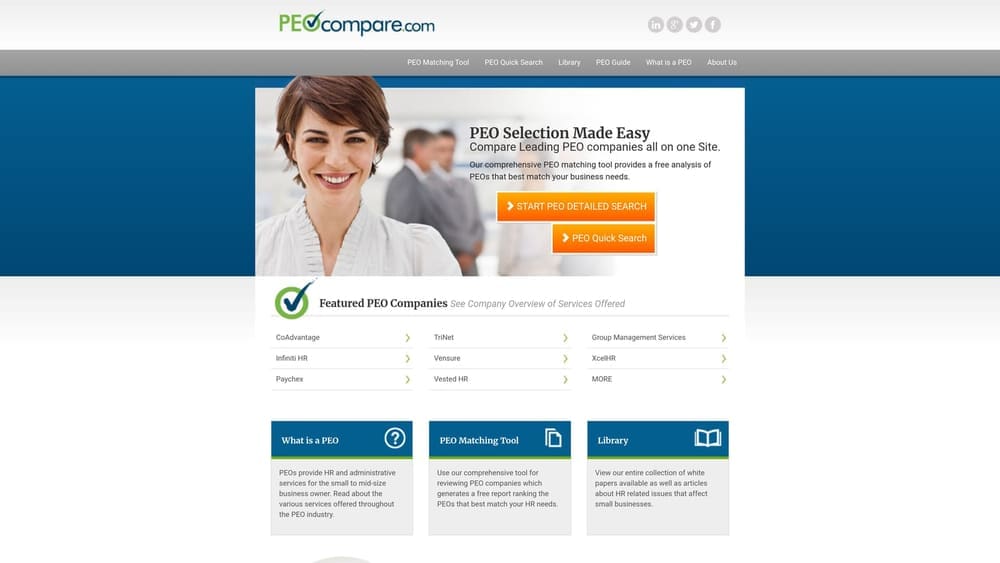
PEOcompare is a broad-market resource that aggregates information on PEO providers to give businesses a starting point when they’re first getting oriented.
Where This Tool Shines
If you’re new to the PEO space and trying to understand what providers exist and what the general landscape looks like, PEOcompare gives you a reasonable starting point without requiring you to engage a sales team first. It’s a useful first step for building awareness of the market before you get into detailed evaluation.
The limitation is depth. For a security guard company that needs to understand how specific providers handle high-risk workers’ comp classifications or multi-state guard licensing, a general aggregation tool won’t get you far enough. Think of it as the research you do before the research.
Key Features
Broad Provider Coverage: Aggregates information across a wide range of PEO providers, giving you market breadth when you’re still figuring out who to evaluate.
General Comparison Framework: Provides a basic structure for thinking about PEO options before you’ve developed specific evaluation criteria.
Low Barrier to Entry: Free to use and doesn’t require you to submit contact information to access general provider information.
Best For
Business owners in the early stages of PEO research who want to understand what providers are in the market before narrowing to a shortlist. Less useful once you’re at the stage of comparing pricing, contract terms, and compliance capabilities in detail.
Pricing
Free to use.
3. HR Guide
Best for: HR teams and business owners building foundational understanding of co-employment, PEO structure, and HR compliance basics
HR Guide is an educational HR reference resource covering employment fundamentals, compliance topics, and HR best practices across a broad range of subject areas.
Where This Tool Shines
When you’re evaluating a PEO vs. payroll company decision, part of the challenge is that the terminology and legal concepts can get murky fast. What does co-employment actually mean for liability? What’s the difference between an employer of record and a professional employer organization? HR Guide provides a reference library for working through those questions before you sit down with a vendor.
It’s not a comparison tool and it won’t help you evaluate pricing. But for HR managers or operations leads who need to get grounded on the conceptual side before engaging vendors, it’s a solid free resource. Particularly useful if multiple stakeholders at your company need to get up to speed before a decision gets made.
Key Features
PEO and Co-Employment Basics: Covers the foundational mechanics of how PEOs operate, including co-employment structure and employer-of-record implications.
Compliance Reference Library: Broad coverage of employment law, wage and hour topics, and HR compliance fundamentals that are relevant to security guard operations.
HR Best Practices: Useful for internal HR teams that need context on standard practices before evaluating whether a PEO’s approach aligns with their needs.
Best For
HR professionals and business owners who want to build foundational knowledge before engaging vendors. Particularly useful if you’re newer to the PEO concept or want a neutral reference point before evaluating what specific providers are telling you.
Pricing
Free resource.
Which Direction Makes Sense for Your Operation
For most security guard companies, the PEO vs. payroll company decision comes down to one honest question: how much risk and complexity are you willing to manage internally?
A payroll company processes checks. A PEO takes on co-employment responsibilities, bundles workers’ comp, handles multi-state compliance, and gives you access to group benefits at rates you couldn’t access independently. That’s a fundamentally different value proposition — and a fundamentally different cost structure. The comparison isn’t just about price per employee. It’s about what you’re buying.
If you’re running 20 or more guards, operating across multiple jurisdictions, or dealing with workers’ comp rates that are eating into margin, a PEO is almost certainly worth a real evaluation. If you’re a small, single-location operation with stable headcount and existing comp coverage you’re comfortable with, a payroll company may be the simpler and cheaper path. Neither answer is wrong — it depends on where you actually are.
The mistake most security firm owners make is evaluating PEOs through a broker-led process where the comparison is shaped by commission incentives rather than your actual situation. Before you commit to anything, run a structured side-by-side comparison of pricing, contract terms, and workers’ comp handling across providers. That’s where PEO Metrics is useful — it’s built for exactly that evaluation, without the broker dynamics distorting the results.
Don’t auto-renew. Make an informed, confident decision.
Before you sign that PEO renewal, make sure you’re not leaving money on the table.
Many businesses unknowingly overpay because of bundled fees, hidden administrative markups, and contracts designed to limit flexibility. We give you a clear, side-by-side breakdown of pricing, services, and contract terms—so you can see exactly what you’re paying for and choose the option that truly fits your business.
