Contract reviews, exit planning, transition steps, and what happens when you leave a PEO.
Switching property management companies to a PEO requires careful sequencing across payroll, workers’ comp classifications, and multi-entity structures — and this guide covers exactly how to execute that transition without costly missteps, whether you’re leaving a bad PEO or moving off manual HR processes entirely.
Switching architecture firms to a PEO requires careful sequencing to avoid payroll gaps, benefits lapses, and compliance exposure during the transition. This guide covers the full practical process—from auditing current costs and defining firm-specific requirements to evaluating providers, reviewing contracts, and managing the cutover without disrupting licensed staff or active project teams.

Engineering firms switching to a PEO face unique challenges—complex workforce classifications, multi-code workers’ comp exposure, and licensed credential obligations—that generic transition guides overlook. This step-by-step guide walks engineering firm leaders through the actual mechanics of switching engineering firms to a PEO, from evaluating current contracts to ensuring payroll continuity, benefits preservation, and compliance throughout the transition.
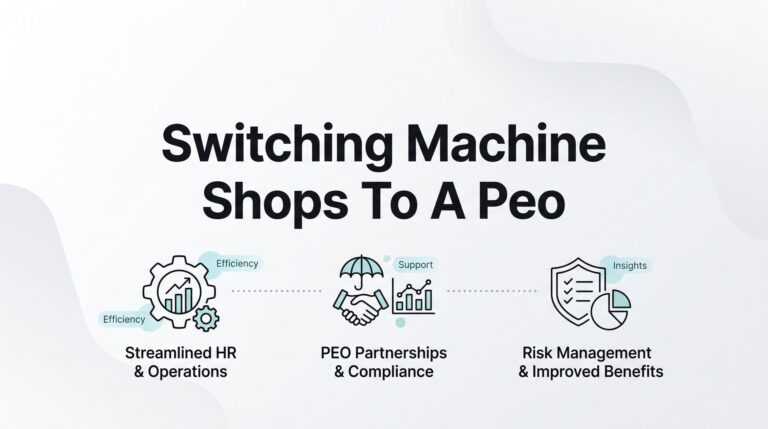
Switching machine shops to a PEO requires more preparation than most industries due to complex workers’ comp classifications, mixed payroll structures, and manufacturing-specific risk profiles. This step-by-step guide covers what to audit before you start, how to evaluate PEO providers on criteria that matter for machine shop operations, and how to avoid costly coverage gaps or misclassification errors during the transition.

Switching industrial maintenance companies to a PEO involves more complexity than standard HR transitions, with mid-term workers’ comp policies, open claims, and high-hazard job classifications requiring careful sequencing to avoid coverage gaps. This step-by-step guide walks through the actual transition process built around the specific operational realities of industrial maintenance, from evaluating PEO fit to protecting field crews throughout the switch.

Switching oilfield services companies to a PEO requires a different approach than a standard business transition, given the industry’s complex workers’ comp exposure, multi-state compliance demands, and fluctuating field crews. This step-by-step guide walks oilfield operators through the full process—from auditing current HR gaps to completing the switch without disrupting active job sites.
Exiting a manufacturing PEO involves more than sending a cancellation notice — multi-year contracts, workers’ comp audits, and shift-based payroll transitions create financial and compliance risks unique to manufacturers. This guide covers how to review your manufacturing PEO cancellation policy, time your exit strategically, and avoid the costly mistakes that catch most businesses off guard before they ever submit notice.

Switching manufacturing companies to a PEO can consolidate workers’ comp coverage, correct payroll classifications, and reduce compliance burdens unique to shift-based operations—but the transition requires careful validation and independent oversight to avoid operational risk. This step-by-step guide walks manufacturing HR leaders through each phase of the process to ensure a clean, accurate handoff.
Switching a freight brokerage to a PEO requires careful planning around commission structures, workers’ comp coverage, and payroll continuity that generic transition guides overlook. This step-by-step guide covers exactly what freight brokerage owners need to audit, prepare, and execute to avoid costly disruptions when switching freight brokerage companies to a PEO.

Switching a warehousing company to a PEO requires careful planning around industry-specific challenges like seasonal staffing, workers’ comp coverage, and state compliance requirements. This step-by-step guide walks warehouse operators through the full transition process so payroll, benefits, and HR functions move over cleanly without disrupting daily operations.
