
Most advice on choosing an HR services provider starts in the wrong place. It starts with the admin fee, the payroll bundle, or the promise that someone else will handle handbooks and tax filings.
That framing is too narrow for any company with real growth plans, multi-state exposure, benefits pressure, or a thin internal HR bench. The better question isn't “What can this provider take off our plate today?” It's “What operating risk, talent gap, and complexity will this provider help us manage over the next few years?”
That distinction matters because this isn't a small market with a handful of obvious choices. The global HR and recruitment services industry was estimated at $739.4 billion in 2026, and IBISWorld describes a highly fragmented market where buyers need side-by-side analysis to separate real value from polished sales language (IBISWorld global HR and recruitment services data). In practice, that means many providers can sound similar in a demo while delivering very different outcomes in service quality, compliance support, benefits administration, and contract flexibility.
A CFO usually sees this first as a vendor decision. An HR director sees it as a capability decision. A business owner feels it when growth outpaces internal process. All three are right. The mistake is treating those as separate issues.
Table of Contents
- Choosing an HR Provider Is Not Just an Expense Line
- The Four Models of HR Service Delivery
- PEO vs ASO vs Payroll A Practical Comparison
- The Business Case for Outsourcing Your HR Function
- Your Five-Point HR Provider Evaluation Checklist
- Avoiding Common Pitfalls in Provider Selection
- Making a Confident and Scalable HR Decision
Choosing an HR Provider Is Not Just an Expense Line
A weak HR services provider creates hidden costs long before anyone notices a line item problem. Employees wait for answers. Managers escalate routine issues. Payroll exceptions pile up. Open enrollment gets messy. Then finance starts paying for inefficiency in the form of rework, delay, and avoidable vendor switching.
That's why the cheapest proposal often becomes the most expensive operating decision. A low visible fee can sit on top of weak service coverage, thin compliance support, poor implementation discipline, or a technology stack that still leaves internal staff doing manual cleanup.
The real buying question
The practical question is whether the provider adds usable capacity and expertise. For a 25-person company, that might mean dependable payroll, onboarding, and benefits administration without hiring a full in-house team. For a 300-person company, it might mean stronger employee relations support, cleaner workflows, and better control across multiple states.
Practical rule: If the evaluation starts and ends with administrative pricing, the buyer is comparing invoices, not operating models.
A serious review also has to include adjacent decisions. Benefits strategy is one example. A company evaluating a PEO or broader HR partner often also needs a clearer view of plan design, employer contributions, and retention trade-offs. For teams sorting through those issues, this guide to Florida business benefits is a useful reference because it grounds the conversation in practical employer choices rather than generic plan descriptions.
What works and what doesn't
What works:
- Defined scope: The company knows which HR functions must be transferred, which must stay internal, and who owns decisions.
- Operational fit: The provider's service model matches the company's complexity, pace, and management style.
- Decision discipline: Buyers compare providers side by side instead of reacting to the strongest salesperson.
What doesn't:
- Buying for today's pain only: That often leads to a provider the company outgrows.
- Assuming all bundled offerings are equal: They aren't. The same headline service can be delivered with very different depth.
- Confusing software access with HR capability: A dashboard doesn't replace judgment, escalation support, or compliance handling.
The Four Models of HR Service Delivery
A company can outsource HR in several ways and still think it bought the same thing. That's where bad fit starts. The label on the proposal matters less than the operating model behind it.
Why the model matters before the feature list
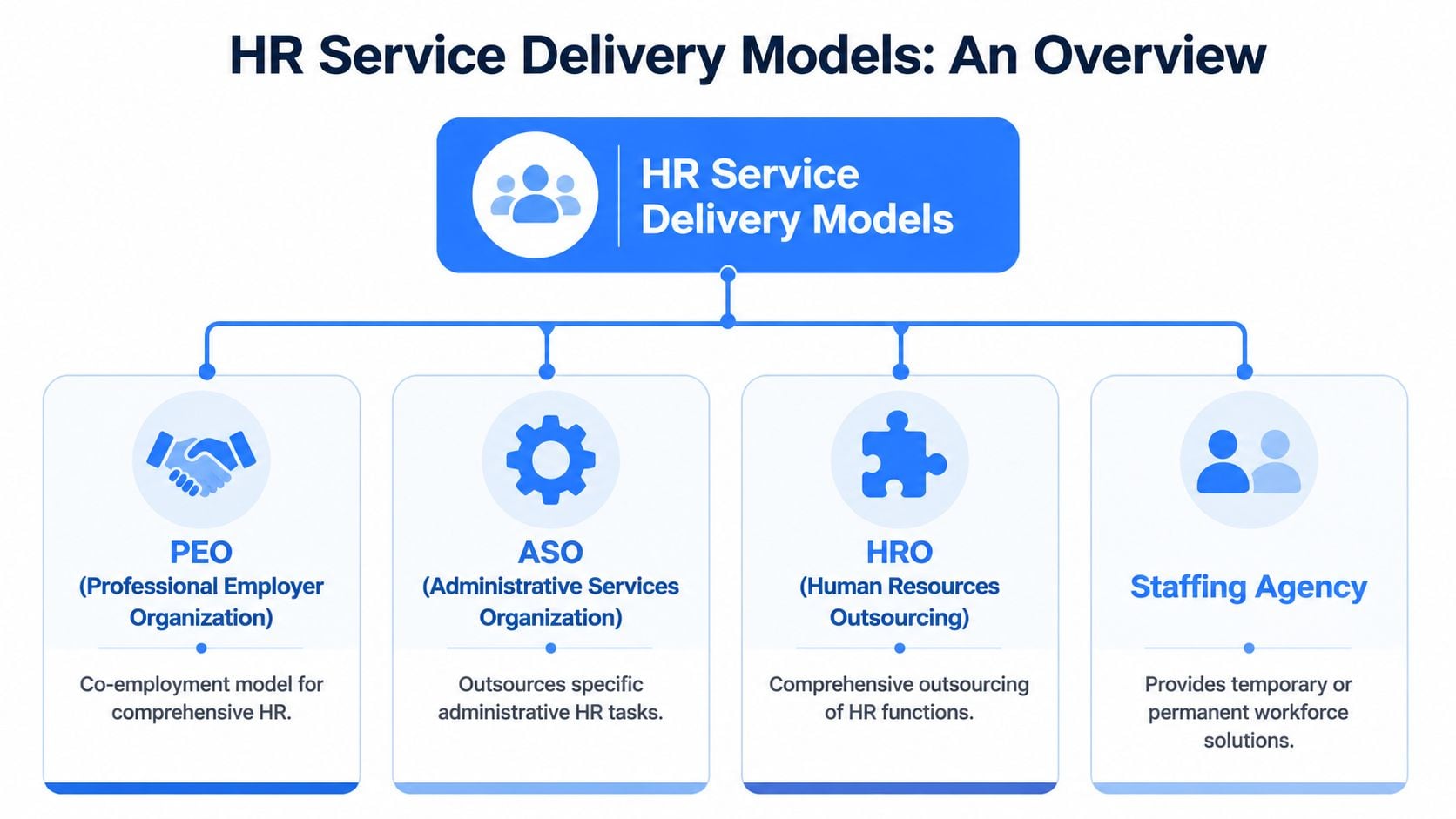
A PEO, ASO, HRO, and staffing firm can all talk about payroll, compliance, onboarding, and support. But they don't take the same role in the business. They don't carry the same obligations, and they don't solve the same problems.
For readers comparing broader outsourcing structures, this overview of human resources outsourcing models is useful because it separates categories that are often blurred together in sales conversations.
A house-building analogy that actually helps
The easiest way to understand the categories is to compare them to building a house.
PEO
A Professional Employer Organization is closest to a design-build firm. It gives the client a more integrated package. Payroll, benefits administration, compliance support, HR guidance, and workers' compensation are typically managed in one coordinated model. The trade-off is that the relationship is more structured, and the client is buying into a broader operating framework rather than selecting isolated services one by one.
PEOs tend to fit employers that want one partner to handle multiple HR layers with less internal coordination. That becomes especially useful when a company is growing quickly, hiring in new states, or trying to standardize a messy set of people processes.
ASO
An Administrative Services Organization is more like hiring a general contractor while still owning the property, permits, and ultimate responsibility. The ASO helps manage administrative HR tasks, but the employer retains more direct responsibility and often more flexibility in how services are assembled.
This model tends to suit companies that want support without stepping into the tighter structure associated with a PEO. It can be a strong fit for employers that already have internal HR leadership and need execution help rather than a more full-scope operating partner.
HRO
Human Resources Outsourcing, or HRO, is the modular outsourcing version. This model involves hiring specialists for major portions of the project. One provider may handle recruiting support, another payroll administration, another leave management, and another compliance consulting. This can work well for companies with enough internal sophistication to coordinate multiple vendors and enforce service accountability.
The benefit is customization. The risk is fragmentation. When something breaks, the client may need to figure out which vendor owns the issue.
Staffing agency
A staffing agency is solving a different problem. It provides workers, either temporary or permanent, rather than acting as the primary long-term HR operating layer for the business. Staffing firms can be valuable, especially for seasonal or urgent hiring needs, but they shouldn't be mistaken for a substitute for a full HR services provider.
A provider that can process payroll isn't automatically a provider that can stabilize employee relations, support managers, and absorb complexity as headcount grows.
PEO vs ASO vs Payroll A Practical Comparison
Most SMB buyers don't struggle with definitions. They struggle with trade-offs. A PEO, ASO, and payroll provider can all appear reasonable until the company starts expanding, changing benefits, or dealing with employee issues that don't fit neatly into a software workflow.
Where the legal and operating differences show up
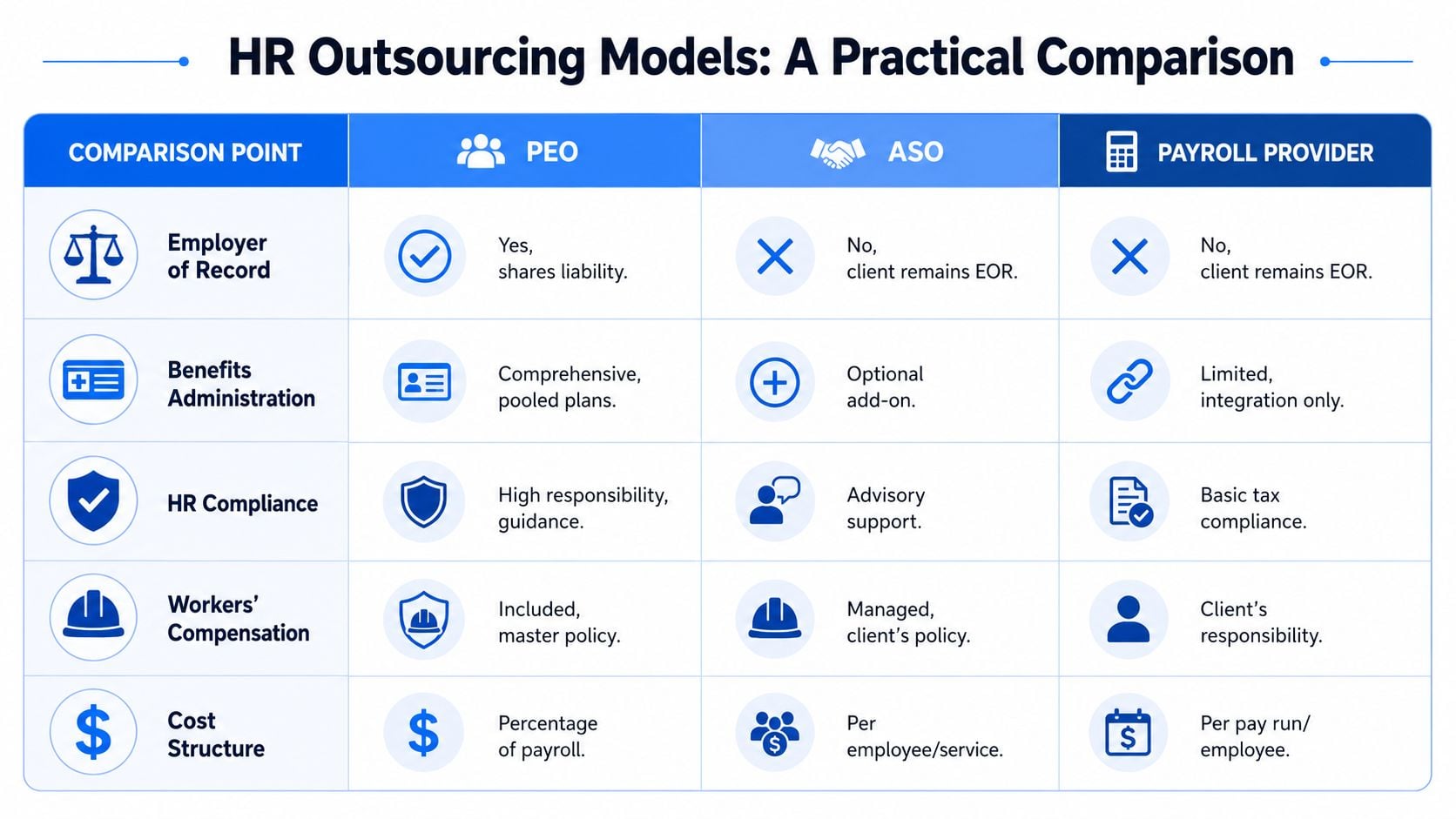
The biggest divide is responsibility. A payroll provider mostly handles payroll execution and tax administration. An ASO adds broader administrative HR support. A PEO usually sits in a more integrated relationship that can include broader HR infrastructure, risk handling, and benefits administration under a co-employment model.
If the company is trying to decide between the first two integrated models, this PEO legal structure vs ASO comparison helps frame where liability, control, and support differ in practice.
A payroll provider is often enough when the employer already has mature HR leadership, stable processes, and limited need for outside guidance. It's usually not enough when managers need help with terminations, leave questions, handbook enforcement, onboarding controls, or multi-state compliance issues.
For companies still tightening payroll fundamentals before they compare larger outsourcing models, this expert advice for small business payroll gives a useful baseline for what clean payroll operations should include.
A side-by-side view
| Decision area | PEO | ASO | Payroll provider |
|---|---|---|---|
| Employer relationship | Shared employment framework | Client remains primary employer | Client remains primary employer |
| Benefits administration | Usually broad and integrated | Often available as an add-on | Usually limited or partner-based |
| Compliance support | Higher-touch guidance | Advisory and administrative support | Narrower, focused on payroll and tax functions |
| Workers' comp handling | Often part of the bundled model | Usually coordinated around the client's arrangement | Typically left to the client |
| Best fit | Companies needing broader infrastructure | Companies wanting support with more retained control | Companies needing transaction efficiency more than HR depth |
Here's a practical perspective:
- Choose a PEO when the company wants one operating partner to support payroll, benefits, HR administration, and compliance in a more unified model.
- Choose an ASO when the company has internal HR judgment but wants outside help executing recurring functions.
- Choose payroll only when HR complexity is low or already handled elsewhere.
The future-state issue matters most here. A 40-person company opening operations in new states may find that payroll-only support looks cheap until leave rules, onboarding documents, and employee relations issues start landing on finance and operations. A 200-person employer with an experienced internal HR team may prefer the flexibility of an ASO because it doesn't need a provider to own as much of the HR stack.
The Business Case for Outsourcing Your HR Function
The strongest argument for outsourcing isn't that internal HR is unnecessary. It's that many companies can't build the full range of HR capability they need with one or two hires.
Paycor's roundup of HR statistics notes that 46% of HR professionals had been in their roles for two years or less, and it lists average pay of $82,215 for human resources managers (Paycor HR statistics roundup). For a CFO, those figures matter because they point to two realities at once. HR talent is in demand, and many teams are still relatively new in role.
Why hiring one internal person usually doesn't solve the problem
A single internal HR manager can be strong at culture, recruiting coordination, employee support, or payroll oversight. That doesn't mean that same person also brings deep expertise in benefits administration, handbook updates, leave compliance, workers' compensation coordination, investigations, and HR systems.
That gap is where outsourcing becomes a capacity decision, not just a salary comparison.
When an employer hires one internal HR generalist to avoid a provider fee, it often ends up buying narrower coverage and higher key-person risk.
A provider can spread that work across specialists. The company isn't relying on one person to know everything, stay current on every issue, and be available for every escalation. That's often the primary economic value.
What finance teams should compare instead
The more useful comparison is internal build cost versus outsourced coverage quality.
A finance team should ask:
- Coverage depth: Does the provider give access to payroll, benefits, compliance, and employee relations support, or just software plus a help desk?
- Continuity risk: What happens if the internal HR lead resigns during open enrollment or a sensitive termination?
- Manager time: How much line-management time gets pulled into HR cleanup when support is thin?
- Scalability: Will the same setup still work after expansion, acquisition, or headcount growth?
For teams building a financial model around those questions, this PEO ROI and cost benefit analysis provides a practical framework for evaluating trade-offs beyond sticker price.
Your Five-Point HR Provider Evaluation Checklist
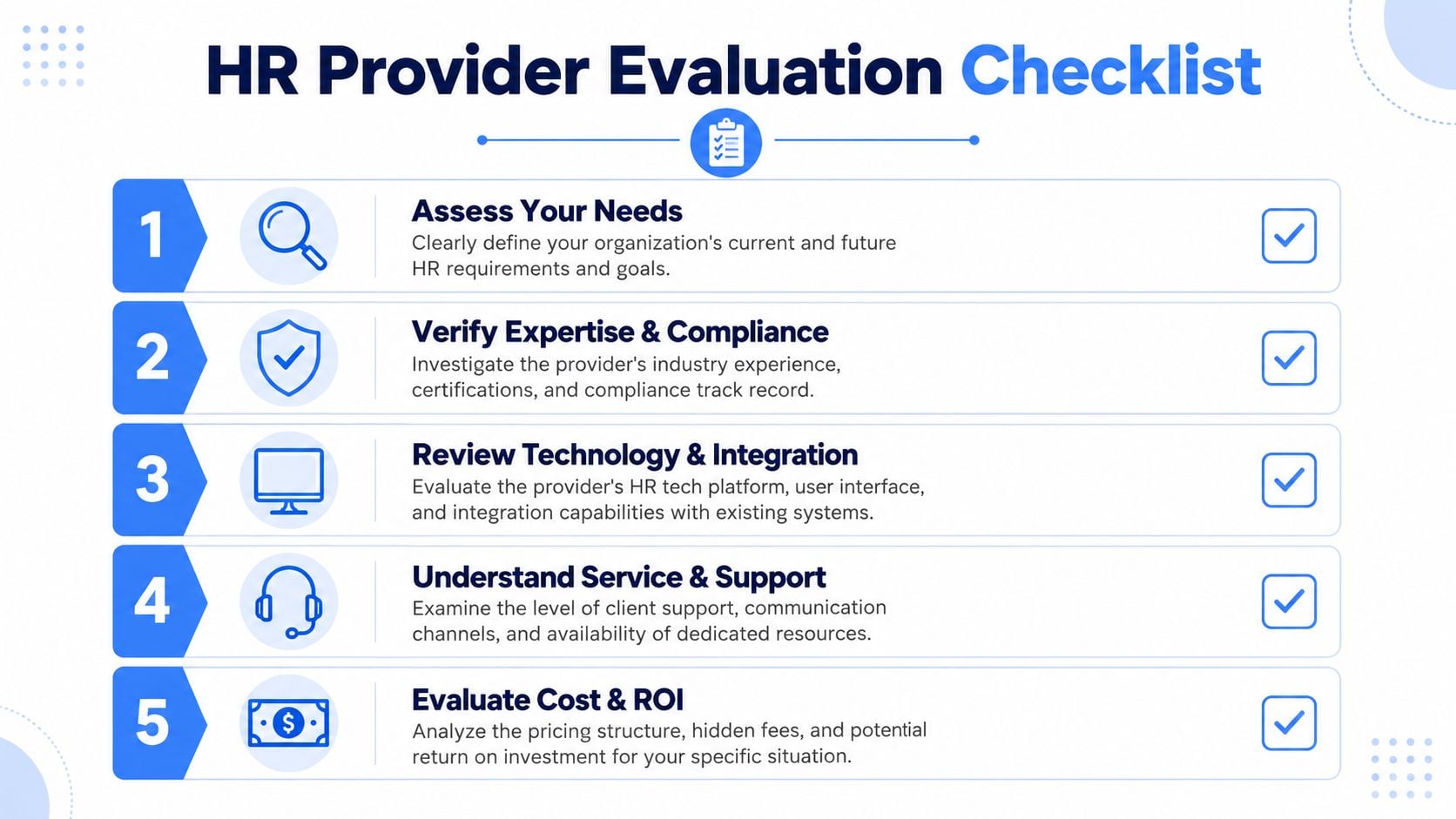
A strong hr services provider should survive a diligence process that looks more like vendor underwriting than a friendly demo. Buyers who skip this work usually discover the problems after implementation, when changing providers becomes expensive and disruptive.
Check the full cost not just the quoted fee
Start with total cost of ownership. The visible admin charge is rarely the whole picture. A disciplined review should separate recurring service fees from pass-through costs, implementation charges, benefit-related expenses, and any pricing tied to payroll volume or service add-ons.
Five areas deserve direct scrutiny:
Base pricing structure
Is pricing tied to payroll, headcount, service modules, or a blended formula? Buyers should understand what changes as the workforce grows.Benefits economics
The right question isn't only whether benefits are offered. It's whether plan quality, carrier access, network fit, and employee contribution strategy align with hiring and retention goals.Risk allocation
Review how the provider handles workers' compensation coordination, claims support, employee relations guidance, and employment practices issues.Technology burden
A polished demo can hide manual work. Ask who enters data, who owns corrections, who trains managers, and how the platform handles approvals and reporting.Contract exposure
Renewal provisions, implementation fees, service carve-outs, and exit language often matter more than the initial quote.
Measure service like an operator
The most useful service questions are operational, not promotional. TMI's HR analytics guidance recommends measuring mature providers through HR service satisfaction, employee service request resolution, and HR software utilization because those metrics show whether the service reduces friction rather than merely producing administrative output (TMI guide to HR metrics and analytics).
Ask for evidence in concrete terms:
- Resolution handling: How are employee and manager requests triaged, escalated, and closed?
- Support design: Is there a named team, a pooled queue, or a hybrid model?
- Platform adoption: Do employees and managers use the system, or does HR still handle basic transactions manually?
- Implementation accountability: Who owns data migration, training, and go-live support?
Operator's test: If a provider can't explain how it measures response quality, issue resolution, and system usage, it probably isn't managing service with enough rigor.
Stress-test the contract before signing
Many buyers require outside assistance. The contract often contains the actual economics of the relationship. A careful legal and operational review should look at fee changes, service exclusions, insurance language, termination timing, and any obligation that becomes painful during a switch.
A practical tool for that review is a PEO master service agreement checklist. It helps buyers organize diligence around the clauses that create the most post-sale surprise.
One market option in this process is PEO Metrics, which provides side-by-side analysis of provider pricing, service model, contract terms, and fit. That kind of structured comparison is often more useful than collecting more demos.
Avoiding Common Pitfalls in Provider Selection
The most expensive provider mistake usually isn't overpaying in year one. It's choosing a model that solves the current headache but breaks under the next stage of growth.

Employers Council's outsourcing guidance makes the key point clearly. Buyers should evaluate providers against current and future service needs, because HR outsourcing is a capacity and specialization decision tied to the next level of business complexity, not just today's administrative pain (Employers Council outsourced HR services guidance).
The three traps that cost the most
One common trap is the service model mismatch. The provider promises dedicated support, but the actual setup functions more like a rotating help desk. Escalations get slower, context gets lost, and internal managers start bypassing the system.
Another is the renewal surprise. The first-year quote looks manageable, but the contract leaves too much room for fee movement, implementation charges, or service repricing. Finance approved one model and inherited another.
The third is the scalability trap. A provider can handle a single-state employer with straightforward payroll. Then the company adds locations, more formal employee relations processes, and more manager training needs. Suddenly the original provider can't support the operating reality.
Future-state fit is the filter
A better diligence question sounds like this: “If the business doubles in complexity before it doubles in headcount, does this provider still work?”
That means testing:
- Geographic complexity: Can the model handle multi-state needs and policy variation?
- People-manager load: Will supervisors get practical support when employee issues become more frequent?
- Process maturity: Can the provider support formal onboarding, offboarding, investigations, and policy enforcement as expectations rise?
For buyers negotiating terms around these risks, this review of PEO contract negotiation red flags is a useful checkpoint.
A provider that looks efficient at the current org chart can become a bottleneck once the company needs more control, more specialization, and faster escalation support.
Making a Confident and Scalable HR Decision
The right hr services provider isn't the one with the lowest visible fee. It's the one that can support the business without forcing an expensive reset when complexity increases.
That requires a different buying lens. Instead of asking only what the provider will take over, ask what the provider will make easier to control. Better support coverage, stronger manager guidance, cleaner workflows, and fewer surprises in contract and service delivery usually matter more than a narrow fee comparison.
BambooHR's HR metric guidance points to two useful business-impact measures: the ratio of employees per HR professional and the ROI of HR services, which help show whether support is scaling efficiently and lowering total employment cost (BambooHR key HR metrics). Those are better decision anchors than vendor slogans.
A confident decision comes from matching the provider to the next operating stage, not the current pain point. If the model works only while the company stays simple, it isn't a fit. It's a temporary patch.
PEO Metrics helps employers compare, select, and negotiate PEO options with a side-by-side view of pricing, benefits, service model, contract terms, and provider fit. For teams evaluating a first-time move, switching providers, or preparing for renewal, PEO Metrics offers an independent way to structure the decision.
