
A finance leader reviewing HR outsourcing proposals usually sees the same layout. A per-employee admin fee, a benefits summary, a payroll promise, and a polished slide about service. That format encourages the wrong decision.
The key question isn't which provider has the lowest visible fee. It's which model reduces avoidable HR cost, lowers compliance exposure, improves operating discipline, and still holds up after implementation, renewal, and growth. That's where most evaluations break down.
HR outsourcing benefits are real, but they aren't evenly distributed. Some companies achieve significant advantage. Others buy a cleaner workflow and then get trapped in a rigid platform, a vague service agreement, or a renewal structure that erodes the original savings story. A useful evaluation has to include both sides.
Table of Contents
- Why Comparing HR Admin Fees Is a Financial Mistake
- PEO vs ASO vs HRO Understanding Your Options
- The Seven Core Benefits of HR Outsourcing
- How to Build a Business Case and Measure ROI
- Exposing the Hidden Costs and Common Trade-Offs
- Decision Framework When to Outsource Your HR
- Next Steps for Evaluating and Negotiating Providers
Why Comparing HR Admin Fees Is a Financial Mistake
A CFO gets three HR outsourcing proposals. One shows a $42 PEPM admin fee, one bundles services into a flat rate, and one comes in at $58 PEPM with better service guarantees. If the review stops at the fee table, the cheapest option usually wins the meeting and often loses in execution.
The admin fee is a poor proxy for total cost.
What matters financially is the full operating model behind that fee. A lower PEPM price can still produce a worse result if payroll errors rise, managers spend hours chasing service tickets, benefit plans get weaker, or internal staff keeps compliance work the provider was supposed to reduce. The pertinent question is not "Which quote is cheapest?" It is "Which option lowers total HR cost and risk after fees, time, errors, turnover pressure, and contract terms are factored in?"
That distinction matters because employers often use outsourcing to cut cost, standardize execution, and reduce internal burden, as the Society for Human Resource Management notes in its overview of outsourcing HR functions. Cost matters. Fee alone does not answer the cost question.
What the fee comparison misses
- Retained internal labor: If your HR manager, controller, and operations leads still spend hours each pay cycle fixing issues or answering employee questions, the "savings" are overstated.
- Error cost: A missed tax filing, wage-hour mistake, or botched deduction can cost more than a year of admin fee savings.
- Benefits economics: A higher admin fee may come with stronger plan options, lower employee premium pressure, or less turnover in hard-to-fill roles.
- Service model: Named contacts and accountable support teams usually reduce rework compared with a general queue.
- Contract exposure: Setup fees, off-cycle payroll charges, year-two increases, and termination terms often matter more than the first quoted PEPM rate.
I tell finance teams to treat admin fees as a screening metric, not a decision metric.
A disciplined review starts with loaded cost. Include vendor fees, internal time, expected error reduction, benefit changes, implementation effort, and downside risk if service quality slips. Employers that want a better baseline for fee mechanics should review how much a PEO costs before comparing proposals side by side.
The trade-off is straightforward. Paying more for a provider can be the right financial decision if it removes enough labor, improves controls, and reduces avoidable losses. Paying less is only a win when the cheaper model holds up under real operating conditions.
PEO vs ASO vs HRO Understanding Your Options
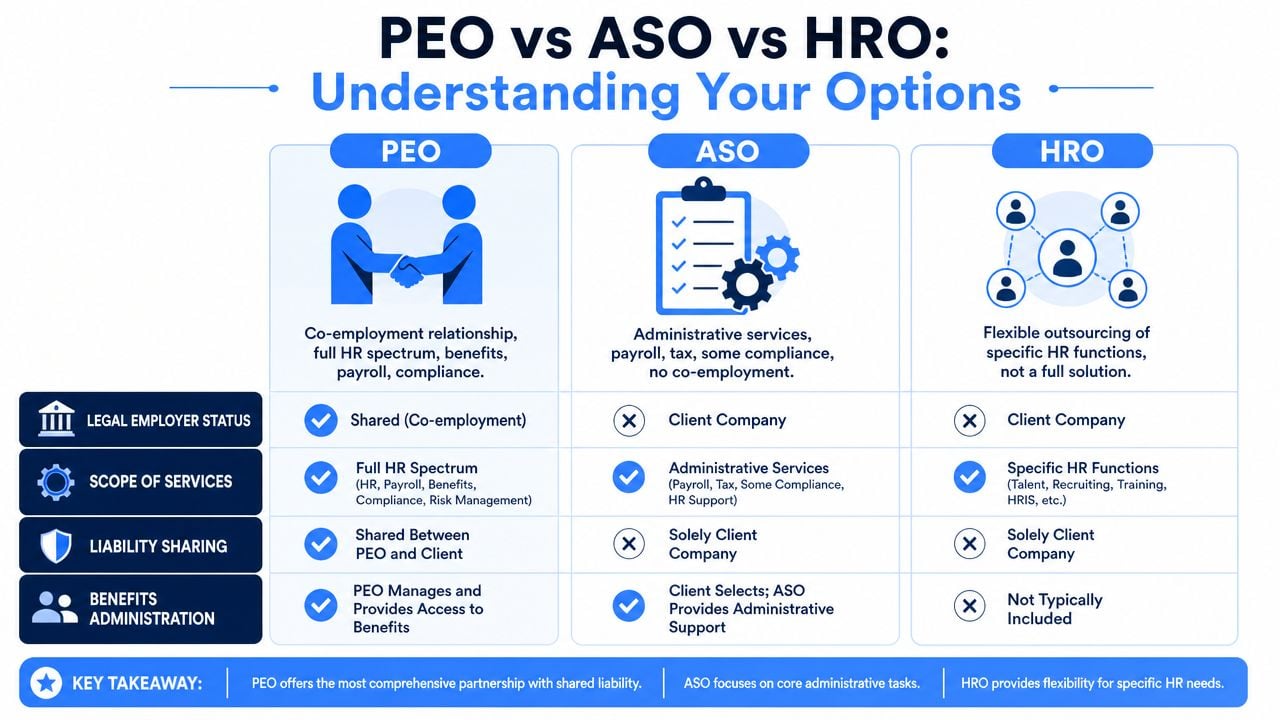
Not all outsourcing models solve the same problem. Buyers often compare a PEO, an ASO, and a narrower HRO provider as if they're interchangeable. They're not.
Where the legal and operational line changes
A PEO is usually the most full-service model. It typically combines payroll administration, benefits administration, HR support, compliance guidance, and a co-employment structure. In practice, that changes how responsibilities are shared and how the employer accesses bundled infrastructure such as benefits programs, workers' compensation administration, and HR process support.
An ASO usually provides administrative support without co-employment. The employer keeps more direct responsibility while outsourcing selected functions such as payroll, tax administration, benefits administration, and certain compliance tasks. This can fit employers that want help with execution but don't want the structural shift that comes with a PEO arrangement.
HRO is broader and more flexible as a category. It can mean outsourcing only payroll, only benefits administration, only recruiting support, or a mixed set of HR functions. That flexibility is useful, but it can also create fragmented accountability if multiple vendors touch the same employee workflows.
| Model | Best known for | Liability structure | Typical fit |
|---|---|---|---|
| PEO | Broad outsourced HR support | Shared responsibilities through co-employment | Growing employers that need scale and support |
| ASO | Admin help without co-employment | Employer retains more direct responsibility | Employers with internal HR leadership |
| HRO | Function-specific outsourcing | Depends on scope and contract | Employers solving a narrow operational gap |
Which model usually fits which employer
A company with lean internal HR, multiple states, and rising compliance complexity often benefits from a more integrated model. A company with a strong HR team and a specific processing problem may need only a narrower outsourcing arrangement.
The wrong choice usually shows up in one of two ways:
- Overbuying: The company pays for strategic support it won't use.
- Underbuying: The company keeps liability and workflow burden it thought it was offloading.
A useful selection process starts by mapping responsibilities before reviewing vendors. Employers comparing service structures in more detail can use this overview of human resources outsourcing as a practical reference point.
The Seven Core Benefits of HR Outsourcing
A CFO usually sees the issue first in the month-end mess. Payroll closes late because a benefits deduction was set up wrong. A manager escalates a leave question that no one owns. Finance spends time correcting avoidable errors instead of reviewing labor cost. That is where HR outsourcing creates value. The gain is not just lower admin spend. It is cleaner execution, fewer interruptions, and better control over labor-related risk.
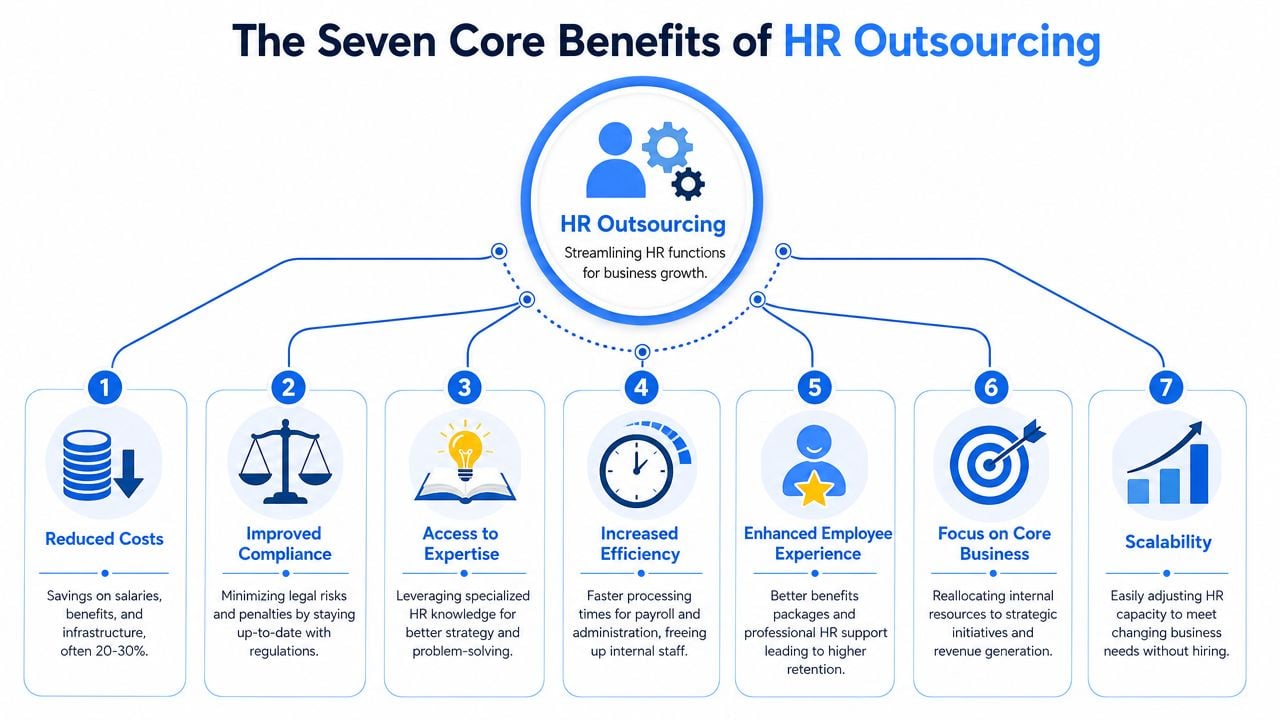
Some benefits show up clearly on a finance model. Others appear in error rates, management time, and the company's ability to grow without adding overhead too early. Both matter.
The benefits that show up on a finance model
1. Administrative cost reduction
Outsourcing can reduce the cost of delivering payroll, benefits administration, HR support, and core systems, especially when the internal team is small and fixed costs are spread across a limited employee base. Obsidian HR's review of outsourcing economics cites average savings of about 27% versus in-house HR models.
That number is only useful if the comparison is honest. A provider fee should be weighed against HR labor, software licenses, outside consultants, manager cleanup time, and the cost of errors that keep flowing back into finance and operations. A PEO break-even analysis framework helps pressure-test whether the savings case is real for your headcount and service mix.
2. Efficiency gains
Efficiency is usually less dramatic than sales decks suggest, but it is still material. Good outsourcing arrangements reduce rework. Fewer manual handoffs mean fewer payroll corrections, fewer enrollment misses, and fewer employee tickets bouncing between HR, managers, and finance.
Obsidian HR's review of outsourcing economics also points to faster access to HR systems and specialist support that internal teams often cannot justify hiring full-time.
3. Fewer mistakes
Error reduction is often a better reason to outsource than fee reduction. Leaders buying HR support frequently care more about preventing payroll, benefits, and documentation mistakes than shaving a few dollars off administration.
That priority is consistent with broader outsourcing research. In Deloitte's Global Outsourcing Survey, executives cite service quality, standardization, and process efficiency alongside cost reduction as major outsourcing objectives. In practice, fewer mistakes protect cash flow, reduce employee frustration, and keep managers out of avoidable disputes.
Providers earn their keep by reducing exception handling, not by taking routine tasks off a checklist. The true test is how the provider handles off-cycle payrolls, leave cases, deductions, terminations, and state-specific issues when the process breaks from the script.
The benefits that show up in execution
4. Compliance specialization
Compliance support has value because most employers do not struggle with the obvious rules. They struggle with volume, variation, and follow-through. Multi-state hiring, leave administration, wage notice requirements, ACA tracking, policy acknowledgments, and employee documentation all create failure points.
The Society for Human Resource Management overview of HR outsourcing notes that employers often outsource to get specialized expertise in compliance-heavy HR functions. That support matters most when the provider does more than answer questions. The provider needs to enforce deadlines, maintain documentation, and keep workflows consistent across locations.
5. Stronger growth support
Growth creates HR strain before it creates obvious headcount need in HR. Hiring ramps up. Onboarding becomes inconsistent. Benefit enrollments start missing deadlines. Managers begin making their own decisions because central support is too slow.
A capable provider absorbs some of that load with established workflows, service teams, and systems that can handle more employees without a full internal rebuild. The financial benefit is timing. The business can support growth without hiring several specialized HR roles too early.
6. Better employee experience
Employee experience is an operational metric, not a branding exercise. If payroll is accurate, benefits are easy to use, onboarding is organized, and questions get resolved quickly, employees notice. If those basics fail, retention and manager credibility usually take the hit.
The improvement usually comes from process discipline:
- New hire readiness: offer documentation, tax forms, payroll setup, and benefits enrollment follow one defined path.
- Manager support: supervisors get clearer guidance on leave, documentation, and routine employee issues.
- Benefits administration: employees have a more reliable enrollment and service process, with fewer dropped requests and fewer billing surprises.
7. Scalability without adding fixed headcount
This is often the most practical benefit for companies in the 25 to 250 employee range. They need broader HR capability, but not enough volume to justify a payroll manager, benefits specialist, compliance lead, and HR systems owner on staff.
Outsourcing fills that gap. It gives the business access to specialized support and operating capacity while keeping costs more variable. The trade-off is that control shifts partly outside the building, so service model, escalation quality, and ownership lines matter as much as the fee.
How to Build a Business Case and Measure ROI
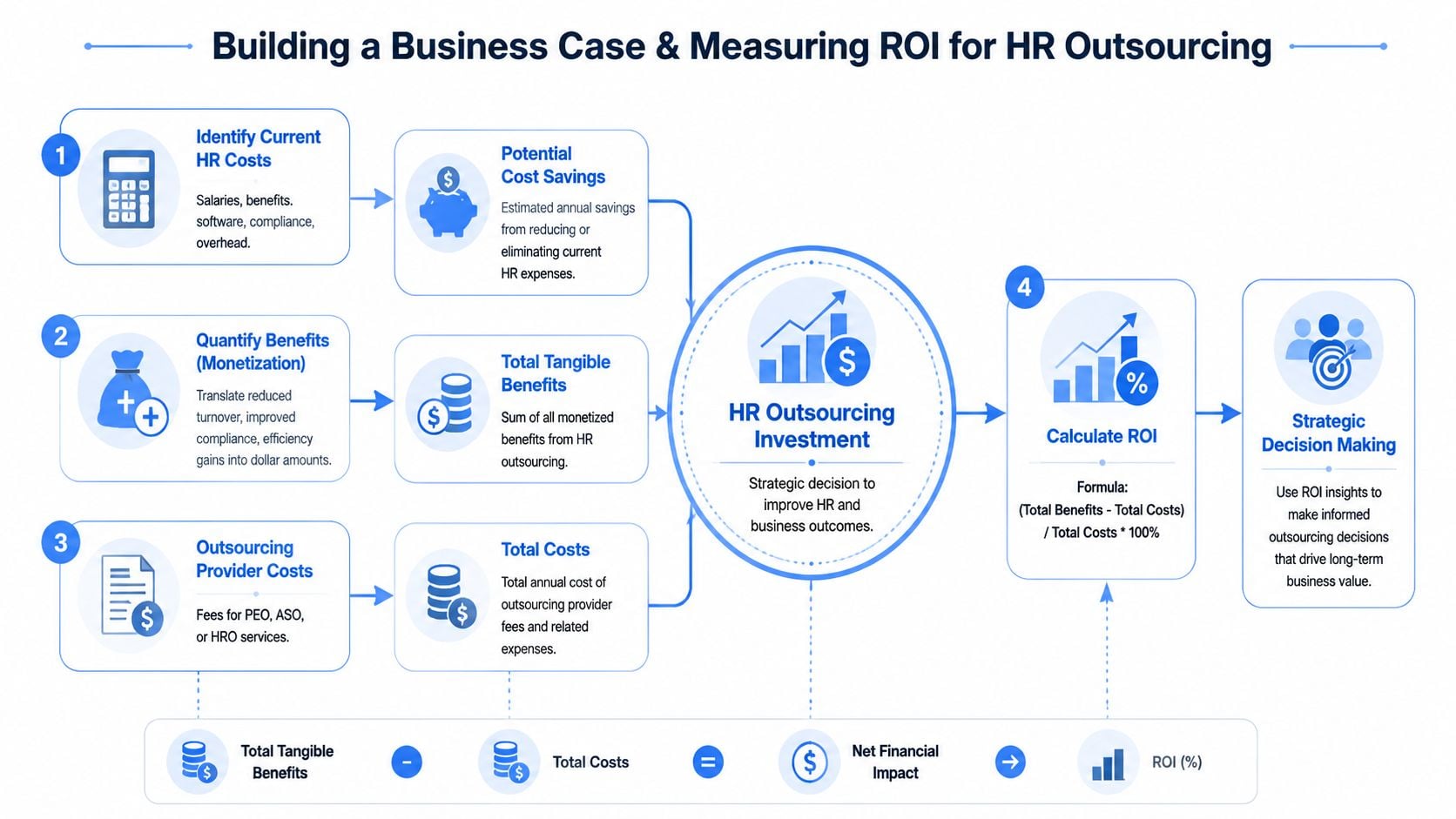
A useful ROI model has to go wider than the admin invoice. The right comparison is current-state HR cost and risk versus outsourced-state cost and risk. If that model only captures direct fees, it will understate both upside and exposure.
Start with current-state cost
Build the internal baseline first. That usually includes:
HR labor cost
Include HR staff time spent on payroll, benefits administration, onboarding, reporting, employee questions, and compliance tasks.Technology stack
Count payroll platforms, benefits administration tools, HRIS licenses, reporting tools, and any outside consultants supporting them.Management time
Add the time finance, operations, and department managers spend fixing issues that shouldn't reach them.Process instability
If key workflows depend on one payroll administrator or one HR generalist, note that concentration risk even if it doesn't have a clean ledger code.
Then price the value that doesn't sit in payroll
Once the baseline is built, model the outsourced state. Don't stop at fee comparison.
A finance-ready model usually includes:
- Administrative savings: Outsourced HR often reduces administrative costs by 20% to 30% on average, with studies cited by vendors reporting about 27% average savings, as noted in the earlier section's sourced benchmark.
- Error reduction value: Estimate the cost of rework, employee disruption, correction cycles, and escalations tied to payroll or benefits mistakes.
- Compliance value: Use a probability-weighted view of risk. Even if exact exposure varies, companies know which recurring issues create avoidable vulnerability.
- Retention value: If better service and benefits support reduce turnover pressure, the economic effect reaches recruiting, training, and manager time.
A simple business case often works better than a “perfect” one. Employers can build a practical framework with a break-even analysis for PEO adoption and then refine it during final diligence.
Boardroom test: If the ROI only works when every soft benefit is counted at full value, the case is weak. If it works before that, the case is durable.
The best models also separate first-year and steady-state economics. Implementation friction can distort year one. That doesn't mean the partnership is bad. It means the timing of value matters.
Exposing the Hidden Costs and Common Trade-Offs
A CFO signs an HR outsourcing agreement expecting cleaner execution and fewer distractions for finance and operations. Ninety days later, the invoice is higher than the quoted admin fee, the payroll team is still chasing exceptions, and managers are learning which requests fall outside scope. That outcome is common because many evaluations stop at the headline rate instead of the full operating model.
The primary question is not whether outsourcing has benefits. It does. The question is where the provider shifts cost, risk, and effort after go-live.
The financial items buyers miss
Hidden cost usually shows up in four places. Implementation, contract structure, service boundaries, and exit terms.
The first issue is timing. A provider can look cost-effective on paper while year-one economics are weighed down by setup fees, data cleanup, parallel payroll processing, training time, and internal project management. None of that means the deal is bad. It means the payback period is longer than the sales model suggests.
The second issue is pricing behavior after signature. Introductory rates, PEPM minimums, added charges for special projects, and higher renewal increases can change the economics more than the initial quote. This is why buyers should review a PEO cost creep over time analysis before final contract review, especially if the provider is pricing aggressively in year one.
A third issue is what the market is buying. Many leadership teams pursue HR outsourcing to reduce mistakes, improve productivity, and create more dependable execution. Cost matters, but reliability often carries more value than a modest admin fee reduction. A lower-cost contract loses its appeal fast if payroll corrections, benefit enrollment issues, or leave administration errors keep pulling managers and finance back into cleanup work.
Common sources of financial friction include:
- Implementation charges: Setup, historical data conversion, payroll parallel runs, and training support may sit outside the quoted fee.
- Renewal increases: First-year pricing may not reflect the actual long-term rate path.
- Out-of-scope work: Handbooks, investigations, complex leave cases, custom reporting, and multi-state support are often billed separately.
- Minimums and thresholds: Small headcount changes may not reduce cost if the contract includes monthly minimum fees.
- Exit expense: Notice periods, termination fees, data extraction, runout payroll, and benefit transition support can create a costly departure.
The operating trade-offs that affect value
Outsourcing changes control points. That is the trade-off buyers need to test.
A strong provider improves consistency because process ownership is defined, deadlines are enforced, and specialist support is available when issues get technical. A weak provider creates distance between your managers and the people doing the work. You get a ticketing queue instead of judgment, slower answers on exceptions, and more internal follow-up than expected.
The trade-off usually comes down to service design, not brand size.
| Trade-off | What works | What creates drag |
|---|---|---|
| Service model | Named contacts, clear escalation paths, documented response times | Shared inboxes, rotating reps, unclear ownership |
| Technology | Clean workflows, usable reporting, visible task status | Rigid systems, limited reporting, manual workarounds |
| Process fit | Provider aligns with your approval structure and manager habits | Provider forces process changes without business context |
| Accountability | SLAs, error correction standards, and contract remedies | General promises with no measurable service standard |
The best diligence happens in the ugly scenarios, not the demo. Ask how the provider handles off-cycle payroll, retro pay, garnishments, terminations, benefit eligibility disputes, multi-state notices, and leave errors. Ask who owns the issue, how fast it is corrected, and whether the fix creates an added fee.
That is where hidden cost becomes visible. A provider that performs well in edge cases usually protects ROI better than one with a lower base fee and vague service terms.
Decision Framework When to Outsource Your HR
A common trigger looks like this. Payroll errors are still rare, but your controller is approving off-cycle runs twice a month, managers are asking different policy questions in different states, and HR is spending more time fixing exceptions than supporting the business. At that point, the decision is not about convenience. It is about whether the current model can absorb more complexity without adding cost, risk, or management distraction.
The right time to outsource is usually earlier than leadership expects and later than sales teams suggest. If you wait until breakdowns are visible, the business is already paying for rework, delayed hiring, manager time, and avoidable compliance exposure. If you outsource too early, you can lock in fees, process changes, and vendor dependence before the volume or complexity justifies it.
A practical test is to look at three factors together: complexity, internal capacity, and cost of failure. Outsourcing tends to make financial sense when at least two of the three are rising at the same time.
Signals that outsourcing likely fits
A company is usually a good candidate when several of these conditions are present:
- Growth is outpacing HR execution: Hiring, onboarding, policy administration, and employee support are getting inconsistent across teams or locations.
- The business operates across multiple states: State-specific wage and hour rules, leave requirements, notices, and policy updates create more ongoing work than a lean internal team can reliably manage. The U.S. Small Business Administration notes that outsourcing can help small businesses address specialized compliance and administrative demands, which becomes more relevant as employer obligations expand across jurisdictions.
- Finance or operations is absorbing HR cleanup work: Leaders who should be focused on margin, forecasting, and execution are spending time resolving payroll issues, documentation gaps, employee questions, or benefits problems.
- The company needs broader capability at once: Benefits administration, compliance support, HR systems, and employee lifecycle workflows are all straining, which means one additional generalist will not solve the underlying load.
- The cost of getting HR wrong is increasing: A delayed termination, leave error, late enrollment, or misclassified employee now carries a bigger financial or operational consequence than it did a year ago.
Signals that it may be the wrong move
Outsourcing is often a poor fit under these conditions:
- Internal HR is already efficient and scalable: A capable team with solid systems and clear ownership may only need targeted help in payroll, benefits, or compliance.
- Leadership expects the provider to replace management discipline: An outsourced partner can process, advise, and document. It cannot fix weak managers, inconsistent decisions, or culture problems.
- The company resists standard workflows: Providers perform best when approvals, deadlines, and responsibilities are defined. If every exception becomes a custom case, cost rises and service slows.
- No one will own the provider relationship internally: Vendor performance depends on a client-side decision maker who can set priorities, resolve disputes, and handle conflict during provider negotiations before those issues turn into service problems.
One more filter helps. Ask whether the pain is mostly transactional or mostly behavioral.
If the problem is capacity, fragmented administration, or growing compliance workload, outsourcing can produce measurable relief. If the problem is unclear policies, weak manager judgment, or leadership avoidance, the provider will process the symptoms and leave the root cause in place.
The best outsourcing decisions come from a finance lens, not a feature list. Compare the provider fee against the full cost of staying in-house: management time, hiring another HR employee, software overlap, error correction, and the cost of weak execution in a more complex business. That is usually where the case becomes clear.
Next Steps for Evaluating and Negotiating Providers
A CFO usually sees the problem late. The quoted admin fee looks acceptable, then the contract language shifts renewal pricing, implementation takes longer than promised, and internal staff still spend hours each week chasing payroll exceptions, eligibility errors, and employee questions. Provider selection should prevent that outcome, not document it after the fact.
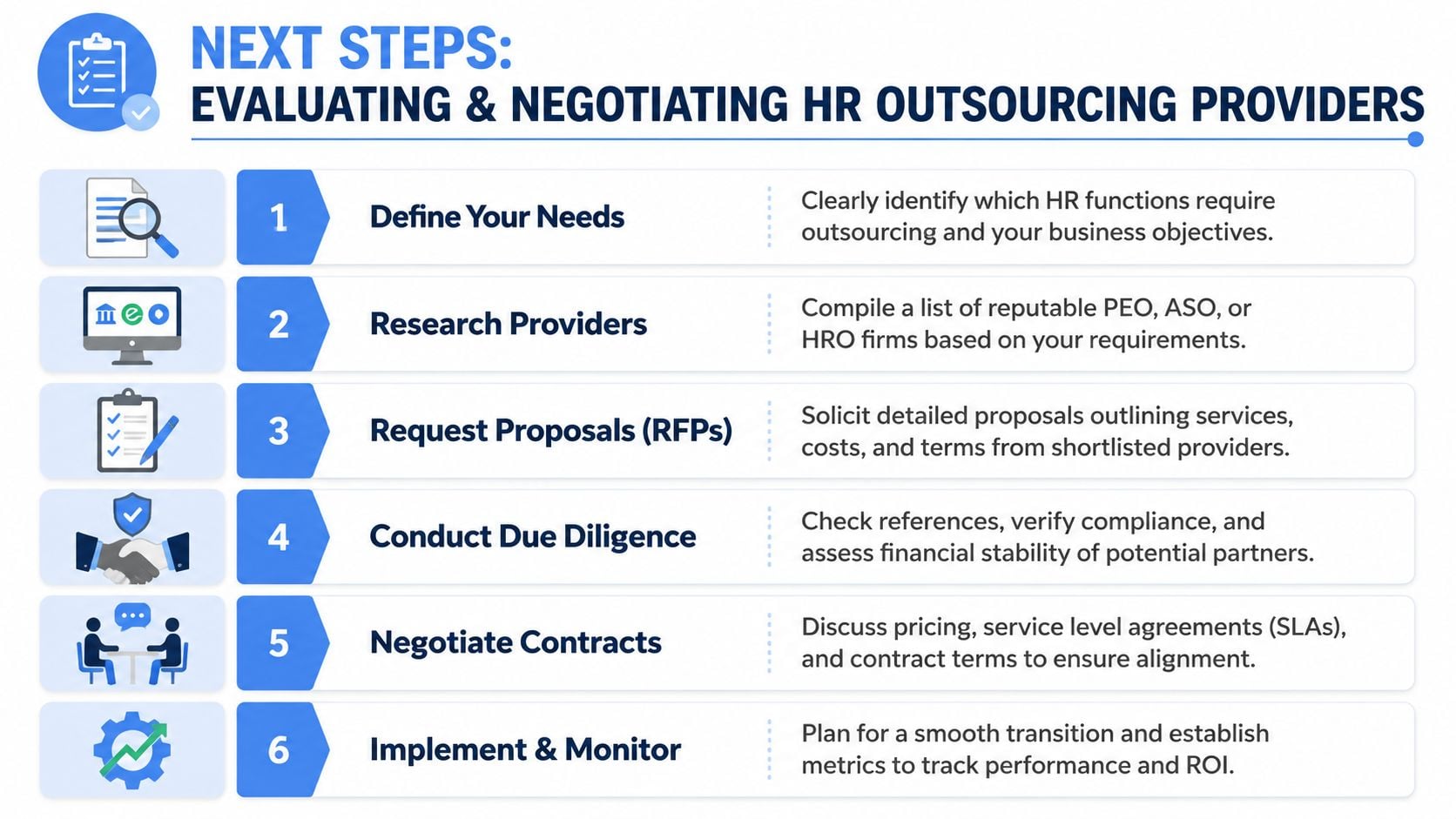
Start with the operating model, then negotiate the contract to fit it. A provider that looks inexpensive on a per-employee basis can cost more if support is routed through a generic service queue, payroll corrections are frequent, or basic reporting requires extra fees. The key question is not whether the vendor can process HR tasks. It is whether the arrangement reduces finance, HR, and manager time without adding service risk.
Use a short evaluation and negotiation checklist:
- Define the scope: Separate must-have services from items that can stay in-house for now. That prevents overbuying in year one.
- Map the service model: Confirm who handles payroll, benefits, onboarding, employee questions, and compliance issues. Dedicated contacts and pooled teams produce very different response times.
- Review contract mechanics closely: Check renewals, annual fee increases, minimum participation rules, termination rights, implementation support, and data ownership.
- Set measurable service protections: Ask for response standards, payroll accuracy expectations, escalation paths, and specific remedies if service slips.
- Test reference quality: Speak with clients that match your headcount, state footprint, hiring pace, and benefits complexity.
- Prepare for negotiation pressure: Buyers get better terms when someone on the team knows how to handle conflict during provider negotiations without conceding key protections too early.
Cost savings still matter. SHRM notes that companies often outsource HR to reduce expenses and improve efficiency, but those savings depend on scope control, process discipline, and contract terms, not just the initial quote. A weak agreement can erase much of the expected return.
The practical standard is simple. Compare providers on total economic impact: vendor fees, retained internal labor, implementation burden, service reliability, compliance exposure, and flexibility at renewal. The best deal is the one that holds up after go-live, not the one that looks best in the sales presentation.
PEO Metrics helps companies compare, select, and negotiate the right PEO with a side-by-side view of pricing, benefits, contract terms, service model, and risk. For HR leaders, CFOs, and business owners who want a more disciplined process than a vendor sales cycle, PEO Metrics provides independent analysis that helps buyers avoid surprises and negotiate from a stronger position.
