
Most employers pick a payroll model the same way they pick office software, by comparing the quoted fee and stopping there. That’s the wrong decision. Employer payroll solutions are really a risk allocation choice, because the model determines who carries compliance burden, how co-employment works, what happens in multi-state payroll, and how hard it is to exit later.
That matters because payroll is still messy in practice. A 2026 roundup said 51% of organizations still use spreadsheets and 19% still rely on manual processes, while 85% report problems with payroll technology and only about half use cloud-based systems, which is one reason payroll has moved from clerical work to operating risk (Select Software Reviews payroll statistics). If the leadership team wants a clean answer for the CFO or board, the starting point is not price. It’s structure.
Table of Contents
- Why Most Employers Pick the Wrong Payroll Model
- What Counts as an Employer Payroll Solution
- Comparing the Four Delivery Models
- Where the Cost Actually Lives in Each Model
- A Practical Evaluation Framework for Buyers
- Contract and Implementation Pitfalls That Quietly Drain Value
- Negotiation Levers That Actually Move the Deal
- A 30-60-90 Day Path to a Confident Decision
Why Most Employers Pick the Wrong Payroll Model
The default buying process is backwards. Teams ask for quotes, compare per-employee fees, and pick the lowest monthly number. That looks disciplined. In reality, it ignores the issues that drive the actual bill, co-employment exposure, multi-state compliance drag, benefits optimization, and contract exit terms.
A 120-person company is a good example. It can move from a low-fee PEO to a supposedly cheaper arrangement and still end up paying more once workers’ comp classification, carrier restrictions, and renewal language kick in. Eighteen months later, the finance team often discovers the original quote never captured the operational friction that came with the contract. The invoice was low, the total cost was not.
That’s why smart buyers stop treating payroll as a narrow admin service. The market itself has already shifted in that direction, with one major estimate putting global payroll services at USD 35.32 billion in 2026 and USD 52.75 billion by 2031, alongside a 8.35% CAGR and 66.95% cloud share in 2025 (Mordor Intelligence). Growth like that happens when payroll becomes an operating system for compliance and scale, not a clerical back office.
For finance leaders who want a stronger operating lens, the 2026 CFO services guide for startups is a useful companion because it frames cost, controls, and decision discipline the way a board will. The right payroll model should be defensible twelve months later, not just cheap on signature day.
Practical rule: If the vendor can’t explain who absorbs the downside when something goes wrong, the quote isn’t really a quote. It’s an incomplete forecast.
What Counts as an Employer Payroll Solution
An employer payroll solution is any combination of software, services, and risk-sharing that gets employees paid correctly and compliantly across the places where they work. That can mean a basic payroll platform, a managed service, a co-employment arrangement, or a full outsourcing relationship. The category is broader than most comparison pages admit.
For a 75-person manufacturer with employees in Texas, California, and Illinois, the distinction matters immediately. One setup may handle pay runs only. Another may handle filings but leave benefits and employment liability with the client. A third may change who appears as employer on certain filings and shift administration under a master agreement.
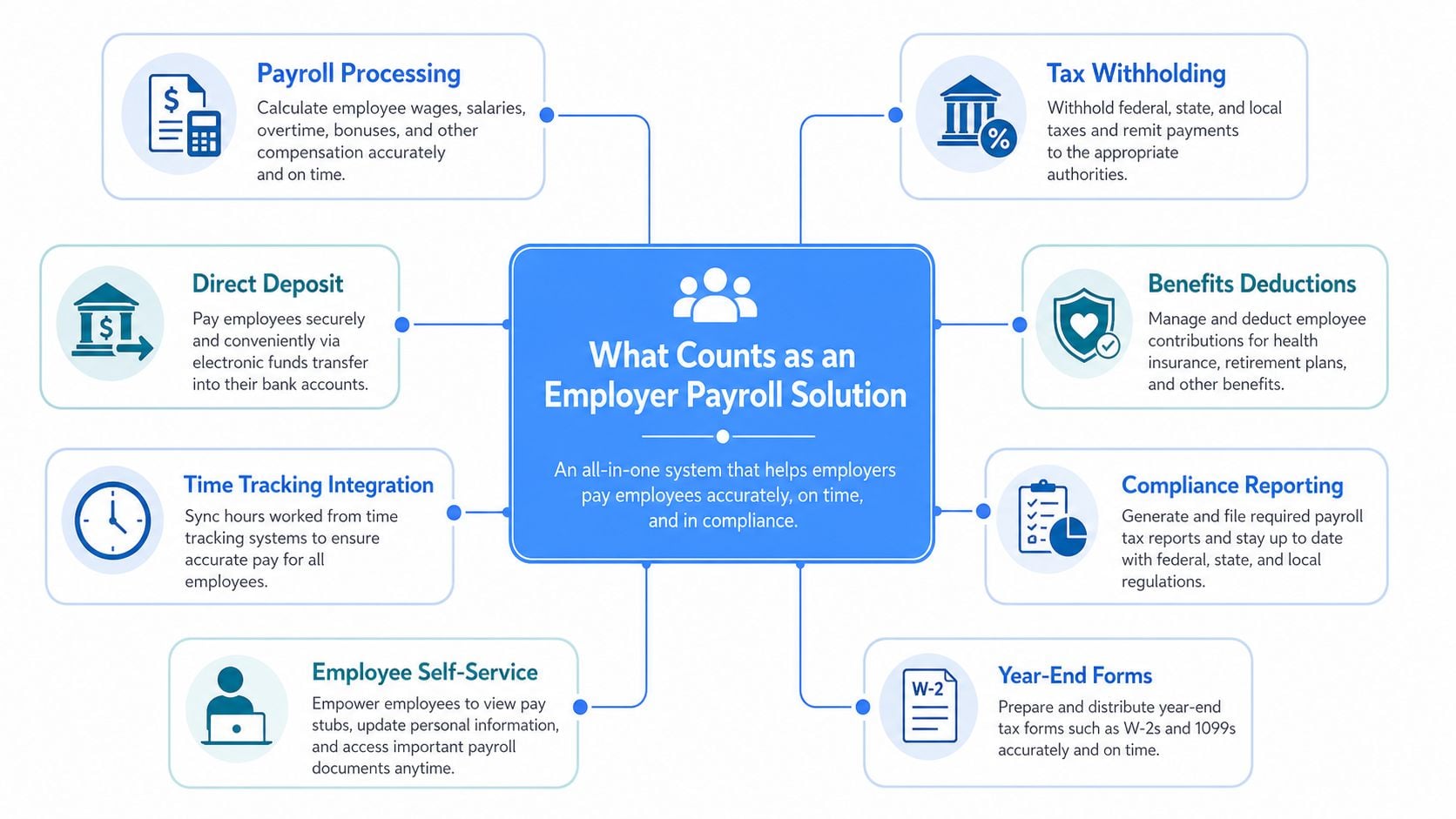
The four delivery models
In-house means the company runs payroll internally, usually through its own finance or HR team. It keeps control, but it also keeps the burden.
Payroll-only vendor means software and processing are outsourced, while the employer still owns the employment relationship and most compliance responsibility. That’s the model many businesses think they’re buying when they ask for “payroll.”
ASO means an administrative services organization adds HR support, but the company remains the employer of record. For a cleaner explanation of that middle ground, the HR outsourcing and payroll overview is a practical reference point.
PEO means the provider enters a co-employment relationship under a master client agreement. That structure changes how risk, benefits access, and filings are arranged.
A UK-focused process example is the UK payroll with DynamicsHub resource, which helps show how process design changes when payroll complexity sits inside different administrative models.
In practice, buyers should be able to answer one question after this section, who is actually responsible when the payroll setup fails, the client, the provider, or both.
Comparing the Four Delivery Models
Who owns what
The cleanest comparison is not feature lists, it’s control and liability. The table below puts the models on the same axes so the trade-offs are visible.
| Dimension | In-House | Payroll-Only Vendor | ASO | PEO |
|---|---|---|---|---|
| FEIN used for payroll filings | Client FEIN | Client FEIN | Client FEIN | Shared or provider-side filing structure under co-employment |
| Employment liability | Client | Client | Client | Shared under the co-employment arrangement |
| Compliance filings | Client team | Vendor processes, client remains responsible | Shared support, client remains responsible | Provider handles many filings, with client obligations still present |
| Benefits sourcing | Client broker and carriers | Client broker and carriers | Often client-led, with vendor support | Provider-bundled or provider-negotiated |
| Scale fit | Small to mid-size teams with strong internal ops | Businesses that want software without outsourcing employment structure | Employers that want HR support without co-employment | Multi-state or high-complexity employers that need deeper outsourcing |
| Where it breaks down | Limited HR capacity, weak controls, error-prone handoffs | Gaps between software and actual compliance ownership | Confusion about who owns decisions and documents | Contract rigidity, carrier lock-in, and reduced direct control |
The point is simple. A payroll-only vendor sells processing. An ASO adds support. A PEO changes the employment structure. Those are not cosmetic differences.
What usually gets bundled in real life
Most mid-market companies do not run one pure model. They use payroll software plus a separate benefits broker plus an HR consultant. That hybrid can work, but it also creates coordination problems when data lives in three places and nobody owns the handoffs.
The ASO model explanation is useful for buyers trying to separate “help with HR” from “transfer of employment structure.” That distinction stops a lot of bad comparisons before they start.
The best test is blunt. If the vendor’s sales deck can’t answer who carries the filing obligation, who carries the workers’ comp exposure, and who can terminate the relationship, the buyer doesn’t have a model. It has a marketing label.
Where the Cost Actually Lives in Each Model
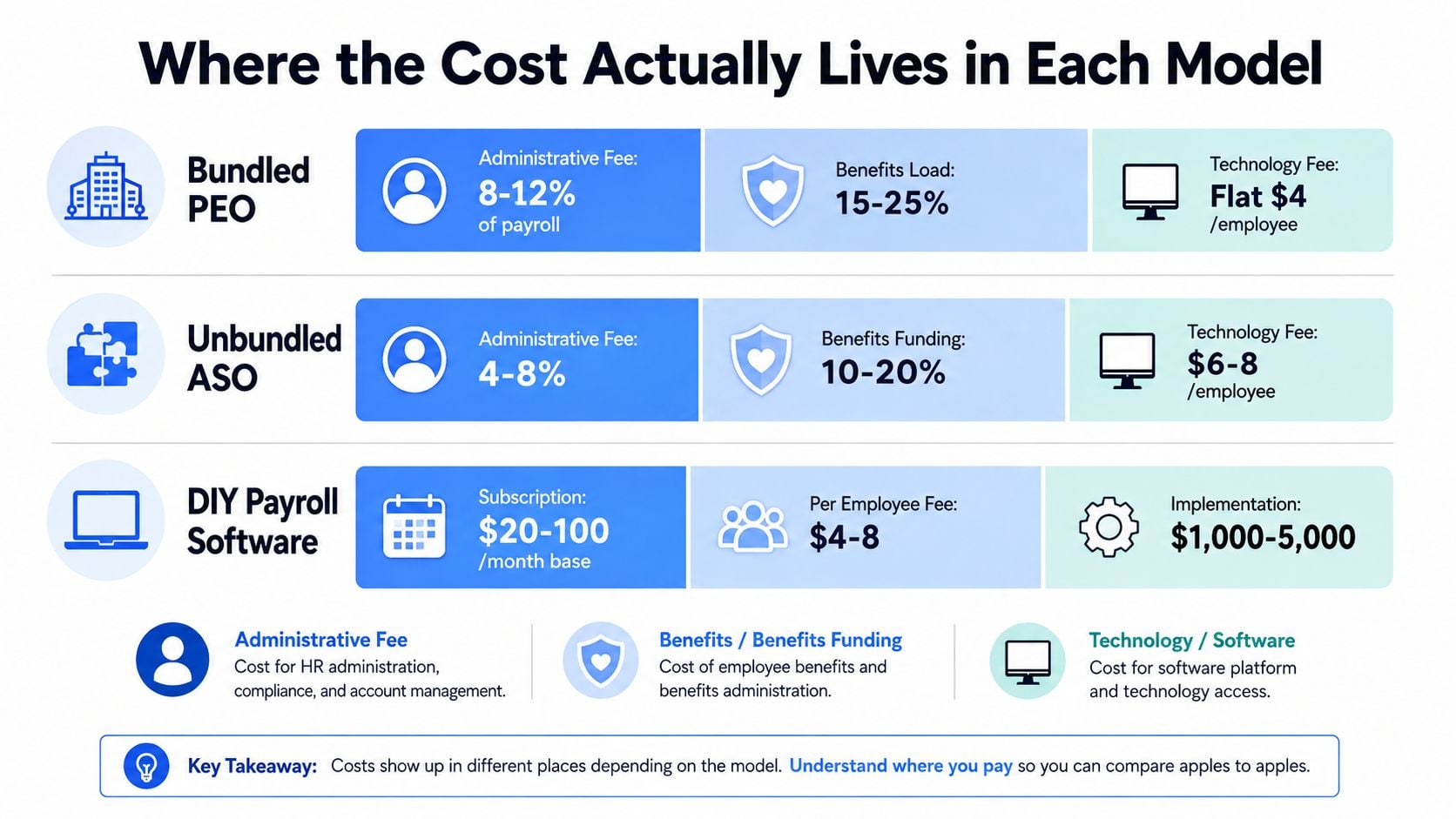
The headline fee is rarely the full cost. What changes the economics is the mix of administrative charges, benefit loads, implementation costs, and the penalties that show up later when the process is messy. A PEO can look expensive on paper and still win on total effort. A payroll-only setup can look cheap and still cost more once the client team absorbs all the work.
The line items vendors bury
Buyers should ask for every item in writing, not just the monthly invoice. That includes per-employee-per-month fees, percentage-of-payroll pricing, pass-through benefit charges, workers’ comp premiums net of any dividends, state unemployment pooling fees, year-end W-2 charges, off-cycle run fees, and conversion costs that appear after the demo.
A simple comparison often turns on workload. An in-house payroll operation may require a dedicated HR generalist or payroll specialist, and that staffing cost can dwarf software fees. By contrast, a PEO or ASO may charge a recurring admin fee, while shifting some work off the client team.
Cost rule: If a vendor won’t show implementation, year-end, and off-cycle pricing on the same page as the base fee, the quote is incomplete.
Why the hidden costs matter
Multi-state employers pay extra for complexity even when no one names it that way. Every state adds more withholding, more setup, more reconciliation, and more room for error. That means the lowest sticker price can become the highest operational cost when payroll mistakes trigger corrections, re-filings, or legal cleanup.
A useful outside reference for sourcing support services is find enterprise scraping partners, not because payroll is scraping, but because it illustrates a broader vendor truth, service bundles hide meaningful differences in scope.
The cost to outsource HR also belongs in the buyer’s benchmark set, because payroll often gets priced as if it were isolated when it usually sits inside a wider admin stack.
The right lens is three-year economics. Error reduction, compliance stability, and fewer internal handoffs usually matter more than the first quote.
A Practical Evaluation Framework for Buyers
Score the vendor on five dimensions
A useful scorecard starts with five weighted questions, not a feature tour.
Total cost of ownership over three years. Ask for implementation fees, renewal assumptions, service add-ons, and exit costs in the same model. If the vendor can only price year one, the buyer does not have a contract, it has a teaser.
Compliance and risk exposure by jurisdiction. Ask how the vendor handles updates, filings, corrections, and support across the states or countries where the workforce is located.
Benefits access and renewal stability. Ask what happens at renewal, who controls the carrier relationship, and whether benefit changes force a payroll migration.
Service responsiveness. Ask whether there is a dedicated account team or a shared queue, then test response time with a mock payroll emergency.
Contract flexibility. Ask about rate locks, termination for convenience, transition support, and any notice window that could trap the company later.
The evaluation framework works best when the buyer writes the scoring sheet before the vendor meeting. Otherwise, the vendor defines the rules.
Weight the score to the company’s stage
A 25-person startup usually cares more about getting benefits and HR infrastructure in place fast. A 500-person multi-state employer should push harder on compliance coverage, renewal controls, and exit terms. The same vendor can be the right answer for one and a bad fit for the other.
A short block of questions often reveals more than a demo.
Does the vendor provide a written multi-year rate cap?
Can it show how it handles retro pay and corrections without a manual scramble?
Who owns the account after implementation, and how fast does that person actually respond?
The goal is not to score every vendor identically. The goal is to build a ranking that reflects the company’s real exposure.
Contract and Implementation Pitfalls That Quietly Drain Value
The contract is where the cheapest quote often gets expensive. Buyers fixate on the monthly price and ignore the terms that decide whether they can leave, renegotiate, or clean up mistakes without a fight.
The clauses that do the damage
Auto-renewal is the classic trap. A 90-day notice window sounds manageable until it sits inside a calendar packed with open enrollment, budgeting, and year-end close. By the time finance notices, the renewal is locked.
Fee escalation language is just as dangerous when it tracks payroll or headcount instead of a fixed cap. A CFO who signs a three-year PEO deal with a 5% annual fee escalator tied to gross payroll can watch the contract cost climb even when headcount stays flat. The rate looked stable. The economics were not.
Benefits carrier lock-in can force the employer to keep a carrier relationship it no longer wants. Co-employment language can also narrow termination options if the buyer tries to exit for cause. Indemnification language matters too, because it can push employment-related liability back onto the client.
For a deeper look at the legal side, the PEO contract loopholes to watch article is worth reading before anything gets signed.
Implementation mistakes that create real exposure
Data conversion errors often surface in the first quarterly filing, not during the demo. Missing wage garnishments create legal exposure. Benefits ID cards can arrive late when carrier setup wasn’t tracked carefully, and that turns into employee frustration on day one.
A strong implementation plan should name the calendar dates that matter, especially open enrollment, first payroll, and the first quarter filing deadline. If the vendor cannot map those milestones to named owners, the rollout is already at risk.
Bottom line: The implementation plan should be treated as a control document, not a project schedule.
The practical lesson is harsh but useful. A strong contract and a disciplined implementation checklist catch more value than another round of software feature comparisons.
Negotiation Levers That Actually Move the Deal
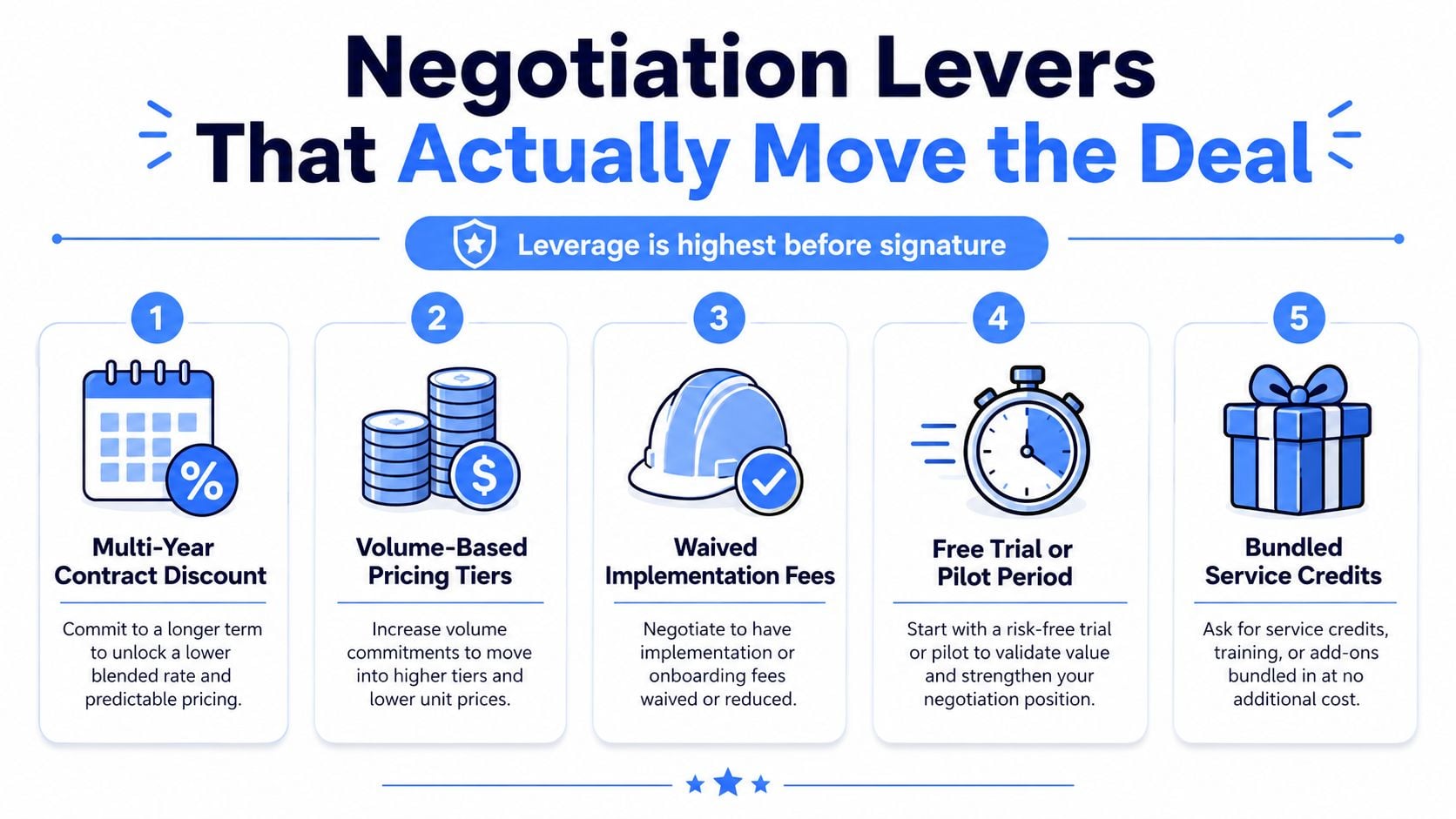
The best negotiating power exists before signature. After the implementation team starts converting data, the vendor knows the client has sunk time, and the room for concessions shrinks fast. Buyers who wait too long usually negotiate details, not economics.
The levers worth pushing
Multi-year rate locks are the first ask. A written cap beats an open-ended escalator every time, and a 3% to 5% annual cap is a much better starting point than leaving pricing to renewal discretion.
Implementation fee waivers or credits matter because they reduce the cash hit at launch. Vendors will often move if the buyer is willing to commit to a longer term or larger scope.
Service-level language should define response windows and remediation, not just promise “support.” If the contract names accountability, the vendor has to staff to it.
Exit-for-convenience language is worth real money because it gives the buyer a cleaner off-ramp. A 90-day termination window with transition support is far better than an auto-renewal that resets the clock.
Benefits carve-outs are often overlooked. Preserving the ability to self-fund, switch carriers, or separate benefits at renewal can prevent the entire payroll relationship from being held hostage by one benefit decision.
The PEO membership fee discussion helps buyers see how providers package pricing, which is important because packaging is where many negotiable items get hidden.
The buyer’s job is not to squeeze every dollar out of the vendor. It is to remove the clauses that turn a usable model into an inflexible one.
A 30-60-90 Day Path to a Confident Decision
The cleanest decisions follow a schedule. Days 0 to 30 should be about internal alignment, not vendor demos. Leadership needs a written evaluation criteria document, a current-state cost baseline, and a shortlist of four to six providers that fit the company’s footprint and risk profile.
Days 31 to 60 should turn that shortlist into a scored RFP. Reference checks need to focus on service quality, dispute handling, and how the provider behaves when payroll breaks. By the end of that window, the team should have two finalists and a side-by-side total cost model that includes implementation and exit terms, not just the recurring fee.
Days 61 to 90 are for negotiation, implementation scoping, and executive sign-off. That is when rate caps, transition support, service levels, and benefits flexibility need to be locked before the data conversion starts. After that point, opportunity begins slipping.
The central takeaway is simple. Choosing an employer payroll solution is a structural decision about risk allocation and operating model, not a procurement exercise about fees. The right model is the one the leadership team can explain and defend twelve months later, especially if a filing problem, carrier issue, or compliance question hits the desk.
PEO Metrics helps employers compare PEOs, ASOs, and payroll providers with the contract terms, cost structure, and service trade-offs laid out clearly. For teams that want a cleaner vendor shortlist and sharper negotiation position, visit PEO Metrics and use it to pressure-test the model before signing anything.
