
Employer healthcare costs are projected to rise 9.2% in 2025, and even after plan changes, the expected increase still lands at 7.3% (Aon’s 2025 benefits outlook). For HR leaders, CFOs, and owners, that gap is the core planning problem. It means the question is no longer whether benefits are expensive, it’s which parts of the package are driving the most pressure, and which contract terms still give a buyer advantage.
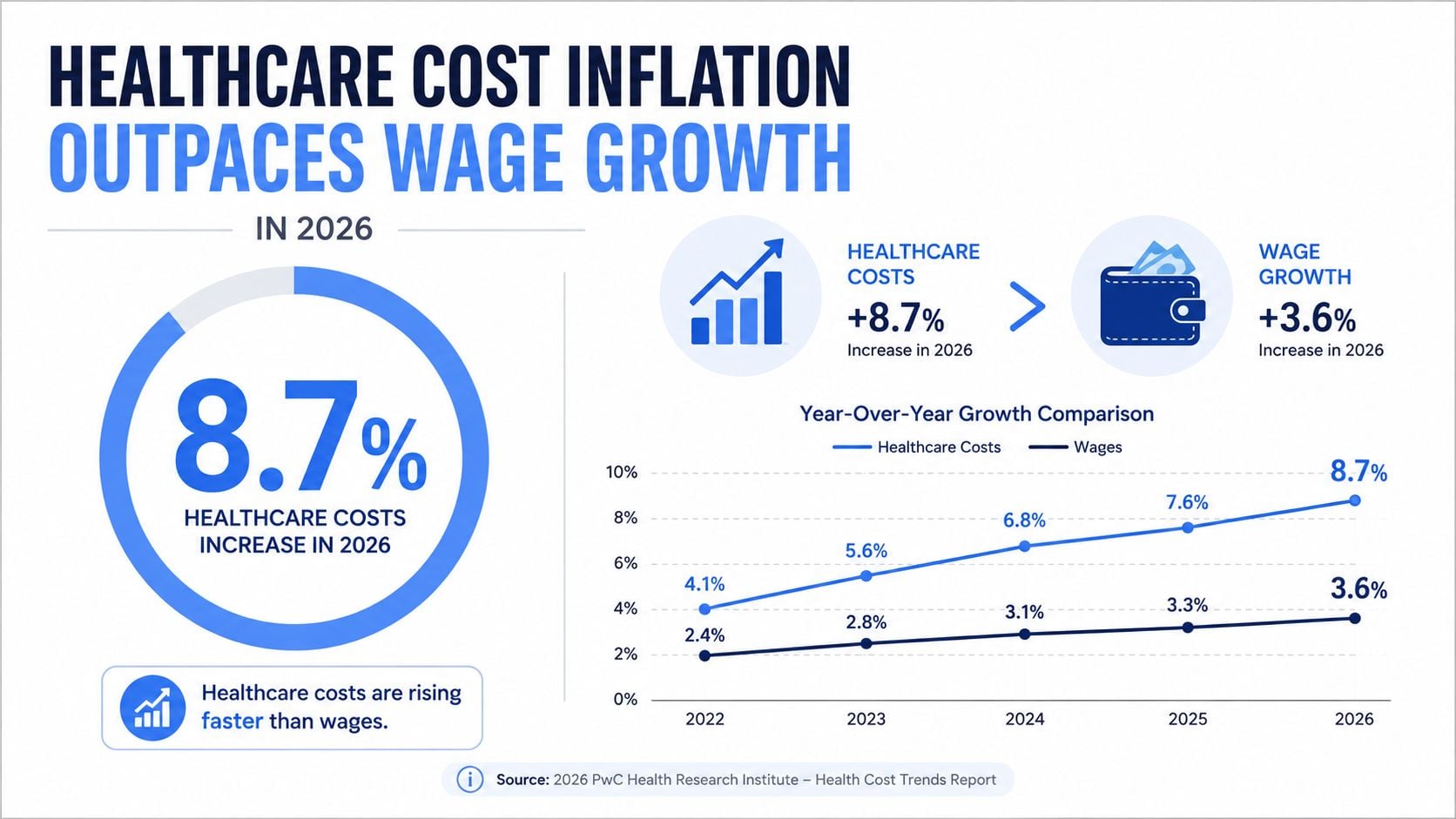
That’s why employee benefit trends in 2026 should be read as a procurement issue, not a perks list. Rising medical trend, pharmacy design, and HDHP migration are changing what PEOs cost, how much employer contributions need to rise, and which renewal concessions still matter. A buyer who only compares plan richness will miss the bigger question, whether the package is financially sustainable for the next renewal cycle.
For a practical benchmark on the benefit side of a renewal, it helps to look at how employers evaluate tirzepatide and similar high-cost therapies inside the broader pharmacy conversation. A useful starting point is this guide to tirzepatide price with insurance, because pharmacy pressure is rarely isolated, it sits inside a larger affordability problem.
Table of Contents
- Why 2026 Demands a New Approach to Benefit Cost Control
- How the Benefits Menu Itself Has Expanded
- The Quiet Migration Toward HDHPs and What It Means for Contribution Strategy
- The Utilization Gap Most Trend Pieces Ignore
- Pharmacy, Retirement, and Family Care Costs Driving the Greatest Pressure
- Translating the Trends Into PEO Negotiation Position
- A 200-Employee Renewal Scenario and Your Next Move
Why 2026 Demands a New Approach to Benefit Cost Control
The number finance teams should actually plan around
A lot of benefit planning starts with the gross trend number, then stops too early. Aon’s 9.2% projected healthcare cost increase for 2025 drops to 7.3% after plan changes, and that post-change figure is the one that belongs in a budget model (Aon). The gap shows how often employers are already relying on plan design, employee contributions, and utilization controls just to bring a still-high trend back into something they can carry in a renewal.
That matters because many PEO renewals are negotiated as if benefits were a fixed bundle. They are not. The package moves with carrier pricing, employee election patterns, pharmacy cost pressure, and the PEO’s willingness to restructure contributions without adding avoidable friction.
The central question is which parts of the package are driving the most pressure. If the budget assumes a flat renewal trend and the contract assumes the PEO can absorb inflation, the buyer is already behind. The better model starts with gross medical trend, then asks how much of that the employer is willing to offset through contribution strategy, deductible positioning, or narrower plan design.
Why 2026 is different from a normal renewal year
2026 is not just another year of inflation. The pressure now reaches into every line item attached to health coverage. The UBA 2024 Employee Benefits Trends Report found that nationwide health plan costs rose 6.4% in 2023, up from 5.7% the prior year, and average annual cost per employee reached $12,776 (UBA via Stephens). It also noted that nearly 73% more employers added prescription drug tiers as a cost-control strategy, and that small employers with 50 or fewer employees were hit hardest by medical inflation (UBA via Stephens).
That mix changes how renewals should be evaluated. Employers are no longer just buying coverage, they are buying a cost-management structure around coverage. That is a different procurement question, and it demands a different level of scrutiny.
Practical rule: A PEO renewal should be modeled like a capital decision, not an admin renewal. If the contract does not show how cost increases move through the plan, the buyer is missing the most important line.
A good internal benchmark for that planning work is a structured benefits cost review such as the one on employee benefits benchmarking. The point is not to chase a perfect number, it is to know what a sustainable employer contribution looks like before the renewal lands. The same discipline matters when pharmacy exposure is distorting the renewal, including high-cost therapies such as tirzepatide price with insurance.
How the Benefits Menu Itself Has Expanded
The old benefits package was simple to describe. Medical coverage, retirement, maybe a flexible spending account. That picture no longer fits the market. In the 2024 SHRM Employee Benefits Survey, health care-related benefits were rated extremely or very important by 88% of employers, while leave benefits and retirement savings or planning benefits each scored 81% (SHRM). Family care sat at 70%, and professional and career development at 65%.
Those rankings show how employers now define value. Benefits are no longer treated as one broad bucket. They are being divided into core categories, such as health, leave, and retirement, and into modular categories, such as family support and development, that can be adjusted for different employee groups.
Core stack versus modular layer
The sharper buyers now think in two layers. The core stack covers the benefits employees notice first and judge most strictly, medical, leave, and retirement. The modular layer covers the offerings that help one employer stand out from another, such as caregiving support, learning stipends, or broader family policies.
That distinction matters inside a PEO contract because bundled menus can blur the difference between real value and brochure value. A PEO may market a wide menu, but the buyer still has to ask which benefits see broad use, which are underwritten cleanly, and which ones add administrative work without changing retention.
A workforce segmentation issue sits underneath that. In a 2024 industry study cited in the brief, 69% of Gen Z respondents called paid leave a must-have, and nearly 75% said they would consider changing jobs for better family benefits. Benefit strategy now has to account for employee life stage, not just headcount.
For buyers comparing bundled programs, the next useful step is often to separate plan design from plan branding. The HSA and FSA mechanics behind the package deserve their own review, and a structured guide on HSA and FSA management through PEO can help frame that analysis without getting lost in marketing language.
Employers that treat every perk as equally important usually spend too much on the wrong parts of the package. The better move is to protect the core stack and make the rest configurable.
The Quiet Migration Toward HDHPs and What It Means for Contribution Strategy
Who is choosing what, and why that matters
Benefitfocus’ 2025 report shows a pattern many buyers see before they can document it. Across the 2023 to 2025 plan years, the average salary of employees electing an HDHP was 50% higher than the average salary of employees choosing a traditional plan (Benefitfocus). HDHP selection is therefore tied to compensation level, and that usually tracks with risk tolerance, cash flow, and how much out-of-pocket exposure an employee can absorb.
The same report found that 84% of employers offered both traditional and HDHP options in 2025, up from 81% in 2023, while supplemental benefit offerings rose from 41% to 44% over the same period (Benefitfocus). Put together, those changes point to more choice architecture, more self-selection, and more segmentation inside the workforce.
The budgeting mistake most teams make
Averages hide the operating reality. If higher-paid employees are the ones moving into HDHPs, the employer may see lower premium outlay, but only when the contribution design is built carefully around that migration. A weak HSA seed, a deductible that feels punitive, or poor rollout communication can erase the savings through dissatisfaction, higher support volume, or a spike in complaints at renewal.
Negotiation insight: A PEO that sells “choice” without showing election migration by salary band is only giving half the story.
Renewal modeling should track who chooses what, not just how much the premium changes. A 200-person company with a broad salary spread can land in a very different position than a 20-person startup, even if both are offered the same menu. The relevant question is whether the plan sorts employees in a way that lowers total employer spend without creating adverse selection or fairness concerns.
For practical comparison work, a detailed review such as how to compare health plans helps expose the trade-offs behind premium, deductible, and contribution structure. That analysis is more useful than asking only whether an HDHP is cheaper.
What to watch in the next renewal
Buyers should pressure-test three items. First, whether the employer contribution still matches salary bands. Second, whether the HSA seed is large enough to make the HDHP workable for employees being steered into it. Third, whether the plan communications explain the cost trade-off well enough to prevent confusion.
If those three pieces are weak, the employer may be buying a lower premium and a larger employee relations problem at the same time.
The number finance teams should plan around
Benefitfocus’ report gives finance teams a useful signal for renewal planning. The mix of HDHP enrollment and broader plan offering has shifted enough to make contribution strategy a contract issue, not just a payroll issue. That is where the greatest value sits, because the employer contribution, the HSA seed, and the eligibility design all affect who feels the plan is affordable and who moves away from it.
| Metric | HDHP | Traditional Plan |
|---|---|---|
| Average employee salary | 50% higher than traditional-plan electors (Benefitfocus) | Lower than HDHP electors |
| Employer offering rate in 2025 | Offered by 84% of employers (Benefitfocus) | Offered alongside HDHP by 84% of employers |
| Supplemental benefit offerings | Rose to 44% in 2025 (Benefitfocus) | Not the primary driver of this migration |
The Utilization Gap Most Trend Pieces Ignore
A benefit can look attractive on paper and still drain the budget. If employees do not use it, the employer still pays for the vendor setup, the admin work, and the complexity that comes with keeping it in the contract.
Start with usage, not wish lists
Selerix recommends starting with employee surveys, utilization reports, and peer benchmarks because the right priorities depend on the gap between what is offered, what is used, and what comparable employers provide. That sequence works for a renewal review as well. A buyer cannot press for better terms on a program that has never been measured.
The goal is to find dead weight. A company may be funding a benefits menu that looks strong in a brochure but misses the programs employees actually value, or it may be overspending on benefits that are technically available but rarely noticed in practice.
Why flexibility deserves a closer look
The 2025 SHRM data in the brief shows that flexibility-oriented benefits are at 68% and declined by 2 percentage points year over year. That matters because it shows a gap between what gets attention in presentations and what employers keep funding after the budget meeting. Some benefit ideas draw interest quickly, then lose ground when they compete with categories employees already understand and expect.
The budgeting mistake many HR and finance teams make is treating every offered benefit as if it deserves the same renewal priority. A cleaner audit sequence before renewal looks like this.
- Check enrollment by program: Identify what employees selected, not just what was offered.
- Review claims or utilization data: Look for offerings with low take-up and high admin cost.
- Compare against peer employers: Use market benchmarks to see whether a program is standard, niche, or oversized for the company’s size.
- Map benefits to retention risk: Focus on categories tied to talent loss, not just novelty.
- Remove or redesign the quiet losers: A low-use perk with high contract friction should be reworked before it is renewed.
That process helps finance teams separate benefits employees use from benefits that only look progressive in a brochure. It also gives HR a factual basis for saying no to additions that sound appealing but do not change behavior. For teams reviewing a broader package, a PEO retirement plan deserves the same scrutiny, because retirement features can carry real cost even when participation is uneven.
Medication support deserves the same treatment. Employees may value access, but if the program is hard to find or hard to use, the employer still carries the cost without getting much visible value. In that case, the better question is whether the plan helps employees apply for medication assistance before adding another benefit that looks helpful but stays underused.
A benefit portfolio gets stronger when weak programs are cut. The goal is to carry the right benefits, not the most benefits.
Pharmacy, Retirement, and Family Care Costs Driving the Greatest Pressure
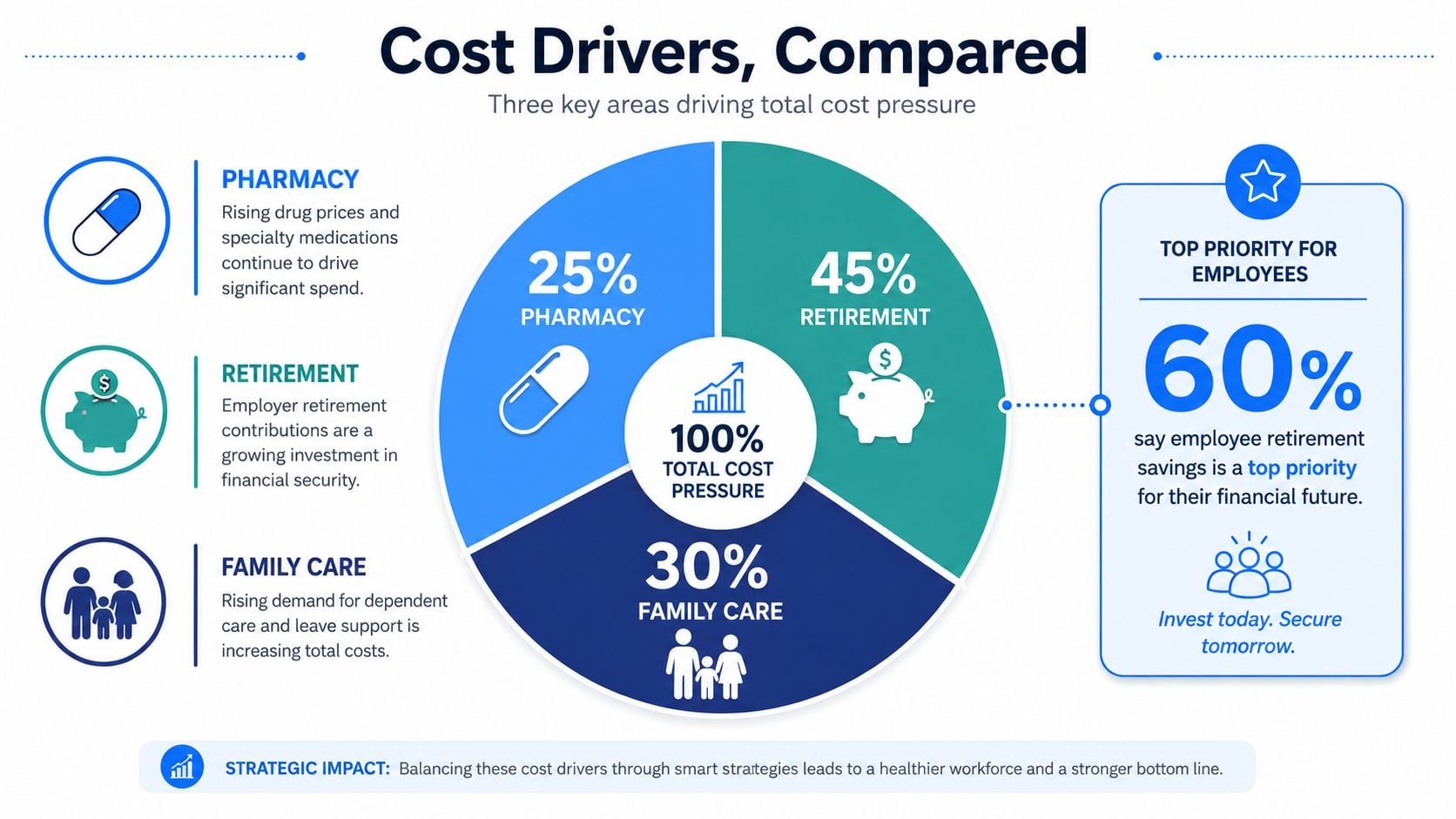
Cost pressure in employee benefits does not come from one line item. It comes from several expensive categories moving at once, and each one changes the renewal conversation in a different way.
Retirement is now a retention issue, not a background benefit
ADP reports that 60% of employees rank retirement savings among their top three benefits, and 401(k) ties for the second-most important benefit (ADP). That shifts the procurement lens. Retirement is no longer a quiet back-office feature, it is one of the first things employees compare when deciding whether an employer is serious about long-term value.
For a PEO buyer, that means reviewing plan administration, match design, and employee communication quality with the same attention given to medical funding. Retirement can distinguish one offer from another, but only if the employer can explain it clearly and keep the administration clean. A messy rollout can erase that value quickly.
A practical reference for that part of the package is PEO retirement plan, especially when comparing bundled versus standalone options.
Pharmacy pressure is rising where the contract is weakest
Marsh McLennan Agency notes that faster-growing pharmacy spending, especially specialty drugs and GLP-1s, is making benefits harder to sustain ([Marsh McLennan Agency, cited in the brief]). That is where many renewals break. The employer thinks the medical plan is the issue, but the pressure sits in pharmacy design, vendor terms, and utilization management.
Adding perks will not fix the math. The employer needs stronger formulary controls, better prior authorization design, or a more deliberate carve-out strategy if the PEO or carrier structure allows it. For families dealing with medication affordability, a resource such as apply for medication assistance can help employees understand the member-side relief options that sometimes complement plan design.
Family care is now part of the cost equation
Interest in childcare and eldercare benefits is rising, and that matters because caregiving support can be both a retention tool and a cost accelerator. It works as a retention tool when it reduces turnover in critical roles. It becomes a cost accelerator when it is added without clear utilization rules, vendor controls, or a realistic funding model.
KFF’s 2025 survey gives buyers a useful benchmark for what larger employers already absorb. Among large firms with more than 200 workers offering health benefits, 53% offer a health risk assessment, 43% offer biometric screening, and 83% offer at least one wellness program such as smoking cessation, weight-loss, or lifestyle coaching (KFF). That does not mean a mid-market company should copy the same stack, but it does show how common preventive and wellness infrastructure has become in larger pools.
The question is whether the PEO’s bundled wellness stack matches actual use. If not, the employer is paying for a broad menu and getting a narrow result.
Translating the Trends Into PEO Negotiation Position
The renewal conversation changes when benefit trends are translated into contract terms. A PEO buyer who walks in with a vague request to reduce costs usually gets broad promises and little else. A buyer who arrives with trend data, utilization data, and a specific ask is in a stronger position to press for terms that change the renewal math.
What to push for in 2026
The strongest asks are tied to cost mechanics, not wish lists. If healthcare inflation and pharmacy spend are doing the damage, the contract should show exactly how that pressure is shared, timed, or capped for the employer.
- Rate lock language: Ask for defined pricing windows or guardrails that limit surprise increases during the contract period.
- Implementation credits: Push for credits or fee offsets when the PEO is changing plan design, systems, or payroll integrations.
- Pharmacy carve-out options: If specialty drug pressure is extreme, ask whether parts of the pharmacy arrangement can be handled separately.
- Contribution strategy protections: Make sure employee contribution changes can’t be altered without notice and agreement.
- Transparent fee structures: Separate admin fees from benefit funding so the employer can see where the increase sits.
The UBA finding that small employers with 50 or fewer employees were hit hardest by medical inflation can still help frame the renewal discussion, as noted in UBA via Stephens. If a PEO uses small-employer pooling to justify higher admin charges, the buyer should ask exactly how that pool is shaping the proposed renewal.
How to frame the negotiation
The conversation should focus on which parts of the package are driving the increase and which terms can absorb some of that pressure. That keeps the discussion on plan mechanics and vendor responsibility instead of drifting into a general plea for relief.
Negotiation discipline: Buyers get more value when they separate the medical trend problem from the service fee problem. Those are related, but they are not the same ask.
The link between contract terms and cost containment gets stronger when a buyer can show utilization gaps or election drift. A practical internal comparison, such as PEO benefits negotiation strategy, can help a finance or HR team organize the asks before the renewal meeting starts.
What a serious counterproposal looks like
A serious counterproposal does not just ask for a discount. It asks for structure. If the renewal shifts more risk onto the employer through higher contributions or a more expensive prescription tiering model, the contract should give something back in the form of clearer pricing, better renewal protections, or service standards that match the added burden.
Family care belongs in that same discussion because it affects both retention and spend. If the PEO is promoting dependent-care support or caregiving benefits, the employer should confirm how those offerings are funded, who can use them, and whether the design lines up with the broader benefit strategy. For a quick check on coverage obligations and employer responsibility, the Family Caregiving Kit ACA guide is a useful reference point.
The goal is not to win every clause. The goal is to avoid paying premium pricing for a bundled program while taking all of the inflation risk alone.
A 200-Employee Renewal Scenario and Your Next Move
A 200-employee, multi-state company renewing through a PEO has a common problem. Medical costs are rising, the benefit menu looks crowded, and leadership wants to preserve retention without taking on an open-ended budget increase. In that situation, the buyer should start with three questions.
First, which benefits are used? Second, which plan elections are drifting toward higher-cost segments? Third, which contract terms can soften the impact of the next 12 months? That sequence matters more than chasing a new perk.
A practical renewal review would begin by separating the core stack from the modular layer, then testing whether the HDHP option is still priced and communicated correctly. From there, finance can compare the employer contribution plan against the projected cost pressure from healthcare and pharmacy, while HR checks whether retirement and family support still match what employees value most. If the wellness menu looks robust but utilization is weak, that’s a sign the employer is buying breadth, not value.
For a company of that size, the next move should be a formal renewal model, not an informal broker conversation. It should include current spend, expected employer contribution exposure, election migration by salary band, and the fee changes attached to any proposed PEO package. The employer should also ask for contract language that limits surprise increases and clarifies how plan design changes will be handled if cost pressure worsens.
The takeaway is simple. In 2026, the best benefit decisions won’t be the ones that add the most perks, they’ll be the ones that protect the core package, reduce waste, and preserve negotiating room at renewal.
PEO Metrics helps employers compare PEO options, benchmark benefit costs, and pressure-test contract terms before they renew. If a company is trying to understand where its benefit spend is leaking and what terms are still negotiable, visit PEO Metrics to review the available benchmarking and comparison resources.
