

A manager usually notices the problem long before anyone says the word “lazy.” The emails slow down, deadlines slip, the strongest people start covering the gap, and then one day a top performer asks why the coworker who barely contributes still has a seat at the table. That is the moment most companies lose trust, not because one employee underperformed, but because leadership let the rest of the team absorb it.
That is why how to deal with lazy employees is really a risk-management question. The right response is not a pep talk, and it is not public shaming. It is a disciplined sequence, diagnose the cause, set measurable expectations, document every miss, and escalate when the evidence says the person either won't or can't meet the role.
Table of Contents
- Why Inaction on Underperformance Costs More Than You Think
- Diagnosing the Root Cause Before You Talk to the Employee
- Setting Clear Expectations That Eliminate the Lazy Excuse
- Coaching First, Documenting Always, Escalating on a Threshold
- When Termination Is the Right Call and How to Do It Safely
- Protecting the Rest of the Team From the Slowdown Effect
- Frequently Asked Questions From Managers Handling Lazy Employees
Why Inaction on Underperformance Costs More Than You Think
A senior developer gives notice after watching a teammate spend half the day on social media and still keep the job. The exit interview is polite, but the message is blunt. High performers do not stay where effort feels optional and accountability feels random.
That is the risk managers underestimate. Engagement is already fragile, so tolerating visible underperformance sends the wrong signal fast. The team stops trusting the standard, and the manager starts losing people who had every reason to stay.
What the team sees
One unresolved underperformer changes the tone of the entire group. The reliable people notice who gets away with missed commitments, and they start asking whether the standards are real or just decorative. That is why workplace integrity matters, because inconsistent enforcement teaches the whole team what leadership will tolerate.
Burnout makes the situation worse. Turnozo reports that burnout is widespread, so a manager who reaches for the lazy label too quickly can miss the core problem. The issue may be overload, poor task design, or a supervisor who never created a measurable standard in the first place.
Practical rule: if a manager can't point to a written expectation and a missed checkpoint, the problem is not just the employee. It is the system.
Why inaction is expensive
Letting one weak contributor slide pushes work onto the rest of the team. The dependable people absorb the slack, resentment builds, and the manager pays twice, once in lost output and again in turnover. A stronger retention plan needs to treat low performance as a warning sign, not a personality quirk, and the same logic applies in guides on how to improve employee retention.
A leader who ignores the problem also teaches everyone else what the standard really is. If a person can miss deadlines, disappear from the work, and still face no consequence, then the rule is simple, effort is optional. That message spreads quickly, and it is expensive long before anyone starts talking about termination.
Diagnosing the Root Cause Before You Talk to the Employee
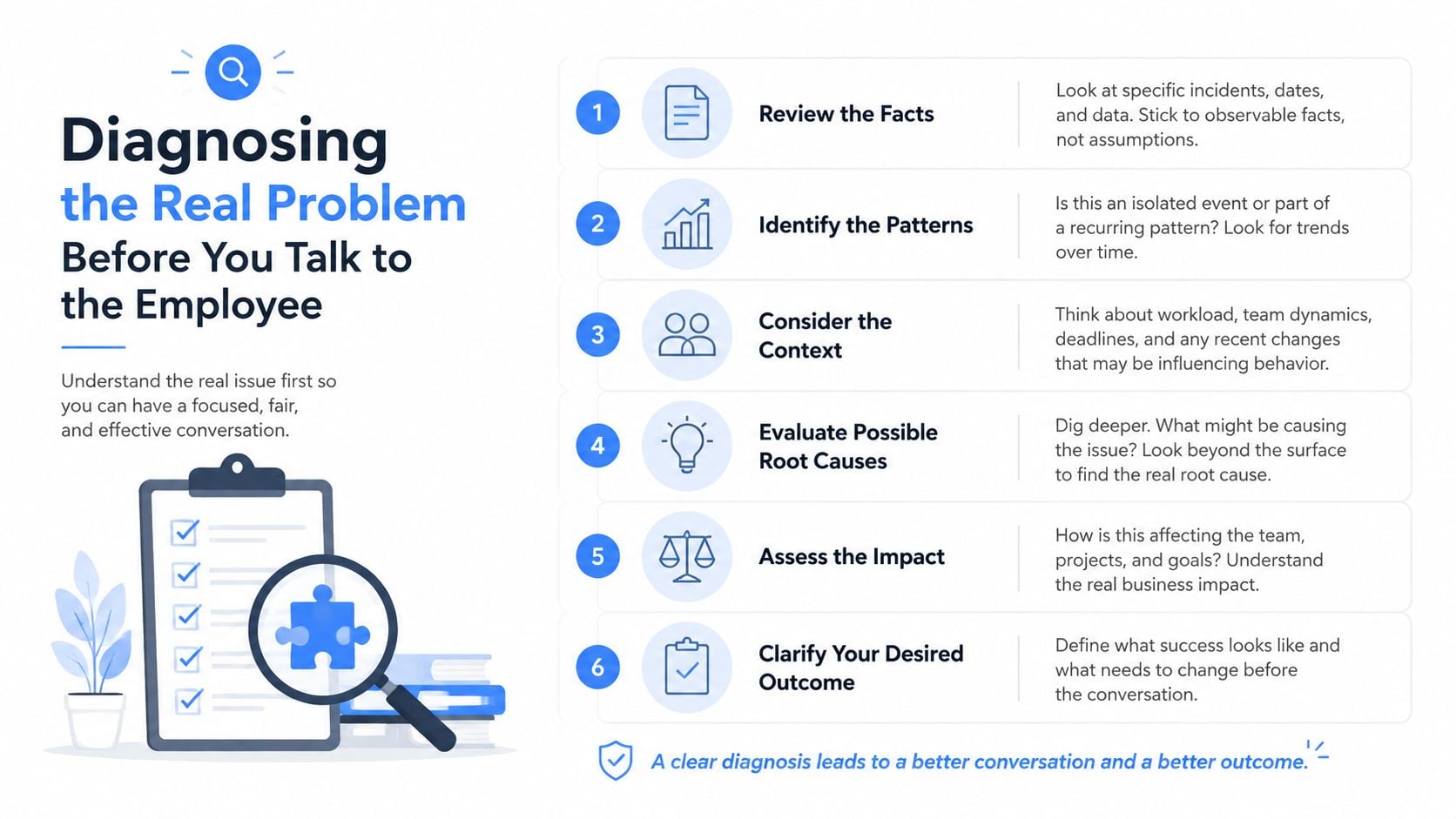
The first mistake managers make is walking into a coaching conversation already convinced the person is lazy. That shortcut wrecks judgment and creates bad documentation. Before any discussion, the manager has to test four possibilities, motivation, skill, workload, and role design. If the core issue is a broken process or a missing tool, discipline will fail and the manager will still end up with the same bad outcome.
Four buckets to check first
The cleanest way to separate attitude from system failure is to ask where the breakdown sits. One account manager who looked disengaged turned out to be buried under manual data entry because the team had stopped sharing the administrative load. Once that was fixed, the “lazy” label disappeared fast.
| Root Cause Diagnostic Map | ||
|---|---|---|
| Symptom You See | Probable Root Cause | First Check |
| Missed deadlines but good effort | Workload or role design | Review task volume and handoff points |
| Slow output and recurring errors | Skill gap or missing training | Confirm training, tools, and support |
| Avoids ownership or goes silent | Motivation or disengagement | Ask what success looks like and whether expectations were clear |
| Inconsistent delivery across tasks | Unclear standards or priorities | Check whether goals were written and agreed |
A manager should also verify whether the person ever knew what success looked like. That question matters because people cannot be disciplined fairly for failing a target they never received. If the expectation was never written down, the file is weak before the conversation even starts.
The safest diagnostic sequence
The practical sequence is simple. Diagnose the cause. Set short-term measurable goals. Document expectations in writing. Check in frequently. Escalate if there is no improvement.
That sequence is not theory. It is how managers protect the company from sloppy discipline and their own memory gaps. A useful reference on handling difficult employees and disruptive behaviors says the same thing in plainer terms, verify the standard, identify the gap, then move to formal action only after the employee has had a fair chance to correct course. John Spence makes the same point, if the manager cannot show what was expected and what was missed, the case is already on shaky ground.
Ask for evidence, not vibes. If the manager can't name the task, the deadline, and the missed result, the diagnosis is not done yet.
Setting Clear Expectations That Eliminate the Lazy Excuse
Most “lazy employee” cases are really expectation failures dressed up as attitude problems. Vague direction creates exactly the drift managers later complain about. If someone is told to “own the partnership pipeline,” that is not a standard. It is a slogan.
Use a template the employee can't misunderstand
The expectations need to be written in plain language, tied to observable work, and reviewed on a regular schedule. A manager can copy this structure and fill in the blanks:
Role expectation template
- Deliverables: List the specific output the employee owns.
- Quality standard: State what good looks like in measurable terms.
- Deadline: Name the date, time, or recurring schedule.
- Review cadence: Set the check-in rhythm, weekly or bi-weekly.
A strong expectation also includes what happens if the employee misses the mark. That is not cruelty. It is clarity.
The reason this matters is simple, teams that set expectations clearly are not relying on memory or interpretation when things go wrong. They are comparing output against an agreed target. The most common management guidance on this point is blunt, clear expectations, frequent feedback, and documented accountability beat subjective frustration every time (Gallup).
What a weekly check-in should cover
A weekly meeting should not turn into a morale chat. It should answer three questions, what was due, what shipped, and what blocked the work. If the manager does not hear a blocker, the conversation should move to documented action immediately.
A useful way to frame the meeting is:
Observed work this week
Expected work this week
Gap and next step
That structure makes the issue visible before it hardens into a discipline case. It also protects the manager from the most common defense, “No one told me that was the priority.”
For leaders building repeatable documentation standards, a related reference on what should be included in an employee handbook helps reinforce that expectations belong in writing, not in hallway conversations.

Coaching First, Documenting Always, Escalating on a Threshold
A private coaching conversation is the right first move, but only if the manager leaves a paper trail. Coaching without documentation is just memory, and memory loses lawsuits. The goal is to build a record that shows the issue, the standard, the response, and the next checkpoint.
The escalation ladder that actually works
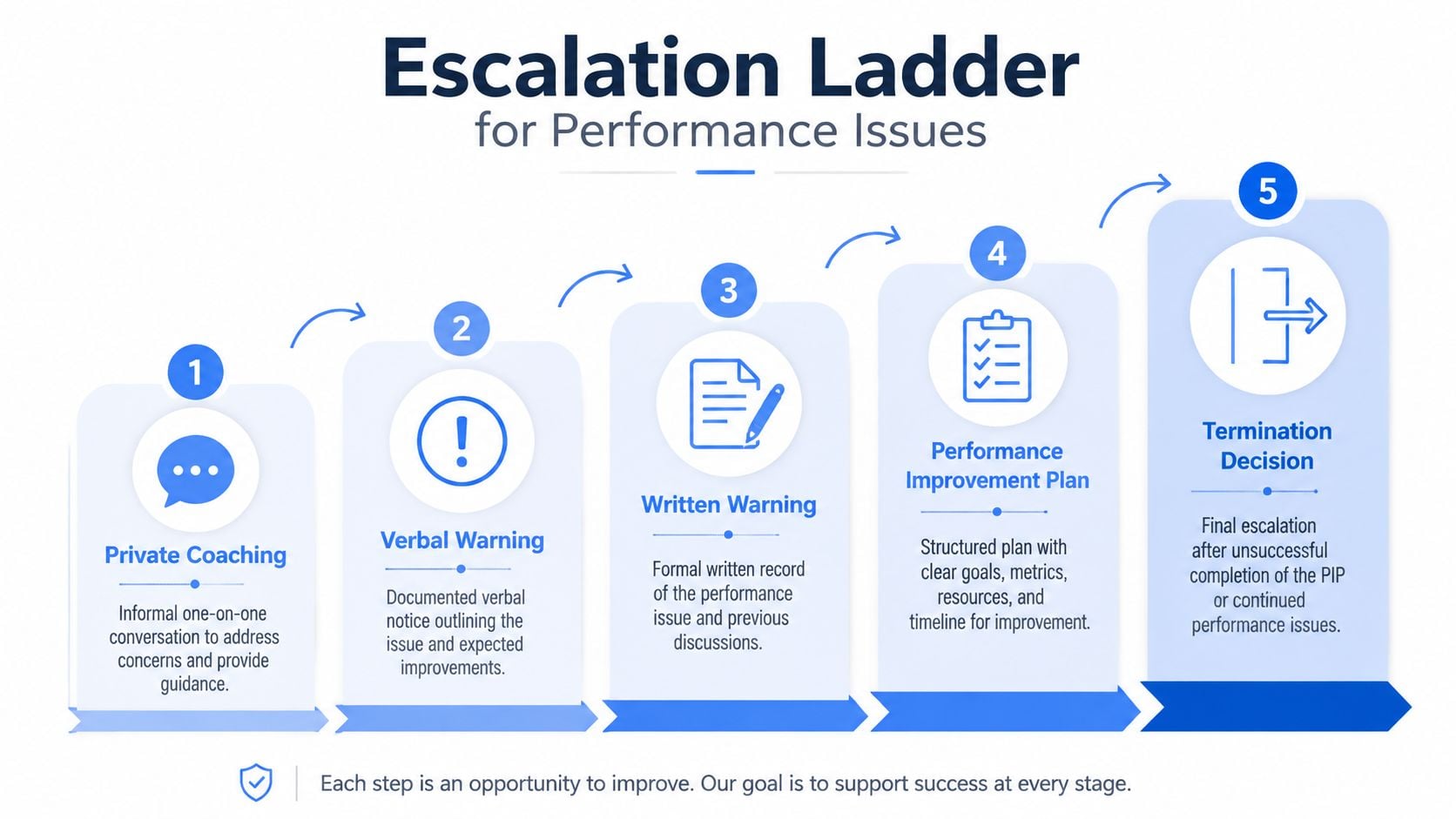
The clean progression is private coaching, verbal warning, written warning, then a formal performance improvement plan if the issue persists. Practitioner guidance also points to a three-warning threshold as the point where termination becomes a realistic decision if the employee still doesn't improve (Gavel International). That does not mean a manager waits passively. It means each step should be specific enough that nobody can later claim surprise.
A performance improvement plan is not the same thing as a coaching conversation. Coaching is informal and corrective. A PIP is structured, written, and tied to metrics and a timeline. It exists because the company has already given the person a fair chance to close the gap.
What every documentation note should include
Each note should capture the same four elements:
- Date and time: When the issue happened.
- Observed behavior: What was seen, not what was assumed.
- Agreed action: What the employee said they would do next.
- Follow-up date: When the manager will check the result.
That format is boring, which is exactly why it works. It removes emotion and keeps the record tied to evidence. It also matters because one source on documentation emphasizes writing down poor behavior and the reasons given for it, while another says the manager should gather proof that measurable performance was clearly described and then missed (Gavel International).
Why the threshold matters
A lot of managers wait too long because they hope the issue will fix itself. That almost never happens. The longer the delay, the weaker the record, and the harder it gets to defend a later termination if the employee improves only after the final warning.
A practical reference for building compliant documentation habits is PEO employment documentation standards. The bigger point is sharper, the company cannot fire a person for “attitude” if the file does not show measurable expectations, repeated misses, and a fair chance to improve.
When Termination Is the Right Call and How to Do It Safely
There comes a point where keeping the employee is more expensive than letting the person go. That point usually arrives after the company has diagnosed the cause, set expectations, documented the misses, and still seen no improvement. At that stage, termination is not harsh. It is responsible.
Stop using labels and start using facts
Words like “lazy” and “unmotivated” are dangerous because they are subjective. They invite bias, and bias is exactly what turns a performance issue into a legal headache. A manager should be able to show missed deadlines, quality failures, uncompleted assignments, and the dates of every warning. Anything less invites the argument that the process was really about personality, not performance.
A final-warning meeting should stay short and direct. The manager should state the standard, summarize the missed commitments, reference the prior warnings, and give the employee one final chance to respond. If the file already shows repeated misses and no meaningful improvement, the company should move forward rather than prolong the problem.
Handle the exit like a risk event
HR should control the process, not improvise it. The offboarding conversation, access removal, return of equipment, and final pay details all need to be coordinated in advance. That protects the company and keeps the manager from making emotional statements that can be replayed later.
A useful reference point for this stage is the employee termination process, because the legal risk comes less from the decision itself than from sloppy execution. The employee who has been warned properly can be let go cleanly. The one who was never told what was wrong becomes a much bigger problem.
A clean exit protects the company, but it also protects the team. People trust leaders who act on evidence instead of stalling until everyone is demoralized.
What to tell the team
The rest of the team does not need a dramatic explanation. They need reassurance that standards are real. A simple statement works best: performance expectations are the same for everyone, the matter was handled through the proper process, and the team should focus on the work ahead.
That message matters because silence creates rumors. Rumors do more damage than a straightforward, professional explanation. When the exit is handled well, it signals that the company values performance, fairness, and consistency.
Protecting the Rest of the Team From the Slowdown Effect
A weak performer does not stay isolated for long. The rest of the team starts covering gaps, the dependable people take on extra work, and managers slowly normalize a lower standard. By the time the strongest employees are irritated enough to say something, the signs are already there, missed deadlines, sloppy handoffs, and a team that no longer trusts leadership to protect their time.
The retention problem underneath
The person contributing the least often creates the most noise. Other employees notice when extra work keeps getting reassigned without any real consequence, and they read the message clearly, effort is optional here. Once that belief takes hold, underperformance stops being a single-person issue and turns into a retention problem.
That is the legal and management risk many leaders miss. A weak case left to linger tells your best people that leadership would rather avoid conflict than document performance, apply standards, and protect the team from unfair load-bearing. As noted earlier, engagement has already been weak enough that managers should not add avoidable drag on top of it. If a company lets one poor performer drain everyone else, it signals a tolerance for inconsistency that high performers rarely accept for long.
What to say to high performers
High performers do not need a morale lecture. They need a clear sign that leadership is taking the problem seriously and will not keep asking them to subsidize someone else's poor output. A manager should say, “The issue is being handled through the normal process, the standards stay in place, and the team's workload will be protected.”
Keep it short. Anything more invites gossip, defensiveness, or the sense that leadership is still improvising. The point is to show accountability, stop rumor fuel, and reassure strong employees that standards still mean something.
The sequence that protects the group
Use the same sequence every time, diagnose, coach, document, escalate. Skip one step and the whole team absorbs the cost. Stay disciplined and you reduce two major risks at once, a lawsuit built on sloppy records and a culture where the best people decide they are better off elsewhere.
That is why underperformance cannot be treated as a personality issue or a patience test. It is a documentation and risk-management problem, and the team pays for every delay.
Frequently Asked Questions From Managers Handling Lazy Employees
How much documentation is enough before a PIP
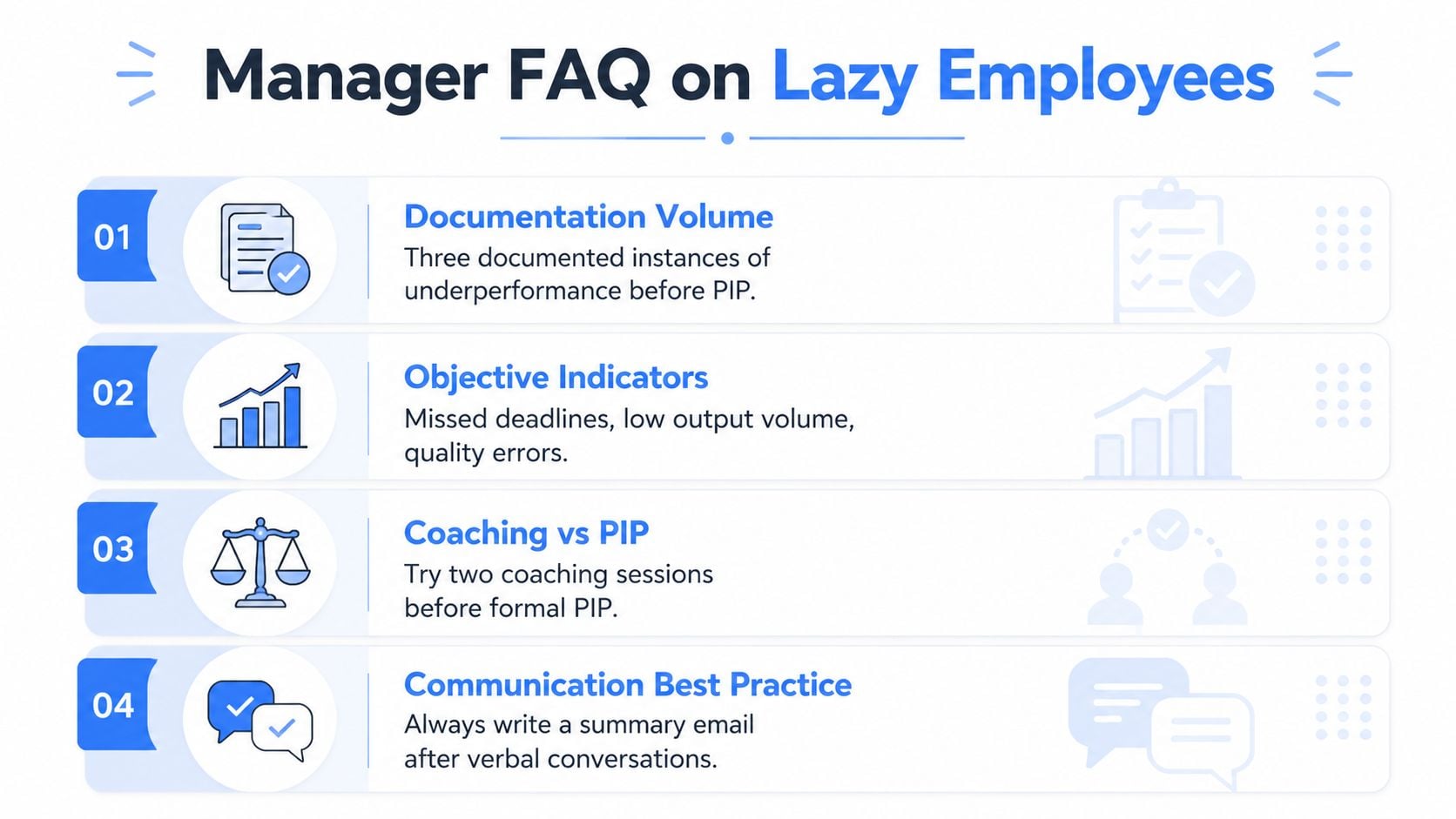
Three documented instances of underperformance is the practical floor most managers should aim for before formalizing a PIP, especially when each instance includes the date, the observed behavior, the expectation, and the follow-up. Anything less can look like a rushed reaction instead of a fair process. The file should show that the employee had notice and a real chance to correct course.
What objective indicators should replace the word lazy
Use missed deadlines, low output volume, quality errors, unanswered requests, and incomplete assignments. Those are measurable. “Lazy” is not. If a manager can't point to what was due, when it was due, and what was delivered instead, the evidence is too soft for discipline.
When is it really a workload or role-design problem
It's a workload or role-design problem when the employee is making effort but the system is still failing. That includes unclear priorities, unbalanced task assignment, missing training, or manual work that no one planned for. If a person looks disengaged but is buried, coaching the attitude will not fix the structure.
When should HR or external support get involved
HR should be involved before the first formal warning, not after the manager has already made the situation messy. That is the point at which documentation, consistency, and bias review matter most. If a company uses a PEO or outside HR support, this is the time to pull them in, before the next conversation, not after it.
PEO Metrics helps companies compare, select, and negotiate the right PEO, and that matters when performance problems start turning into documentation and compliance risks. If your team needs a cleaner HR process, stronger recordkeeping, or help evaluating outside support, visit PEO Metrics and get a clearer path before the next underperformance case lands on your desk.
