
A difficult employee rarely looks like a cartoon villain. More often, it’s the high performer who cuts people off in meetings, the account lead who sends sharp Slack messages at 8:47 p.m., or the manager who keeps hoping the tone will magically improve after the next one-on-one. In a small or mid-sized company, that delay is expensive, because the rest of the team starts compensating, credibility erodes, and the problem spreads beyond one person.
The hard truth is that managing difficult employees and disruptive behaviors is usually a management-process problem first and an individual-behavior problem second. If the behavior is ignored, the cost shows up in lost time, strained relationships, and avoidable turnover. If the response is sloppy, the company also inherits compliance and legal risk that didn’t need to exist.
Table of Contents
- The Real Cost of Waiting Too Long
- Diagnosing the Actual Problem Before You Act
- A Proven Conversation Framework for Disruptive Behaviors
- Documentation That Holds Up Under Scrutiny
- From Verbal Warning to PIP to Termination
- When the Problem Is the Manager or the System
- Preventing the Next Difficult Employee Conversation
The Real Cost of Waiting Too Long
A familiar version of this problem starts with a strong account manager who is technically excellent and socially corrosive. He rolls his eyes in meetings, makes sarcastic comments about colleagues’ ideas, and gets away with it because he brings in revenue. The manager notices the shift, says nothing for six months, and tells himself that the team is “professional enough” to handle it.
That silence has a price. The CIPD found that 35% of employees had experienced interpersonal conflict in the previous year, and employees were almost twice as likely to report bullying as harassment over the past three years, 15% vs. 8%. UK workplace-conflict estimates cited by industry sources put the annual cost at £28.5 billion, or more than £1,000 per employee (CIPD conflict report). This is the core issue. Unmanaged behavior isn’t a personality annoyance, it’s operating expense.
What delay does inside the team
By month three or four, the rest of the nine-person team has adapted in the worst possible way. People stop challenging the difficult employee in meetings, reduce collaboration, and spend more time working around the problem than solving it. The manager also loses authority, because the team can see that standards are negotiable when the wrong person is involved.
The practical damage is usually indirect before it becomes visible. A top contributor becomes exhausted by being the only one who objects. A newer employee decides this isn’t the culture they were promised. A client-facing team starts taking heat for friction that started internally.
| Cost Driver | Realistic Range | Typical Timeline |
|---|---|---|
| Manager attention diverted from normal work | Repeated weekly interruptions | Immediate to ongoing |
| Team trust and morale erosion | Hard to rebuild once visible | Weeks to months |
| Informal workarounds and conflict avoidance | Extra coordination across the team | Weeks to months |
| Risk of turnover among strong performers | One resignation can trigger more | Months |
| Escalation into formal HR review | Depends on pattern and severity | When behavior persists |
The link many leaders miss is simple. The longer the company waits, the more the issue shifts from one person’s conduct to a wider failure of leadership. For a deeper look at what that escalation can eventually require, the termination process for employees becomes relevant long before anyone wants it to be.
Practical rule: if a manager has heard the same complaint twice from different people, the problem has already moved past a private annoyance and into team-level risk.
Diagnosing the Actual Problem Before You Act
A manager hears the complaint, sees the behavior, and wants to act fast. That is where good intentions go wrong. The first move is diagnosis, because a warning issued before you understand the cause can turn a fixable performance issue into a trust problem.
Use a four-part behavioral diagnosis
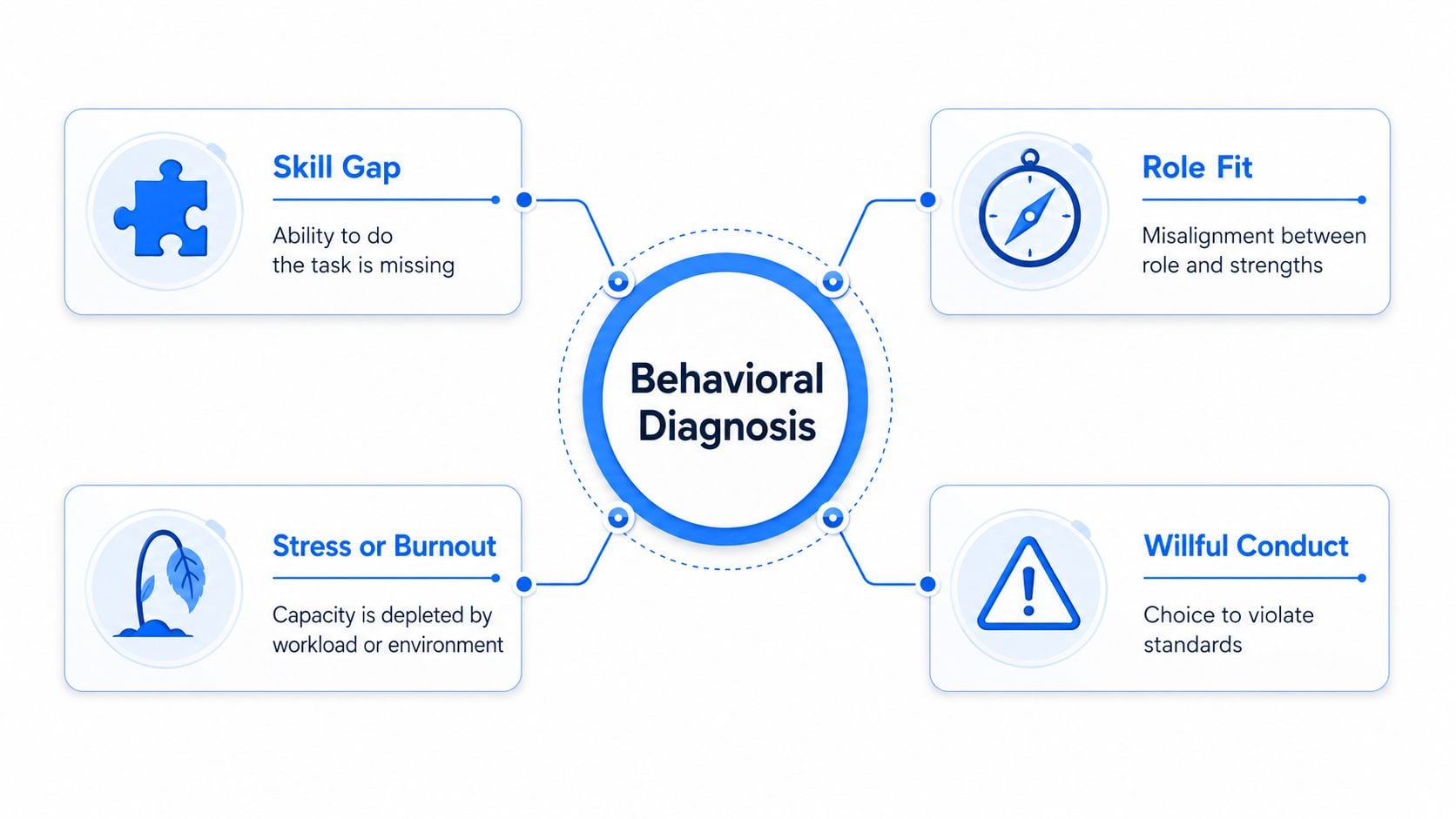
Start with four questions. Is the person missing a skill, in the wrong role, under too much strain, or choosing to ignore the standard? Those are different management problems, and they call for different responses. The root-cause diagnostic matters because managing difficult employees and disruptive behaviors gets easier when the manager knows whether to coach, redesign, support, or discipline. That decision tree also keeps the issue from becoming a personality argument before the facts are clear.
- Skill gap. The employee wants to do the work, but cannot do it cleanly yet. A new team lead who interrupts because he does not know how to facilitate is a training problem, not a discipline problem.
- Role fit. The person may be capable, but the job does not match their strengths. A detail-oriented analyst pushed into constant external client interaction may become short, defensive, or withdrawn.
- Stress or burnout. Capacity is depleted. A once-reliable employee who starts snapping after a reorganization may be reacting to workload, ambiguity, or emotional fatigue rather than attitude.
- Willful conduct. The employee can do the work, understands the expectation, and keeps choosing not to meet it. Repeated sarcasm, open undermining, or refusal to follow instructions usually belongs here.
The first conversation should be fact-finding, not punitive. Harvard’s negotiation guidance on listening to learn points to a simple truth, leaders need to ask what success looks like before deciding they already know the answer (Harvard Program on Negotiation). That same discipline helps managers avoid turning every disruption into an attitude case.
If the employee can do the work but will not, the path is discipline. If the employee wants to do the work but cannot, the path is support, redesign, or retraining.
For managers who need a sharper link between behavior and motivation, the motivation in the workforce category is useful as a companion lens. Poor motivation can look like insubordination until the underlying issue is capacity, fit, or clarity. If you need a practical reference for handling the conversation itself, use intone your authority at work as a reminder to keep your tone steady without sounding theatrical.
A Proven Conversation Framework for Disruptive Behaviors
Private conversations break down when they drift into vague feedback, emotional venting, or moralizing. The PIRA method, Problem, Impact, Request, Agreement, gives the manager a sequence that is direct without becoming theatrical. It keeps the conversation short enough to stay focused and long enough to produce a clear next step.

Open with the behavior, not the character
A strong opening sounds like this, “In the last two project meetings, you interrupted colleagues while they were speaking, and that changed the tone of the discussion.” It is specific, observable, and hard to dispute. It also avoids labels like “toxic,” which usually turn the meeting into a debate about personality instead of conduct.
The impact statement should be just as concrete. “When that happens, the team stops contributing, and the meeting becomes harder to run.” That shifts the issue from personal preference to business effect, which is where it belongs.
Ask for one specific change
The request needs to be narrow. “For the next two weeks, let others finish before responding, and raise your point after the speaker is done.” Broad requests such as “be more respectful” sound reasonable and often change nothing.
A useful structure is:
- Problem: name the behavior.
- Impact: name the operational consequence.
- Request: state the exact change.
- Agreement: ask the employee to confirm the next step.
A manager can close with, “Here’s the expectation going forward. I’ll follow up on Friday, and we’ll review whether the behavior has changed.” That ending matters because it turns a conversation into an accountable checkpoint.
The conversation should usually stay in the 20 to 30 minute range. Longer meetings often become emotionally diffuse, especially if the employee is defensive or tearful. Calm matters more than speed. If the employee reacts strongly, the manager does not need to solve every emotion in the room, only to stay factual and keep the standard intact.
For managers who want a separate resource on handling the tension between authority and candor, intone your authority at work is a useful read on tone and presence. The main point remains the same, authority is shown through precision, not volume.
The conflict and confrontation category can also help when the conversation is about behavior patterns that keep repeating across multiple meetings or channels.
Documentation That Holds Up Under Scrutiny
Documentation is not bureaucracy. It is the difference between a manageable case and a messy reconstruction months later. When a manager writes down exactly what happened, HR and counsel can review the facts without guessing at motive, tone, or memory gaps.
Write the event, not the interpretation
A defensible note names the behavior, the date, the time, the setting, and the witnesses. The City of Mesquite’s guidance is practical here, because it tells managers to capture specific behaviors, when they were observed, and who was present (City of Mesquite guidance). CoachHub adds that the record should include meetings, emails, and phone calls, tied to a behavior or training plan (CoachHub guidance). Together, those pieces create a trail that can survive scrutiny.
A strong entry looks like this, “March 12, 10:15 a.m., during the client call with Dana Lopez and Mark Chen present, the employee interrupted three times and dismissed a teammate’s update before the call ended.” The follow-up note then records the private conversation, the expectation, and the next review date. That is very different from writing, “Employee was rude and unprofessional.”
Use a running log, not scattered reminders
One email thread, one meeting note, and one behavior log work better together than a pile of separate complaints. The goal is continuity. HR should be able to see how the concern started, what was said, what changed, and where the next decision point sits.
Three sample entries show the difference:
- Vague: “Bad attitude in team meeting.”
- Better: “Interrupted two colleagues during the April 4 planning meeting, then rolled eyes when asked to wait.”
- Defensible: “April 4, 2:00 p.m., planning meeting. Employee interrupted two colleagues, rolled eyes after being asked to wait, and continued speaking over the facilitator. Conversation held at 3:00 p.m. same day, expectation restated, follow-up scheduled for April 11.”
The goal isn’t literary quality. It’s evidence. A manager who documents this way creates the kind of record that supports fair enforcement later.
The internal handbook standards also matter, which is why the employee handbook category belongs in the same workflow.
From Verbal Warning to PIP to Termination
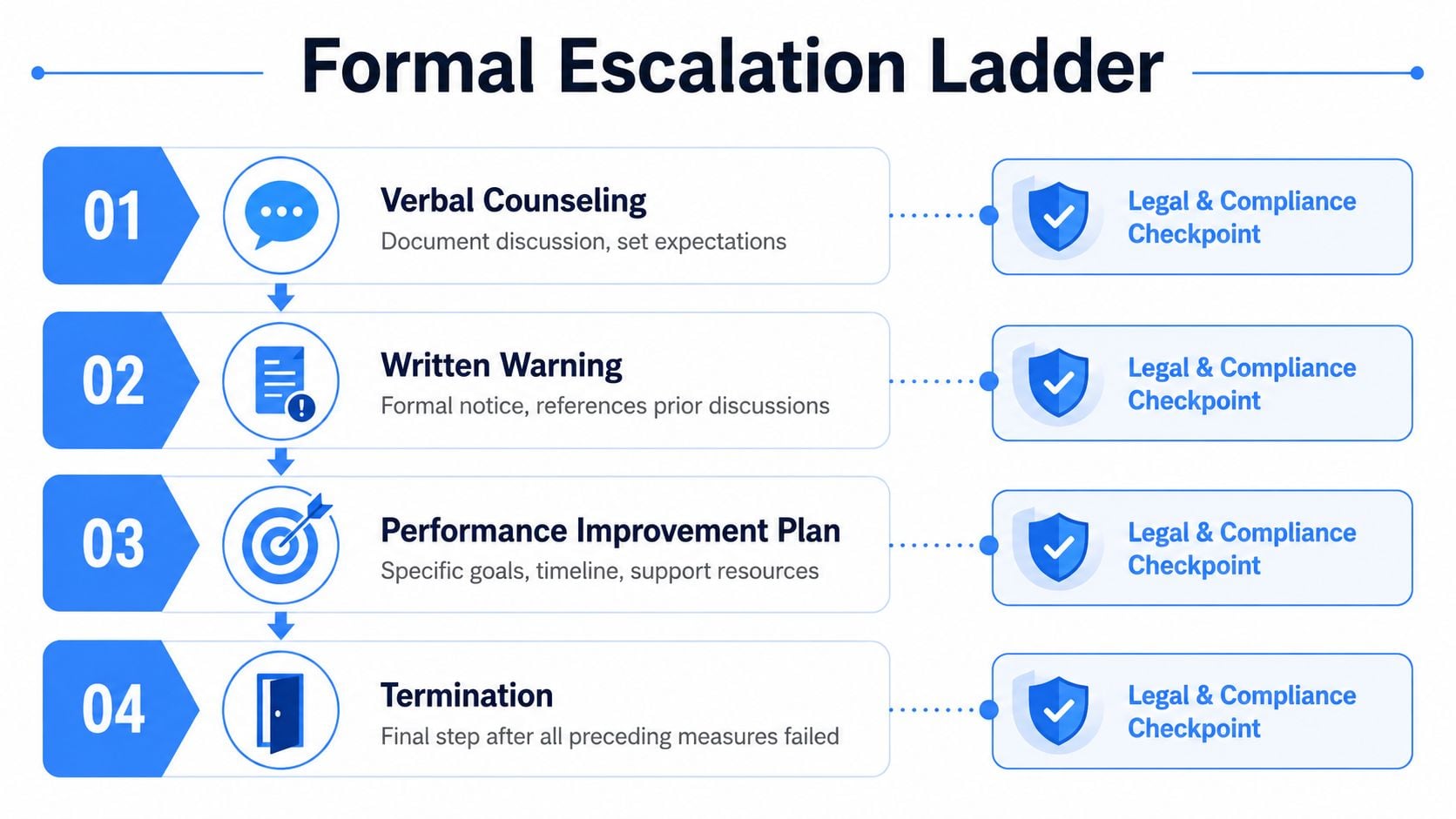
Once the behavior is confirmed and documented, the escalation ladder should stay consistent from case to case. That consistency is what makes the process feel fair instead of improvised, and it gives HR a cleaner record if the matter ends in termination.
The formal steps and what each one needs
The ladder usually starts with verbal counseling. The manager documents the discussion, restates the expectation in plain language, and says what happens if nothing changes. After that comes a written warning, which captures the earlier conversation and puts the standard on record more formally.
A Performance Improvement Plan should be specific enough to measure. In practice, the stronger PIPs include:
- Measurable KPIs. Clear behavioral or performance targets.
- Weekly or bi-weekly check-ins. Short reviews of progress.
- Support resources. Coaching, training, or tools before termination is considered.
- Explicit consequences. What happens if the plan is missed.
A PIP without dates, metrics, and consequences is just a polite memo. A PIP with those elements becomes a process you can enforce without guessing later. Many employers use 30, 60, or 90 days depending on the issue, the role, and how quickly improvement can realistically be observed. If the employee misses the plan, the final warning or termination step should match what was already stated.
Compliance checkpoint: if the behavior might overlap with disability, protected status, retaliation, harassment, or safety, HR should review the path before the next step is issued.
That checkpoint matters even more in global or multi-state settings. For organizations with more complex employment rules, the guide on ending employment in Israel is a useful reminder that termination rules can vary widely by jurisdiction. The law may change from place to place, but the management discipline stays the same. Document first, escalate carefully, and do not skip the record.
A PEO can help here as a resource, not as a handoff. In a company evaluating provider support, PEO Metrics can assist with the employment-process side of the review, and other HR partners can support investigation documentation, multi-state compliance checks, or termination paperwork when a case crosses into formal action.
When the Problem Is the Manager or the System
Not every difficult employee is the problem. Some are reacting to a role that changed underneath them, a manager whose feedback style creates resistance, or a workflow that makes success nearly impossible. Treating every case as a bad-actor case leads to expensive misdiagnosis.
Look for system-shaped red flags
A high performer becomes disengaged after a reorganization. That can be a role-design issue, not an attitude change. A team lead becomes sharp and defensive because no one has clarified what success looks like. That’s a management failure. A manager gives feedback in a public, sarcastic, or overly vague style, and the employee pushes back. That’s not just employee misconduct, it may be a leadership problem feeding the conflict.
The practical fact-finding questions are simple. What support do they need? What does success in this role look like? What changed right before the behavior started? Those questions aren’t soft. They’re diagnostic.
Reassign, redesign, or repair before exiting
Sometimes the right move is a reassignment or role redesign, especially when the behavior started after a structural change. Sometimes the manager needs coaching more than the employee does. And sometimes the system is so broken that discipline only treats the symptom. If success metrics are unclear, workloads are lopsided, or the feedback culture is inconsistent, the company should fix that before assuming the employee is the sole source of dysfunction.
A useful internal filter is this, if several people in the same role are struggling in similar ways, the role may be broken. If only one person is struggling, the issue may be fit, skill, or conduct. That distinction saves time, money, and a lot of unnecessary discipline.
The anti-bullying policies in the workplace category is relevant when the behavior tips from friction into repeated undermining or hostility. The point is not to shield people from accountability. It’s to make sure the company is solving the right problem.
Preventing the Next Difficult Employee Conversation
The fastest way to reduce these cases is to shorten the time between the first signal and the manager’s response. Prevention is mostly discipline around management habits, not one dramatic policy change.
A quarterly checklist that actually helps
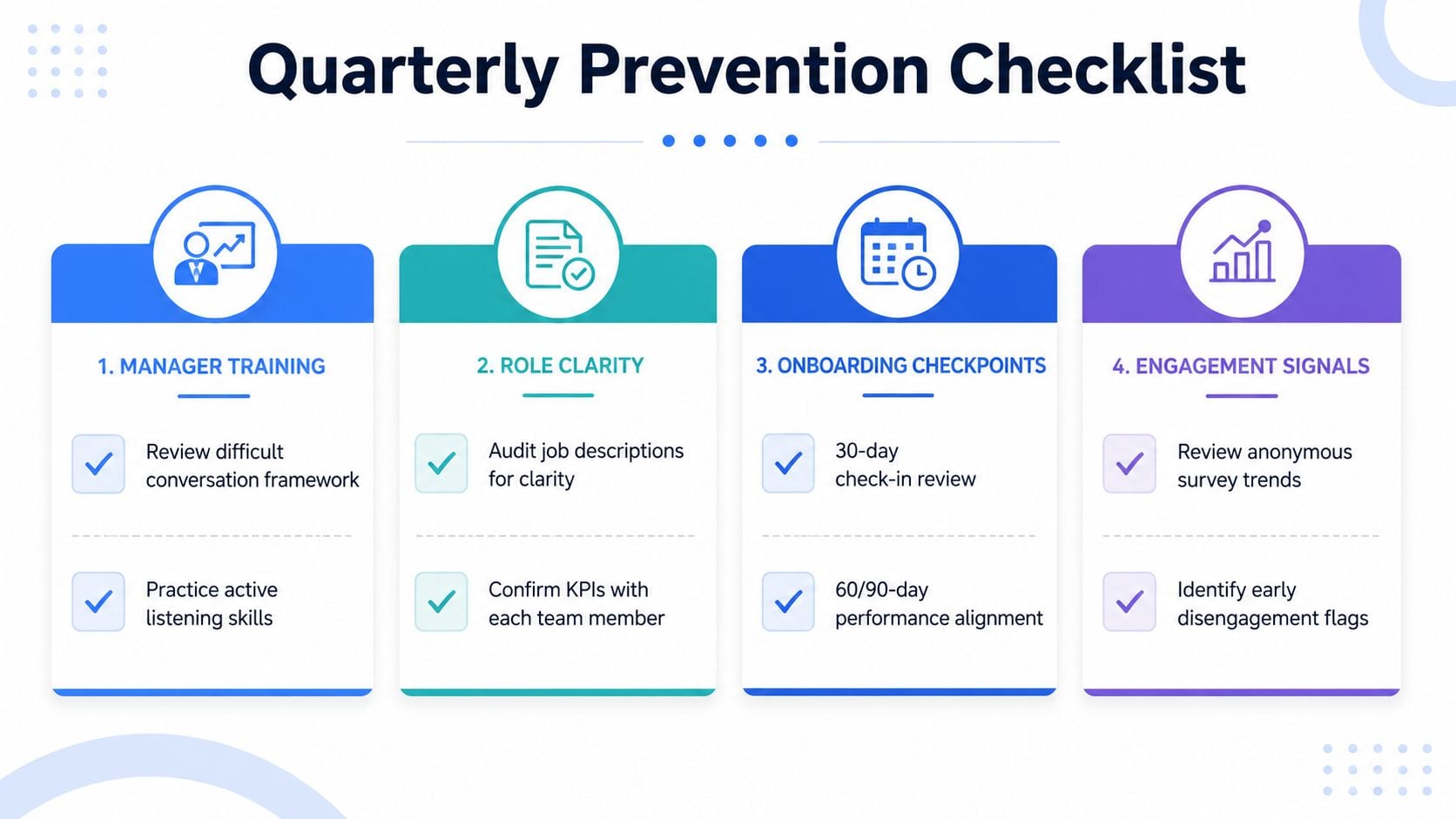
- Manager training. Review the difficult-conversation framework and practice active listening skills. For teams that need counseling support, browse virtual counselling options so the manager knows what support is available before stress becomes behavior.
- Role clarity. Audit job descriptions for clarity and confirm KPIs with each team member. Ambiguity is where a lot of conflict starts.
- Onboarding checkpoints. Use 30-day check-ins, then 60/90-day performance alignment so early behavior issues don’t sit unresolved.
- Engagement signals. Review anonymous survey trends and identify early disengagement flags before the issue becomes a confrontation.
A PEO can reduce the operational load for a 10 to 2,000 employee company by helping standardize handbook language, compliance review, and manager support processes. It doesn’t replace judgment, but it can make the response more consistent, which is often what a stretched leadership team needs most.
The practical takeaway is straightforward. Don’t wait until the team is already avoiding someone, then scramble for a process. Build the process now, train managers to use it, and make sure escalation happens while the issue is still manageable.
PEO Metrics helps companies compare and evaluate PEO support with an eye on compliance, HR process, and contract fit, which matters when employee issues start touching policy, documentation, and escalation. If your team is weighing how to tighten HR operations and make difficult-conversation workflows more consistent, visit PEO Metrics to see how independent PEO guidance can support that decision.
