
A manager snaps in a team meeting. Someone gets excluded from a project channel. A complaint lands in HR, then gets parked because the supervisor says it is “just personality conflict.” That is how a small workplace issue turns into a retention problem, a documentation problem, and eventually a legal problem.
Anti bullying policies in the workplace should be treated like an operating control, not a culture poster. If the policy cannot tell managers what counts as bullying, where to report it, who owns the response, and how fast action has to happen, it is decoration. The companies that get this right do not rely on goodwill. They build a process that employees can use and leaders can audit.
Table of Contents
- What an Anti-Bullying Policy Actually Costs You When It Is Missing
- The Legal and Compliance Context You Are Operating In
- Defining Bullying So Managers Can Actually Apply It
- The Seven Components a Real Anti-Bullying Policy Must Include
- Reporting, Investigation, and Response Timelines That Work
- How PEOs and Third-Party Advisors Fit Into the Program
- Measuring Whether the Policy Is Working and Triggering Updates
What an Anti-Bullying Policy Actually Costs You When It Is Missing
The bill rarely starts with a headline-grabbing lawsuit. It starts with a resignation, a bad manager review, or a claim that no one documented properly. A mid-market employer can lose far more in turnover and internal disruption than it ever planned to spend on prevention, especially when a high performer leaves because the complaint process felt pointless.
A vague policy makes the cost worse. If HR cannot show a clear reporting path, prompt response, and contemporaneous notes, the employer often loses the one thing that keeps ordinary conflict from becoming a defensible management action, the record. That is why the absence of structure is not just an HR miss. It is a financial control failure.
Practical rule: if a policy does not create a paper trail, it does not protect the balance sheet.
A sensible owner or CFO should think about three exposure buckets. First, a single complaint can drag in management time, outside counsel, and insurance reporting. Second, a respected employee can walk, and the replacement cost is usually far higher than the cost of writing and enforcing the policy. Third, weak documentation can turn a legitimate discipline case into a retaliation narrative because the employer cannot prove what happened or when.
The business case is straightforward. A written policy, trained managers, and a documented response process cost far less than the damage caused by a stalled complaint and a messy exit. For companies comparing providers or tightening governance after a rough year, this is the kind of control that belongs in the same conversation as employment litigation cost projection.
The Legal and Compliance Context You Are Operating In
Employers do not get a free pass because they call the conduct “bullying.” The compliance floor comes from harassment standards, workplace safety duties, and complaint handling expectations. Under EEOC guidance, conduct becomes unlawful when it is severe or pervasive enough that a reasonable person would view the environment as intimidating, hostile, or abusive. Managers need that line before they start improvising. For a broader compliance frame, see EEOC compliance support under PEO.
Most employers do not need a lecture about statutes. They need one policy that works across jurisdictions, because a multi-state company cannot run a different standard in every office. The right move is to set a company-wide rule that sits above the weakest local minimum, then narrow it only where a local rule requires a different approach.
What that means in practice
Bullying complaints often sit inside more than one legal bucket. They can overlap with harassment claims when protected traits are involved, with safety duties when the conduct creates risk, and with retaliation claims when the reporter gets punished for speaking up. These disputes also show up in retention fights and separation disputes, because the complaint record becomes evidence in the next conflict.
Smart employers do not wait for a statute that names bullying outright. They build a policy that defines the behavior, creates a reporting route, and forces investigation discipline. That gives HR a way to act before the matter hardens into a formal legal claim.
A policy that only says “be respectful” is not a compliance program. It is a slogan.
For companies with 10 to 2,000 employees, the key question is not whether to match the strictest state rule line by line. It is whether the policy travels cleanly across states, supports manager action, and survives scrutiny if the same issue later becomes a harassment or retaliation matter. That is the standard to design toward.
Defining Bullying So Managers Can Actually Apply It
Most policies fail right at the definition. Phrases like “unwelcome conduct” and “offensive behavior” sound inclusive, but they collapse in an investigation because they are too subjective to apply consistently. One manager hears “bad attitude,” another hears “protected complaint,” and the investigator gets stuck sorting feelings instead of facts.
The better definition is more operational. EU-OSHA describes bullying as repeated, unreasonable behavior directed at an employee or group that creates a risk to health and safety. That formulation works because it gives managers three things to test, frequency, unreasonableness, and impact. It also keeps one-off friction separate from a real pattern of harm. OSHA’s workplace bullying factsheet frames bullying as a workplace health-and-safety issue, which is exactly how good policy writers should treat it.
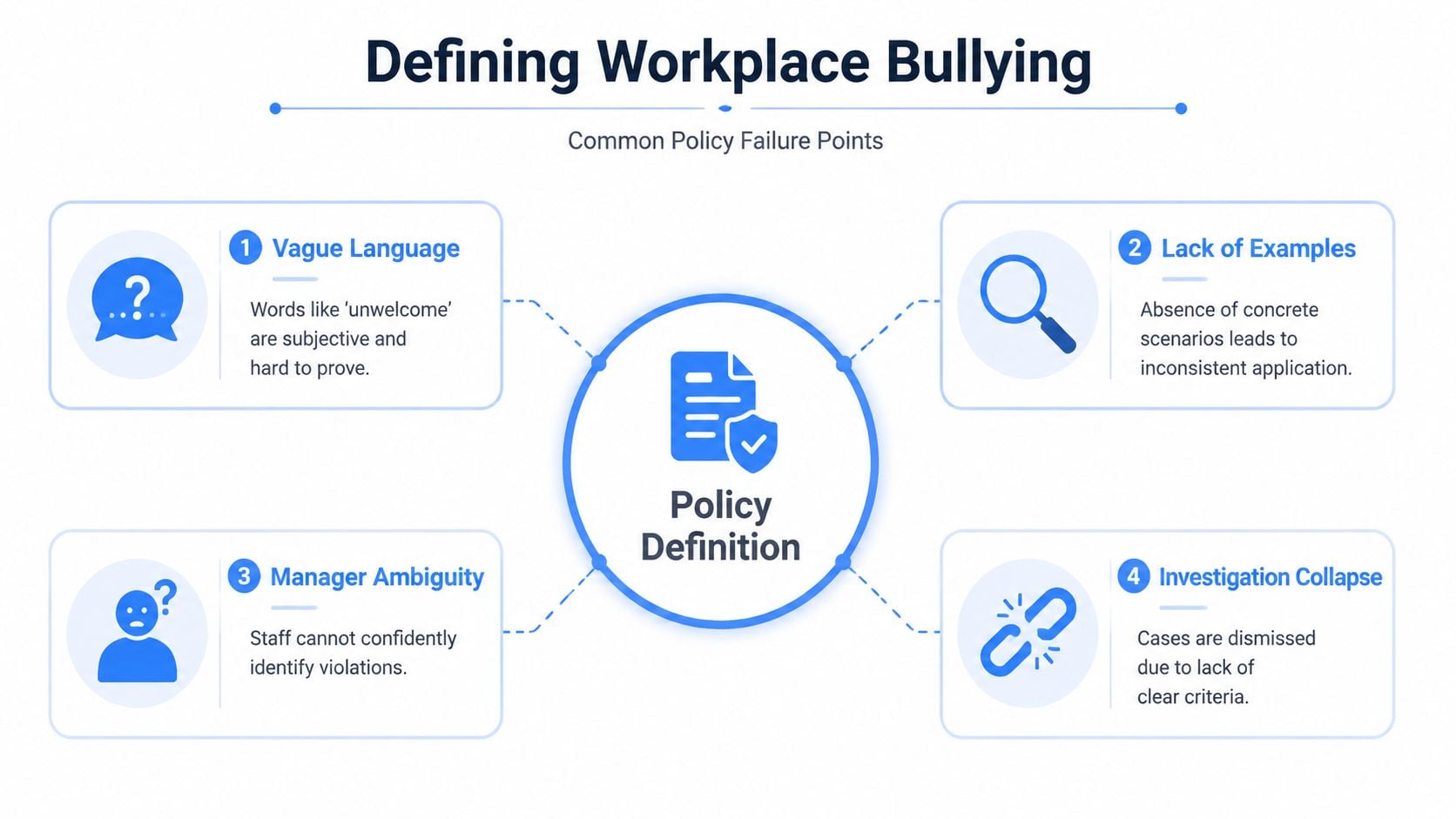
The line between bullying and management action
Most handbooks get sloppy here. A manager can lawfully set deadlines, reassign work, correct performance, and issue discipline. None of that becomes bullying just because the employee hates it. The policy should say that legitimate management action stays legitimate when it is applied fairly, documented, and tied to business reasons.
The reverse is also true. Repeated public humiliation, selective exclusion, and intentional sabotage are not “tough management.” They are the kind of pattern a policy should catch early. Guidance from the University of Edinburgh risk management material stresses that the definition has to distinguish bullying from legitimate supervision, or the policy becomes either toothless or overbroad. Address workplace bullying makes that distinction plainly.
For handbook language, the safest structure is simple. State the threshold, list examples, and reserve room for context. For a deeper handbook framework, the employee handbook inclusion guide is the right internal benchmark.
The Seven Components a Real Anti-Bullying Policy Must Include
A working policy is not a paragraph of values. It is a control document with named duties and auditable steps. If any one of these components is missing, the policy usually falls apart the first time a manager has to use it.
The non-negotiables
| Component | What it must contain | Common gap |
|---|---|---|
| Purpose and scope | State who the policy covers and where it applies | It only covers “employees” and forgets contractors, managers, or off-site conduct |
| Operational definition | Use a repeated, unreasonable behavior standard with risk impact | It relies on “unwelcome” or “inappropriate” language |
| Prohibited conduct examples | Give concrete examples like exclusion, humiliation, or sabotage | No examples, so managers guess |
| Multi-channel reporting options | Offer more than one reporting route, including confidential options | A single reporting line that fails when the supervisor is involved |
| Named contacts | Identify who receives reports and who can escalate them | “Contact HR” with no named owner |
| Anti-retaliation clause | State clearly that retaliation is prohibited | The policy is silent, so employees stay quiet |
| Investigation timeline and action commitment | Say how fast the employer will acknowledge, investigate, and respond | No deadlines, so complaints drift |
A model policy from the AFT emphasizes purpose, scope, defined responsibilities, anti-retaliation language, employee consultation, induction, business-wide communication, and regular review. That is the right shape because it turns the policy into a managed program instead of a shelf document. Model anti-bullying policy is useful precisely because it includes governance, not just wording.
Sample language that actually works
Purpose and scope. “This policy applies to all employees, supervisors, managers, contractors, and business-related conduct at work, at work events, and in work communications.”
Definition. “Bullying means repeated, unreasonable behavior directed at an individual or group that creates a risk to health or safety.”
Anti-retaliation. “Retaliation for raising a concern, participating in an investigation, or supporting another employee will not be tolerated.”
Action commitment. “Reports will be reviewed promptly, investigated where warranted, and addressed through corrective action, coaching, or discipline as appropriate.”
That last line matters because SafeWork NSW is blunt about implementation. Workers who understand the risks should help shape the policy, managers have to be trained, and reading the policy alone is not enough. SafeWork NSW guidance also makes clear that non-compliance by workers or managers should trigger discipline, which is the right level of seriousness.
Reporting, Investigation, and Response Timelines That Work
A complaint system without deadlines is a waiting room. Good employees stop trusting it, and bad managers learn they can run out the clock. One public-sector model requires complaints to be raised within three working days and the supervisor or department head to respond within five working days, with formal escalation if the issue is not resolved. That structure works because it shrinks delay and makes inaction visible. Workplace anti-harassment and anti-bullying policy
The workflow HR should require
The complaint path should be usable in more than one format. Employees should be able to report verbally, electronically, or through a confidential channel, because a single pathway breaks down fast when the direct manager is part of the problem. The Mental Health Foundation of New Zealand is clear that workers need more than one person they can talk to, and that one of those routes should not be their supervisor if the supervisor is implicated. Bullying at work resource
A solid workflow looks like this:
- Receipt and acknowledgment. HR or the designated owner confirms the report and logs the date.
- Triage and separation. If needed, the employer changes reporting lines, adjusts schedules, or limits contact.
- Investigation planning. The investigator identifies witnesses, documents, messages, and relevant work records.
- Interviews and evidence review. Statements are taken in a consistent order, and notes are preserved.
- Outcome and follow-up. The employee gets a closed-loop response, and management checks back after the case closes.
Keep the record contemporaneous. Reconstructed notes after the fact are weaker than notes taken during the complaint.
What breaks these cases
Three failure modes show up again and again. First, a single reporting line makes the process fragile. Second, a manager who is part of the issue cannot be the first and only recipient of the complaint. Third, missing notes destroy credibility later, especially if the employee claims retaliation or constructive discharge.
The public-sector guideline that requires immediate support and keeping a record of all discussions is a good model for employers that want defensible process. Preventing and addressing bullying in the workplace is especially useful because it treats the complaint file like evidence, which is exactly how it should be treated.
How PEOs and Third-Party Advisors Fit Into the Program
A PEO can make anti-bullying policy management easier, but it cannot own the culture problem for the employer. The strongest use case is operational support, policy templates, multi-state review, training delivery, hotline infrastructure, and help organizing investigation steps. That is where outside support saves time and reduces inconsistency.
The line gets blurry when the issue involves senior leadership or a co-employment arrangement complicates the investigator-of-record question. In those cases, the employer still needs internal judgment on who should handle the matter, who should see the file, and how independence will be preserved. A third party can support the process, but it should not become a shield against accountability.
When outside support makes sense
- Multi-state employers: A single policy framework helps avoid inconsistent local versions.
- Senior leadership allegations: Independence matters more than convenience.
- Claims likely to escalate: Outside review can improve defensibility.
- Lean HR teams: Service partners can handle the mechanics, while internal leaders keep decision rights.
The right division of labor is simple. The employer owns the policy, the response, and the final decision. A PEO or advisor helps build the system, pressure-test the language, and keep the program from going stale.
For companies comparing labor support models, this is also where PEO guidance for harassment investigations becomes practical, not theoretical. It helps answer a question that gets ignored too often: who has the responsibility to move the case forward when the report lands.
Measuring Whether the Policy Is Working and Triggering Updates
A policy that never gets measured turns into a branding exercise. HR should track complaint volume and category, average days from report to resolution, training completion, employee willingness to report, and whether employees believe retaliation is a real risk. Exit interviews matter too, because they often show whether people stayed quiet long before they resigned.
The best interpretation is not “more complaints are bad.” More complaints can mean employees trust the process enough to use it. The danger signal is silence paired with turnover or repeated off-cycle exits, because that usually means the policy exists but nobody believes it will help.
What should trigger a rewrite
A full review should happen every 12 months, not whenever someone remembers it. An out-of-cycle rewrite is warranted after a substantiated complaint against senior leadership, a material legal change, a merger, geographic expansion, or a turnover spike that shows up in culture feedback.
A useful companion resource is insights for HR leaders, especially for teams trying to connect complaint trends with employee listening data. That connection matters because anti-bullying policy failures often show up first as silence, not as formal complaints.
The policy should also be tested against retention data. If employees keep leaving after unresolved conflict, the issue is no longer just misconduct. It is a management failure, and retention improvement analysis should sit next to the policy review.

Bottom line: if the policy is not changing manager behavior, shortening response time, or improving trust in the reporting process, it is not working.
PEO Metrics helps companies compare, select, and negotiate the right PEO when they need stronger HR controls without relying on sales pitches. If a workplace needs a cleaner anti-bullying framework, better compliance support, or help judging whether a PEO can deliver those services, PEO Metrics can help the leadership team make a sharper decision.
