
Most advice about motivation in the workforce starts in the wrong place. It treats motivation like a perk problem, then hands leaders a checklist of recognition programs, wellness add-ons, and flexible work policies that sound sensible but often don’t change behavior.
The harder truth is that motivation is usually a systems problem. When goals are unclear, feedback is inconsistent, managers are overloaded, and rewards don’t match how work gets done, even good people drift. That helps explain why Gallup’s global engagement research still shows only 23% of employees engaged in 2023, meaning 77% were not fully engaged at work, and why later summaries of the same research put global engagement at roughly 21% with an estimated cost of about $8.8 trillion, or roughly 9% of global GDP (Gallup engagement research summary).
For companies with 10 to 2,000 employees, that gap matters because the biggest motivation levers often sit inside the HR stack, the manager model, and the PEO relationship. A PEO can make it easier to deliver coherent policies, benefits, and compliance support, or it can lock a company into rigid processes that leave managers with little room to motivate people well. The difference shows up in retention, productivity, and the amount of time leaders spend managing friction instead of performance.
Table of Contents
- Why Most Motivation Strategies Fail
- The Three Drivers That Move the Needle
- Measuring Motivation Before It Becomes a Retention Problem
- Evidence-Based Strategies That Work in Practice
- When Incentive Programs Backfire
- How Your PEO Partnership Supports or Undermines Motivation
- Evaluating PEOs Through a Motivation Lens
Why Most Motivation Strategies Fail
The biggest mistake leaders make is assuming motivation comes from pay, perks, or praise alone. Those things matter, but they’re usually too shallow to fix a work system that confuses people, slows them down, or makes effort feel invisible.
Gallup’s data shows the scale of the problem, but the operational issue is simpler. Most companies invest in engagement activities without redesigning the daily experience of work, so the same management habits keep producing the same results (Gallup engagement research summary). A new recognition platform doesn’t help much if goals keep shifting, managers can’t coach consistently, or employees don’t understand how their work connects to company priorities.
A practical example makes this clear. A 40-person services firm can spend money on monthly gift cards and still watch morale slip if project owners change priorities every week and no one explains why. Employees don’t read that as a motivation problem. They read it as a leadership problem.
Motivation follows the design of work
McKinsey’s performance management research found that employees were more motivated when goals combined individual and team objectives, were linked to company goals, and were updated through the year as priorities changed. Employees also viewed performance systems as fairer when they were involved in the process, and nonfinancial rewards were associated with stronger perceptions that the system improved company performance (McKinsey on performance management).
That matters for PEO buyers because the right benefits package is only part of the story. If payroll, handbook rules, and performance cycles live in separate silos, the employee experience feels fragmented. A company can have competitive benefits and still lose momentum because managers lack a clean system for setting priorities, reviewing progress, and rewarding the work that matters. For a useful reference point on policy clarity, see this employee handbook purpose guide.
Practical rule: if employees say they want more recognition but still miss deadlines or avoid ownership, the problem probably isn’t a lack of praise. It’s usually a lack of clarity, consistency, or meaningful control over the work.
The key takeaway is that motivation in the workforce is not a soft morale issue. It’s a design issue. Leaders who treat it that way stop buying surface fixes and start looking at how their operating model either helps or suppresses drive.
The Three Drivers That Move the Needle
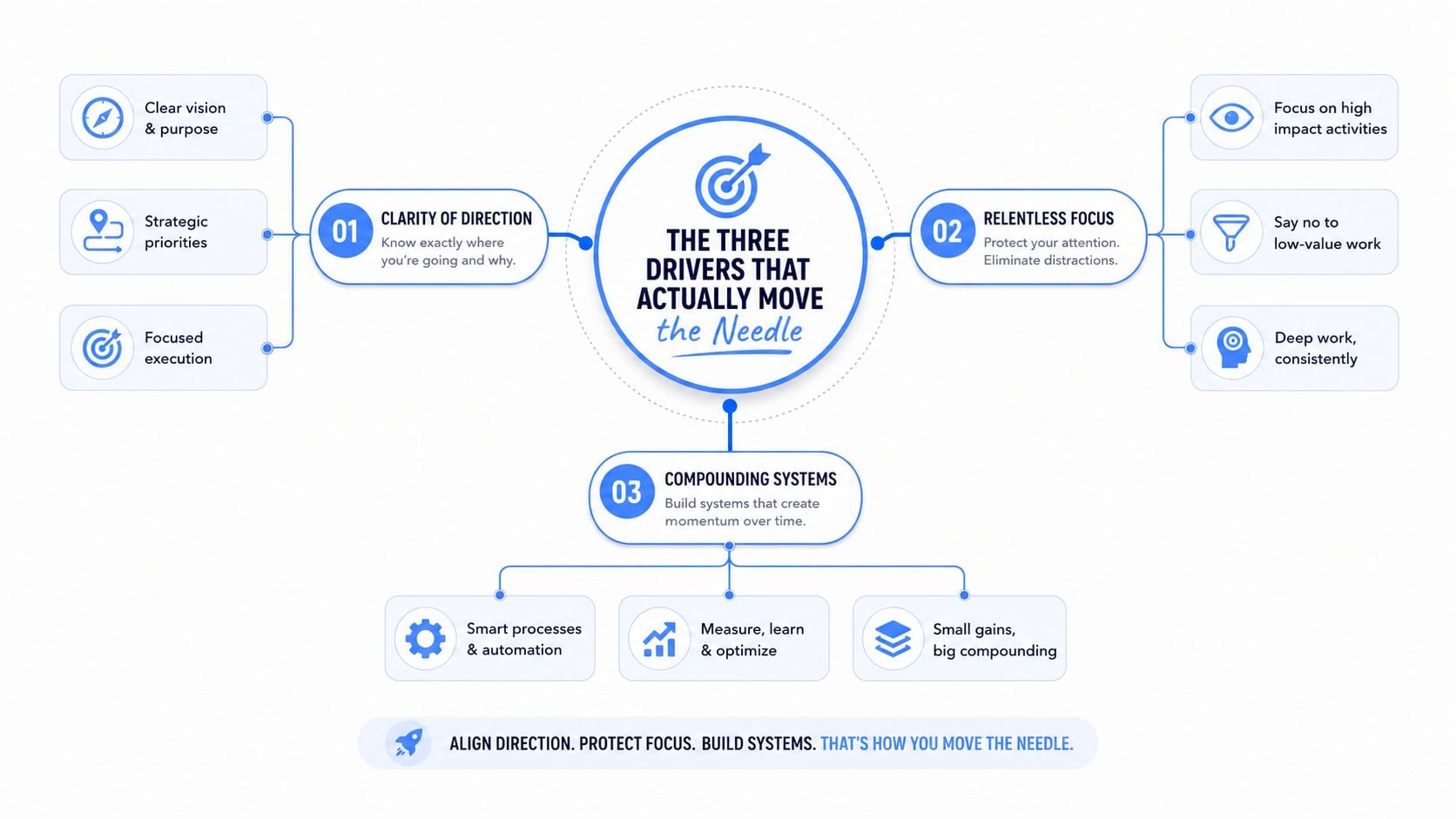
The strongest research-backed motivation levers are autonomy, relatedness, and competence. These three needs keep showing up because they describe how people experience work, not just how they answer a Friday survey.
Autonomy does not mean leaving people alone. It means giving them real discretion over how they execute work, as long as the goals and guardrails are clear. In a hybrid team, that might mean a sales manager setting weekly outcome targets while letting reps decide whether they prospect in the morning or afternoon. It is structure with room to think.
Relatedness is not pizza lunches or generic team-building exercises. It is the sense that people matter to one another and understand how their work fits into a shared effort. That becomes especially important in distributed teams, where people can spend weeks solving problems without ever seeing the downstream impact.
Why competence is more than training
Competence is often treated like a learning budget problem. It is not. Workers feel competent when the organization gives them tools, feedback, and a path to improvement that they can use. A two-hour course will not fix a role if the workflow is broken or the manager never follows up with coaching.
A cross-national study in the Journal of Business Research found that autonomy and social relatedness were positively associated with work motivation, while competence showed a negative association in that sample. The authors also reported that these effects were moderated by country-level cultural variables such as religious affiliation, political participation, humane orientation, and in-group collectivism, which means motivation levers are not fully portable across markets (study in the Journal of Business Research). Multinational employers need localized playbooks, not copy-and-paste engagement programs.
Autonomy works best when the manager still defines the outcome, the deadline, and the quality bar. Without that, freedom becomes ambiguity.
For employers evaluating their HR structure, these drivers usually map to systems. Autonomy lives or dies in job design. Relatedness depends on manager habits and team rhythm. Competence depends on whether training, feedback, and tools are built into the workflow. That is why a culture of empathy framework cannot be reduced to messaging alone. It has to show up in policy, supervision, and how people get help when they are stuck.
A practical test is simple. If a PEO partnership improves payroll, benefits administration, and compliance, but leaves managers without a clear way to set priorities or coach performance, motivation will still stall. The operating model has to support the way work gets done, especially for knowledge workers and hybrid teams who have more discretion and more room for confusion.
Measuring Motivation Before It Becomes a Retention Problem
Most companies wait until people start leaving. By then, the warning signs have usually been there for months, buried in missed deadlines, quieter meetings, slower response times, and managers who explain it away as a rough patch.
Treat motivation like a business risk, not a mood. Survey scores help, but they do not give a full picture on their own. Leaders need a small set of signals that show whether people are pulling back before turnover shows up in the numbers.
What to watch every quarter
Quarterly check-ins work better than annual reviews because they capture patterns while they are still manageable. The most useful measures stay close to the work itself, such as productivity trends, absenteeism, meeting participation, work quality, and training participation. Survey results still matter, but they belong beside operational data, not above it.
The guide to boosting engagement with wellness programs reinforces a practical point, motivation has to be measured and acted on regularly if leaders want to catch drift early. That matters most in smaller firms, where leadership can still adjust workload, coaching, or priorities without waiting for a long planning cycle.
| Motivation Warning Signs and Diagnostic Metrics | |||
|---|---|---|---|
| Warning Sign | Metric to Track | Benchmark Threshold | Action Trigger |
| Declining output | Team productivity trend | Any sustained drop from normal workload patterns | Review workload, priorities, and manager follow-up |
| Rising absenteeism | Absence frequency | Repeated missed time without a clear operational cause | Check for burnout, role mismatch, or scheduling strain |
| Low meeting engagement | Participation in team meetings | Consistent silence from people who normally contribute | Ask direct questions in 1:1s and review psychological safety |
| Falling work quality | Rework and error rate | More corrections, missed details, or client complaints | Audit process, training, and manager coaching |
| Weak development interest | Training participation | Low enrollment or incomplete follow-through | Confirm whether training feels relevant and useful |
Survey-based workplace guidance also recommends regular employee surveys, performance tracking, motivation-linked KPIs, and check-ins at least quarterly (Paychex workplace motivation guidance).
If motivation falls across a whole team, look first at workload, manager quality, or broken process before blaming attitude.
That distinction matters because a lot of supposed motivation problems are workload problems or process problems. If five people are underperforming in the same department after a software rollout, the issue may be adoption or training. If one employee is disengaged while others are thriving, the issue may be fit, role clarity, or leadership.
Motivation tracking should also connect to retention planning. A weak score on its own is not the whole story, but a pattern of lower output, weaker participation, and declining development interest is enough to warrant action before resignations start. A practical next step is to pair your quarterly review with employee retention guidance for PEO clients so managers can separate short-term frustration from a deeper retention risk.
Evidence-Based Strategies That Work in Practice
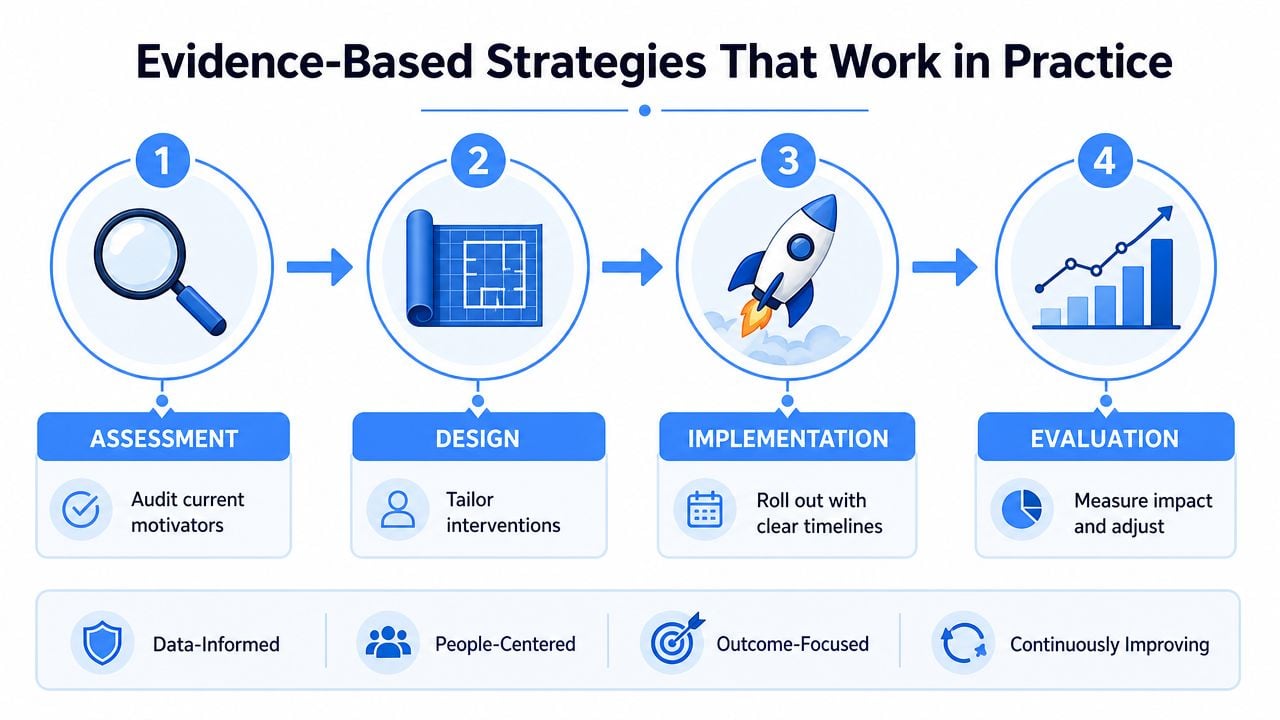
The most reliable interventions are the ones that fit the actual problem. A company with strong pay and weak ownership needs a different approach than a company with unclear goals or inconsistent feedback. Throwing in perks just adds noise.
Start with the performance system. McKinsey’s findings support a model where goals combine individual and team objectives, stay connected to company priorities, and get updated during the year (McKinsey on performance management). In a 100-person professional services firm, that can mean replacing a once-a-year review with a quarterly goal reset and a short manager check-in template. The cost is mostly manager time, not software.
Use meaning before perks
For knowledge workers and experienced employees, the stronger lever is often task meaning. Research-based coverage in a Forbes discussion of overlooked motivation strategies points toward the same idea, workers who already have decent pay and benefits usually need a clearer sense of purpose, ownership, and contribution, not another generic reward.
That’s where many companies miss. They try to motivate senior analysts, engineers, or account managers with small perks that don’t touch the core issue. A better move is to show who benefits from the work, what breaks if the work slips, and where the employee has genuine decision rights.
A strong implementation plan often looks like this:
- Month 1: rewrite goal sheets so every role has one company-linked outcome, one team goal, and one individual deliverable.
- Month 2: train managers to give feedback in short, frequent conversations instead of saving everything for review season.
- Month 3: test nonfinancial recognition tied to specific outcomes, such as client retention, process improvement, or cross-team support.
- Month 4 and beyond: review whether employees understand why their work matters and whether the new system feels fair.
For distributed teams, the operating cadence matters just as much as the message. A distributed team management guide is useful when managers need a tighter rhythm for communication, accountability, and follow-through.
A practical example helps. In a 250-employee company, a leadership team might spend a few hundred dollars per manager on training and internal tooling, then track whether quarterly check-ins happen on schedule and whether employees report clearer priorities. The point isn’t the spend. It’s whether the system makes motivated behavior easier to sustain.
For leaders who want a direct peer reference, Vendmoore’s leadership guidance on motivating employees is worth reading alongside your internal playbook because it reinforces the same practical theme, leaders need to change how work is managed, not just how it’s praised.
When Incentive Programs Backfire
Bonuses and contests can work, but only when the problem is motivational. If the issue is skill, workload, or process, adding money usually just puts a spotlight on the wrong thing.
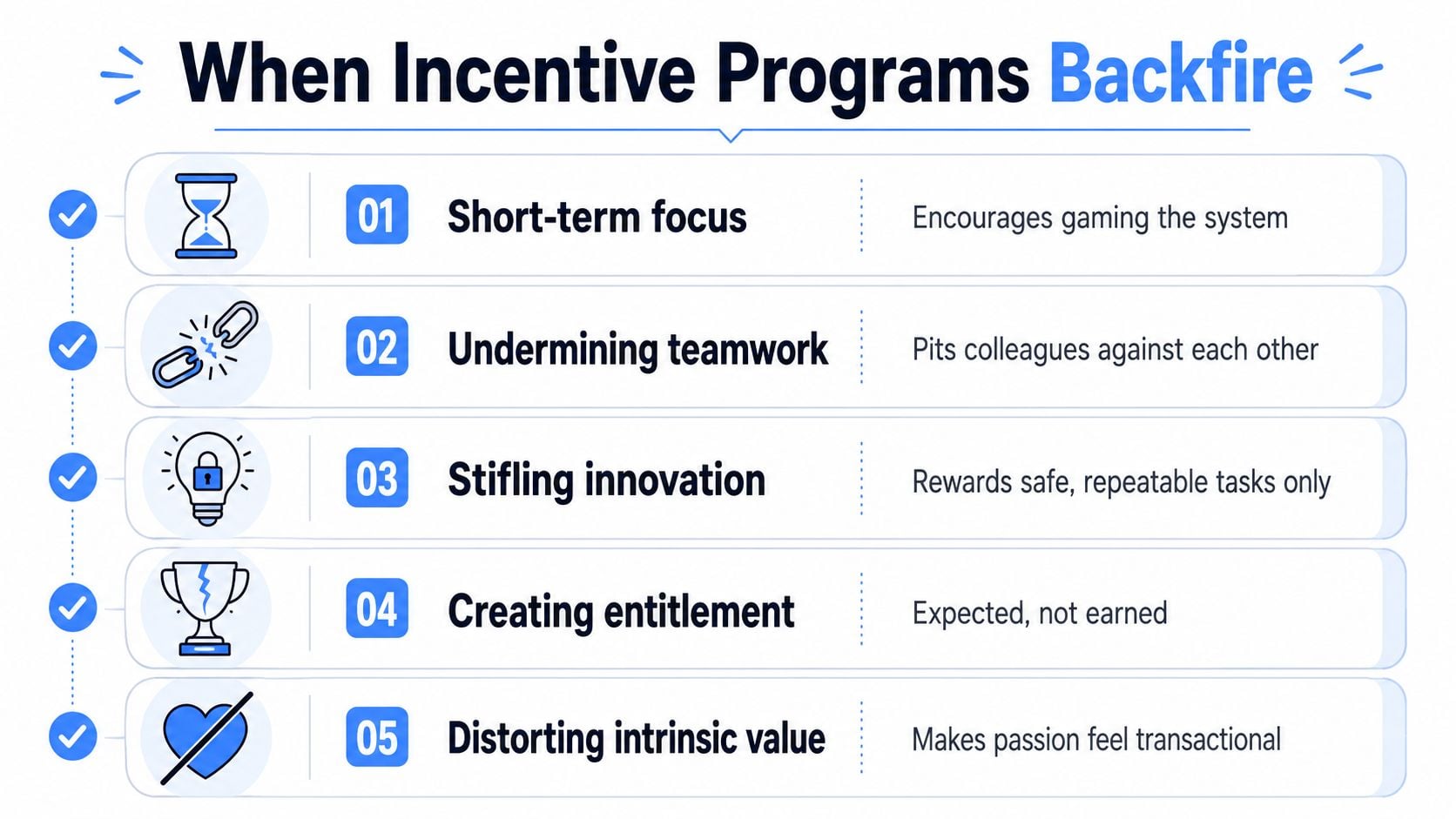
Research on incentive programs identifies five conditions for them to work well. Current performance has to be inadequate, the problem has to be motivational rather than skill-based, the target behavior has to be quantifiable, the goal has to be challenging but achievable, and the incentive can’t conflict with broader organizational goals (incentive program research and best practices). That’s a useful filter before a company launches a reward plan that creates more problems than it solves.
Diagnose before you pay
A common mistake is rewarding visible activity instead of the result that matters. Sales teams see this when leaders overpay for raw call volume and get sloppy prospecting. Operations teams see it when speed is rewarded and quality slips. In both cases, the bonus drives gaming, not better performance.
Nonfinancial rewards can be stronger when they reinforce status, growth, or purpose rather than replacing them. McKinsey’s research found that employees viewed systems more favorably when nonfinancial rewards helped them believe the company was improving overall performance (McKinsey on performance management).
The practical rule is simple. If the team already knows how to do the job, but isn’t doing it consistently, an incentive may help. If the team is confused, undertrained, or buried in bad process, fix that first. A money problem is easier to solve than a broken operating model, but it’s also easier to misuse.
How Your PEO Partnership Supports or Undermines Motivation
A PEO affects motivation whether leaders plan for it or not. The provider shapes benefits access, payroll friction, handbook consistency, compliance burden, and the administrative load managers carry every week.
That’s why motivation should be part of the PEO conversation, not an afterthought. A rigid service model can leave managers with too little flexibility to support different employee needs, while a more adaptable model can reduce admin work and give leaders time back for coaching. In practice, this often shows up in how benefits are packaged, how quickly HR questions get answered, and whether the PEO gives the company tools it can use.
What to look for in the service model
A motivation-supporting PEO usually helps in three places. First, it offers benefits and policy structures that feel credible to employees and easy to explain. Second, it gives managers fewer administrative interruptions, which leaves more time for feedback and goal setting. Third, it supports learning and development instead of treating training as a side issue.
A motivation-undermining PEO often does the opposite. It relies on generic templates, puts compliance ahead of manager usability, and makes policy changes hard to tailor to the business. That can leave workers feeling like the company has outsourced the employee experience instead of improving it.
The best PEO fit is not just the one that lowers admin burden. It’s the one that helps managers spend more time leading and less time translating HR paperwork.
That’s also where independent comparison matters. A PEO review and comparison resource can help leaders pressure-test whether a provider’s service model fits the company’s actual employee experience, not just its compliance needs.
One relevant option in this space is PEO Metrics, which compares PEO pricing, benefits, contract terms, service quality, compliance support, and industry fit so buyers can see trade-offs more clearly. For a company trying to improve motivation, that kind of review is useful because the wrong provider can make every downstream engagement effort harder to execute.
The larger point is simple. A PEO is not just an HR vendor. It is part of the system that either frees managers to motivate people well or burdens them with enough friction that motivation becomes an afterthought.
Evaluating PEOs Through a Motivation Lens
When HR and finance leaders review PEO proposals, they usually start with cost and compliance. Those matter, but they’re not enough. A provider can look efficient on paper and still make it harder to retain people, develop managers, and support a healthy employee experience.
The clearest way to assess a PEO is to ask how it affects the actual levers of motivation. That means looking at benefits design, payroll and compliance workflows, training resources, and service responsiveness together. If a provider saves money but adds friction to manager support or policy flexibility, the company may be paying for the wrong kind of efficiency.
Questions that expose fit quickly
Use a short decision checklist when comparing proposals or renegotiating a contract:
- Benefits design: Can the provider support a package employees value, and can it be explained without a long administrative script?
- Manager usability: Do HR tasks, policy questions, and routine approvals stay simple enough that managers can keep coaching?
- Training access: Does the platform or service model support learning and development, or does training sit outside the PEO’s strengths?
- Compliance burden: Does the provider reduce administrative load, or does it require constant manager oversight to stay on track?
- Service quality: When employees or managers need help, does the provider resolve issues quickly enough to avoid frustration?
If a current provider makes it hard to answer those questions clearly, the problem is bigger than price. Leaders should compare the cost of staying put with the cost of recurring friction, especially if managers keep spending time on administrative cleanup instead of performance conversations.
The decision often comes down to whether the provider supports autonomy, clarity, and confidence in the employee experience. If it doesn’t, a better contract or a different provider may be the most practical motivation move the business can make.
If you’re comparing PEOs, trying to renegotiate a contract, or deciding whether your current provider is helping or hurting employee motivation, PEO Metrics can help you compare service models, benefits, contract terms, and trade-offs with more discipline. Use it to pressure-test whether your PEO is supporting retention, manager effectiveness, and a better day-to-day employee experience.
