
Most advice on managing distributed teams starts in the wrong place. It starts with tools, meeting cadence, and vague reminders to "communicate more." That's backwards. A distributed team doesn't fail because Slack was set up poorly. It fails because leaders treat location flexibility like a culture perk instead of an operating model with real consequences for payroll, management quality, documentation, and compliance.
That distinction matters because distributed work is no longer edge-case management. In a 2023 World Bank analysis, roughly 39% of workers in 108 economies had a remote or hybrid arrangement, and in the U.S. 35.2% of employed people worked from home in some capacity in 2022, up from 24.3% in 2019, according to coverage summarized in Insightful's review of distributed team management data. At that scale, managing distributed teams isn't a side topic for HR. It's a core operating discipline for leadership.
The practical question isn't whether a company allows remote work. The practical question is whether the business has designed the systems required to run distributed work well. That includes communication rules, hiring and onboarding mechanics, performance visibility, state registrations, tax withholding, benefits administration, and decision rights. Leaders who get this right usually run calmer organizations. Leaders who don't often create a messy hybrid of office habits and remote exceptions.
Table of Contents
- Your Distributed Team Is an Operating Model Not a Perk
- Build Your Distributed Communication Operating System
- How to Hire and Onboard Talent from Anywhere
- Measure Outcomes to Drive Performance Remotely
- Navigate the Multi-State Payroll and Compliance Maze
- How to Choose Your HR Operations Partner
Your Distributed Team Is an Operating Model Not a Perk
The fastest way to create distributed-team friction is to assume flexibility changes only where people sit. It changes how work gets assigned, how managers evaluate performance, how decisions get recorded, and how the company handles employer obligations across states and countries.
A business that runs well in one office can become surprisingly fragile once people spread out. Informal approvals disappear. New hires lose hallway context. Managers start substituting responsiveness for results. Finance discovers too late that an employee relocation affects withholding, unemployment setup, or benefits administration. None of those problems get fixed by adding another weekly call.
Practical rule: If a team needs constant live interaction to stay aligned, the operating model isn't stable yet.
The better frame is system design. Leaders need clear communication lanes, role clarity, manager standards, and approval workflows that survive time zones and handoffs. That is the core work of managing distributed teams.
For leaders sorting through the broader challenges, this overview of mastering distributed team challenges is a useful companion because it helps separate structural issues from day-to-day annoyances. That's an important distinction. Structural issues create recurring cost, risk, and drag. Annoyances are usually symptoms.
Three signs a company is still treating distributed work like a perk:
- Location changes happen informally. Employees move first, payroll finds out later.
- Managers improvise standards. One team documents everything, another runs on chat, a third depends on meetings.
- Visibility replaces accountability. Employees who respond fastest get trusted more, even when output quality says otherwise.
Distributed teams don't need more enthusiasm. They need operating discipline.
Build Your Distributed Communication Operating System
A strong distributed team doesn't communicate constantly. It communicates predictably. That difference is where a lot of companies either gain an advantage or create chaos.
Set channel rules before communication breaks down
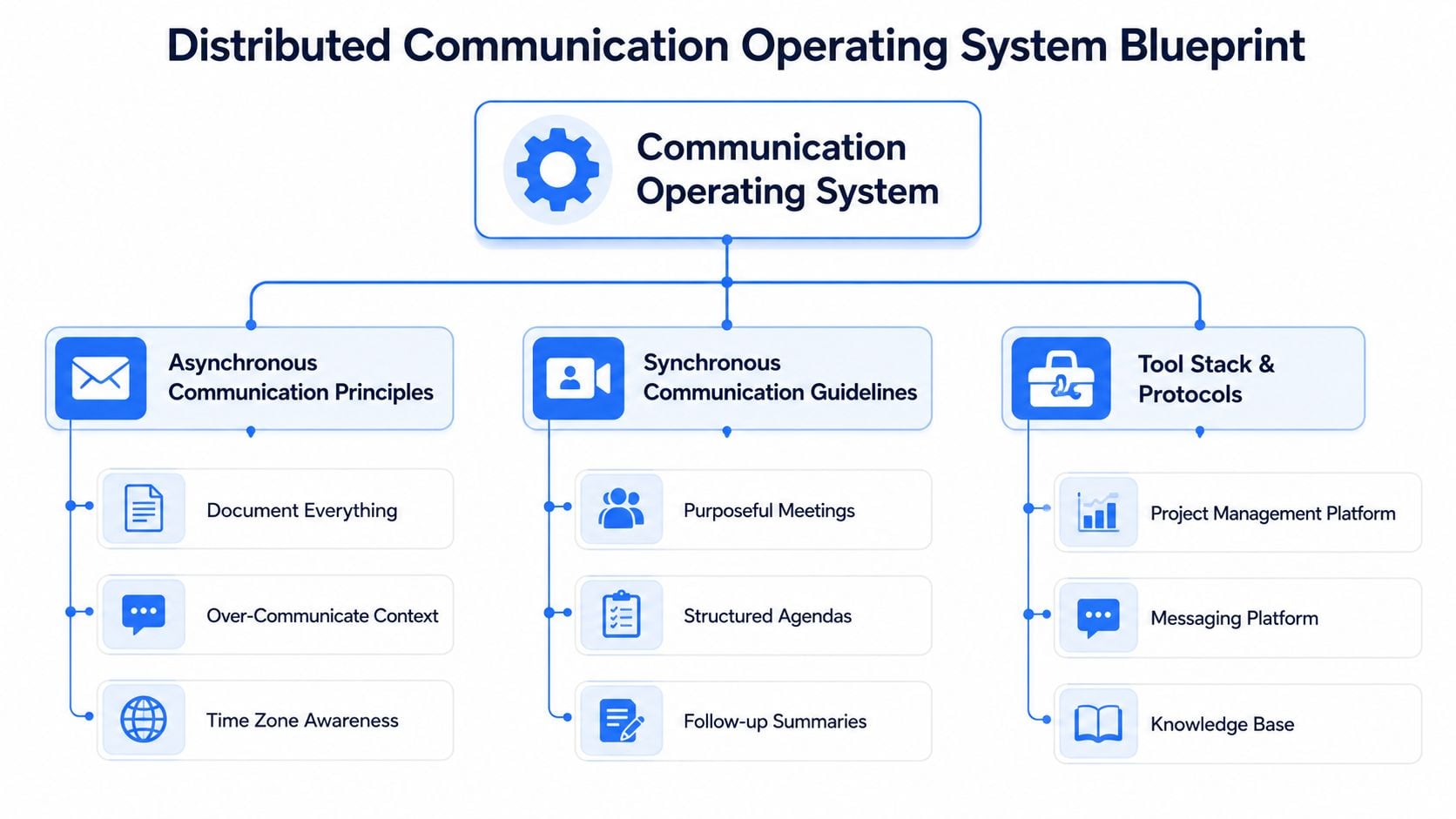
The most useful communication system is simple enough that a new hire can understand it in one day. The baseline model is straightforward: one primary chat tool for fast coordination, one documentation hub for durable knowledge, and one task system for work tracking.
That structure lines up with guidance summarized in RST Software's distributed workplace practices, which recommends an asynchronous-first model built around four habits: define primary channels for chat, documentation, and tasks; document response-time expectations; require written context before meetings; and reserve synchronous time for high-complexity decisions. The same guidance notes that unclear channel rules and excessive meetings are common failure points.
A practical setup might look like this:
| Purpose | Primary tool | What belongs there | What doesn't |
|---|---|---|---|
| Fast coordination | Slack or Microsoft Teams | urgent blockers, quick clarifications, scheduling | final decisions, project history |
| Work tracking | Asana, Jira, Monday.com | owners, due dates, status, dependencies | casual discussion threads |
| Permanent knowledge | Confluence, Notion, Google Docs | SOPs, policies, meeting notes, decisions | fleeting updates |
For teams refining their distributed communication habits, this joyshift communication article is useful because it focuses on practical remote communication patterns rather than generic transparency advice.
A more detailed example of this structure in an HR context appears in this guide to hybrid employee communication structure, especially for employers trying to standardize how operating updates, policy changes, and employee requests move through the business.
Design for asynchronous work first
Teams often state their support for asynchronous work. Fewer teams define what that means in practice.
It usually means four things:
- Every request has a home. A task request goes into the project system, not a buried chat thread.
- Response expectations are explicit. "Urgent" isn't subjective. Teams define what needs immediate attention and what can wait.
- Context gets written down before discussion. Nobody joins a call just to learn what the meeting is about.
- Overlap hours are limited and intentional. Shared live time is reserved for issues that require live coordination.
A team that writes clearly can move work across time zones without creating a meeting tax.
The operational payoff is bigger than convenience. Asynchronous systems reduce rework, lower dependency on specific managers, and leave an audit trail. That last point matters for HR and finance. When policy decisions, compensation exceptions, and process approvals sit inside chat messages, companies lose both accountability and memory.
Use meetings for decisions not narration
The usual failure mode is over-meeting. Leaders sense drift, so they add recurring calls. The calls then become the place where context is delivered, which means absent team members miss key information and everyone else waits for meetings to move work forward.
A better rule is to ask one question before any meeting gets scheduled: what can happen live that can't happen well in writing?
Good answers include:
- Decision-making: two reasonable paths exist and a choice is needed
- Conflict resolution: tone or tension is slowing execution
- Complex collaboration: several functions need to work through dependencies in real time
Bad answers include status reading, broad FYI updates, and walking through documents people could have reviewed beforehand.
When managing distributed teams, communication quality usually improves when leaders write more, decide faster, and meet less.
How to Hire and Onboard Talent from Anywhere
Hiring into a distributed company requires a different filter. The best candidate on paper can still struggle if the role depends on self-direction, written clarity, and comfort working without constant live feedback.

Hire for autonomy and written communication
Most interview loops still overweight charisma in live conversation. Distributed roles often reward something else: the ability to absorb context, clarify ambiguity, document progress, and move work forward without waiting to be managed.
That changes the interview design. Instead of relying only on conversational interviews, companies should test for written thinking and independent execution. For technical hiring teams, resources like Talantrix's developer interview insights can help sharpen the evaluation process around how candidates solve problems in practice, not just how polished they sound in a call.
Useful prompts include:
- Async judgment: "You receive a vague request in Slack late in your day. What do you do before responding?"
- Documentation ability: "Write a short handoff note for a project that's behind schedule."
- Autonomy: "Tell us about a time you had to make progress without immediate manager input."
- Coordination: "How do you surface blockers when teammates are offline?"
Candidates don't need perfect answers. They need workable habits.
Run onboarding like a managed rollout
Distributed onboarding fails when it's treated like a calendar event. A laptop ships. A few intro calls happen. Access gets granted gradually. By the end of the first week, the new hire has met people but still doesn't know how the company really operates.
Good onboarding is built like an implementation plan. Before day one, the company should assign a manager, an onboarding buddy, a first-month deliverables list, access owners, and a documented schedule.
A practical system often includes:
- Pre-day-one setup: equipment, accounts, payroll documents, benefits enrollment, and a written first-week agenda
- Defined first-week outputs: one small task completed, one process documented back to the team, one stakeholder map created
- Buddy coverage: a peer who handles informal questions that don't belong in a manager 1:1
- Scheduled manager touchpoints: short check-ins early, then less frequent as confidence builds
Companies building repeatable onboarding flows often benefit from a system like this guide to onboarding automation for high-growth companies, especially when multiple hires start across different functions and locations.
New hires need proof that the company is organized. Onboarding is where that proof shows up.
A workable first-month structure
A realistic first month in a distributed team should give the employee enough structure to gain momentum without creating a full-day video schedule.
A simple format works well:
| Timeframe | Focus | Manager expectation |
|---|---|---|
| First week | access, relationships, role clarity, first deliverable | remove blockers quickly |
| Second week | process immersion, stakeholder meetings, visible work output | confirm priorities and standards |
| Third week | independent execution on a defined workstream | shift from instruction to coaching |
| Fourth week | ownership of recurring tasks and documented questions | evaluate ramp quality, not personality fit |
The core mistake is trying to build belonging only through social calls. Belonging usually comes from competence plus clarity. When a new hire knows what good looks like, knows where to find information, and can complete useful work early, integration gets much easier.
Measure Outcomes to Drive Performance Remotely
Distributed teams underperform for a simple reason. Leaders measure what they can see instead of what the business needs.
That usually shows up as Slack responsiveness, meeting attendance, and online presence. Those signals are easy to observe and easy to misuse. They reward availability, not throughput. They also create a hidden cost structure. Managers spend time chasing updates, high performers spend time performing visibility, and real execution gets buried under coordination work.
Replace activity monitoring with ownership
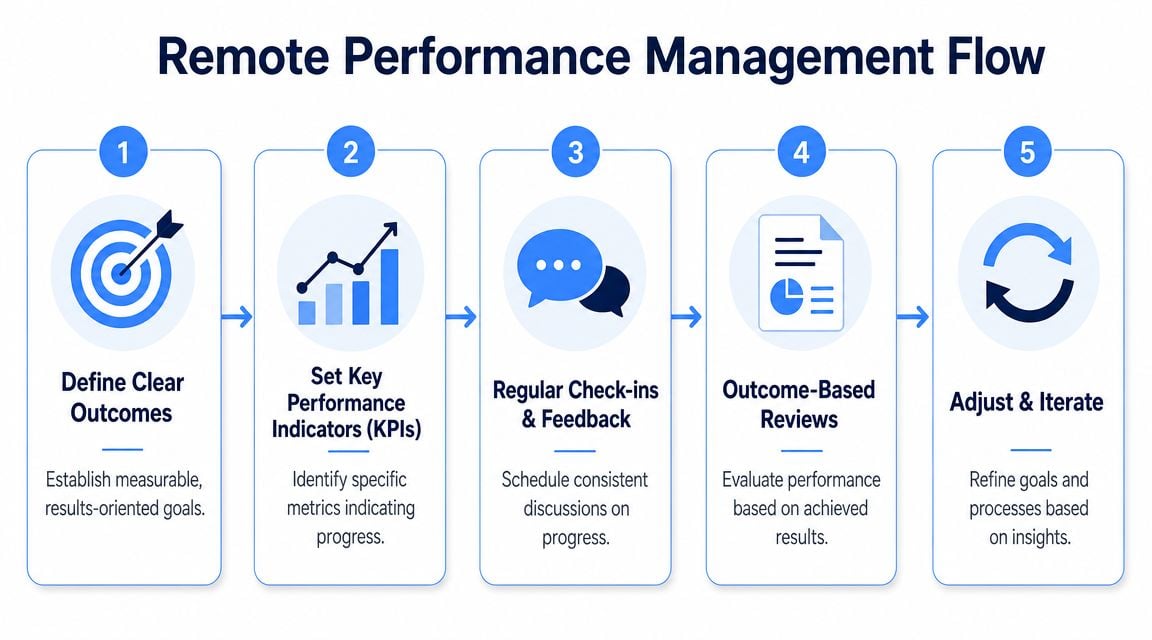
Remote performance improves when each priority has a clear owner, a defined result, and a visible record of progress. Guidance in Gable's distributed workforce management recommendations supports that model: assign one accountable owner per workstream, define OKRs, track work in a shared system, and review progress through retrospectives. That same guidance points out that ambiguous ownership drives coordination failure across locations.
This is an operating design issue, not a motivation issue.
If five people are "helping" but no one owns the result, delivery slows and accountability disappears. If the goal is stated as "improve customer onboarding," teams will stay busy without agreeing on what success means. If updates live in private chats, managers cannot separate a real blocker from a reporting gap.
A better system is plain:
| Weak system | Strong system |
|---|---|
| multiple people loosely involved | one directly accountable owner |
| goals described in broad language | outcomes defined in concrete terms |
| updates live in private messages | status visible in a shared tool |
| manager asks "what did you do today?" | manager asks "what's blocked and what decision is needed?" |
Leaders often resist this because it feels rigid. In practice, it reduces meetings and exposes risk earlier. The team knows who decides, who executes, and what must move each week.
Build a review rhythm leaders can sustain
Performance systems fail when they rely on managerial heroics. The review cadence has to fit normal operating reality, including busy weeks, hiring spikes, and quarter-end pressure.
A workable rhythm usually includes:
- Weekly 1:1s for blockers and coaching. Status should already exist in the work system.
- Team priority reviews. Keep them short and tied to current commitments, dependencies, and decisions.
- Periodic retrospectives. Fix process breakdowns before they turn into interpersonal conflict.
- Quarterly goal resets. Headcount changes, sequencing changes, and customer demand changes. Goals should change too.
Manager quality matters because managers set the pace of clarity, escalation, and follow-through. Gallup has long argued that the manager has an outsized effect on team engagement, and that point is especially relevant in distributed environments where weak management quickly turns into drift, delay, and uneven standards. Surveillance does not correct that. Clear operating rules do.
The reporting model also needs one source of truth. If HR pulls headcount data from one system, finance tracks productivity in another, and department leaders maintain separate spreadsheets, performance reviews become arguments about data quality instead of execution quality. A defined HR reporting governance model for distributed operations helps standardize which metrics matter, where they live, and who owns them.
Performance management should answer three questions quickly: who owns this, what outcome matters, and what is blocked?
Prevent a two-tier hybrid team
Hybrid teams introduce a predictable control failure. People in the office hear decisions earlier, get informal context faster, and build more manager access by proximity. Remote employees then appear slower, less informed, or less engaged when the problem is uneven information flow.
Microsoft reported in its 2023 Work Trend Index that managers were more likely than employees overall to prefer more in-office work. Atlassian's discussion of distributed teams also points to how much time knowledge workers lose to coordination. Put those two facts together and the risk is obvious. If leaders let office proximity shape who gets context, they create a performance system that favors location over contribution.
Three controls help:
- Decision logs. Record decisions that change priorities, owners, or deadlines in a shared system.
- Role-based meeting rules. Invite people because they have decision rights or execution responsibility, not because they are nearby.
- Rotating visibility. Rotate demos, project updates, and meeting facilitation so the same in-office employees do not become the default public face of progress.
Fairness matters, but the bigger issue is operational consistency. A team cannot hit reliable performance targets if one group gets context by overhearing conversations and another group has to reconstruct decisions after the fact.
Navigate the Multi-State Payroll and Compliance Maze
Distributed teams do not create risk because people work from home. They create risk when leadership treats work location as an informal preference instead of an operating input. The expensive failures are rarely dramatic at first. They show up as payroll set up in the wrong state, benefits that do not match the employee's location, missing registrations, and managers approving moves they do not have authority to approve.
The compliance problem also extends beyond domestic payroll. As noted in Robin's overview of how to lead distributed teams, global mobility turns distributed hiring into a finance and risk issue, not just a management issue. Once employees move across jurisdictions, the company has to decide how employment, tax handling, benefits, and local labor rules will be administered before the move creates a problem.
A single employee relocation can trigger multiple obligations.
Start with a common case. A company hires an employee in Florida and configures payroll there. Six months later, the employee moves to New York and keeps working because the manager wants to retain them and assumes HR can clean it up later.
Now the company may need to change withholding, register in a new state, review unemployment insurance setup, confirm leave compliance, update notices, and check whether benefits still fit the employee's new location. The move may look small to the employee and reasonable to the manager. From an operating standpoint, it is a legal, payroll, and cost event.
Questions finance and HR should ask immediately
Every distributed employer needs a standard intake process for work location changes. That includes moves across state lines, long temporary stays, and arrangements that begin as exceptions.
Use a checklist that forces a decision before the move is approved:
| Question | Why it matters |
|---|---|
| Where is the employee performing work? | tax and labor obligations often follow work location |
| Is the move temporary or open-ended? | short-term arrangements can still create compliance and payroll issues |
| Is the company already registered there? | payroll may not be legal to run there until registrations are complete |
| Do benefits work in that jurisdiction? | eligibility, notices, and network access may differ by state |
| Who has approval authority? | manager-level exceptions create liability for the employer |
The common leadership mistake is simple. They let relocation sit with the manager because it feels like a retention or flexibility issue. It is not. It is an employer compliance decision with payroll, tax, and policy consequences.
What good control looks like
Strong operators build controls into the process instead of relying on reminders and good intentions.
A workable model usually includes four parts:
- A written location approval policy. Employees request a move before it happens, not after they have settled in.
- Cross-functional review. HR, payroll, finance, and legal or outside counsel review the request based on risk, cost, and setup requirements.
- System updates before approval is final. HRIS, payroll, tax settings, benefits records, and manager records all need to match.
- Manager guardrails. Managers can support a request, but they cannot authorize a location change on their own.
For employers expanding across multiple states, this guide to multi-state payroll compliance under a PEO is useful because it focuses on the operating details leaders need to get right.
This is the broader point. Communication discipline and compliance discipline are part of the same system. If employees can change where they work without a formal process, the company does not have a remote work policy. It has an uncontrolled liability path.
How to Choose Your HR Operations Partner
A distributed company does not need an HR vendor. It needs operating capacity.
That distinction matters because leadership teams often buy on demos, brand familiarity, or a promise that one platform will clean up messy people operations. The core question is simpler. Which work will stay inside the company, which work will sit with a partner, and who is accountable when payroll is wrong, a state registration is missed, or a manager handles an employee issue badly?
Compare support models by control, accountability, and cost
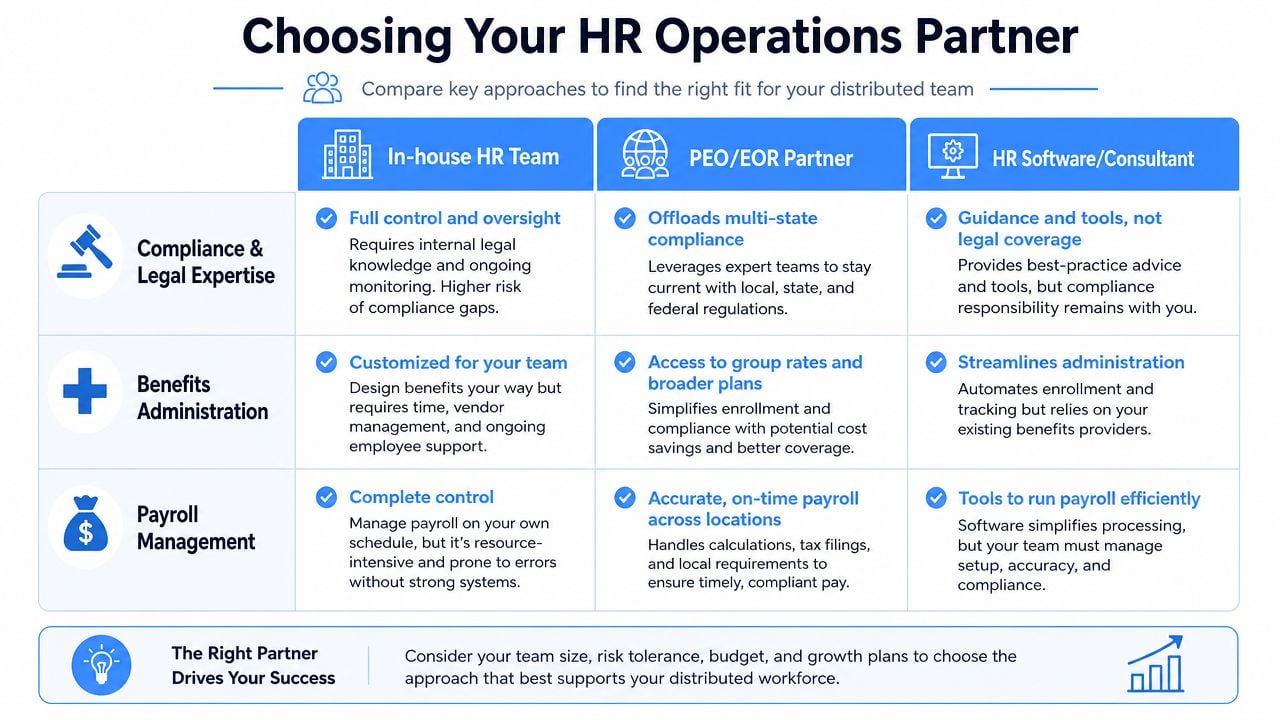
The cleanest evaluation starts with the actual operating work. Payroll runs. tax setup. benefits administration. employee support. onboarding. policy enforcement. manager escalation. leave handling. termination process. reporting.
Then compare each model against that workload.
| Option | Best fit | Watch-outs |
|---|---|---|
| In-house HR and payroll | companies with internal expertise and a stable state footprint | higher fixed headcount cost, more internal process ownership, and less outside compliance support |
| PEO or EOR-style support | employers that need broader administrative support and faster operating coverage across jurisdictions | contract terms, service boundaries, and handoff quality vary a lot |
| Payroll software plus advisors | teams with some internal capability that only need targeted outside help | coordination risk stays with the employer, especially when issues cross payroll, HR, and legal |
The management piece belongs in the same evaluation. A weak partner does not just slow down administration. It creates inconsistent manager behavior because policies, approvals, documentation, and escalation paths are unclear. SHRM's guidance on building strong manager support through HR systems and training is useful here because it reinforces the operational point. Better management usually comes from defined processes, not from asking managers to improvise.
A short buyer checklist
Leaders should press for specifics before signing anything.
- State coverage: Which jurisdictions can the provider support today, and where do gaps appear if hiring expands?
- Service ownership: Who handles implementation, employee questions, payroll corrections, leave issues, and compliance escalation?
- Benefits quality: Are the plans competitive for the talent market you hire in, or are they just convenient to bundle?
- Technology fit: Will employees and managers use the system correctly, or will it create manual workarounds outside the platform?
- Contract exposure: What changes on renewal, termination, service failure, or headcount swings?
- Reporting and controls: Can finance, HR, and leadership get the data they need for audits, workforce planning, and board reporting?
Teams that want a more structured procurement process can use this guide on how to choose a PEO to compare providers by service model, risk allocation, and fit.
A good HR operations partner reduces failure points. It does not remove leadership responsibility. The employer still owns policy decisions, manager quality, workforce planning, and the financial consequences of a bad setup.
Distributed teams run better when the support model is designed with the same discipline as any other operating function. PEO Metrics helps employers compare and negotiate PEO options with a clearer view of pricing, contract terms, service trade-offs, and compliance fit, so leadership teams can make a more confident decision without relying on provider sales pitches.
