
A 60-person company hires its first employee in another state. The employee starts quickly, but the employer's registrations, required postings, payroll withholding, leave policy, workers' compensation coverage, and handbook updates aren't ready. The hiring plan moved faster than the compliance process.
That gap is where employment compliance services enter the picture. They exist to help employers manage rules that vary by location, change over time, and create financial exposure when payroll, HR, benefits, and legal workflows don't stay aligned. This guide is for HR directors, CFOs, and business owners at companies with 10 to 2,000 employees, particularly those evaluating or managing a PEO relationship.
By the end, the practical decision should be clearer: which compliance tasks can be delegated, which responsibilities must remain under the employer's control, what type of provider fits the operating model, and which contractual protections should be negotiated before signing.
Table of Contents
- Why Employment Compliance Services Exist
- What Employment Compliance Services Actually Cover
- The Multi-State Compliance Problem Driving Demand
- Common Risk Areas Where Employers Get Burned
- Service Models Compared From PEO to Specialist Firm
- When Outsourcing Compliance Reduces Risk and When It Just Moves It
- How to Vet a Compliance Provider Before You Sign
Why Employment Compliance Services Exist
Employment compliance services exist because enforcement remains active, not because employers lack good intentions. The U.S. Department of Labor's Wage and Hour Division reported 16,924 concluded compliance actions in fiscal year 2025, following 17,300 in FY 2024 and 20,215 in FY 2023. In FY 2025, the division recovered more than $259 million in back wages for 176,957 employees nationwide. Those figures appear in the department's Wage and Hour Division enforcement data.
A growing employer can encounter that enforcement environment through an ordinary operational mistake. A manager classifies a role as exempt because the employee has a professional title. Payroll calculates overtime using one pay practice in the home state and another after expansion. HR distributes a federal poster but misses a state-specific notice. None of those failures requires intentional misconduct. Each can still create back-pay claims, penalties, interest, corrective work, and management distraction.
For an employer with operations in several states, a compliance provider may maintain registration records, monitor rule changes, update notices, test payroll practices, and coordinate corrective action. The quality of that support depends less on the length of a provider's service list than on whether it has a repeatable process for turning legal changes into operational instructions.
Practical rule: A compliance service that only produces templates is incomplete. The useful service connects a rule change to the employee population, payroll configuration, policy language, owner, deadline, and evidence of completion.
The HR compliance resources available to PEO buyers can help employers frame that evaluation, but no provider eliminates the employer's need for oversight. A business still needs to understand what the vendor performs, what the client approves, and what happens when an item is late or wrong.
What Employment Compliance Services Actually Cover
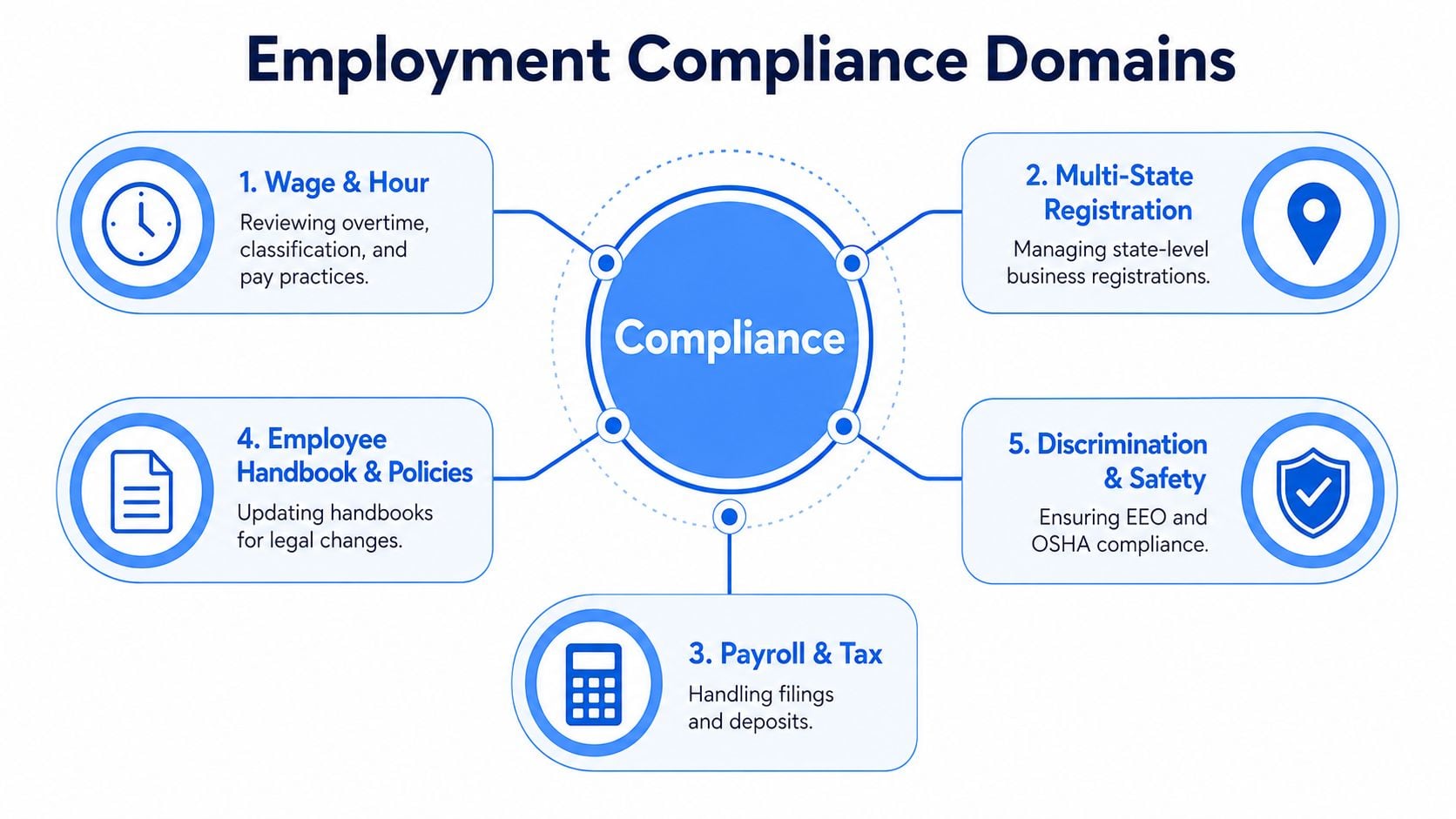
The category is broader than a policy library. Effective employment compliance services operate across several connected domains, because a change in one area often affects payroll, benefits, documentation, and manager behavior at the same time.
Wage and hour controls
A wage-and-hour review examines overtime eligibility, exempt and nonexempt classification, timekeeping, deductions, commissions, bonuses, rounding, and pay practices. A concrete work product might be a role-by-role audit that flags an exempt sales coordinator whose actual duties don't support the classification, then maps the correction into payroll and manager guidance.
The risk is cumulative. A classification error can affect back wages across the period reviewed, not just the next pay cycle. The DOL enforcement data cited above explains why providers commonly pair policy review with payroll testing and corrective-action support.
Registrations and payroll filings
A new work location can require business registrations, payroll tax withholding, unemployment insurance setup, workers' compensation coordination, and jurisdiction-specific filings. A provider may deliver a registration matrix showing each entity, state, account, filing owner, due date, and confirmation document.
Payroll providers often handle the mechanics, but employers should confirm whether the service includes account setup, notices, reconciliation, amended filings, and response support. For employers with foreign workers or specialized staffing arrangements, practical Contigo Labor Solutions compliance expertise can also provide useful context around employment-related compliance complexity.
Workplace safety and OSHA programs
Safety support can include required programs, training records, incident documentation, inspections, and response procedures. The work product might be an updated injury-reporting workflow that tells supervisors what to document, who receives the report, and how the employer preserves records.
A generic safety handbook won't correct an unsafe workstation or an incomplete incident process. The service has value when it reaches the people and locations where the risk occurs.
Benefits and employee documentation
Benefits compliance may involve ERISA plan documents, participant notices, eligibility administration, ACA reporting, and coordination with carriers or administrators. A provider could reconcile a plan change against the governing document, employee communications, payroll deductions, and enrollment records.
That reconciliation matters because a benefits change can create inconsistent evidence if the carrier file, payroll system, and plan document describe different terms.
Audits and corrective action
An audit should produce more than a list of issues. It should identify the affected population, legal or operational gap, remediation owner, deadline, employee communication requirement, and documentation needed to show completion.
Employers evaluating a broader PEO HR compliance service should ask whether the provider performs recurring audits or only responds after a complaint, notice, or agency inquiry. One-time review can identify a problem. Ongoing controls are what keep a known problem from returning.
The Multi-State Compliance Problem Driving Demand
A remote employee in a new state can create a compliance project before the employer opens an office. Multijurisdictional change management means tracking where people work, identifying which rules apply, and completing the operational changes that follow.
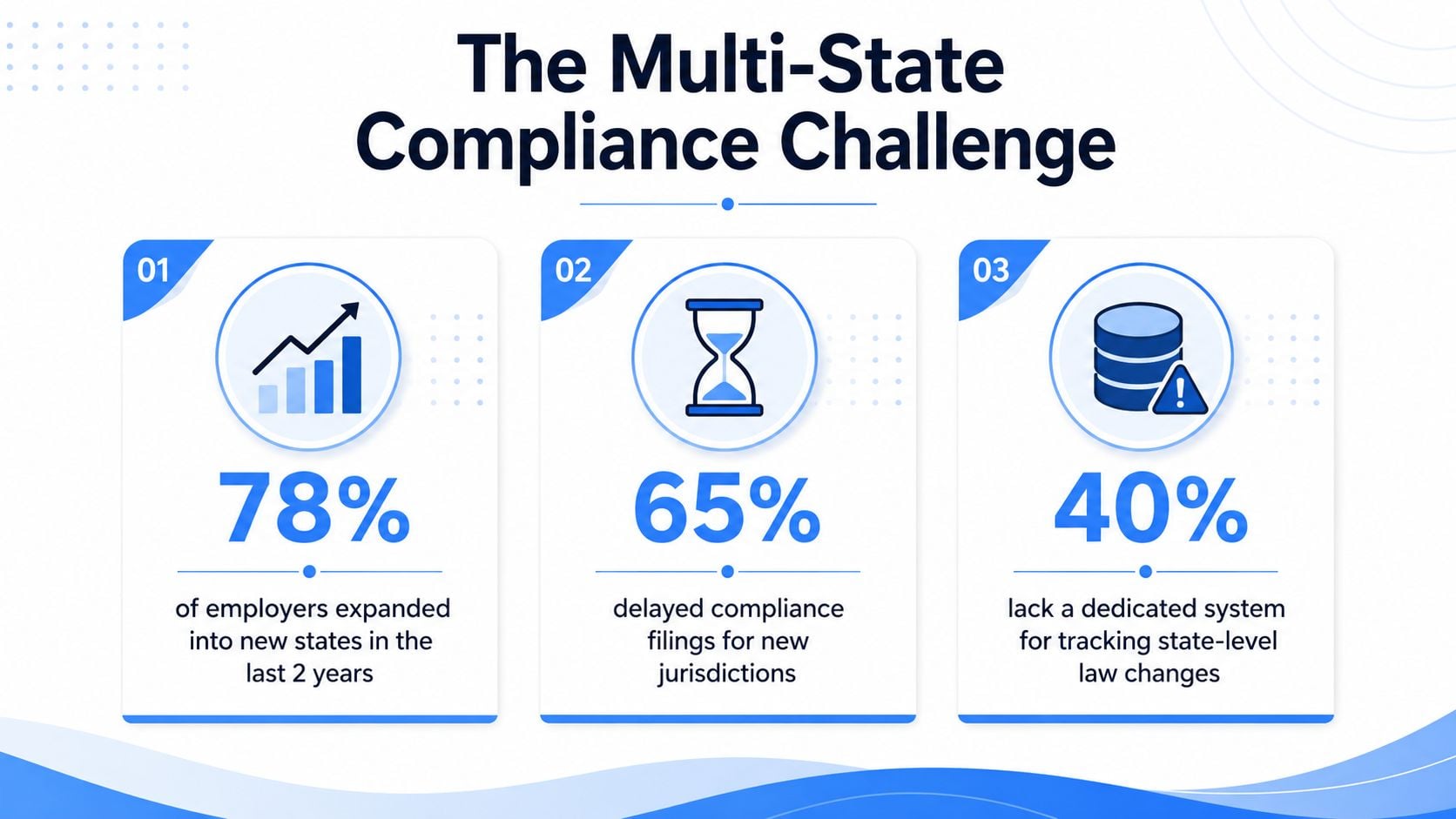
A 2026 industry survey reported that 78.2% of employers expanded into at least one new state in the prior 12 months, while 53.5% expanded into two or more states. It also found that 48% delayed hiring or expansion because of unclear state rules, and 25% incurred penalties, interest, or fines tied to multi-state compliance over the prior two years. These findings appear in the multi-state hiring compliance burden index.
What a new state triggers
Opening a location or approving remote work in a new state can require parallel workstreams:
- Registration: Confirm the legal entity, employer accounts, and operating registrations.
- Payroll tax: Configure withholding, deposits, filings, reconciliations, and corrections.
- Unemployment insurance: Establish the account and contribution process.
- Workers' compensation: Verify coverage, state requirements, and claims procedures.
- Wage and hour: Review overtime, pay timing, deductions, meal periods, and classification.
- Leave laws: Update eligibility rules, notices, tracking, and manager instructions.
- Postings: Install notices required at the employee's actual worksite.
- Handbooks: Align policy language with state and local requirements.
The work continues after launch. Transfers, relocations, hybrid schedules, acquisitions, and temporary assignments can change the governing jurisdiction during employment. Multi-state employment compliance guidance describes the control problem across registration, payroll, insurance, wage rules, leave, postings, and handbook updates.
The survey found that 36% of respondents needed at least one month before feeling fully compliant after entering a new state. California was cited as the single most difficult state by 36% of respondents, showing how one demanding market can influence the employer's operating model.
For a deeper look at how PEOs handle this, see our guide on how PEOs handle multi-state employment compliance and where companies still get fined.
A national handbook and payroll switch do not close every gap. Employers need a process that detects rule changes, assigns owners, updates systems and documents, and verifies completion. Outsourcing can provide that process, but the employer still needs visibility into what changed, who approved it, and what evidence proves the work was completed.
Common Risk Areas Where Employers Get Burned
The same failures appear repeatedly because employers treat compliance as a document problem when the exposure usually sits in the gap between policy and operations.
Consider the employee classified as exempt because the title sounds senior. The person spends most of the week performing routine coordination work, has limited discretion, and regularly works beyond the schedule recorded in payroll. During a review, the employer must defend the classification and reconstruct compensation history. If the exemption fails, the dispute can involve back wages, penalties, interest, and a large amount of management time, even before legal fees enter the discussion.
A second employer distributes a federal labor poster at every office but never checks whether a new state notice applies to a remote employee. The missing posting doesn't surface until an unrelated complaint triggers a broader review. The immediate correction may be simple. The harder task is proving which employees saw which notices and when.

Four failure patterns worth testing
- Classification drift: A job changes after hiring, but the exemption analysis never changes with it. The employer should compare actual duties, authority, salary basis, and time records, not rely on the original job description.
- Overtime inconsistency: Payroll uses a standard calculation that doesn't reflect a jurisdiction's treatment of bonuses, commissions, or other compensation. A small configuration error can affect every employee in the group.
- Leave-law gaps: The handbook contains a general leave policy, but managers don't know how a state-specific request interacts with attendance rules, documentation, or reinstatement.
- Benefits document mismatch: A carrier or provider changes administration, while the plan document, employee notice, payroll deduction, and enrollment file remain out of sync.
The operational controls required for these risks are location-specific. Employers need to track registrations, withholding, unemployment insurance, workers' compensation, wage-and-hour rules, leave laws, postings, and handbook updates for each employee's work location, as outlined in the multi-state employer compliance framework. A background-screening process can create a similar coordination challenge, particularly for organizations handling sensitive volunteer populations. Employers reviewing background checks for nonprofits should apply the same discipline to ownership, timing, notices, and documentation.
Audit question: If an agency asked for the employer's current policy, payroll configuration, registration record, and proof of employee notice, could the company produce one consistent answer?
Service Models Compared From PEO to Specialist Firm
The provider model determines what the vendor performs, what the employer retains, and whether any legal responsibility shifts. A sales presentation may describe “full compliance support,” but the agreement controls the practical outcome.
The IRS states that using a PEO doesn't remove employment tax responsibility when the client remains the common-law employer. The client remains responsible if the third party fails to make required deposits or filings. Under IRC Section 3511, however, a certified PEO in good standing is treated as the employer for wages it pays, shifting federal payroll tax liability for those wages away from the client business, as explained by the IRS guidance on third-party payer arrangements.
| Service Model | What Shifts Contractually | Typical Cost Structure | Best Fit |
|---|---|---|---|
| PEO | Payroll administration, benefits administration, HR support, and selected compliance functions move to the PEO. Common-law employer duties and client oversight generally remain relevant. | Bundled administrative fee, per-employee pricing, or a percentage-based structure, often combined with insurance and benefits costs. | Employers seeking an integrated operating model, particularly during growth or multi-state expansion. |
| ASO or payroll provider | Administrative execution shifts without a co-employment structure. The client generally retains employer responsibility and decision authority. | Separate service fees for payroll, HR administration, tax filings, or compliance modules. | Employers with internal HR leadership that wants execution support without broad PEO integration. |
| Compliance software | Workflow, reminders, document storage, reporting, and change tracking shift to a platform. Legal judgment and implementation remain with the employer. | Subscription or usage-based pricing, sometimes with implementation or support charges. | Employers with capable internal owners and reliable data processes. |
| Boutique employment-law firm | Legal analysis, audits, investigations, policy drafting, and agency response support shift to counsel for the contracted scope. | Hourly, project, retainer, or fixed-fee arrangements. | Employers facing specialized issues, disputes, transactions, or higher-risk policy decisions. |
A PEO also requires benefits diligence. The Department of Labor has said a bona fide PEO can sponsor a multiple employer plan only when it performs substantial employment functions for client employers. The DOL's safe harbor includes paying wages, handling federal employment tax reporting and withholding, taking a defined role in recruiting, hiring, or firing, and exercising substantial control over employee benefits functions.
Employers comparing outsourced human resources options should therefore review the contract's responsibility matrix, not just the service menu. The question is not only who does the work. It's who carries the consequence when the work fails.
When Outsourcing Compliance Reduces Risk and When It Just Moves It
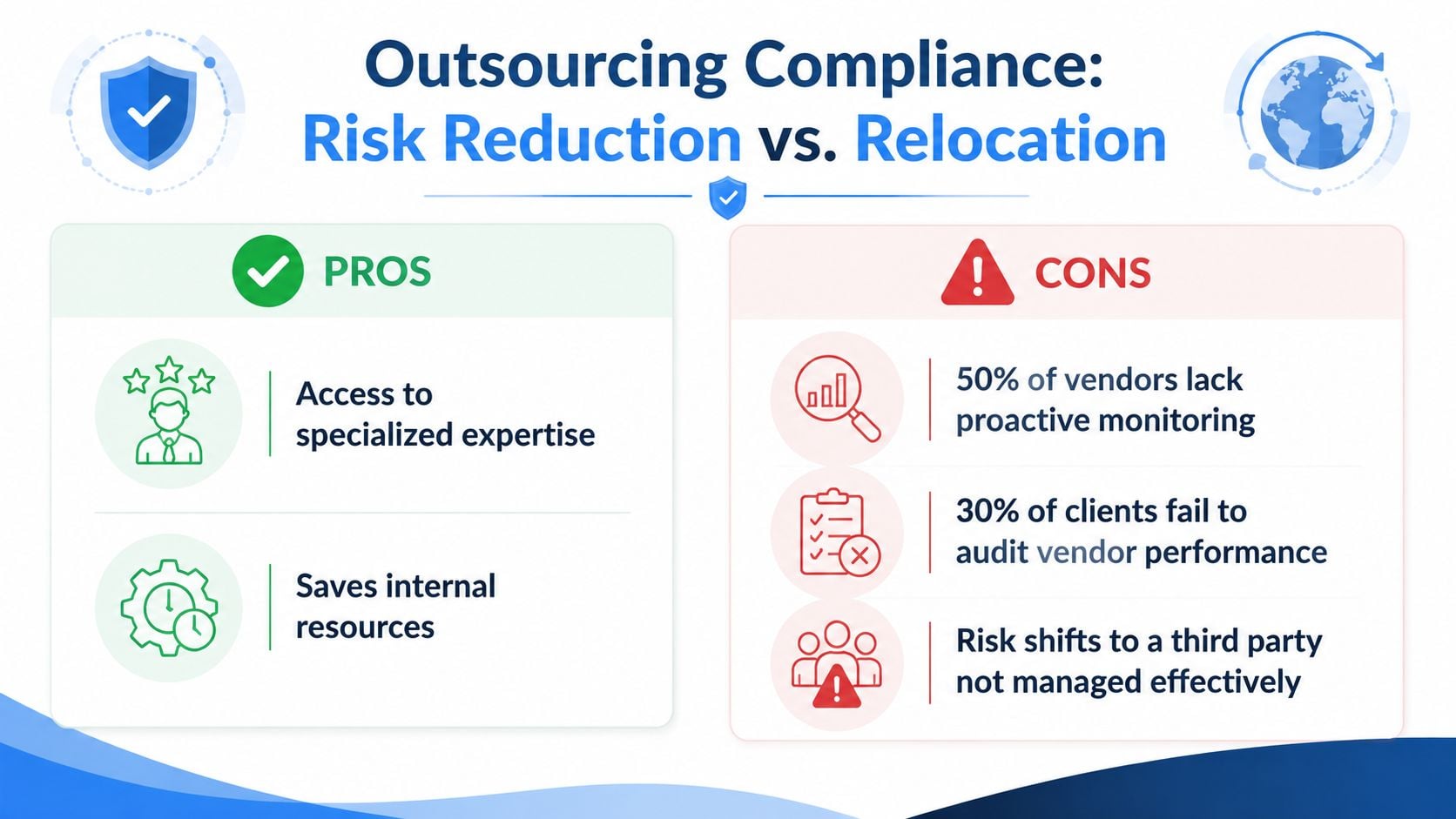
Outsourcing reduces risk when it gives a neglected task a capable owner, a documented process, review controls, and a reliable escalation path. It merely moves risk when the employer delegates the activity but loses visibility into deadlines, filings, data quality, and error correction.
The demand is understandable. 50% of HR teams say they lack sufficient resources to manage compliance effectively, and many spend an average of $66,280 per year on outside counsel, according to employment compliance coverage on the 2026 compliance environment. Those figures explain why a CFO may prefer a managed service, but they don't prove that every outsourced model creates a better control environment.
Tasks that usually delegate well
Registrations, poster distribution, recurring filing calendars, payroll tax deposits, and routine handbook change management often transfer effectively when the provider has the right systems and receives accurate information. A certified PEO may also provide a meaningful federal payroll tax shift for wages it pays under IRC Section 3511, subject to the certification and good-standing requirements.
The employer should still retain approval rights and evidence. A monthly compliance report should show open items, completed actions, late items, filing confirmations, and exceptions requiring client decisions.
Responsibilities that remain with the employer
The client may remain the common-law employer even while a PEO processes payroll. The client also controls workplace conditions, manager conduct, hiring decisions, job duties, scheduling, and many benefits decisions. A provider can advise on a hazardous practice, but it can't physically correct the workplace or supervise every manager.
Benefits arrangements require special care. The DOL has said a bona fide PEO may sponsor a multiple employer plan only if it performs substantial employment functions for client employers. A PEO-sponsored health arrangement covering employees of two or more client employers is a MEWA under ERISA, which places the arrangement within a specialized regulatory framework. The employer therefore needs diligence around plan governance, disclosures, financial controls, claims administration, and contractual recourse.
A keep-versus-delegate test
Keep a task in-house when it requires business judgment, employee relations decisions, workplace control, or fiduciary oversight. Delegate it when the activity is repeatable, rules-based, measurable, and supported by provider access to the required systems.
A strong contract should add service-level agreements, audit rights, correction deadlines, notification duties, data controls, and defined indemnification. Without those terms, outsourcing can reduce internal workload while leaving the underlying exposure substantially intact.
How to Vet a Compliance Provider Before You Sign
A provider should survive a practical test before the employer signs a PEO, ASO, payroll, software, or consulting agreement. The test should focus on failure scenarios, not polished demonstrations.
Ask who owns the mistake
The contract should state who bears penalties, interest, amended filing costs, employee remediation, and agency-response costs when the provider receives correct information but files incorrectly or misses a deadline. It should also define what happens when the employer supplies late, incomplete, or inaccurate data.
A vague promise to “support compliance” isn't enough. The responsibility matrix should name the task, system, owner, input, deadline, review step, evidence, and escalation contact.
Demand operational visibility
The provider should explain how it monitors state and local changes, how it determines which employees and entities are affected, and how quickly it notifies the client. A monthly email with legal headlines is weaker than a change log tied to policy updates, payroll configuration, affected locations, and completion status.
The agreement should include:
- Service levels: Response times, filing deadlines, implementation milestones, and correction commitments.
- Audit rights: Access to filing confirmations, account records, change logs, controls, and relevant subcontractor information.
- Liability terms: Indemnification scope, exclusions, caps, insurance requirements, and treatment of regulatory penalties.
- Data controls: Security responsibilities, retention periods, access rights, incident notification, and data return at termination.
- Exit protection: Transfer of registrations, employee records, reports, filings, and open compliance matters without operational interruption.
The lowest bid often hides the most risk transfer. A lower fee may exclude state registrations, amended returns, penalty-letter support, legal review, or proactive monitoring. Those exclusions only become visible when the employer is already under pressure.
Employers can also use PEO accreditation and provider evaluation criteria to structure diligence, then test the shortlisted provider against the company's actual states, entities, payroll systems, benefits arrangements, and recent compliance incidents.
This week, the employer should take the current or shortlisted provider agreement and mark every compliance task as client-owned, provider-owned, shared, or undefined. Any item marked undefined should be resolved before the next renewal or signature date.
PEO Metrics helps employers compare PEOs and other HR service models across pricing, benefits, contract terms, compliance support, service quality, and industry fit, while identifying liability language, exit terms, fee increases, and renewal risks. Visit PEO Metrics to evaluate provider options with an independent side-by-side analysis before committing to a compliance model.
