
Choosing a PEO isn’t like picking software—you’re essentially handing over payroll, benefits, and compliance to a co-employer. Get it wrong, and you’re stuck in a contract with hidden fees, clunky service, or benefits your team hates.
This comparison cuts through the marketing noise. We’ve evaluated nine PEO providers based on what actually matters: pricing transparency, service responsiveness, benefits quality, and how well they handle the messy realities of multi-state compliance and workers’ comp.
Whether you’re a 10-person startup or a 200-employee company hitting growing pains, this guide helps you match provider strengths to your specific situation. Here are the top PEO providers worth considering.
1. PEO Metrics
Best for: Businesses tired of opaque pricing and biased sales pitches who want unbiased data before committing
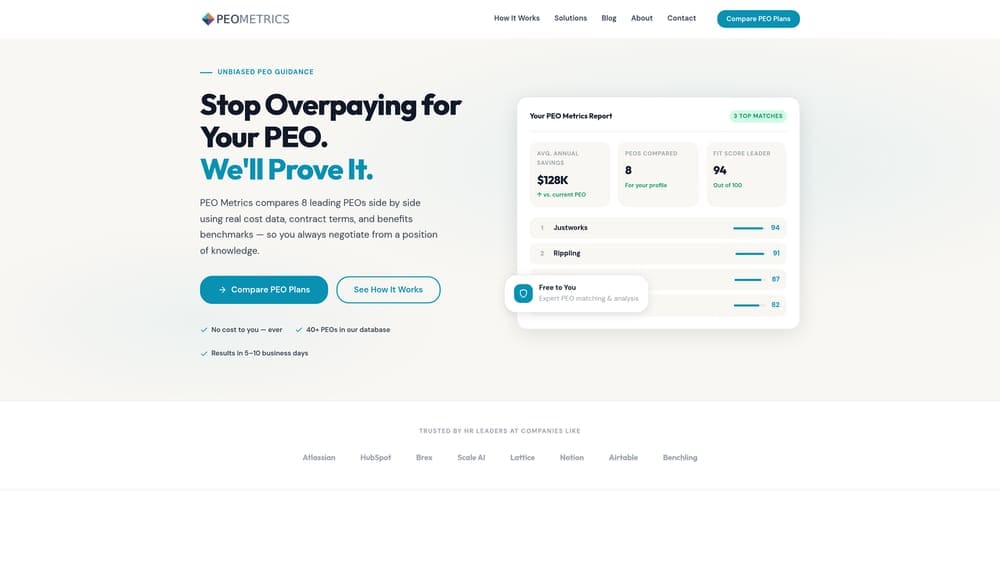
PEO Metrics isn’t a PEO—it’s an independent comparison service that gives you the data PEO salespeople don’t want you to see upfront.
Where This Tool Shines
Most businesses end up comparing PEOs by scheduling five sales calls, listening to polished pitches, and trying to decode intentionally vague pricing. PEO Metrics flips that process. You get side-by-side comparisons with actual pricing structures, contract terms spelled out clearly, and metrics on service quality that matter.
Because they don’t earn commissions from providers, the guidance stays grounded in what fits your situation—not what pays the highest referral fee. That matters when you’re about to sign a multi-year contract that touches every employee.
Key Features
Side-by-Side Provider Comparisons: See pricing models, service tiers, and contract terms laid out clearly without scheduling multiple sales demos.
Unbiased Guidance: No commission incentives means recommendations focus on fit, not which provider pays the most for referrals.
Detailed Pricing Analysis: Understand whether you’re looking at per-employee flat rates or percentage-of-payroll models before the first sales call.
Hidden Fee Identification: Spot administrative markups, implementation charges, and contract exit penalties that only surface after you’ve invested time in the sales process.
Contract Term Breakdowns: Know what you’re signing before you’re locked in—including renewal terms and termination conditions that matter when things go sideways.
Best For
Businesses evaluating their first PEO or switching providers who want transparent data upfront. Especially valuable if you’re comparing multiple options and don’t want to waste weeks decoding sales pitches. Works for any size company, but particularly helpful for businesses with 20-200 employees where pricing differences add up fast.
Pricing
Free comparison service. No cost to access provider data, pricing analysis, or guidance.
2. Justworks
Best for: Startups and small businesses wanting transparent pricing and a modern platform without enterprise complexity
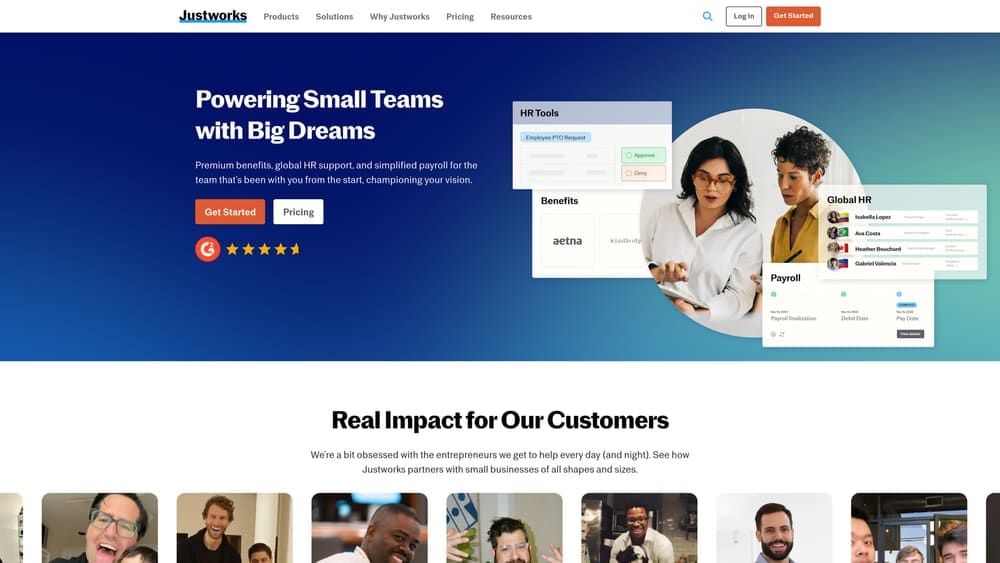
Justworks built its reputation on doing one thing most PEOs avoid: publishing actual pricing on their website.
Where This Tool Shines
If you’re a 15-person startup that doesn’t want to schedule a sales call just to learn what this will cost, Justworks makes sense. Flat per-employee pricing means you can budget accurately without surprises. The platform itself feels like modern SaaS—clean interface, intuitive workflows, nothing that requires a manual to figure out.
Their support for remote teams and contractors reflects how small businesses actually operate now. You’re not fighting a system built for traditional office setups.
Key Features
Flat Per-Employee Pricing: $59 or $99 per employee monthly depending on tier—no percentage-of-payroll calculations that balloon as you give raises.
Modern Platform Design: Interface that doesn’t feel like it was built in 2008, with mobile access that actually works.
Remote Work Support: Handles distributed teams and contractor management without treating it like an edge case.
24/7 Customer Support: Chat, email, and phone access whenever issues hit—not just business hours.
Quick Implementation: Onboarding measured in days, not months, which matters when you need to get payroll running.
Best For
Companies with 5-75 employees who value pricing transparency and platform usability over white-glove consulting. Strong fit for tech startups, remote-first companies, and businesses that prefer self-service tools with support available when needed.
Pricing
Basic tier at $59 per employee monthly; Plus tier at $99 per employee monthly with enhanced benefits and compliance support.
3. TriNet
Best for: Companies wanting industry-specific expertise and access to Fortune 500-level benefit plans
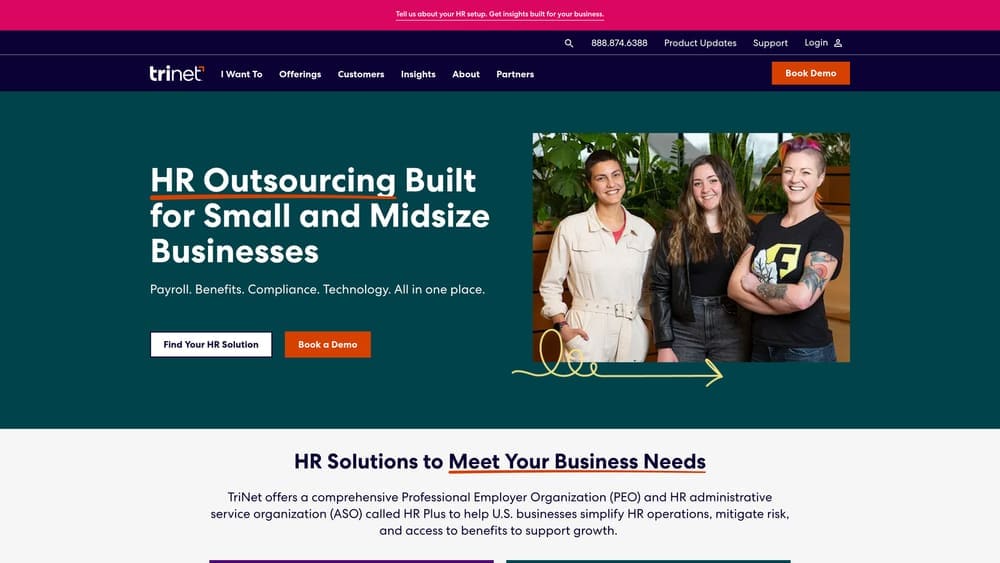
TriNet operates differently than generalist PEOs—they’ve built specialized expertise in specific industries rather than trying to serve everyone equally.
Where This Tool Shines
If you’re in tech, financial services, life sciences, or professional services, TriNet’s vertical focus means they understand your compliance headaches before you explain them. Their benefits packages genuinely compete with what large enterprises offer—multiple carrier options, robust health plans, and perks that help recruit talent.
The strategic HR consulting goes beyond basic compliance. You’re getting guidance on compensation strategy, organizational structure, and workforce planning from people who know your industry.
Key Features
Industry Vertical Specialization: Dedicated teams for tech, financial services, life sciences, nonprofits, and professional services with relevant compliance expertise.
Premium Benefits Access: Health, dental, vision, and retirement plans typically reserved for much larger companies.
Comprehensive Compliance Support: Multi-state employment law guidance, policy development, and audit defense that reflects industry-specific regulations.
Strategic HR Consulting: Compensation benchmarking, organizational design, and talent strategy—not just transactional HR tasks.
Technology Platform: Solid core functionality with employee self-service, though not as modern as pure tech-focused providers.
Best For
Growing companies with 20-500 employees in specialized industries who need both strong benefits and expert HR guidance. Best fit when recruiting competitive talent matters and you want benefits that don’t scream “small company.”
Pricing
Custom quotes based on percentage-of-payroll model. Expect pricing in the 3-8% range depending on services, employee count, and industry risk profile.
4. Insperity
Best for: Businesses valuing high-touch service with a dedicated HR specialist who knows your company
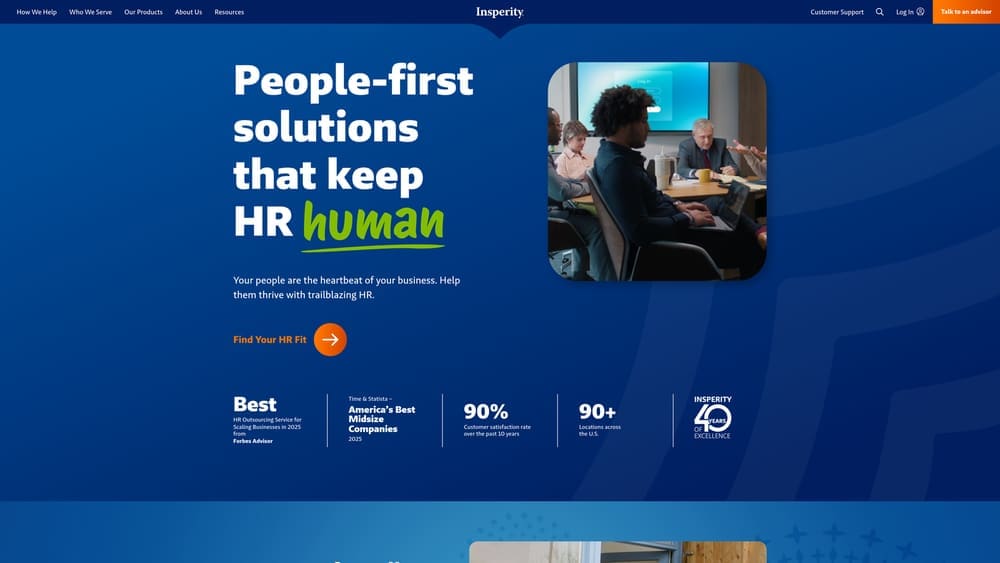
Insperity positions itself as the premium service option—you’re paying for hands-on support, not just platform access.
Where This Tool Shines
The dedicated HR specialist model means you’re not explaining your situation to a different call center rep each time. Your specialist learns your business, knows your employees, and can provide proactive guidance instead of reactive problem-solving.
Their employee training and development programs go beyond what most PEOs offer. If you’re trying to build management capability or upskill teams, these resources add real value beyond basic HR administration.
Key Features
Dedicated HR Specialist: One person assigned to your account who becomes familiar with your business operations and culture.
Employee Training Programs: Leadership development, management training, and professional development resources typically found at larger organizations.
Robust Benefits Packages: Multiple carrier options with competitive health, dental, vision, and retirement plans.
Performance Management Tools: Structured systems for reviews, goal tracking, and employee development beyond basic HR functions.
Proactive Compliance Monitoring: Your specialist tracks regulatory changes affecting your business rather than waiting for you to ask.
Best For
Established small businesses with 20-150 employees who want consultative partnership over self-service efficiency. Strong fit if you’re building HR infrastructure, developing managers, or need guidance on organizational challenges beyond payroll and benefits.
Pricing
Custom quotes with premium pricing reflecting service quality. Generally higher than platform-focused competitors but includes more hands-on support.
5. ADP TotalSource
Best for: Companies planning significant growth or international expansion who need enterprise-grade infrastructure
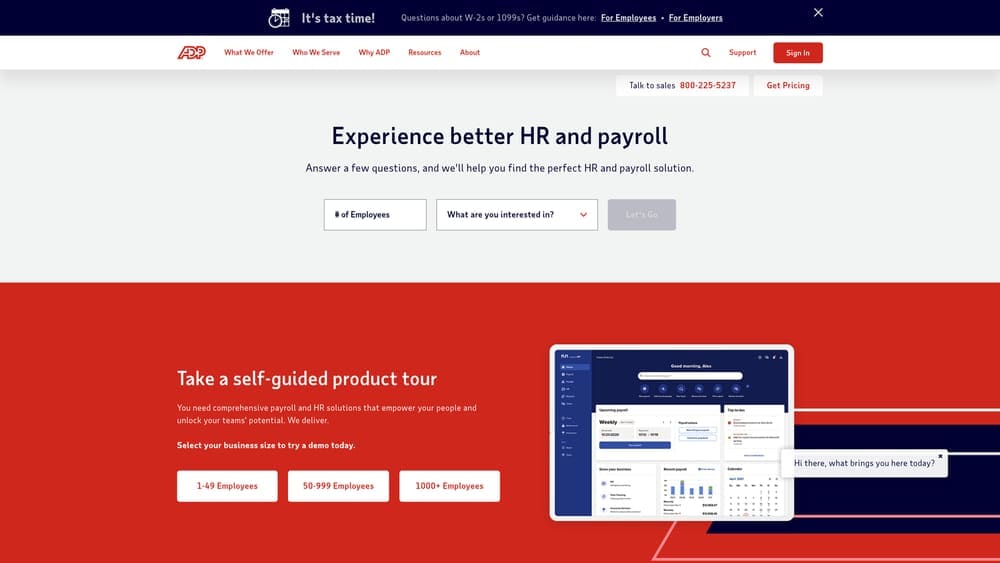
ADP TotalSource brings ADP’s massive payroll and HR infrastructure to the PEO model.
Where This Tool Shines
If you’re already using ADP for payroll, the integration eliminates the data migration headaches that plague PEO switches. Their compliance and legal resources reflect decades of managing complex employment situations—you’re tapping into institutional knowledge and established carrier relationships.
The scalability matters if you’re planning aggressive growth. You won’t outgrow their capabilities at 100, 500, or even 1,000 employees. Global expansion support exists when you need it, which most smaller PEOs can’t handle.
Key Features
ADP Ecosystem Integration: Seamless connection with ADP payroll, time tracking, and HR systems if you’re already in their environment.
Extensive Compliance Resources: Deep legal expertise, policy templates, and audit support backed by substantial infrastructure.
Enterprise Scalability: Systems and processes that support growth from 50 to 500+ employees without switching providers.
Global Capabilities: International payroll and expansion support when you’re ready to hire beyond U.S. borders.
Established Carrier Relationships: Access to competitive benefits rates through long-standing insurance partnerships.
Best For
Mid-sized companies with 75-500 employees planning significant growth, especially those already using ADP services. Best fit for businesses expanding into multiple states or considering international operations where provider continuity matters.
Pricing
Custom enterprise pricing based on employee count, services selected, and complexity. Expect percentage-of-payroll model with implementation fees.
6. Paychex PEO
Best for: Businesses valuing local, in-person support and flexible service tiers
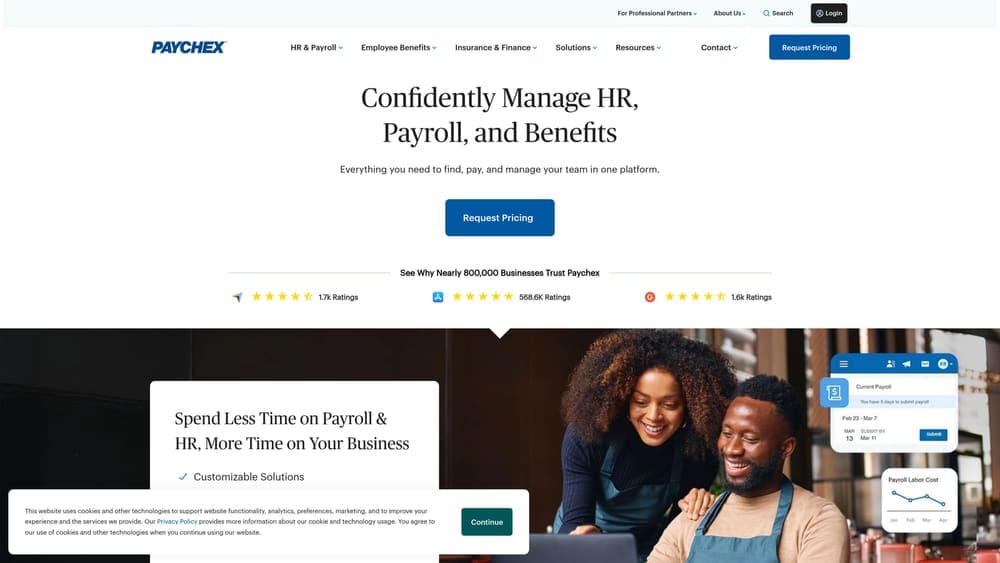
Paychex PEO differentiates itself through an extensive branch network—you can actually meet with someone locally, not just call a national support line.
Where This Tool Shines
The branch presence matters if you prefer face-to-face interaction for complex issues or simply want someone nearby who understands local business conditions. Their payroll accuracy reputation comes from decades of processing experience—errors happen less frequently than with newer platforms.
Pay-as-you-go workers’ comp appeals to businesses with variable staffing or seasonal fluctuations. You’re not prepaying premiums based on estimates that might be wildly off.
Key Features
Local Branch Network: In-person support options through regional offices rather than purely remote service.
Flexible Service Tiers: Multiple packages letting you select coverage levels matching your needs and budget.
Payroll Accuracy: Strong reputation for error-free processing backed by established systems and procedures.
Workers’ Comp Flexibility: Pay-as-you-go options that align premium payments with actual payroll rather than estimated projections.
Small Business Focus: Service model and pricing structured for companies with 5-150 employees.
Best For
Small businesses with 10-100 employees who value local relationships and in-person interaction. Good fit for companies in industries with variable staffing needs or those uncomfortable with purely digital service models.
Pricing
Custom quotes with competitive small business pricing. Generally mid-range compared to premium providers, with flexibility based on services selected.
7. Rippling PEO
Best for: Tech-forward companies wanting unified HR and IT management in one platform
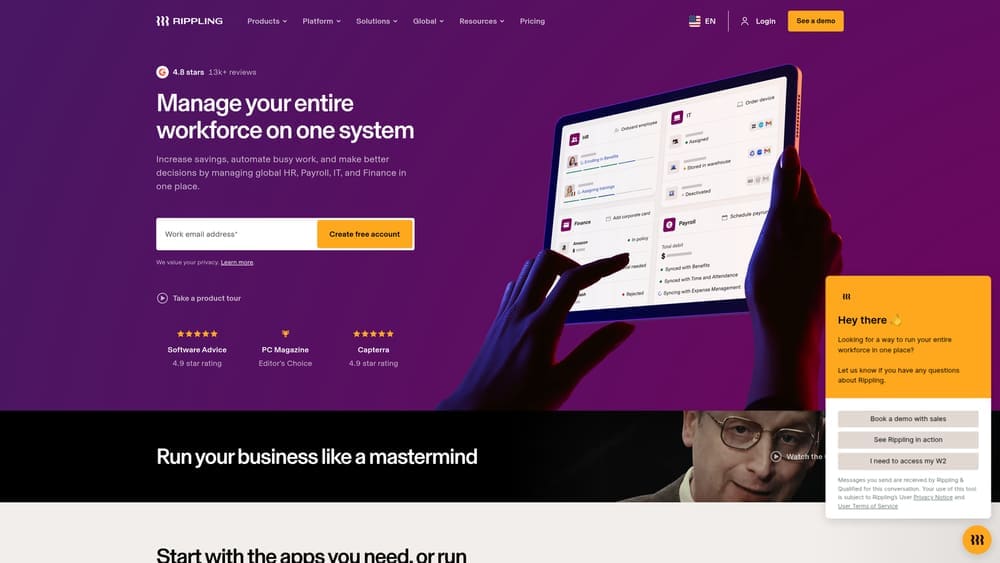
Rippling PEO approaches the market differently—they built a unified system managing both HR and IT infrastructure rather than bolting PEO services onto legacy payroll software.
Where This Tool Shines
If you’re onboarding a new employee, Rippling handles everything in one workflow: payroll setup, benefits enrollment, laptop provisioning, app access, and email account creation. That unified approach eliminates the usual coordination headaches between HR and IT.
The automation and customization capabilities exceed traditional PEOs. You can build workflows matching your specific processes rather than adapting to rigid provider requirements. Their API and integration ecosystem connects with modern tools your team actually uses.
Key Features
Unified HR and IT Management: Single platform handling payroll, benefits, device management, and app provisioning together.
Automated Device Provisioning: New hire laptop setup, software installation, and account creation happen automatically based on role.
Customizable Workflows: Build automation matching your processes rather than conforming to provider limitations.
Strong API Ecosystem: Integrations with modern SaaS tools and ability to build custom connections when needed.
Modern Platform Experience: Interface and functionality reflecting current technology standards, not legacy system constraints.
Best For
Tech companies and remote-first businesses with 15-300 employees who want tight integration between HR and IT. Best fit when your team uses multiple SaaS tools and you value automation over high-touch consulting.
Pricing
Modular pricing with PEO services as an add-on to their core platform. Costs vary based on features selected and employee count.
8. Amplify PEO
Best for: Companies in high-risk industries struggling with workers’ compensation costs and experience modification rates
Amplify PEO specializes in industries most PEOs avoid or price prohibitively—construction, manufacturing, transportation, and other sectors with elevated risk profiles.
Where This Tool Shines
If your experience mod rate is killing your workers’ comp premiums, Amplify’s risk management approach can actually move the number. They understand the specific safety challenges in high-risk industries and provide consulting that reduces incidents rather than just processing claims.
Pay-as-you-go workers’ comp helps with cash flow when you’re managing variable staffing or project-based work. You’re not fronting large premium payments based on estimates that might be way off.
Key Features
High-Risk Industry Expertise: Specialized knowledge in construction, manufacturing, transportation, and other sectors with elevated workers’ comp exposure.
Workers’ Comp Solutions: Focus on reducing experience mod rates through proactive risk management, not just claim processing.
Pay-As-You-Go Premiums: Workers’ comp payments aligned with actual payroll rather than upfront estimates requiring year-end reconciliation.
Risk Management Consulting: Safety program development, training, and incident prevention specific to your industry hazards.
Claims Management: Hands-on support navigating the workers’ comp claim process to minimize impact on your mod rate.
Best For
Companies in construction, manufacturing, transportation, or other high-risk industries with 10-200 employees facing elevated workers’ comp costs. Especially valuable if your experience mod is above 1.0 and affecting your ability to bid competitively.
Pricing
Custom quotes reflecting your specific risk profile, industry, and claims history. Generally competitive for high-risk sectors where other PEOs quote prohibitively high rates.
9. CoAdvantage
Best for: Mid-sized companies wanting customized service arrangements without full PEO bundling
CoAdvantage offers flexibility most PEOs don’t—you can select specific services rather than accepting a predetermined bundle.
Where This Tool Shines
If you already have benefits figured out but need payroll and compliance support, CoAdvantage lets you structure that arrangement. Their à la carte approach means you’re not paying for services you don’t need or capabilities you’ve already built internally.
The flexible contract terms matter when you’re uncertain about long-term needs or want the ability to adjust as your business changes. Many PEOs lock you into rigid multi-year commitments that become problematic when circumstances shift.
Key Features
À La Carte Service Selection: Choose specific components—payroll, benefits, compliance, HR consulting—rather than accepting predetermined packages.
Flexible Contract Terms: More negotiable agreements compared to rigid standard contracts from larger providers.
Mid-Market Focus: Service model designed for companies with 50-300 employees with more complex needs than startups but not enterprise scale.
Customizable Technology: Integration flexibility with your existing systems rather than forcing complete platform replacement.
Scalable Arrangements: Ability to add or remove services as your needs evolve without renegotiating entire agreements.
Best For
Established businesses with 50-250 employees who have specific needs rather than requiring full-service PEO bundling. Good fit if you’ve already invested in certain HR capabilities and want to supplement rather than replace them.
Pricing
Custom quotes based on services selected and employee count. Modular pricing structure allows cost control by choosing only needed components.
Making the Right Choice
The PEO you choose affects every employee, every paycheck, and every benefit claim for the length of your contract. That decision deserves more than a polished sales pitch and a handshake.
If you’re a startup wanting transparent pricing and modern tools, Justworks or Rippling make sense. Need industry expertise and premium benefits? TriNet delivers. Want high-touch service with dedicated support? Insperity fits. Planning significant growth or international expansion? ADP TotalSource scales appropriately. Struggling with workers’ comp in a high-risk industry? Amplify specializes there.
But before you commit, understand what you’re actually paying. Most businesses discover hidden fees, administrative markups, and contract terms that weren’t clear during sales conversations only after they’ve signed.
Before you sign that PEO renewal, make sure you’re not leaving money on the table.
Many businesses unknowingly overpay because of bundled fees, hidden administrative markups, and contracts designed to limit flexibility. We give you a clear, side-by-side breakdown of pricing, services, and contract terms—so you can see exactly what you’re paying for and choose the option that truly fits your business.
