
The most popular advice on OSHA compliance is also the most dangerous. It tells employers to “partner with a PEO and let them handle it.”
That framing is wrong. A PEO can help with training administration, claims coordination, recordkeeping support, and policy infrastructure. It can't stand on the shop floor, inspect a ladder, verify a machine guard, or explain missing documentation to an inspector who's asking what happened, who trained the employee, and where the records are.
For companies evaluating a PEO, the actual question isn't whether OSHA risk can be outsourced. It can't. The useful question is whether the PEO improves the employer's control over safety, reporting, and documentation, or merely adds another party to blame after an incident.
Table of Contents
- Your PEO Does Not Make You OSHA-Proof
- The Core OSHA Mandates Every Employer Must Know
- How Requirements Change for Your Industry and Size
- The Most Common and Costly Compliance Pitfalls
- A Practical Guide to Surviving an OSHA Inspection
- Vetting Your PEOs OSHA Compliance Promises
- Frequently Asked Questions About OSHA Compliance
Your PEO Does Not Make You OSHA-Proof
A co-employment relationship doesn't erase employer responsibility. That matters because OSHA's reach is broad. Federal OSHA and state partners oversee about 130 million workers across more than 8 million worksites, with roughly 1,850 inspectors nationwide, or about one compliance officer for every 70,000 workers, according to OSHA common statistics. The same OSHA data says workplace injuries and illnesses fell from 10.9 incidents per 100 workers in 1972 to 2.4 per 100 in 2023, which shows how standards, inspections, and recordkeeping have shaped employer behavior over time.
A CFO should read that another way. Inspection resources are limited, but the duty to comply isn't. Many employers won't see an inspector until something serious happens, and by then the file review moves quickly from “Who was responsible?” to “Show the evidence.”
That's where weak PEO assumptions fail. If the service team helped draft handbook language but no one maintained training logs, site inspections, or incident escalation rules, the employer still carries the exposure. The issue isn't whether the PEO mentioned safety in a proposal. The issue is whether the company can produce records, corrective actions, and a clear chain of responsibility.
Practical rule: Treat a PEO as a compliance support vendor, not a liability transfer device.
For buyers comparing providers, this is less about legal theory and more about operating discipline. The employer still controls the workplace, supervisors, equipment, and work practices. A good PEO can strengthen those systems. A weak one can create false confidence and fragmented accountability.
A useful way to pressure-test that risk is to review examples of PEO compliance overreliance risk. The pattern is usually the same. The contract says “support,” the employer hears “covered,” and nobody notices the gap until an injury, complaint, or inspection exposes it.
The Core OSHA Mandates Every Employer Must Know
The center of the rule set is simple even when the paperwork isn't. Employers must furnish a workplace free of serious recognized hazards, inspect workplace conditions for conformity with OSHA standards, provide and maintain safe tools and equipment, implement hazard communication for hazardous chemicals, and train employees in a language and vocabulary they understand, according to OSHA employer responsibilities.
That list sounds general. It becomes operational fast.
What the law expects in day-to-day operations
The General Duty Clause matters most when a hazard is obvious but not well managed. If a company knows employees work around forklifts, energized equipment, raised surfaces, chemicals, or repetitive manual handling, management needs a repeatable method to identify hazards, assign controls, verify correction, and train employees.
Hazard communication is where many office-based leaders underestimate exposure. A company may think it has “no real chemical risk,” then discover cleaning supplies, maintenance products, shop chemicals, or production inputs trigger labeling, Safety Data Sheet access, and training obligations.
For employers with facility equipment, lockout and tagout issues are a common blind spot. A practical example is commercial door hazardous energy control, where servicing powered doors can expose workers to moving parts or stored energy if shutdown procedures aren't clear, documented, and enforced.
What has to be reported fast
Some events trigger immediate reporting. Those deadlines are short enough that companies need a prebuilt escalation path, not a meeting about who owns the process.
| Event or Document | Deadline | Required Form/Action |
|---|---|---|
| Fatality | Within 8 hours | Report to OSHA |
| Inpatient hospitalization | Within 24 hours | Report to OSHA |
| Amputation | Within 24 hours | Report to OSHA |
| Eye loss | Within 24 hours | Report to OSHA |
Many employers also maintain OSHA forms and incident files as part of regular recordkeeping, but the urgent mistake is delay. If a plant manager, HR lead, broker, workers' compensation contact, and PEO account team all assume someone else has made the call, the reporting window can close before anyone acts.
A serious injury reporting process should work at 2 p.m. and at 2 a.m. If it depends on one person checking email, it isn't a process.
A baseline checklist for management
A practical internal audit for osha requirements for employers should cover these items:
- Hazard identification: Are supervisors documenting workplace inspections and corrective actions, not just discussing them verbally?
- Equipment control: Are tools, machines, and PPE assigned, maintained, and replaced through a defined process?
- Chemical communication: Can an employee quickly access labels, Safety Data Sheets, and training relevant to the products in use?
- Training delivery: Can the company prove employees were trained in language and vocabulary they understand?
- Incident escalation: Does every location know who reports severe events and who is backup if the primary contact is unavailable?
Finance leaders should also look at system integration. Safety, workers' compensation, payroll, and HR administration often sit in separate hands. That's why the handoff between claims activity and compliance activity matters. A useful framework is PEO workers' comp and safety compliance integration, especially for employers with multiple sites or rotating shifts.
How Requirements Change for Your Industry and Size
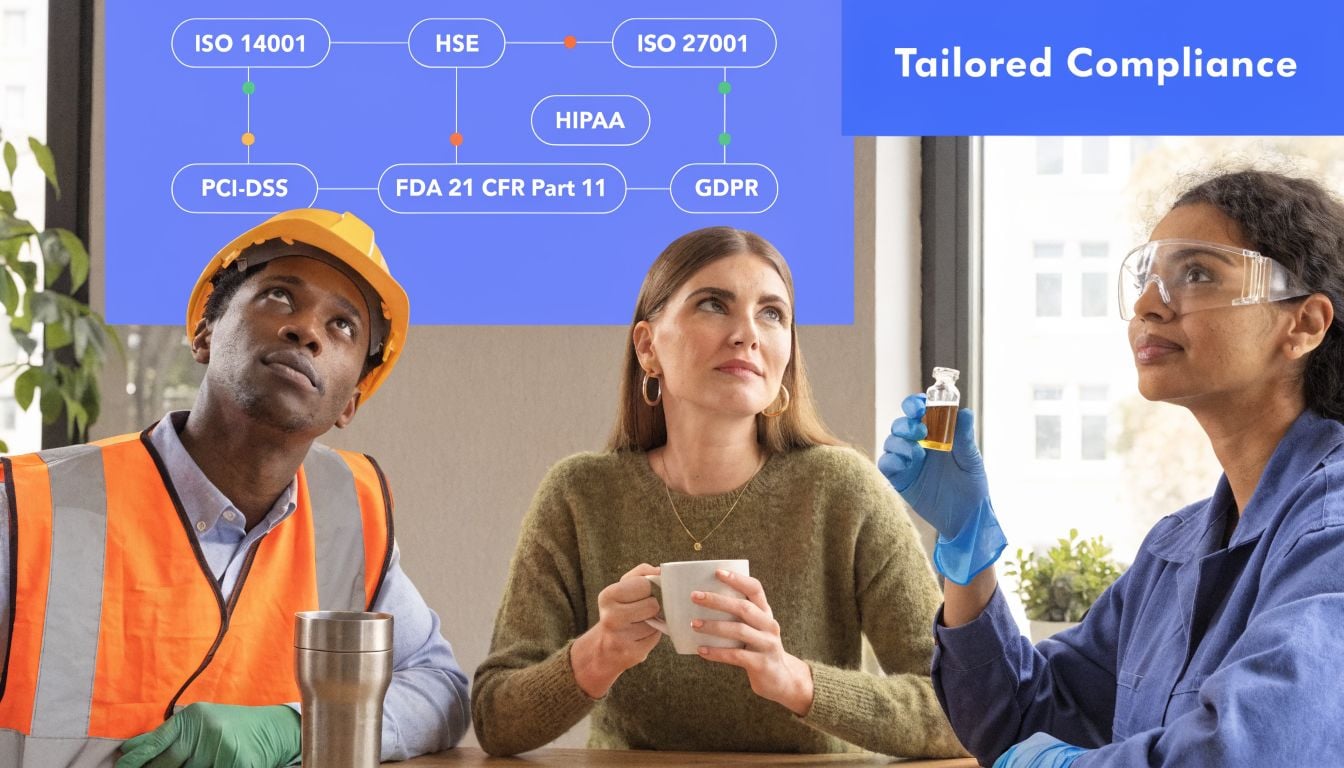
A small employer doesn't get a free pass, and a low-injury office environment doesn't remove all obligations. OSHA rules change by context. That's where many owners and HR teams get tripped up.
Small employer does not mean exempt employer
Employers with 10 or fewer employees are partially exempt from routine injury and illness recordkeeping, but they're still subject to OSHA standards, the general duty obligation to provide a workplace free of recognized hazards, and hazard-specific rules such as eye protection and fall protection under OSHA recordkeeping rule 1904.1.
That distinction matters. Partial exemption from routine logs is not exemption from hazard control. A ten-person machine shop still has to deal with guarding, eye protection, and serious incident exposure. A nine-person contractor still has to address fall hazards. A small warehouse still has to manage powered equipment and material handling risks.
Industry risk changes the workload
An accounting office and a fabrication shop won't carry the same compliance burden. The office may focus on walking-working surfaces, electrical basics, emergency procedures, and ergonomic issues. A construction or manufacturing employer will typically face more hazard-specific programs, more site supervision, and more frequent retraining because the work changes more often.
For PEO buyers, generic “we support OSHA compliance” language becomes almost useless at this point. The critical question is whether the provider understands the employer's risk profile. A provider that's fine for a professional services firm may be a poor fit for a field-service contractor with ladders, lifts, and subcontractor traffic.
A stronger evaluation starts with governance. Who inspects each site. Who approves corrective actions. Who follows up when a branch manager ignores a hazard. A practical reference point is PEO workers' comp and safety governance framework, because safety failures often begin as ownership failures.
The most expensive misunderstanding in small business safety is “we're too small for OSHA to care.” OSHA may not care about company size nearly as much as it cares about a serious hazard, a severe injury, or missing proof.
The Most Common and Costly Compliance Pitfalls
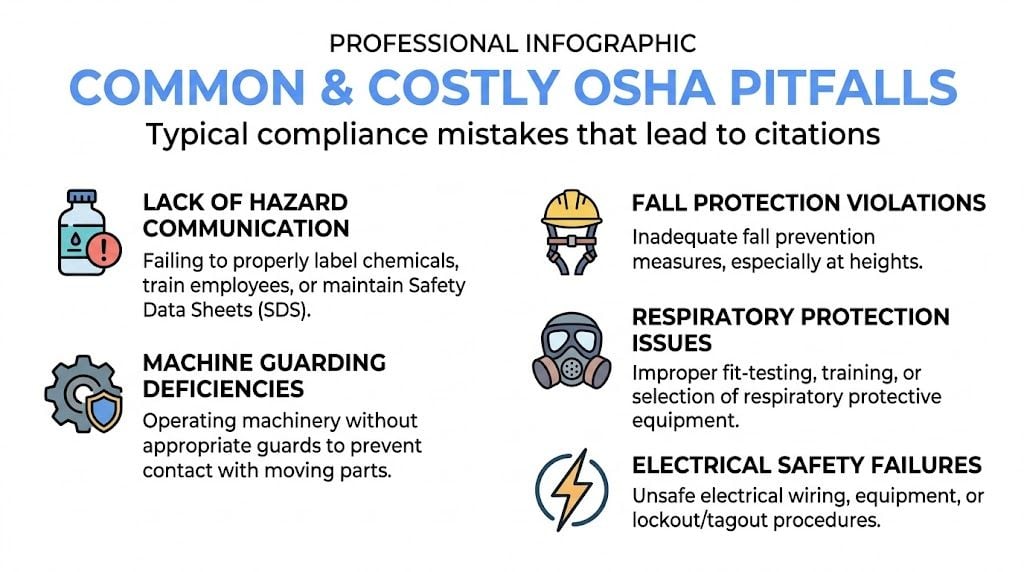
Most compliance failures aren't exotic. They come from ordinary gaps that sit in plain view until an employee gets hurt, a manager reports a concern, or an inspector asks for records.
Where employers usually fail
The first failure is training that can't be proved. A company may hold a toolbox talk, email a slide deck, or rely on a vendor webinar, but if no one records attendance, topic, date, and employee language needs, the company has weak evidence.
The second is hazard communication that exists on paper but not in practice. The written program may sit in a binder in HR while the chemicals are in maintenance, production, or janitorial closets. Employees then work around products without easy access to labels or Safety Data Sheets.
The third is machine guarding and lockout confusion. Maintenance staff may know the shutdown routine, but operators, cleaners, or supervisors may not. That gap gets exposed when someone clears a jam, resets a machine, or assists with servicing outside the normal maintenance chain.
A fourth problem is reporting failures after an injury. That can become bigger than the original event. Employees who believe an employer hid or mishandled an injury report may escalate the matter legally or administratively. For employers in Pennsylvania, the legal issues around whether a worker can sue a PA employer for hiding injury show why prompt, documented reporting matters beyond OSHA alone.
Why these failures become expensive
These breakdowns cost money in several ways, even without citing a specific penalty amount. They consume management time, trigger corrective action projects, disrupt production, complicate workers' compensation handling, and weaken the employer's credibility during review.
Consider a realistic pattern:
- Day one: An employee gets hurt clearing a jammed machine.
- Day two: The site says training happened, but no signed records exist.
- Day three: The vendor says it provided safety templates, but the site never adapted them to the machine in use.
- Day four: HR, operations, and the PEO disagree on who owns the incident file.
That's not a technical legal problem. It's an operating model failure.
For multi-site companies, these examples often repeat with slight variations. One branch posts notices correctly, another doesn't. One manager documents PPE issuance, another handles it verbally. One site escalates an injury immediately, another waits until payroll hears about lost time.
A useful comparison set is PEO compliance gap case examples, especially for buyers trying to separate polished sales support from durable field execution.
A Practical Guide to Surviving an OSHA Inspection
An OSHA inspection is a management test under pressure. Companies that do well usually don't improvise. They assign roles before anyone arrives and keep core records accessible.
What should happen when the inspector arrives
The front desk or site lead should know exactly who receives the inspector, who verifies credentials, and who notifies legal, HR, safety, and operations. The company representative should stay calm, take notes, and mirror document requests so there's a record of what was asked and what was provided.
During the walkaround, managers should avoid speculation. If a supervisor doesn't know an answer, the correct response is to say the company will verify and respond. Casual guesses create unnecessary contradictions later.
Employee interviews deserve preparation too. Managers shouldn't coach testimony, but employees should understand basic safety procedures, reporting paths, and where documents or equipment are located. If workers appear unfamiliar with the company's own policies, the inspection gets harder quickly.
What to keep ready before anyone shows up
The best inspection file is simple and current. It should be easy for a site leader to pull without waiting on a corporate administrator or PEO service rep.
A practical ready file usually includes:
- Written programs: Safety policies relevant to the site, including hazard communication and any hazard-specific procedures in use.
- Training records: Sign-in sheets, acknowledgments, training dates, topics, and any translated materials where needed.
- Inspection logs: Supervisor or facility inspection records with corrective actions and completion notes.
- Incident records: Internal investigation notes, escalation records, and evidence of timely response.
- Responsibility map: A one-page sheet showing who handles HR, safety, maintenance, and compliance communication.
Good inspection preparation isn't about hiding defects. It's about showing that management identifies hazards, documents action, and follows through.
The companies that struggle most are usually waiting on someone else. The corporate office has one piece, the branch has another, and the PEO has a third. By the time those pieces are assembled, the employer looks disorganized even if some of the work was done.
Vetting Your PEOs OSHA Compliance Promises
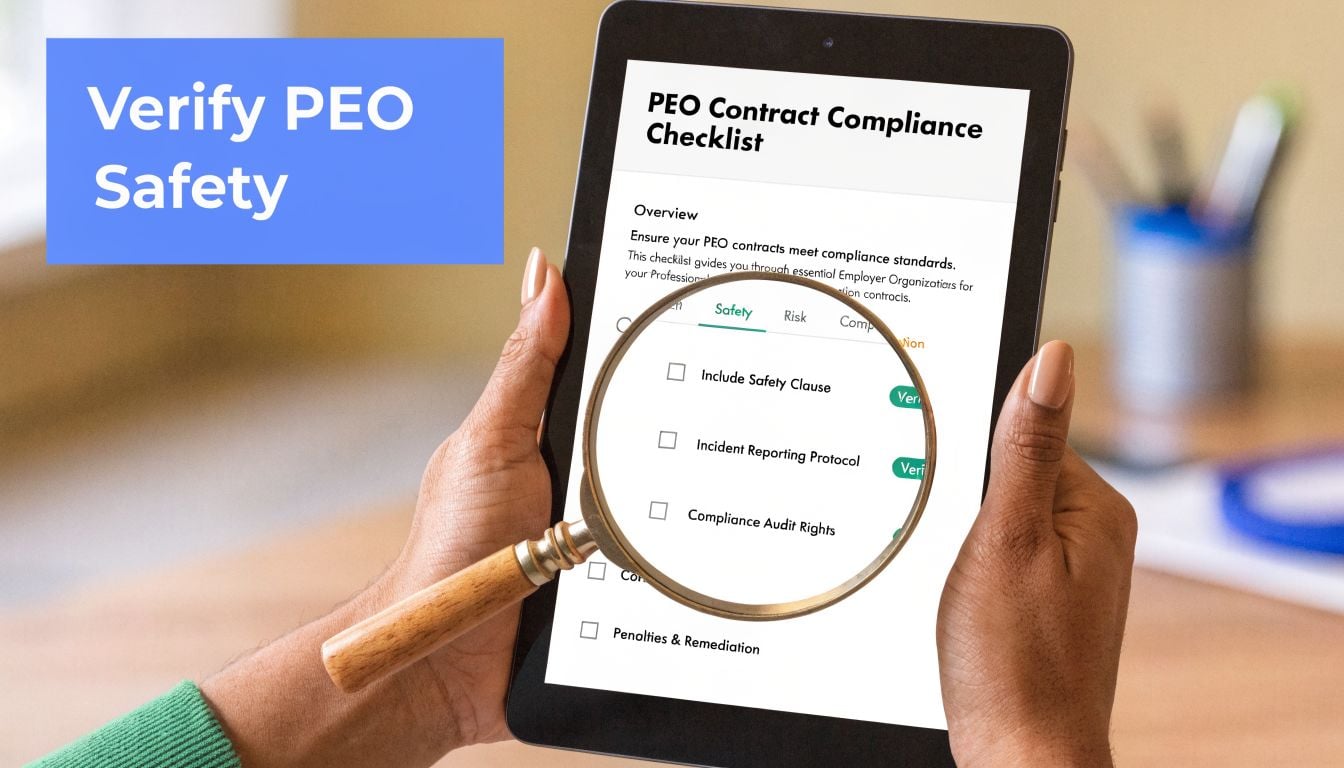
When a PEO says it “handles safety compliance,” the next step shouldn't be relief. It should be contract review.
OSHA guidance makes the core issue clear. Employers are expected to keep records, provide access to injury and illness logs, and in specific hazards, keep written proof of due diligence. As OSHA's interpretation guidance makes clear, outsourcing HR doesn't outsource OSHA liability. The employer still has to show active compliance effort, not just point to a vendor.
Contract language matters more than sales language
The risky wording is usually vague. Terms like “support,” “assist,” “consult,” or “resources available upon request” may sound helpful, but they don't answer who does the work.
A CFO should look for operational specifics such as:
- Document ownership: Who maintains training records, inspection logs, and incident documentation?
- Update responsibility: Who revises written programs when the employer opens a new site, adds a process, or changes equipment?
- Response timing: If a serious incident occurs after hours, who gets notified first and who has authority to act?
- Site specificity: Are safety materials generic templates, or are they adapted to the employer's actual hazards?
This is one place where outside comparison can help. Firms such as PEO Metrics review how PEO agreements assign compliance support, documentation duties, and service boundaries across providers. That kind of side-by-side review is useful because the differences are often buried in exhibits, service descriptions, and liability language rather than the main sales proposal.
Questions that expose weak compliance support
A serious buyer should ask questions that can't be answered with marketing copy.
Start with these:
- Who owns the OSHA 300 log and annual summary process if recordkeeping applies to this employer?
- Who conducts site-specific safety training, and how is completion documented?
- Who maintains hazard communication documents at each location?
- Who investigates incidents and writes corrective actions?
- What happens if an OSHA inspector requests records at a branch before the PEO team is available?
- Does the contract describe deliverables, or only advisory support?
- If the employer changes industry mix, facility layout, or equipment, is updated safety support included or billed separately?
A strong PEO will answer directly and show examples of artifacts. A weaker one will fall back on broad assurances, redirect to workers' compensation, or say the client remains responsible without clearly defining what the provider does.
If a PEO can't show the records, workflows, and ownership map before the contract is signed, it probably won't create them well after an incident.
That's the hidden complexity in osha requirements for employers using a PEO. The issue isn't whether support exists in theory. It's whether the employer can prove, on demand, who did what, when, and with what documentation.
Frequently Asked Questions About OSHA Compliance
Does a safety committee satisfy OSHA obligations?
No. A committee can improve communication and follow-up, but it doesn't replace hazard control, training, reporting, or documentation.
What's the difference between an OSHA inspection and a free consultation?
An inspection is an enforcement event. A consultation is generally framed as help identifying and correcting hazards. Employers should still treat both seriously and document corrective action.
Can employees refuse to wear required PPE?
Employers still have to enforce the rule. If PPE is required for the hazard, management needs a documented enforcement process, not repeated verbal reminders.
If a PEO provides a handbook, is that enough?
No. A handbook is not proof that supervisors inspected conditions, trained employees, corrected hazards, or maintained required records.
What's the most important first step for a multi-site employer?
Create one incident escalation protocol that works across all locations, shifts, and managers. Confusion during the first few hours after a serious event creates avoidable risk.
Companies comparing PEOs or reviewing an existing agreement often need a clearer answer to one question: who owns OSHA-related tasks in practice, not just on paper. PEO Metrics helps employers compare providers, review contract terms, and identify where compliance support, documentation duties, and service promises sit before those gaps turn into expensive surprises.
