
A Texas company can feel healthy on paper and still hit an operating wall fast. Revenue is moving. Hiring requests keep coming in. Then payroll gets more complex, benefits questions start eating manager time, and a single remote hire outside Texas turns a straightforward HR process into a compliance project.
That pressure shows up in familiar ways. An Austin software company adds engineers in Colorado and Illinois, then realizes handbooks, onboarding forms, payroll setup, and leave administration no longer fit one-state assumptions. A Houston field-services business grows headcount quickly, but every benefits renewal and injury-reporting process turns into a finance and HR fire drill. At that point, the question isn't whether HR matters. The question is whether the business can keep scaling with a patchwork of broker advice, payroll software, spreadsheets, and a lean internal team.
A PEO in Texas can solve that problem, but only when the buyer treats it as a financial and liability decision, not just an outsourced admin package. That means looking at co-employment, workers' comp strategy, multi-state support, contract language, and renewal advantage. Teams that also need better document control should tighten internal recordkeeping before or during the transition. Resources like DigiParser's HR solutions can help standardize employee files so the PEO relationship doesn't start with messy inputs. For high-growth teams, the decision usually works best when it's tied to a broader PEO strategy for rapid growth companies, not treated as a stand-alone vendor swap.
Table of Contents
- Is Your Texas Business Hitting a Growth Ceiling
- What a PEO Legally Means for a Texas Business
- The Financial Case for a PEO in Texas
- Texas PEOs vs National Providers and ASOs
- How to Evaluate and Benchmark PEO Costs in Texas
- Critical PEO Contract Terms You Must Negotiate
- Your Action Plan for a Confident PEO Decision
Is Your Texas Business Hitting a Growth Ceiling
A growth ceiling usually doesn't look dramatic. It looks like leadership spending too much time on things that shouldn't require executive attention. A CFO is reviewing payroll exceptions. An HR lead is chasing benefits invoices. An operations manager is fielding questions about onboarding in another state because nobody is sure which policy applies.
That pattern is common in Texas because many employers grow fast before they build a deep internal HR bench. Texas is also one of the largest PEO markets in the country, and a 2025 NAPEO white paper says four states, including Texas, account for the largest shares of PEO clients. The same paper shows how concentrated adoption is in smaller businesses. 50% of all PEO clients have between 10 and 49 employees, while another 35% have fewer than 10 employees.
A common Texas scenario
A company with a few dozen employees can still carry enterprise-style headaches. One location is easy. A second state changes payroll withholding, leave rules, onboarding workflows, benefits eligibility administration, and manager training. Add high turnover or seasonal hiring and the internal process starts breaking in quiet but expensive ways.
A PEO becomes relevant when the company needs three things at once:
- Administrative scale: Payroll, onboarding, benefits enrollment, and employee support need a repeatable system.
- Compliance support: The business wants more than software. It wants someone accountable for process execution.
- Financial predictability: Leadership wants fewer surprises around HR operations, claims handling, and renewal discussions.
A PEO is rarely the first thing a company buys. It's usually the thing a company buys after the current setup stops being dependable.
Where the ceiling becomes visible
For Texas employers, the trigger often isn't "we need HR help." It's more specific.
- Remote hiring pushes complexity up: The company can recruit talent nationally, but policy and payroll administration don't travel as easily.
- Benefits become a retention issue: Candidates compare plans. Employees ask harder questions at renewal. The company needs a better answer than "that's what our broker found."
- Risk sits in too many places: Payroll sits with one vendor, workers' comp with another, handbooks with outside counsel, and nobody owns the full picture.
When that happens, a PEO in Texas stops being a generic outsourcing option. It becomes a way to remove the operational bottleneck that growth exposed.
What a PEO Legally Means for a Texas Business
A Texas employer shouldn't treat a PEO like a normal software vendor or payroll processor. In legal terms, the relationship is more significant than that. The state regulates PEOs directly, which changes how buyers should evaluate risk, contract language, and provider quality.
Why Texas regulation matters
Texas formally regulates professional employer organizations under state law. The Texas Department of Licensing and Regulation says a PEO is the modern term for a “staff leasing company” and that the industry is regulated under Chapter 91 of the Texas Labor Code. To operate legally, a Texas PEO must obtain a license and meet financial security requirements tied to assigned headcount: $50,000 for fewer than 250 assigned employees, $75,000 for 250–750 assigned employees, and $100,000 for more than 750 assigned employees. The state also charges license and application fees of $300, $450, or $700 depending on size, according to the Texas Department of Licensing and Regulation PEO FAQ.
That matters because it separates legitimate PEO arrangements from loose outsourcing claims. A licensed Texas PEO isn't just offering help with payroll. It's operating inside a supervised employment-services framework.
What co-employment changes in practice
The practical issue is co-employment. The client company still runs the business, chooses who to hire, sets pay, manages performance, and makes termination decisions. The PEO handles agreed administrative and compliance functions inside that shared arrangement.
For a buyer, the main legal takeaway is simple:
- The relationship affects liability allocation
- The relationship affects tax and payroll administration
- The relationship affects who handles specific compliance workflows
That means legal review shouldn't stop at pricing. It should focus on where the PEO's obligations begin, where they stop, and what happens when the provider makes a mistake.
Practical rule: If a provider describes itself like a PEO but avoids clear co-employment language, the buyer should slow down and verify exactly what legal responsibilities are actually being shared.
Texas buyers also need to think beyond Texas. A company may be headquartered in Dallas and still employ people in other states with different payroll, leave, and labor-law requirements. That's why legal review should include a broader state employment law risk review, not just a Texas checklist.
Employee relations issues are part of this picture too. HR leaders who need a clearer view of worker rights and escalation paths can review guidance on filing employee complaints in Texas, especially when they want to understand how internal processes and external rights overlap.
What buyers should verify before signing
Before signing with a PEO in Texas, leadership should verify a short list of essential requirements:
- Licensing status: Confirm the provider is authorized to operate as required in Texas.
- Scope of services: Get a written schedule that separates included services from extra-fee items.
- Responsibility mapping: Identify who owns payroll accuracy, tax filings, handbook updates, claims administration, onboarding documents, and employee support.
- Error handling: Make sure the contract states what happens if the PEO misses a filing, botches payroll, or mishandles a compliance workflow.
A PEO relationship can reduce internal burden. It can also create confusion if the legal structure isn't understood upfront. Texas law gives buyers a framework. The contract has to turn that framework into something operationally usable.
The Financial Case for a PEO in Texas
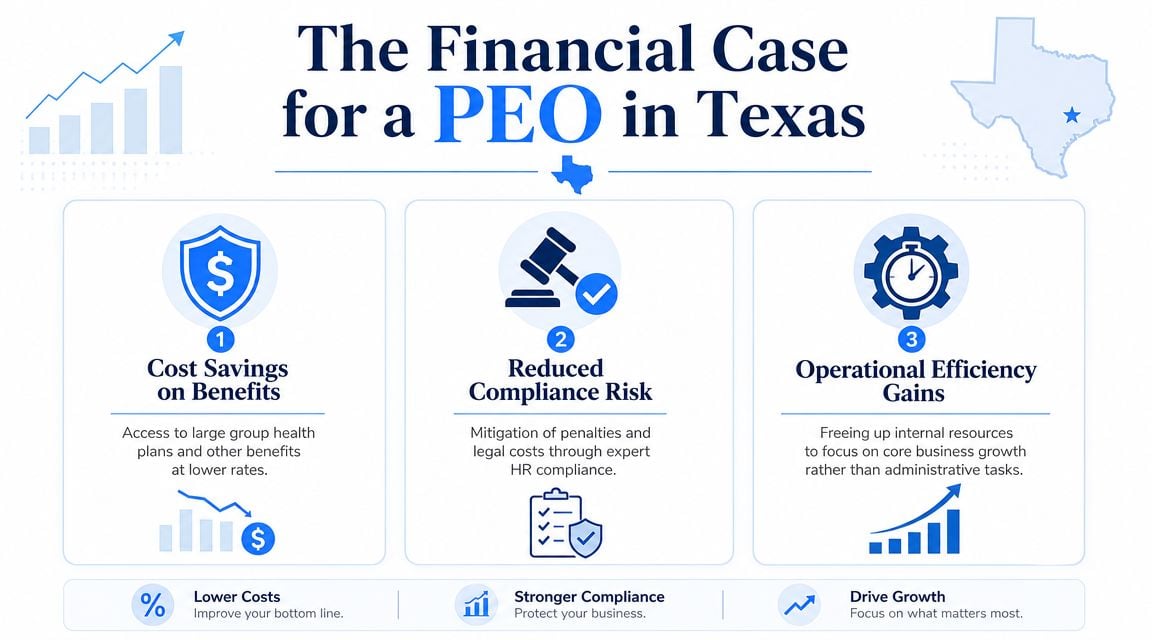
The strongest business case for a PEO in Texas isn't "HR gets easier." That's true, but it doesn't close the deal in a finance review. The core justification lies in benefits buying power, risk management, and whether administrative complexity is starting to cost more than a bundled model.
Where the economics can work
Texas has meaningful industry fit for PEO adoption. National PEO research cited by NAPEO shows that among employers with 20 to 499 employees, overall PEO penetration is 14%, and penetration is especially high in Information, Real Estate and Rental/Leasing, Professional Services, and Financial/Insurance, according to Shortlister's summary of PEO statistics. That matters because those are exactly the kinds of employers that often need stronger HR infrastructure before they can justify building a large internal team.
The financial upside usually comes from three places:
- Benefits advantage: A smaller employer may gain access to stronger plan options or a more manageable contribution structure than it could negotiate alone.
- Risk transfer and administration: The employer may reduce internal exposure to payroll and HR process errors because more of that work sits inside a formal platform and service model.
- Time redeployment: Finance and operations leaders stop spending premium time on transactional HR clean-up.
A practical example helps. A Dallas professional services firm may not want to hire a full internal HR department yet. If the PEO provides better benefits administration, cleaner onboarding, and faster issue resolution, leadership can keep headcount focused on revenue and operations rather than adding overhead too early.
Where buyers misread the math
The common mistake is evaluating only the admin fee. That's too narrow. The right question is whether the total employment operating model improves.
A Houston employer might like the benefits package but dislike the claims handling process. A fast-growing Austin company might accept the payroll platform but realize later that the provider's multi-state support is thin. In both cases, the sticker price alone misses the operational cost.
Cheap PEO pricing can still be expensive if managers spend every pay period fixing service issues.
That is why proposal review should include side-by-side modeling. Use the provider's fee structure, but also look at implementation costs, service exclusions, renewal language, and support quality. Buyers who need a structured way to compare those moving parts should review a detailed framework for how much a PEO costs.
A CFO lens for decision-making
A finance team usually gets better results when it evaluates a PEO in Texas through these questions:
- What cost is the company carrying today because HR work is fragmented?
- Which risks become less likely if the provider handles payroll, benefits administration, and compliance workflows well?
- Which functions still stay in-house, even after the PEO is added?
If the answers are vague, the deal probably isn't ready. If the answers are specific, the buyer can test whether the PEO model improves both control and cost discipline.
Texas PEOs vs National Providers and ASOs
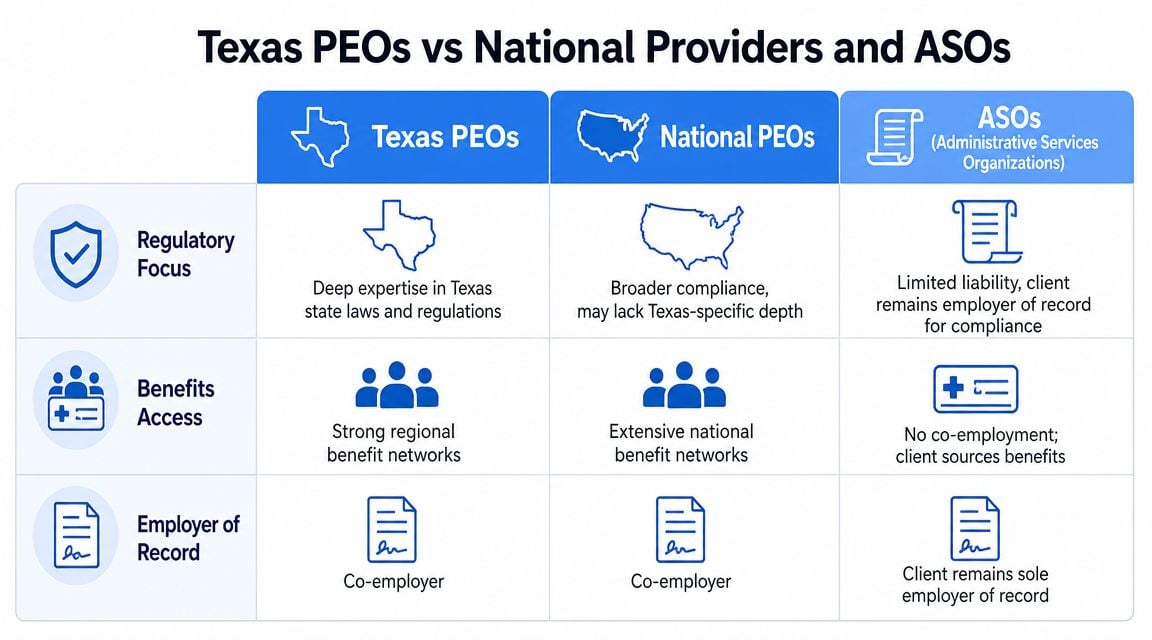
Most buyers don't need "a PEO." They need the right operating model. In Texas, that usually means choosing among three paths: a Texas-focused PEO, a national provider, or an ASO. Each can work. Each can also fail badly when it's matched to the wrong workforce, geography, or internal capability.
When a Texas-focused PEO makes sense
A Texas-focused provider often fits companies with a large in-state population, local operating complexity, or leadership that wants more hands-on service. That can work well for construction-adjacent employers, field services, healthcare support teams, regional professional firms, and businesses with concentrated Texas hiring.
The appeal is usually practical, not theoretical:
- Local regulatory familiarity: The provider often understands Texas employment practices, payroll norms, and state-specific operating issues in a more grounded way.
- Service access: Some buyers value direct support teams over large call-center structures.
- Regional benefit relationships: For a Texas-heavy workforce, local network quality can matter as much as headline plan design.
When national scale or an ASO fits better
A national PEO starts making more sense when the workforce is spread out. That's increasingly common. A recent Gallup tracking update cited in Rippling's Texas PEO overview found that 27% of U.S. employees were fully remote and 53% were hybrid. For a Texas employer hiring across several states, the primary issue isn't Texas payroll. It's whether the provider can coordinate onboarding, tax administration, workers' comp handling, and policy alignment across jurisdictions.
That is where some local providers struggle. A Texas-first service model can be excellent for a mostly local workforce and still be a weak fit for a distributed team with hires in California, New York, or other higher-complexity states.
An ASO is different again. It can be the better choice when the company already has strong internal HR leadership and wants admin support without entering a co-employment model. Buyers comparing structures should also understand adjacent models like EORs, especially when international or highly distributed hiring is in play. This overview of EOR pros and cons for job offers is useful because it helps clarify where employer-of-record support differs from both PEO and ASO arrangements.
The wrong model usually fails in one of two ways. Either the company buys too little support and keeps all the risk, or it buys a full PEO bundle when it really needed a lighter administrative layer.
A simple decision lens
Use this framework when comparing options:
| Model | Best fit | Main trade-off |
|---|---|---|
| Texas-focused PEO | Texas-heavy workforce, desire for local service, need for co-employment support | May have less depth for complex multi-state expansion |
| National PEO | Multi-state workforce, standardized operations, broad platform needs | Service can feel less tailored |
| ASO | Strong internal HR team, desire to retain employer responsibility, selective outsourcing | Client keeps more compliance and liability exposure |
Companies that sit between those categories often need a hybrid evaluation. This comparison of PEO and ASO hybrid options is useful when leadership wants support in some areas but doesn't want a full co-employment structure across the board.
How to Evaluate and Benchmark PEO Costs in Texas
A Texas company with 40 employees gets two PEO quotes in the same week. One comes in at $115 PEPM. The other is 3.5% of payroll. On the surface, the PEPM quote looks cleaner and cheaper. Then finance models the full year. The percentage quote includes onboarding, HR support, and a stronger workers' comp arrangement. The PEPM quote adds setup fees, benefit administration charges, and a renewal increase after 12 months. That is how buyers misread PEO pricing in Texas.
Texas adds another layer because workers' comp is elective for many private employers. A proposal that looks inexpensive can turn costly if the workers' comp structure does not match your actual risk profile, hiring mix, and claims history. Generic savings language does not help much here. Buyers need line-item math, renewal math, and exit math. PEO Blueprint makes that point in its guide to PEOs in Texas, but the critical work is in forcing each provider onto the same cost template.
Price the deal in three views
Benchmark every proposal in three separate frames.
First-year cost. Include admin fees, implementation, benefit elections, payroll processing, and any state or local service charges.
Likely year-two cost. Many Texas employers focus on first-year discounts and miss repricing triggers tied to payroll growth, benefit renewals, or minimum headcount changes.
Cost to exit. If a provider requires 60 or 90 days' notice, charges offboarding fees, or makes data extraction difficult, that cost belongs in the evaluation now, not after the relationship sours.
Break every proposal into the same buckets
| Cost Item | Provider A PEPM Model | Provider B % of Payroll Model | What to test |
|---|---|---|---|
| Administrative fee | Fixed amount per employee each month | Variable fee tied to payroll | Percentage pricing climbs as wages rise, even if service levels stay flat |
| Implementation fee | Separate one-time charge or waived | Separate one-time charge or folded into pricing | Confirm whether setup, data migration, payroll config, and manager training are all included |
| Benefits costs | Employer and employee contributions billed separately | Employer and employee contributions billed separately | Compare plan design, network fit in Texas markets, and contribution flexibility |
| Workers' comp handling | Included, partially included, or excluded | Included, partially included, or excluded | Check whether the PEO policy, class codes, and claims support improve your current position |
| HR support | Dedicated rep, shared service team, or add-on | Dedicated rep, shared service team, or add-on | Service quality changes how much manager time you still burn internally |
| Renewal terms | Fixed, repriced annually, or automatic renewal | Fixed, repriced annually, or automatic renewal | Flag fee escalators, notice deadlines, and vague repricing language |
| Termination costs | Notice period and offboarding charges | Notice period and offboarding charges | Cheap entry pricing often gets recovered on the way out |
What Texas employers should press on harder
Workers' comp deserves a separate review, especially for construction, field services, light industrial, transportation, and mixed-duty operations. A Dallas contractor with office staff and jobsite labor should not accept a vague "included" label. The buyer needs to know whose policy applies, how class codes are assigned, who manages claims, and what happens if payroll shifts toward higher-risk labor during the year.
Benefits also need a local test, not a brochure test. A health plan that looks competitive on premium can still create employee friction if the Houston or San Antonio provider network is thin. Lower premium does not always mean lower employer cost if out-of-network usage drives complaints, turnover, or pressure to increase contributions midyear.
Then look at fee mechanics. Percentage-of-payroll pricing can work well for businesses with stable wages and a broad service bundle. It gets expensive fast in businesses adding higher-paid supervisors, sales staff, or engineers. PEPM pricing is easier to forecast, but some providers use low PEPM rates to hide charges elsewhere.
Ask direct questions:
- What is included in implementation, in writing?
- Which services trigger extra fees?
- What assumptions are built into the workers' comp piece?
- What can change at renewal without mutual approval?
- What are the notice requirements and hard dollar costs to leave?
One more point matters. Contract language can erase a good headline rate. Before signing, run the pricing review alongside a PEO master service agreement checklist so finance, HR, and legal are testing the same risks.
Price the first year, the probable renewal year, and the exit. If one of those numbers is missing, the comparison is incomplete.
Good PEO deals in Texas survive that scrutiny. Weak deals usually depend on the buyer stopping at the proposal cover page.
Critical PEO Contract Terms You Must Negotiate
A PEO agreement shouldn't be treated like standard vendor paper. The contract controls money, service accountability, bargaining power at renewal, and the operating pain of getting out if the relationship fails. Buyers who skip negotiation usually pay for it later in one of two ways. They absorb avoidable cost, or they get trapped in a service model they no longer want.
Terms that affect real leverage
Start with the clauses that shape the economics of the relationship.
- Renewal language: Buyers should push for clear notice periods, explicit repricing mechanics, and limits on unilateral fee changes.
- Termination rights: The company needs both for-cause and workable without-cause exit rights. If the provider misses payroll, mishandles support, or underperforms operationally, leadership needs a path out.
- Implementation commitments: If the provider promises onboarding support, data migration, or training, that should appear in writing.
- Service levels: Payroll deadlines, response times, tax handling responsibilities, and issue-escalation procedures shouldn't live only in sales conversations.
A separate review of the PEO master service agreement checklist can help legal, HR, and finance teams pressure-test those terms before signature.
What a strong fallback position looks like
Not every buyer can get every concession. The goal is to protect the business on the terms that matter most.
A practical fallback position usually looks like this:
- Get pricing clarity even if a hard rate cap isn't available. If the provider won't cap increases, ask for a defined review process and advance notice.
- Shorten the lock-in if the provider won't improve termination rights. Long commitments with weak performance protections are dangerous.
- Tie implementation fees to delivery. If onboarding slips or promised functionality doesn't launch cleanly, the buyer should seek credits or reduced fees.
- Define error ownership. If the provider causes a payroll or filing issue within its assigned scope, the contract should say how correction and remediation work.
The strongest negotiation point is often readiness to walk away. Providers become more flexible when the buyer has alternatives and can compare terms line by line.
Contract negotiation isn't just a legal exercise. It's where a PEO in Texas becomes either a manageable operating partnership or a recurring source of friction.
Your Action Plan for a Confident PEO Decision
A Texas employer with 35 people can waste real money by rushing this choice. I have seen companies sign on a low admin quote, then find out six months later that the workers' comp structure, renewal language, payroll support model, and off-cycle fees changed the economics completely.
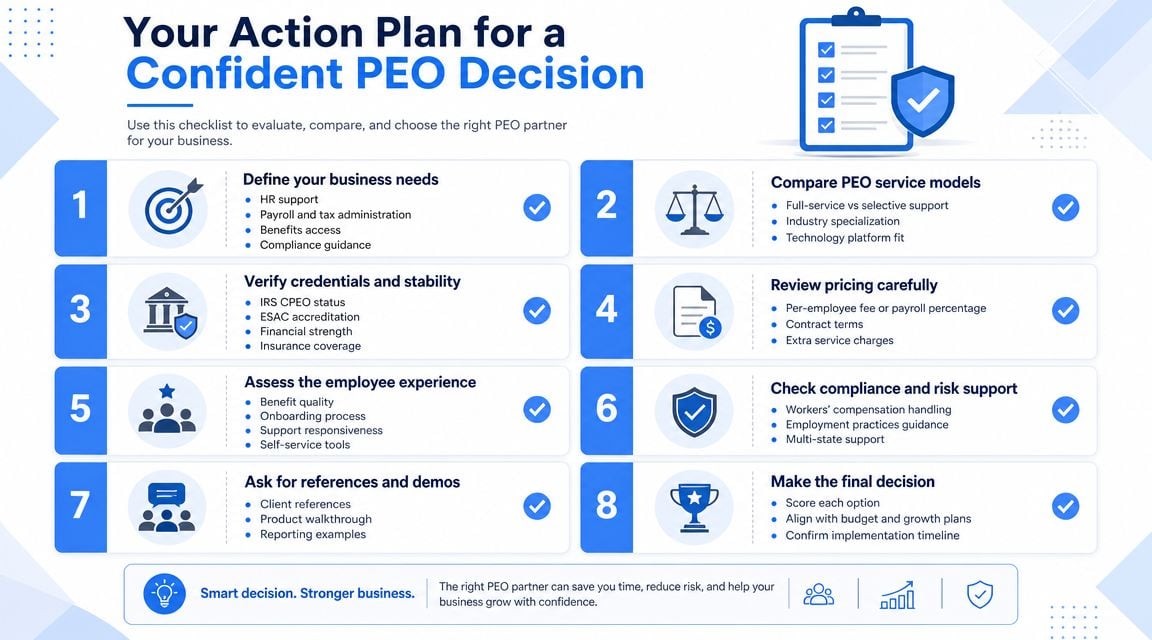
A confident decision starts with the math and the operating constraints, not the demo.
For a Texas construction subcontractor, the key issue may be whether the PEO's workers' comp arrangement lowers claim volatility or just shifts it. For a Dallas software company hiring in three states, the bigger question may be service execution, tax registration support, and benefit competitiveness in a tight labor market. For a Houston distributor with 60 employees, the test may be whether the PEO reduces internal HR headcount pressure enough to justify a five-figure annual admin spend.
Use a buying process that forces those differences into the open.
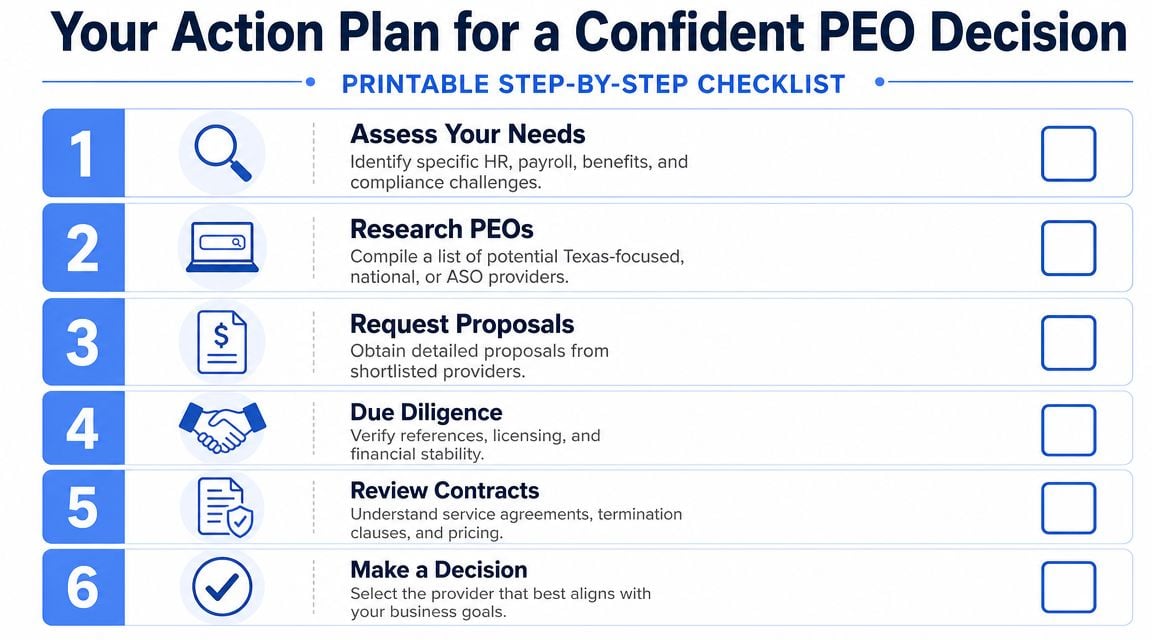
A practical sequence for the buying team
Start with the problem that has a dollar value. Rising health costs, payroll error exposure, HR staffing gaps, multi-state hiring, and workers' comp administration are different problems. They require different PEO models.
Then define what the provider must do well. Clean payroll, clear tax responsibility, implementation deadlines, renewal controls, and a support team that answers the phone usually matter more than a polished app.
After that, compare structures before you compare brands. A Texas-focused PEO, a national PEO, and an ASO can all look similar in a sales process while producing very different cost, liability, and service outcomes.
A disciplined review usually includes these steps:
- Build a side-by-side cost model: Include admin fees, benefit premiums, workers' comp charges, setup fees, year-two pricing assumptions, and any charges for off-cycle payrolls or year-end work.
- Match each provider to your Texas risk profile: Separate office-heavy employers from contractors, light industrial firms, trucking operations, and healthcare groups. The workers' comp and claims approach can change the whole deal.
- Use the same questionnaire for every finalist: Ask identical questions about tax filing scope, service team structure, implementation timing, employee onboarding, and renewal mechanics.
- Check references that look like your company: Similar headcount, similar industry, similar hiring footprint. A 12-person Austin agency should not rely on feedback from a 300-person manufacturer.
- Bring legal and finance in before final paper: Commercial terms move more easily before the contract markup turns into a back-and-forth between counsel.
What leadership should do next
Set a short list of two or three providers. More than that usually creates noise instead of clarity.
Give each one the same census, the same payroll assumptions, the same benefits requirements, and the same list of open states. Ask each provider to show total expected annual cost, not just the admin rate. In Texas, that distinction matters. A proposal that looks cheaper on PEPM fees can end up more expensive once benefit contributions, workers' comp treatment, and renewal assumptions are modeled.
Leadership should press on five points:
- How will you support employees outside Texas, and who handles registrations and tax setup?
- Which services are included in the quoted fee, and which trigger extra charges?
- How do renewals work, and how much advance notice do we get on increases?
- What service credits, correction obligations, or escalation rights apply if payroll or filings go wrong?
- What does exit look like, including notice periods, data transfer, and transition support?
A PEO can improve operations, reduce HR strain, and give a smaller Texas employer access to better infrastructure. It can also lock the company into avoidable cost and friction if leadership skips the hard questions on pricing, scope, and liability.
PEO decisions are easier when someone independent pressure-tests the pricing, benefits, service model, and contract terms before a company signs or renews. PEO Metrics helps employers compare providers side by side, benchmark total cost, flag contract risks, and negotiate stronger terms so the final decision is based on fit, not sales pressure.
