
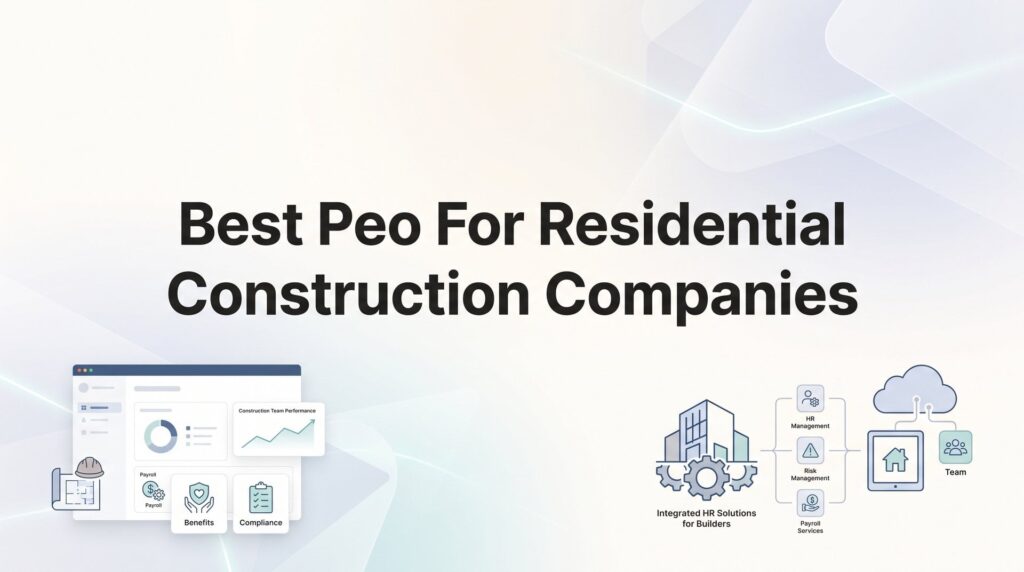
Residential construction runs on tight margins, unpredictable job sites, and a workforce that’s constantly moving between projects. Your HR needs aren’t like a tech company’s—you’re dealing with workers’ comp claims from falls, OSHA compliance audits, prevailing wage requirements, and crews that might work across three different counties in a single week.
A generic PEO won’t cut it. You need a partner that understands construction-specific risk pools, can handle certified payroll for government contracts, and won’t flinch when your headcount swings by 40% between seasons.
Here are eight PEOs that actually get residential construction—ranked by how well they handle the realities of building homes, not just processing paychecks.
1. PEO Metrics
Best for: Residential builders who want to compare multiple PEO options before committing to a contract.
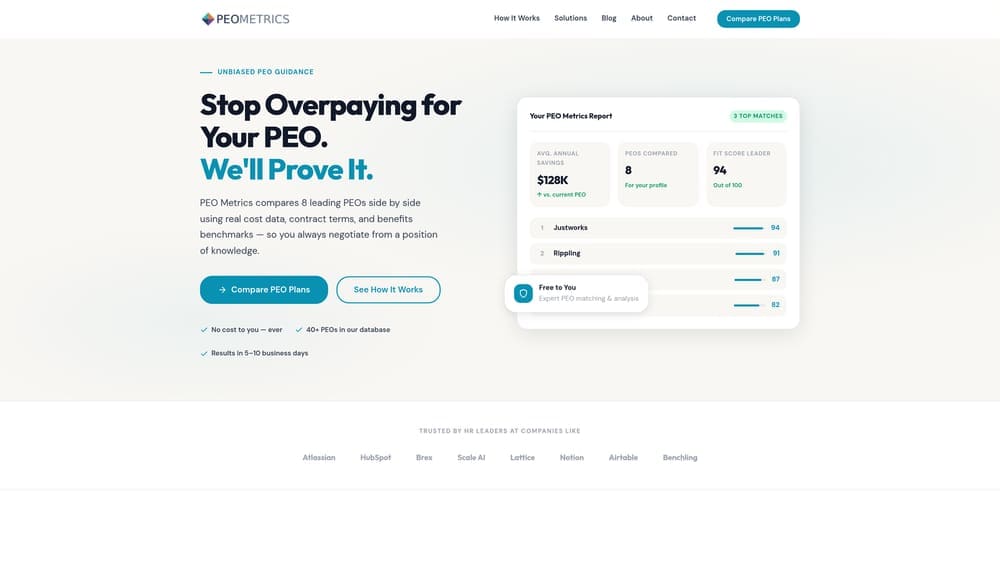
PEO Metrics is an unbiased comparison service designed to help construction companies evaluate PEO providers side-by-side with detailed metrics on workers’ comp rates, construction industry experience, and transparent pricing breakdowns.
Where This Tool Shines
Most residential contractors end up with the first PEO they talk to—or worse, they auto-renew year after year without knowing if they’re overpaying. PEO Metrics solves this by giving you a clear comparison framework built specifically for construction businesses.
The platform filters providers by actual construction industry experience, not just generic HR capability. You can see which PEOs understand your specific trade mix, how they handle seasonal workforce changes, and what their real pricing looks like without the sales pitch.
Key Features
Construction-Filtered Comparisons: View only PEOs with proven residential construction experience, not generic providers trying to break into the market.
Workers’ Comp Rate Analysis: Compare workers’ comp pricing across multiple providers to identify which risk pools and safety programs actually reduce your premiums.
Transparent Pricing Breakdowns: See exactly what you’re paying for—no hidden administrative fees or bundled markups buried in the fine print.
Seasonal Workforce Data: Evaluate how different PEOs handle headcount fluctuations, contract flexibility, and mid-year adjustments without penalties.
Side-by-Side Service Comparisons: Compare certified payroll capabilities, OSHA compliance support, and multi-state operations handling across providers.
Best For
Residential builders who want to make an informed decision instead of taking the first offer. Especially valuable if you’re currently with a PEO but suspect you’re overpaying, or if you’re evaluating PEOs for the first time and don’t know what questions to ask.
Pricing
Free comparison service. No cost to evaluate providers or get detailed breakdowns.
2. Insperity
Best for: Established residential builders who need comprehensive safety programs and dedicated risk management support.
Insperity is a full-service PEO with dedicated construction industry expertise, offering strong safety program support and risk management resources suited for residential builders with mature operations.
Where This Tool Shines
Insperity treats construction as a specialty vertical, not just another client category. Their risk management specialists understand the difference between framing risks and roofing risks, and they’ll actually show up on job sites to conduct safety audits.
If you’re tired of generic HR advice that doesn’t apply to your crews, Insperity brings construction-specific guidance that can materially reduce your experience mod rate over time. Their safety training programs are built around OSHA standards that actually apply to residential work.
Key Features
Construction-Specific Safety Training: OSHA compliance programs tailored to residential construction hazards like fall protection, scaffolding, and trenching.
Dedicated Risk Management Specialists: Assigned specialists who understand construction risks and conduct on-site safety assessments.
Performance Management Tools: Systems designed for crew supervisors and field managers, not just office staff.
Comprehensive Benefits Packages: Competitive health insurance and retirement options that help retain skilled tradespeople in tight labor markets.
Claims Management Support: Active involvement in workers’ comp claims to minimize costs and reduce future premiums.
Best For
Residential builders with 25+ employees who have the budget for premium service and want to invest in long-term risk reduction. Works best if you’re willing to implement their safety recommendations and participate actively in loss control programs.
Pricing
Custom pricing based on headcount and risk profile, typically $150-300 per employee per month. Higher end of the market, but the investment can pay off through reduced workers’ comp costs over time.
3. TriNet
Best for: Residential builders expanding into multiple states who need scalable HR infrastructure and consistent compliance.
TriNet is a PEO with industry-vertical expertise including construction, offering comprehensive HR support for residential builders operating across state lines.
Where This Tool Shines
TriNet’s multi-state capabilities shine when you’re building homes in three different states and dealing with three different sets of tax withholding rules, workers’ comp jurisdictions, and labor regulations.
They’ve built industry-specific service packages, meaning you get HR guidance that actually understands construction workflows instead of generic corporate advice. Their benefits offerings compete with Fortune 500 companies, which matters when you’re trying to recruit experienced foremen away from larger builders.
Key Features
Multi-State Payroll and Tax Compliance: Handles complex tax withholding and workers’ comp jurisdictional issues when your crews work across state lines.
Industry-Specific HR Guidance: Construction-focused HR advisors who understand your workforce challenges, not generic HR generalists.
Fortune 500-Level Benefits: Access to health insurance and retirement plans typically available only to much larger companies.
Mobile-Friendly Platform: Field workers and crew leads can access pay stubs, time-off requests, and benefits information from job sites.
Integrated Time Tracking: Systems designed to handle multiple job sites and cost codes for accurate job costing.
Best For
Growing residential builders with 15-100 employees who are expanding geographically and need infrastructure that scales across state lines. Best if you value strong benefits as a competitive advantage for talent retention.
Pricing
Percentage of payroll model, typically 10-15% of gross payroll. Pricing increases with headcount but includes comprehensive services across all states where you operate.
4. Paychex PEO
Best for: Residential builders with significant seasonal headcount swings who need flexible contracts and scalable service.
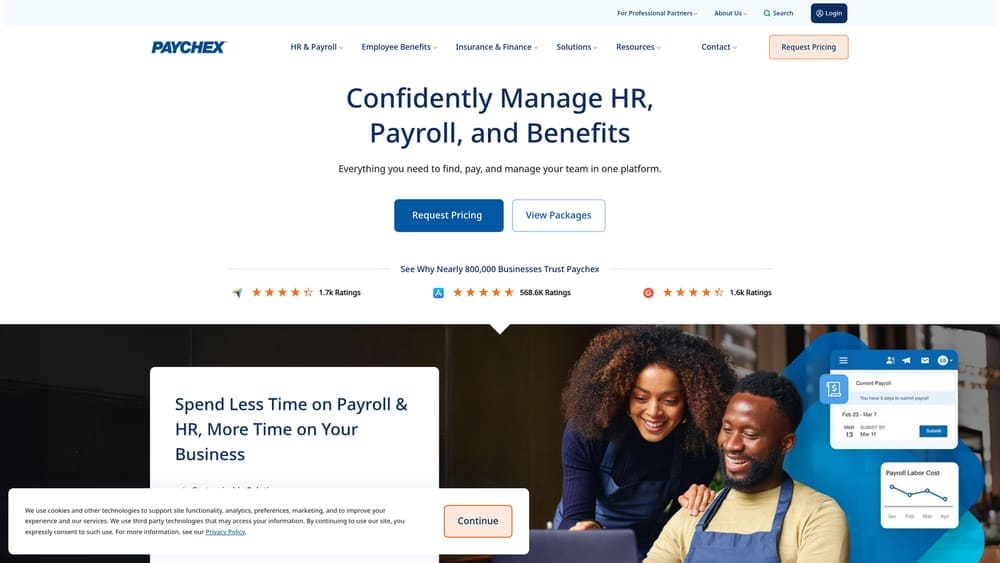
Paychex PEO is a scalable PEO solution with strong payroll capabilities and flexible service tiers that accommodate the workforce changes common in residential construction.
Where This Tool Shines
Paychex understands that your February headcount looks nothing like your June headcount. Their contract structure doesn’t penalize you for seasonal fluctuations, and they’ve built service tiers that let you pay for what you actually need.
The job costing payroll integration is particularly valuable if you’re tracking labor costs across multiple projects. You can see exactly what each job is costing in real-time, not weeks after the fact when it’s too late to adjust.
Key Features
Flexible Seasonal Contracts: Contract terms that accommodate headcount swings without penalties or minimum employee requirements during slow periods.
Job Costing Payroll Integration: Track labor costs by project in real-time for accurate job profitability analysis.
Tiered Service Levels: Choose from basic payroll and compliance up to comprehensive HR support based on your needs and budget.
24/7 Customer Support: Access support outside normal business hours when payroll issues arise before Monday morning.
Scalable Technology Platform: Systems that grow with you from 10 employees to 100+ without requiring platform changes.
Best For
Residential builders with 10-50 employees who experience significant seasonal workforce changes and want to avoid being locked into rigid annual contracts. Works well if you prefer tiered pricing over all-inclusive packages.
Pricing
Per-employee-per-month model starting around $100 PEPM for basic services. Pricing scales up with service tier selection and additional features.
5. ADP TotalSource
Best for: Larger residential builders with government contracts requiring certified payroll and complex compliance tracking.
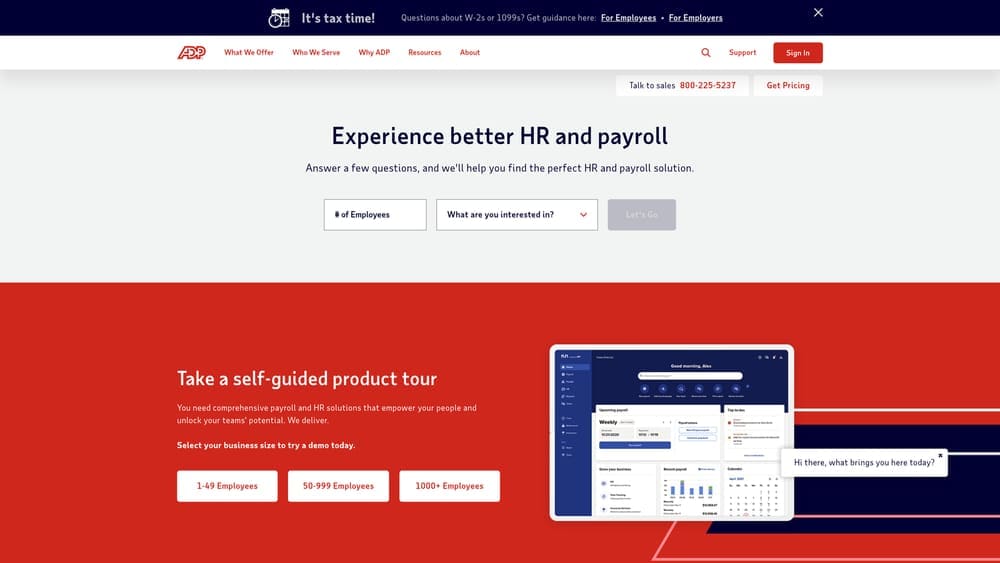
ADP TotalSource is an enterprise-grade PEO with robust certified payroll capabilities and deep software integrations for larger residential construction operations with complex compliance requirements.
Where This Tool Shines
When you’re building HUD-funded affordable housing or state-funded projects with prevailing wage requirements, certified payroll isn’t optional—it’s a contract requirement. ADP TotalSource handles this complexity without breaking a sweat.
Their integration capabilities with construction management platforms mean your payroll data flows directly into your project management systems. No duplicate data entry, no reconciliation headaches, just clean integration between systems.
Key Features
Certified Payroll for Prevailing Wage: Full compliance with Davis-Bacon and state prevailing wage requirements for government-funded residential projects.
Construction Platform Integrations: Pre-built integrations with major construction management software for seamless data flow.
Comprehensive Compliance Tracking: Automated tracking and reporting for complex multi-jurisdictional compliance requirements.
Dedicated HR Business Partner: Assigned partner who learns your business and provides strategic HR guidance, not just transactional support.
Enterprise-Grade Reporting: Detailed analytics on labor costs, turnover, workers’ comp claims, and workforce trends.
Best For
Residential builders with 50+ employees who regularly work on government-funded projects or operate across multiple states with complex compliance needs. Best if you value deep software integration and strategic HR partnership.
Pricing
Custom enterprise pricing based on headcount and service requirements. Typically suited for companies with 50+ employees due to implementation complexity and cost structure.
6. NAPEO-Certified Regional PEOs
Best for: Smaller residential builders who operate primarily in one state and value personalized service over national brand recognition.
NAPEO-Certified Regional PEOs are providers certified by the National Association of Professional Employer Organizations, often offering better state-specific compliance expertise and more competitive workers’ comp rates through local risk pools.
Where This Tool Shines
Regional PEOs typically have deeper relationships with local workers’ comp carriers and understand state-specific construction regulations better than national providers trying to serve all 50 states.
The service model is often more personalized—you’re not account number 47,892, you’re the residential builder they’ve worked with for five years. When you call, you talk to someone who knows your business and can make decisions without escalating to three approval layers.
Key Features
State-Specific Regulatory Expertise: Deep knowledge of local construction regulations, licensing requirements, and compliance nuances.
Local Workers’ Comp Carrier Relationships: Access to regional risk pools and carriers that may offer better rates for local construction operations.
Personalized Service Model: Direct access to decision-makers and dedicated support teams who know your business personally.
Flexible Contract Terms: Often more willing to customize contract terms and service packages for smaller operations.
NAPEO Certification Standards: Verified financial stability and operational standards through national certification.
Best For
Residential builders with 5-30 employees who operate primarily in one state and prefer relationship-driven service over enterprise-scale systems. Works best if you value responsiveness and flexibility over technology sophistication.
Pricing
Varies by provider and region. Often more competitive than national PEOs for smaller builders, with pricing structures that accommodate local market conditions and risk pools.
7. Justworks
Best for: Residential builders with primarily W-2 crews who value transparent pricing and modern technology over construction-specific features.
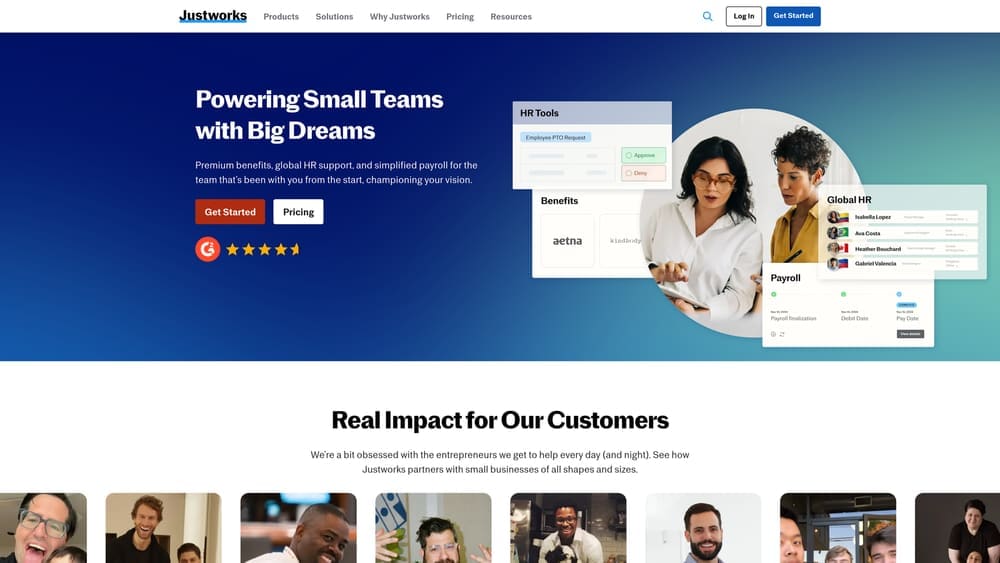
Justworks is a modern, tech-forward PEO with transparent flat-rate pricing and a streamlined platform, best suited for residential builders who prioritize simplicity and cost predictability.
Where This Tool Shines
Justworks strips away the complexity and gives you straightforward pricing—no percentage of payroll calculations, no hidden administrative fees, just a flat monthly rate per employee.
The platform itself is genuinely easy to use. If you’re tired of clunky HR systems that require three training sessions to understand, Justworks feels refreshingly simple. New hire onboarding takes minutes, not hours, which matters when you’re bringing on seasonal crews quickly.
Key Features
Transparent Flat-Rate Pricing: Know exactly what you’ll pay each month without complex calculations or variable fees.
Modern, Intuitive Platform: Clean interface that doesn’t require extensive training for you or your employees to use effectively.
Strong Benefits Options: Competitive health insurance and retirement plan access despite the simplified pricing model.
Fast Onboarding Process: Streamlined new hire setup that works well when bringing on seasonal workers quickly.
Mobile Accessibility: Full platform functionality from phones and tablets for field-based workforce management.
Best For
Residential builders with 5-25 employees who have straightforward HR needs, primarily W-2 workers, and operate in one or two states. Best if you value simplicity and transparent pricing over specialized construction features.
Pricing
$59 per employee per month for Basic plan, or $109 per employee per month for Plus plan with comprehensive benefits. Pricing is transparent and predictable regardless of payroll fluctuations.
8. CoAdvantage
Best for: Residential builders with elevated experience mod rates or claims history who struggle to find PEO coverage.
CoAdvantage is a PEO specializing in harder-to-place risks, including construction companies with elevated experience modification rates, offering strong loss control consulting and safety program development.
Where This Tool Shines
When you’ve had a bad year with workers’ comp claims and your experience mod is sitting at 1.4, most PEOs will politely decline your business or quote astronomical rates. CoAdvantage actually specializes in these situations.
They don’t just accept higher-risk operations—they actively work to improve your risk profile through loss control consulting and safety program development. The initial pricing might be higher than you’d like, but the focus is on getting your mod rate down over 2-3 years so you can access better pricing later.
Key Features
Accepts Higher-Risk Construction Operations: Willing to work with builders who have elevated experience mods or recent claims history that other PEOs reject.
Loss Control and Safety Consulting: Active on-site consulting to identify hazards and implement safety improvements that reduce future claims.
Experience Mod Rate Improvement Programs: Structured programs designed to lower your mod rate over time through claims management and safety improvements.
Flexible Underwriting: Willing to evaluate complex risk profiles individually rather than applying blanket underwriting rules.
Claims Advocacy: Aggressive claims management to minimize costs and prevent claims from inflating your future mod rate.
Best For
Residential builders who have been declined by other PEOs due to claims history or elevated experience mods. Best if you’re willing to invest in safety improvements and work collaboratively on risk reduction.
Pricing
Custom pricing based on individual risk assessment. May be higher initially than standard-risk PEOs, but pricing structure focuses on long-term rate improvement as your risk profile improves.
Making the Right Choice for Your Operation
The right PEO depends entirely on where you are in your business lifecycle and what problems you’re actually trying to solve.
If you’re a smaller builder with 5-15 employees operating in one state, start with regional NAPEO-certified providers or Justworks for simplicity. If you’re growing fast and expanding into multiple states, TriNet or Paychex give you the infrastructure to scale without constantly changing systems.
For established builders with 50+ employees and government contracts, ADP TotalSource handles the certified payroll complexity that smaller PEOs struggle with. And if you’re dealing with elevated experience mods or claims history, CoAdvantage might be your only viable option—but they’ll actually work with you instead of just declining coverage.
Here’s what matters more than the PEO name: workers’ comp rates in your specific risk pool, contract flexibility for seasonal changes, and whether they actually understand residential construction or just claim they do.
The cheapest option isn’t always the best value. A PEO that saves you $50 per employee per month but doesn’t have construction-specific safety programs could cost you tens of thousands when your experience mod jumps after a preventable claim.
Get quotes from at least three providers. Ask specifically about their construction client base, how they handle seasonal workforce changes, what their workers’ comp risk pools look like, and whether they have experience with your specific trade mix.
Before you sign that PEO renewal, make sure you’re not leaving money on the table. Many businesses unknowingly overpay because of bundled fees, hidden administrative markups, and contracts designed to limit flexibility. We give you a clear, side-by-side breakdown of pricing, services, and contract terms—so you can see exactly what you’re paying for and choose the option that truly fits your business.
