
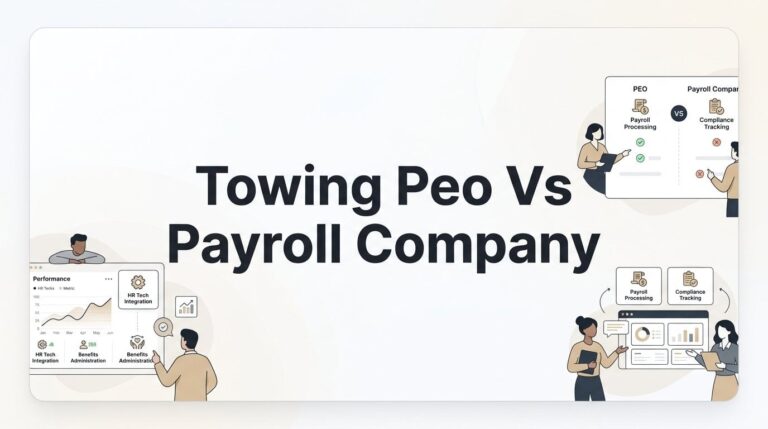
Towing companies face unique HR and insurance pressures — high workers’ comp exposure, DOT compliance demands, and driver turnover — that make the Towing PEO vs Payroll Company decision far more consequential than in most industries. This guide breaks down the key structural differences and the tools worth using to evaluate your options before committing to either.
Most advice on the leasing of employees gets one dangerous point wrong. It treats employee leasing, PEO co-employment, and even staffing as…
Choosing between a PEO and in-house HR looks different for towing companies than for most small businesses — elevated workers’ comp exposure, DOT and FMCSA compliance, and mixed W-2 and contractor workforces all shift the calculus. This guide breaks down seven concrete decision factors to help towing operators make a confident, informed choice.
Choosing the wrong PEO in the towing industry can mean compliance gaps, inflated workers’ comp premiums, and contracts built for the wrong business. This guide evaluates the top towing PEO providers based on the criteria that matter most to towing operators — DOT and FMCSA experience, high-risk underwriting, and payroll flexibility for variable-hour fleets.
A Towing PEO for 5 Employees can deliver real value — but only when small operators know how to evaluate providers, prioritize workers’ comp coverage, and avoid the pitfalls that drain budgets at this headcount. This guide covers the practical, industry-specific strategies that help 5-person towing shops get the most out of a PEO relationship.
A towing company with 15 employees faces a unique HR gap — too large for basic payroll tools, too small for in-house HR — while managing high-risk drivers, DOT compliance, and unpredictable workers’ comp claims. This guide walks through seven practical strategies for evaluating a Towing PEO for 15 Employees so you choose a partner that genuinely fits your operational reality.
Running a towing company with 25 employees creates a unique HR challenge — too large to ignore compliance and payroll complexity, too small to justify an in-house HR team. This guide breaks down seven practical strategies to help towing operators at the 25-employee mark evaluate and select a PEO that genuinely fits their industry, headcount, and risk profile.

A Colorado company usually starts looking at a PEO at the same point. Payroll has become a weekly fire drill. Benefits renewal…
At 50 employees, towing companies face a critical HR inflection point where informal management breaks down but a full in-house department isn’t yet justified. This guide walks towing operators through seven targeted strategies for evaluating a PEO — covering workers’ comp classification, DOT compliance exposure, pricing structure, and how to identify providers that genuinely understand the towing industry.
Finding the right PEO for a moving company requires more than a generic comparison — high-risk workers’ comp classifications, DOT compliance, and seasonal hiring make industry fit critical. This guide covers three top moving PEO providers and resources worth evaluating before you commit to a contract.
Moving companies face a distinct set of challenges — high workers’ comp exposure, seasonal staffing swings, and DOT compliance — that make the choice between a Moving PEO vs Payroll Company more consequential than it looks. This guide breaks down the key differences and the tools that help moving business owners compare their options before committing.
Waste management businesses face a uniquely complex HR landscape — high workers’ comp exposure, DOT and OSHA compliance, and multi-state workforces — making the choice between a PEO and a payroll company a high-stakes decision. This guide breaks down the practical differences, costs, and risk implications specific to the waste industry so operators can make an informed call.