
Most advice on HR consulting solutions starts in the wrong place. It treats the decision like buying software. Compare features, compare monthly fees, pick a vendor.
That's shallow thinking.
A payroll platform can be replaced. A consultant can be scoped down. A PEO can change the legal and operational structure of how a company hires, pays, insures, and manages people. Those are not the same decision. One is a purchase. Another is a business model choice with contract risk attached.
That difference matters more now because external HR support is no sideshow. The global human resources consulting services market was valued at USD 44.56 billion in 2025 and is forecast to reach USD 68.18 billion by 2035, with a 4.3% CAGR over that period, according to Business Research Insights on the HR consulting services market. Buyers aren't shopping in a fringe category. They're entering a large, established market full of overlapping promises and very different risk profiles.
The practical mistake is simple. Many leadership teams ask, “Which provider is cheapest?” The better question is, “Which model creates the best risk-adjusted outcome for this company over the life of the agreement?” Those are not remotely the same thing.
A company with 25 employees in three states, weak internal HR coverage, and rising benefits costs shouldn't evaluate options the same way as a 700-employee manufacturer with an HR team, a payroll manager, and a broker already in place. Yet many do.
Most buying processes fail at this point. They compare service lists instead of legal structure, implementation burden, integration requirements, and exit terms. A broad service menu looks impressive in a sales deck. It says very little about whether the arrangement genuinely fits the employer's operating model.
For teams sorting through vendors, HR services provider comparisons are useful only when they force a side-by-side look at scope, cost, and contract exposure instead of marketing language.

Table of Contents
- Introduction Beyond the Brochure
- The Four Models of HR Outsourcing Explained
- PEO vs ASO vs Consultant A Head to Head Comparison
- The Decision Framework When to Choose Each Model
- Negotiating Your Agreement and Avoiding Contract Traps
- Conclusion Making a Confident HR Decision
Introduction Beyond the Brochure
The brochure version of HR outsourcing says every model solves the same problem with slightly different service bundles. That's wrong.
An HR consultant gives advice. An ASO handles selected administrative functions. A PEO usually changes how employment administration is structured through co-employment. A broker may improve benefits placement but won't fix broken workflows, payroll controls, or fragmented systems on its own. Treating these as interchangeable options is how companies sign the wrong agreement and spend the next renewal cycle trying to unwind it.
Why the labels confuse buyers
Vendors benefit when categories blur together. “Full-service HR support” can mean strategic guidance, outsourced administration, benefits sourcing, compliance assistance, or a bundled co-employment model. Those aren't synonyms.
Buyers should assume the sales narrative hides the real trade-off until the contract and implementation plan prove otherwise.
The right way to evaluate HR consulting solutions is to strip out branding and look at five things:
- Legal structure: Is the provider advising the company, administering functions, or entering a co-employment arrangement?
- Economic model: Is pricing tied to project scope, recurring administration, employee count, payroll, commissions, or a bundle of all four?
- Risk allocation: Which party carries compliance work, payroll execution risk, benefits administration burden, and claim-handling obligations?
- Operational load: How much internal work remains with HR, finance, payroll, and line managers after go-live?
- Exit friction: Can the company leave cleanly, or will it face timing issues, data migration headaches, or benefit disruption?
The real purchase is operating leverage
A CFO shouldn't approve any HR solution because the demo looked polished. An HR director shouldn't support one because the service team felt responsive on the call. Those factors matter, but they sit below the core question. Does the model reduce cost, reduce risk, or increase internal capacity in a measurable way?
Some companies need outside strategic help for six months. Some need processing support but want to keep employer control intact. Some need a more all-encompassing structure because internal HR is thin and benefits buying power is weak. The point isn't to buy the most extensive package. The point is to buy the least complicated model that solves the actual problem.
That's the frame the rest of this article uses.
The Four Models of HR Outsourcing Explained
The U.S. HR consulting industry included 51,209 businesses in 2026, with an estimated market size of USD 29.0 billion, according to IBISWorld's HR consulting industry data. That volume alone explains why buyers get lost. Too many firms sound similar. Very few actually are.
Why the labels confuse buyers
The same provider may describe itself as an HR partner, outsourced HR team, benefits advisor, compliance resource, payroll solution, or strategic consultant. Those labels often describe sales positioning, not the underlying model.
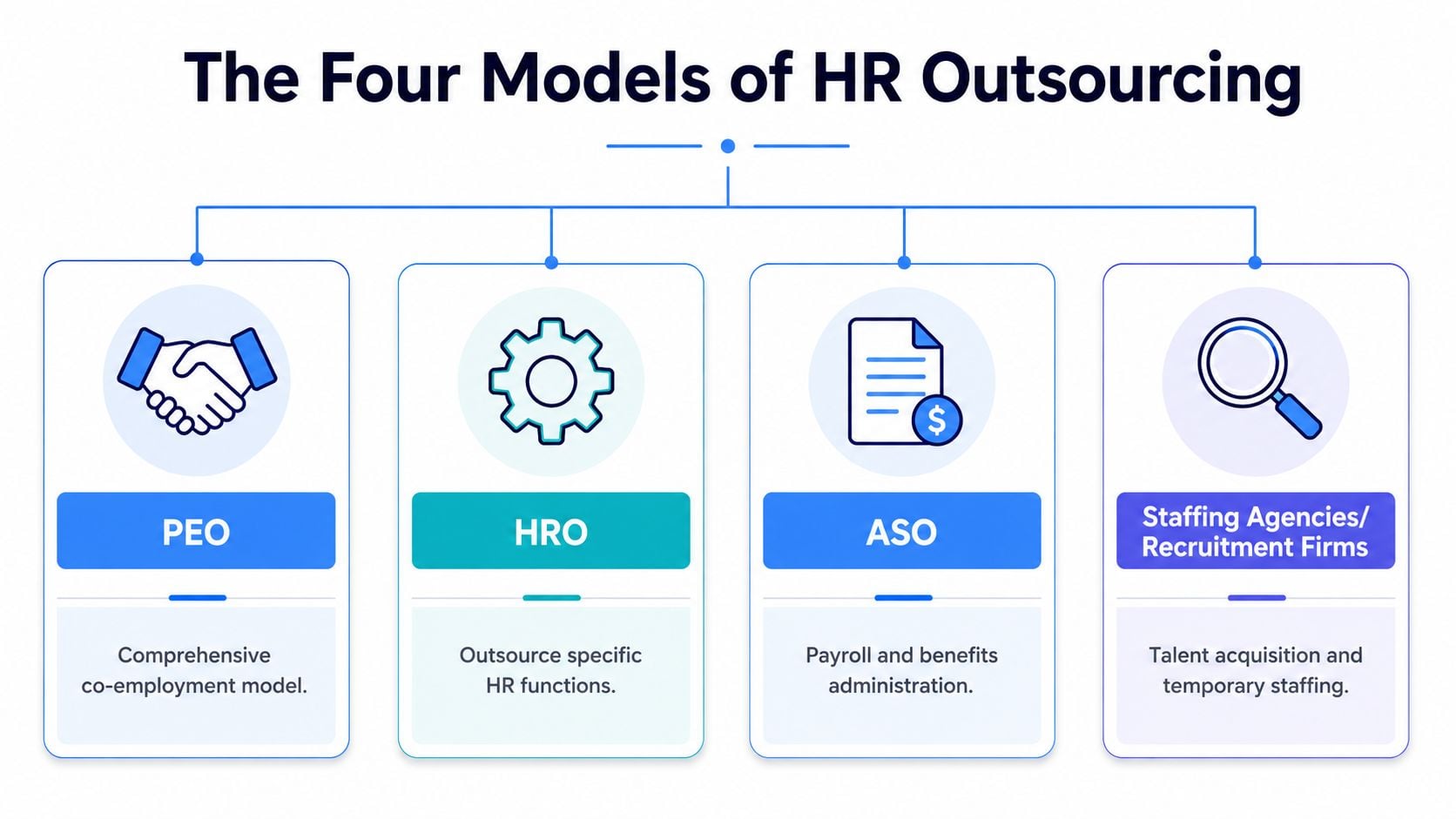
A cleaner way to sort the market is to ask what the provider is selling. Advice. Administration. Risk-sharing. Or placement.
For companies reviewing human resources outsourcing options, this distinction matters because each model creates a different finance burden, service expectation, and contract profile.
What each model really does
HR consultant
An HR consultant is the closest thing to a specialist advisor. The company keeps the employer relationship and hires the consultant for a defined project, a retainer, or targeted support.
Typical use cases include handbook rewrites, compensation projects, compliance reviews, recruiting process redesign, investigations, policy drafting, and HR tech selection. This is usually the cleanest model when the business needs expertise, not infrastructure.
The upside is control. The downside is execution load. Someone inside the company still has to implement the recommendations.
PEO
A professional employer organization usually offers a broad operating model that can include payroll, benefits administration, HR support, compliance assistance, and workers' compensation administration within a co-employment framework.
This model appeals to smaller and mid-sized employers that want a more outsourced setup. It can also appeal to multi-state companies that need tighter process discipline and a single system of record. But the buyer isn't just purchasing services. The buyer is accepting a deeper operational dependency and a more consequential contract.
Practical rule: If the company wants someone else to help carry HR administration at scale, the PEO model deserves review. If the company mainly wants advice, it usually doesn't.
ASO
An administrative services organization sits in the middle. It handles functions such as payroll, benefits administration, and selected HR tasks, but generally without the co-employment structure associated with a PEO.
This can be the right answer for employers that already have internal HR leadership and want systems plus back-office support. It tends to preserve more direct control than a PEO while still reducing administrative burden.
The weakness is that buyers sometimes expect PEO-level support from an ASO agreement and end up disappointed. Scope discipline matters here.
HR or benefits broker
A broker usually focuses on benefits placement, renewals, plan strategy, carrier negotiations, and related advisory support. Some brokers add compliance guidance or limited HR tools. Some don't.
A good broker can improve benefits purchasing decisions. A broker is not a substitute for payroll operations, HR process design, or multi-system implementation management. Companies regularly overestimate what a broker engagement will solve.
Staffing or recruitment firm
This model is narrower. Recruitment firms help find talent, fill searches, or provide temporary labor. They can be valuable, but they are not a complete HR operating solution.
That distinction matters because many buyers fold talent acquisition into a broader HR outsourcing evaluation and muddy the actual decision.
PEO vs ASO vs Consultant A Head to Head Comparison
The most useful comparison isn't “Which option offers more services?” It's “Which option matches the company's pain points without adding unnecessary contract and operating complexity?”
That difference is where buyers either save money or trap themselves.
The comparison that actually matters
The best framework for comparing HR consulting solutions is specialization, implementation effort, and whether the provider can deliver measurable risk reduction or savings. More breadth doesn't automatically create more value, as outlined by HR University's guidance on comparing HR consulting services.
| Feature | HR Consultant | PEO | ASO | HR/Benefits Broker |
|---|---|---|---|---|
| Core role | Advises and designs | Bundles administration and co-employment support | Administers selected HR functions | Places and advises on benefits |
| Legal relationship | Standard vendor relationship | More involved employment administration structure | Vendor relationship without the same co-employment setup | Advisory and placement relationship |
| Best fit | Specific problem, short project, specialized expertise | Small to mid-sized employer needing broad support | Employer with internal HR that wants processing support | Employer focused on benefits strategy |
| Implementation burden | High internal follow-through | Moderate to high during transition | Moderate, especially across payroll and data flows | Usually lighter unless paired with new systems |
| Benefits leverage | Limited by itself | Often central to the value case | Depends on arrangement | Strong on carrier market access |
| Risk transfer perception | Minimal | Highest perceived transfer, but contract language still rules | Limited to admin scope | Limited |
| Technology impact | Recommends tools | Often bundled platform | Platform and workflow heavy | Usually adjacent, not central |
| Exit complexity | Usually low | Often significant | Moderate | Usually low to moderate |
A consultant wins when the problem is narrow and the company already has enough internal horsepower to execute. Examples include fixing handbook gaps, redesigning onboarding, selecting an HRIS, or running a compensation review.
A PEO wins when fragmentation is the core problem. Payroll, benefits, workers' compensation administration, HR support, and compliance processes sit in different places, and nobody inside the company has time to coordinate them. In that case, a higher administrative cost can still be rational if the total package improves benefits access, reduces administrative drag, and gives leadership cleaner accountability.
An ASO wins when the company wants operating support without changing the relationship structure as much as a PEO. That's common in firms with a capable HR lead and a finance team that wants cleaner payroll controls, better benefits administration, and less manual work.
A broker wins when benefits are the primary pain point. If the actual issue is medical renewal strategy, plan design, employee communications, or carrier options, dragging in a broader HR outsourcing model may be overkill.
Where buyers misprice risk
The biggest buying error is comparing only visible fees. That misses contract risk and implementation effort.
A lower-fee option can still cost more if internal staff spend months cleaning employee data, handling payroll exceptions, manually reconciling deductions, and fielding employee issues the vendor never fully owns. Conversely, a broader outsourced model can look expensive until the company calculates what it's currently spending in management time, error correction, fragmented vendor oversight, and avoidable renewal chaos.
A second mistake is confusing “support” with “liability transfer.” PEO marketing often leans hard on compliance comfort. That can be valuable. But comfort is not the same as blank-check protection. Buyers still need to read responsibility, indemnity, claims handling, and termination provisions with discipline. For companies operating in states where worker classification issues are sensitive, a practical guide for US and Canadian businesses can help leadership teams frame the broader classification and labor-structure risks that sit around outsourced models.
For a cleaner legal and commercial breakdown, PEO legal structure versus ASO comparison is the right level of analysis. The category label matters less than the contract language and how the service model works after launch.
The wrong HR model usually doesn't fail in the demo. It fails six months later, when payroll owns the errors, HR owns the complaints, and finance still owns the bill.
The Decision Framework When to Choose Each Model
A technical HR consulting engagement works best when it's treated as an HR-IT transformation program with phases such as needs assessment, solution selection, and implementation, according to HR University's overview of HR technology consulting. That point is bigger than HR tech. It applies to model selection too. The choice should follow the company's operating needs, not the appeal of a polished platform.
Four common buyer scenarios
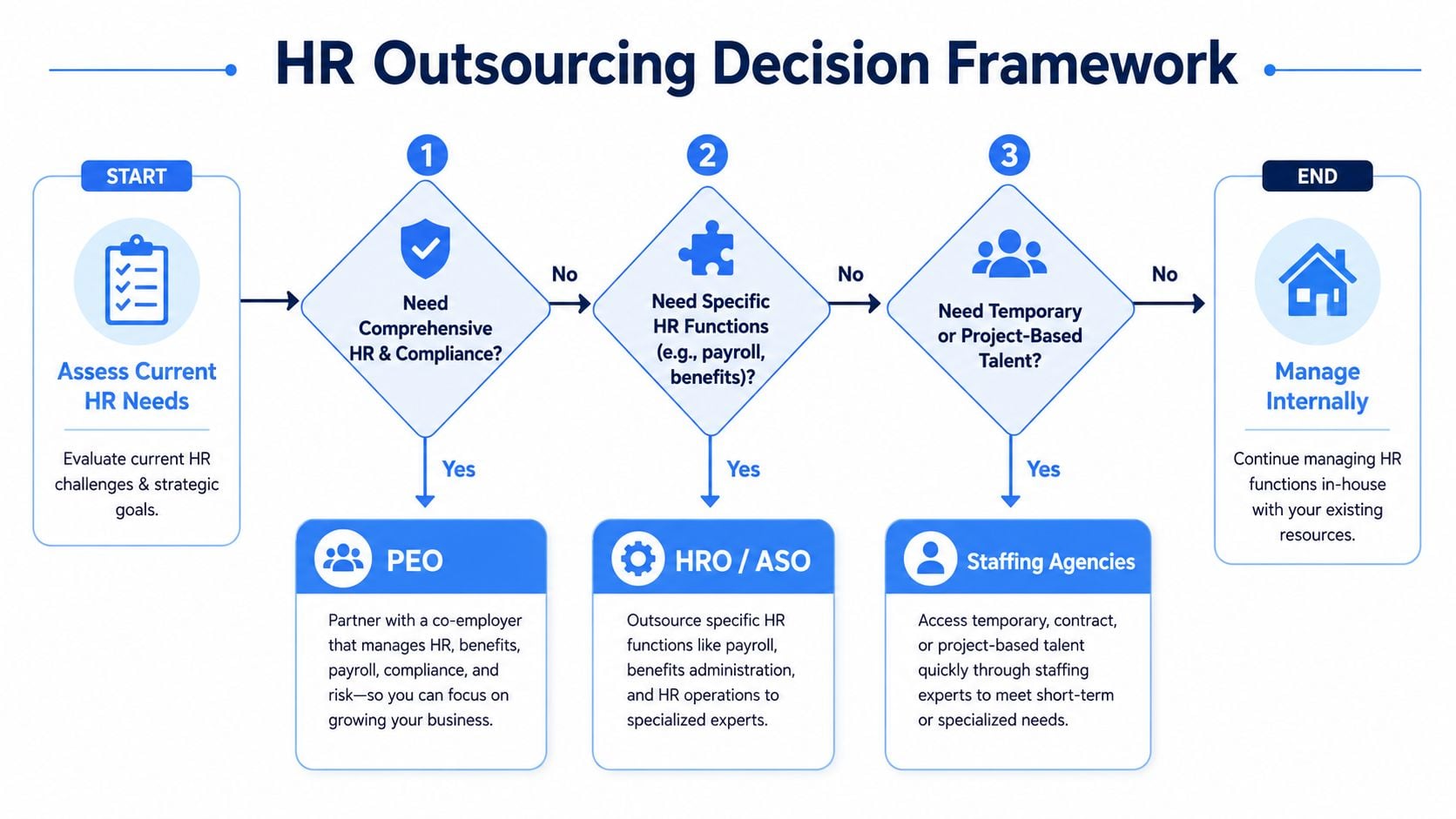
A company with 10 to 40 employees, weak internal HR coverage, and hiring across multiple states usually needs infrastructure more than advice. That company often fits a PEO. The reason isn't that PEOs are inherently better. It's that small teams often can't support payroll administration, benefits questions, onboarding workflows, compliance tracking, and employee relations support without overloading founders or office managers.
A company with 50 to 250 employees, a strong HR manager, and recurring pain around payroll processing, deductions, and open enrollment often fits an ASO. The company doesn't need someone to define its people strategy. It needs cleaner administration and fewer manual handoffs.
A company with 100 to 2,000 employees and a specific unresolved problem usually fits an HR consultant. Examples include a compensation redesign, a leave policy overhaul, a manager-investigation protocol, or an HRIS selection project. This is especially true when the company already has internal HR leadership and doesn't want to outsource broad execution.
A company that is mostly stable operationally but unhappy with medical renewals, plan design, or employee benefits communication often fits a broker-led review. If payroll and HR operations are functioning, a full outsourced shift may create more disruption than value.
The operational test
A fast decision filter works better than a long vendor matrix. Leadership teams should ask:
Is the core problem expertise or capacity?
If expertise is missing, a consultant often fits. If capacity is missing every pay cycle, look harder at ASO or PEO models.Does the company want to retain process ownership?
If leadership wants direct control over workflows and approvals, a consultant or ASO usually fits better than a deeper outsourced model.Will the company tolerate a real implementation project?
Every serious HR solution creates work. Data cleanup, payroll mapping, employee onboarding, manager training, and carrier coordination don't happen by magic.Is benefits buying power central to the business case?
If yes, the analysis has to weigh PEO and broker options carefully.
A model is right when the company can explain, in one sentence, what problem it is paying to remove.
Some buyers use outside comparison support at this stage. PEO partial outsourcing decision framework is one example of the kind of analysis companies use when they need to sort PEO, ASO, and narrower outsourcing paths without relying only on provider sales teams.
Negotiating Your Agreement and Avoiding Contract Traps
The contract matters as much as the service model. Sometimes more.
Most buyers spend too much time on demos and too little time on order forms, master service agreements, implementation exhibits, and renewal language. That's backwards. A polished demo doesn't cap fee growth, define data ownership, or guarantee a clean exit.
The clauses that deserve real scrutiny
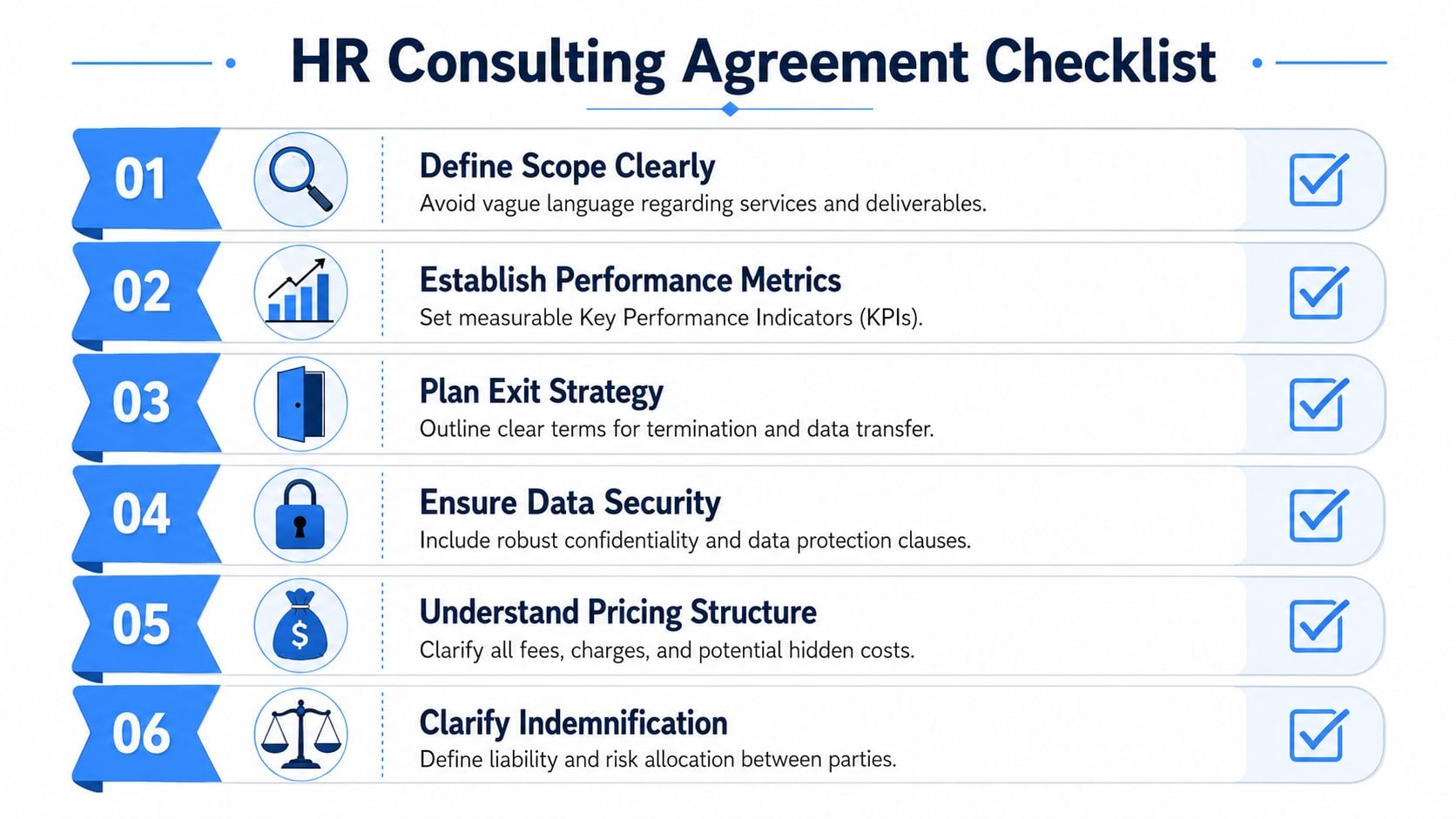
Start with scope. If the agreement says the provider offers support for payroll, benefits, compliance, or employee relations, the contract should define what “support” means. Advisory only. Processing responsibility. Filing assistance. Platform access. Escalation handling. Vague scope is where disputes start.
Then check commercial terms:
- Pricing mechanics: Are fees fixed, usage-based, employee-count-based, or subject to repricing at renewal?
- Implementation charges: Are setup, migration, year-end work, or carrier transition tasks billed separately?
- Renewal language: Does the agreement auto-renew unless notice is given within a narrow window?
- Termination rights: Can the company leave for convenience, or only for cause?
- Data access: Who owns employee data exports, and how quickly must the provider deliver them at exit?
- Service commitments: Are there actual response standards, or just general promises to support the account?
A buyer should also read indemnity and insurance provisions carefully. If the provider's error creates downstream cost or regulatory cleanup, the agreement should make responsibility clearer than “commercially reasonable efforts.” For leadership teams trying to understand the broader risk logic behind professional liability provisions, this overview of how to protect professional services gives helpful context.
Integration language belongs in the contract
For multi-system employers, implementation quality depends on stakeholder alignment, integration capability, scalability, training, and continuous feedback, as described by Mitratech's guidance on building an HR tech stack. That shouldn't stay in a project plan. It belongs in the agreement and statement of work.
If the provider is expected to connect payroll, recruiting, performance tools, background screening, I-9 workflows, or time systems, the contract should name those touchpoints. It should also spell out who is responsible for data mapping, testing, acceptance, error correction, and post-go-live support.
Contracts should be written for the month after go-live, not the week before signature.
This is where independent review can matter. Firms such as PEO Metrics analyze PEO proposals for pricing, benefits structure, service model, and contract risk so buyers can compare actual commercial terms rather than relying on summary decks. For companies in active negotiations, a PEO master service agreement checklist is the kind of document worth using before legal review starts.
Conclusion Making a Confident HR Decision
Choosing among HR consulting solutions isn't an admin task. It's a finance, operations, and risk decision wrapped in HR language.
The wrong model creates hidden cost in the form of internal rework, weak accountability, tool sprawl, and ugly exits. The right model removes a specific burden and does so with economics and contract terms that hold up after implementation. That's the standard. Not brand recognition. Not feature count. Not the sales team's responsiveness.
Leadership teams should pressure-test the decision with a short list of questions:
- What exact problem is being removed?
- Is the company buying expertise, processing capacity, benefit optimization, or a broader operating structure?
- How much implementation work will internal teams still carry?
- Which risks remain with the employer even after outsourcing?
- What happens if the relationship needs to end in twelve months?
If those answers aren't clear, the company isn't ready to sign.
A confident decision usually comes from an evidence-based comparison of model fit, cost structure, service scope, integration burden, and exit terms. That discipline matters whether the company ends up with a consultant, an ASO, a broker, or a PEO. The names matter less than the mechanics.
Companies evaluating or renegotiating a PEO can use PEO Metrics to compare providers side by side, benchmark pricing and benefits, and identify contract terms that deserve negotiation before signing.
