How PEOs work across industries like construction, healthcare, startups, and multi-state employers.

Franchise owners using a PEO with 5 employees face a unique challenge—enough HR exposure to need protection, but too small for most solutions to pencil out. This guide covers seven practical strategies tailored to single-location franchise operators, addressing co-employment dynamics, franchisor agreement conflicts, and how to choose a PEO that actually makes financial sense at this headcount.
Switching quick service restaurants to a PEO can consolidate payroll, workers’ comp, and HR overhead — but the transition requires careful sequencing to avoid payroll errors, employee confusion, or mid-policy audit triggers. This guide walks QSR operators through exactly how to execute the switch without disrupting daily operations.
Retail businesses with 25 employees face a critical HR inflection point where compliance risks and benefits costs outpace internal capacity, making a PEO a practical solution worth evaluating carefully. These seven strategies help retail operators assess PEO options with the specific context of part-time staffing, seasonal hiring, workers’ comp exposure, and headcount-threshold compliance that generic sales pitches routinely overlook.
Ecommerce businesses with 50 employees face a distinct HR inflection point where payroll complexity, seasonal staffing swings, and multi-state compliance make a PEO worth serious consideration. This guide covers seven practical strategies to help ecommerce operators identify the right PEO partner for their specific workforce structure and growth stage.
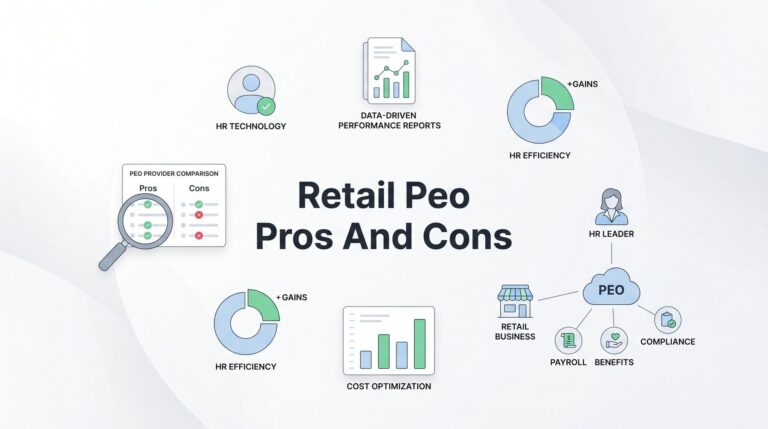
Retail businesses face unique HR challenges that generic PEO evaluations often overlook, from seasonal hiring spikes and high turnover to wage-and-hour compliance risks across multiple locations. This guide breaks down the real operational pros and cons of using a PEO in retail, helping store owners and franchise operators make an informed decision before committing to a long-term agreement.
Switching retail chains to a PEO can reduce payroll complexity, lower workers’ comp costs, and streamline HR across multiple locations — but the transition requires careful planning around multi-state regulations, mixed workforce classifications, and existing vendor relationships. This step-by-step guide walks retail operators through exactly how to execute the switch without disrupting store operations.
Advertising agencies at 50 employees face unique PEO challenges — from contractor classification risk to multi-state payroll for remote creatives — that generic provider pitches rarely address. This guide covers seven targeted strategies to help advertising firms at this headcount evaluate PEO contracts, avoid costly compliance gaps, and choose a partner built for the realities of project-based creative work.
Finding the best PEO for IT managed service providers requires matching to MSP-specific challenges like multi-state payroll, mixed contractor and W-2 workforces, and competitive tech benefits — not generic HR solutions. This guide evaluates eight providers on pricing transparency, compliance support, and how well they serve the sub-100-employee companies that most MSPs actually are.
IT managed service providers face a deceptively complex workers’ compensation challenge because their workforce spans low-risk desk employees and high-risk field technicians—a gap that generic classifications often miss. This guide examines whether a PEO workers’ compensation program genuinely addresses that complexity for MSPs or simply shifts the risk while adding administrative overhead.
Accounting firms weighing a PEO arrangement face unique considerations around licensed staff, seasonal hiring fluctuations, and client data confidentiality that generic evaluations miss. This guide breaks down the real accounting PEO pros and cons across cost structure, co-employment risks, and operational fit to help firm owners make an informed decision before signing a contract.
