Coverage of tax responsibility, workers’ comp, liability exposure, and regulatory obligations under co-employment.
A PEO governance framework for hybrid models establishes clear accountability between your internal team and your PEO partner, preventing costly gaps where critical HR tasks fall through the cracks. This framework defines decision-making authority, ownership of specific functions, and escalation paths—eliminating the confusion that leads to missed compliance deadlines, benefits enrollment failures, and unresolved employee issues when responsibilities aren’t clearly assigned.
Most dental practices overpay on workers compensation insurance because carriers lump all employees—from front desk staff to dentists—into the highest-risk classification by default. A PEO for dental practices with advanced workers comp structuring can save thousands annually by separating class codes, optimizing experience modification rates, and creating multi-location arrangements that accurately reflect each role’s actual risk profile rather than accepting costly one-size-fits-all def…
Medical practices expanding across state lines face complex compliance challenges including varying tax withholding, healthcare worker wage laws, and leave policies. While a PEO for medical practices multi-state payroll governance can manage much of this complexity, success requires establishing clear governance structures from the start—including defined authority boundaries, documented handoff protocols, and regular compliance checkpoints to prevent costly issues before they arise.
If you’re using a PEO and have employees in North Dakota, Ohio, Washington, or Wyoming, you’ll need to navigate monopolistic state workers’ comp requirements separately since PEOs can’t provide coverage there. This guide explains the practical steps for handling PEO monopolistic state workers comp, including registration, coordination with your PEO, and ongoing administration to ensure compliance while maintaining seamless HR operations across all your locations.
The PEO risk management legal structure operates through co-employment, where liability is strategically divided rather than fully transferred. Understanding this split is crucial because some risks transfer completely to the PEO, others are shared, and many remain with your business regardless of contract terms—making it essential to know exactly where responsibility falls when facing tax audits, workers’ comp claims, or employment lawsuits.
Business owners often discover PEO compliance litigation trends too late—when they’re unexpectedly named in lawsuits they assumed their PEO would handle. As courts refine joint employer liability interpretations and state employment laws become increasingly fragmented, understanding where risk actually exists in co-employment arrangements is critical. The key to avoiding costly compliance litigation is asking the right questions during PEO provider selection and structuring contracts that cle…
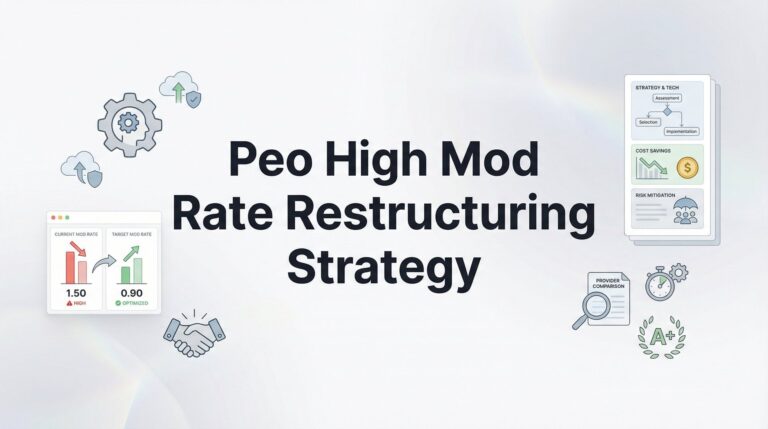
When your experience mod rate exceeds 1.0, it impacts more than insurance costs—it can force PEO contract renegotiations and limit your provider options. This guide presents seven actionable PEO high mod rate restructuring strategies that address the root causes while optimizing your arrangement, covering everything from provider switches to risk management restructuring within your current relationship.
Workers comp audits through a PEO create unique challenges due to co-employment structures that differ from standard audits. This guide provides seven proven strategies for building a strong PEO workers comp audit defense framework, covering essential documentation practices, dispute resolution processes, and negotiation tactics that help businesses successfully challenge questionable classification codes, payroll allocations, and experience modifier calculations—potentially saving thousands …
When regulatory audits or employment lawsuits arrive, many businesses discover their PEO’s “full-service support” doesn’t include legal defense. PEO defense obligations explained: these contractual commitments determine who provides representation, covers defense costs, and pays settlements—varying dramatically between providers. Understanding these obligations before signing means the difference between comprehensive legal protection and facing six-figure bills alone when claims emerge.
Agricultural employers face unique litigation risks that generic PEOs often fail to address, from H-2A worker compliance and piece-rate wage calculations to seasonal workforce management and equipment-specific OSHA requirements. This practical framework helps farms and agricultural operations select and implement a PEO for agriculture litigation risk mitigation that actually covers sector-specific vulnerabilities, preventing costly settlements like the $180,000 penalty one Oregon berry farm f…
