

Private equity firms deal with a specific HR problem that generic PEO marketing almost never addresses directly: margin compression across a portfolio of companies, each running its own disconnected benefits stack, each paying retail rates for health plans a 40-person company has no leverage to negotiate.
A well-matched PEO changes that math. By pooling employees under a co-employment model, portcos can access group benefits rates that would otherwise require thousands of employees to unlock. Workers’ comp pricing improves. Compliance risk shifts. And HR administration stops eating up management bandwidth that should be focused on growth.
The catch is that not every PEO is built for how PE actually operates. Some can’t handle rapid headcount changes during bolt-on acquisitions. Others bury margin in benefits markups rather than passing through actual carrier rates. Many lack the reporting granularity a sponsor needs for quarterly reviews or exit prep.
This list covers the PEO providers and evaluation tools best suited for the cost containment and operational efficiency priorities of PE-backed companies. Here are the top options worth evaluating.
1. PEO Metrics
Best for: PE sponsors and portco leaders who want an unbiased, data-driven evaluation layer before committing to a PEO.
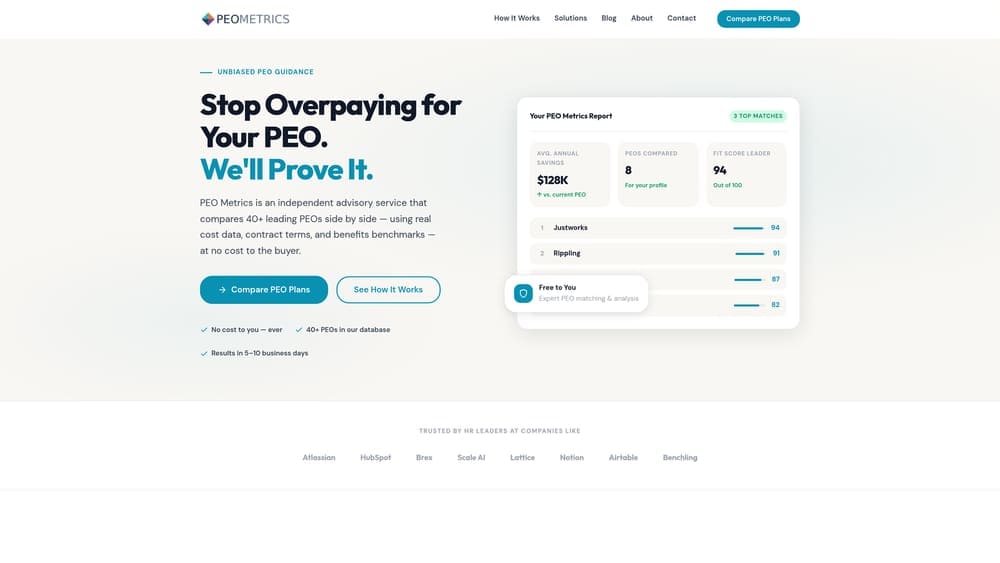
PEO Metrics is not a PEO itself — it’s the comparison infrastructure that sits in front of the decision, giving PE firms the data they need to avoid picking the wrong provider or overpaying on a multi-year contract.
Where This Tool Shines
Most PEO selection processes are reactive: a portco needs HR infrastructure fast, someone gets a few quotes, and the contract gets signed without a rigorous cost comparison. PEO Metrics was built to fix that. It provides side-by-side provider comparisons with granular cost and benefits data, which is exactly what a PE operating partner needs before a board presentation or renewal decision.
The unbiased positioning matters here. PEO Metrics isn’t affiliated with any single provider, which means the analysis isn’t skewed toward whoever pays the highest referral fee. For PE firms trying to benchmark PEO costs across five or ten portfolio companies, that independence has real value.
Key Features
Side-by-Side Provider Comparisons: Detailed cost and benefits breakdowns across multiple PEO providers so you can evaluate apples-to-apples rather than trusting each vendor’s own pitch materials.
Pricing Transparency Analysis: Surfaces hidden markups and identifies where admin fees are bundled into benefits costs rather than disclosed separately.
Portfolio-Level Scalability: Designed to work across multiple portfolio entities, not just a single company evaluation.
Due Diligence Support: Reporting and metrics structured to support PE-grade diligence and board-level reporting requirements.
Unbiased Guidance: No provider affiliation means recommendations reflect actual fit, not commission incentives.
Best For
PE operating partners, CFOs, and portco HR leaders who are entering a new PEO relationship, approaching a contract renewal, or trying to standardize the PEO evaluation process across a portfolio. Particularly valuable when a firm manages five or more portfolio companies and needs a repeatable, defensible selection framework.
Pricing
Contact PEO Metrics directly for custom portfolio-level pricing. Given the scope of multi-entity evaluations, pricing is structured based on portfolio size and engagement scope.
2. ADP TotalSource
Best for: Mid-to-large portcos that need enterprise-grade benefits access and multi-state compliance infrastructure at scale.
ADP TotalSource is one of the largest PEOs in the U.S. by co-employed headcount, which translates directly into benefits purchasing leverage that smaller portcos can’t replicate on their own.
Where This Tool Shines
Scale is ADP TotalSource’s primary advantage. Their co-employment pool is large enough to access Fortune 500-level health plan pricing, which can meaningfully reduce per-employee benefits costs for portcos that are currently buying coverage as a standalone 50 or 100-person company. That cost delta is real and shows up in EBITDA.
The compliance infrastructure is also well-developed. Multi-state payroll, tax administration, and regulatory compliance are handled across all 50 states, which matters for portcos that are expanding geographically or absorbing acquisitions in new markets. The dedicated HR business partner model gives portco leadership a named point of contact rather than a call center.
Key Features
Fortune 500-Level Benefits Access: Health plan options typically unavailable to small and mid-sized employers, negotiated through ADP’s massive co-employment pool.
Multi-State Payroll and Tax Administration: Handles complex multi-jurisdiction payroll accurately, including state-specific tax compliance.
Compliance and Risk Management: Robust tools for ACA compliance, ERISA requirements, and employment law changes across states.
Dedicated HR Business Partner: Each client is assigned a dedicated HR professional rather than routed through generalist support.
Headcount Scalability: Designed to handle companies from 50 to 1,000+ employees, which accommodates growth during a hold period.
Best For
Portcos in the 50-500 employee range, particularly those operating across multiple states or expecting significant headcount growth. Also a strong fit for PE firms that prioritize brand-name vendors for LP reporting or lender relationships.
Pricing
Custom quote based on headcount and services selected. ADP TotalSource typically prices on a percentage-of-payroll model, which means costs scale with compensation — worth scrutinizing carefully during diligence.
3. Insperity
Best for: Portcos that need hands-on HR consulting alongside benefits cost containment, particularly in professional services or distribution.
Insperity is a well-established PEO with a reputation for going deeper on HR strategy than most competitors — which can matter when a portco has an underdeveloped HR function and needs more than just a payroll processor.
Where This Tool Shines
Insperity’s HR Business Performance Consultants are a differentiator. They’re not just there to answer compliance questions — they engage on workforce strategy, performance management, and organizational design. For PE-backed companies where the operating partner is trying to build out a professional HR function quickly, that consulting layer has real operational value.
Their mid-market benefits packaging is competitive, and they have a strong track record with professional services firms and distribution companies — two verticals that frequently appear in PE portfolios. If your portco workforce skews toward white-collar employees with strong benefits expectations, Insperity tends to perform well on plan quality.
Key Features
HR Business Performance Consultants: Strategic HR advisors who engage beyond basic compliance, covering talent strategy and organizational development.
Competitive Group Health Plans: Mid-market benefits packaging with meaningful carrier options for companies that can’t access large-group rates independently.
Performance Management Tools: Built-in infrastructure for goal setting, reviews, and talent development — useful for portcos building out people management processes.
Workers’ Comp Administration: Pay-as-you-go workers’ comp options that reduce cash flow strain compared to annual premium payments.
Compliance Support: Strong regulatory guidance across employment law, benefits compliance, and HR policy development.
Best For
Portcos with 25-500 employees, particularly those in professional services, healthcare administration, or distribution where workforce quality and retention are key value creation levers. Best when the portco needs HR consulting, not just HR administration.
Pricing
Custom quote; generally structured as a per-employee-per-month fee for companies with 5 to 5,000 employees. Request a detailed breakdown of what’s included before comparing against other providers.
4. Justworks
Best for: Smaller portcos or bolt-on acquisitions that need fast HR infrastructure with transparent, predictable pricing.
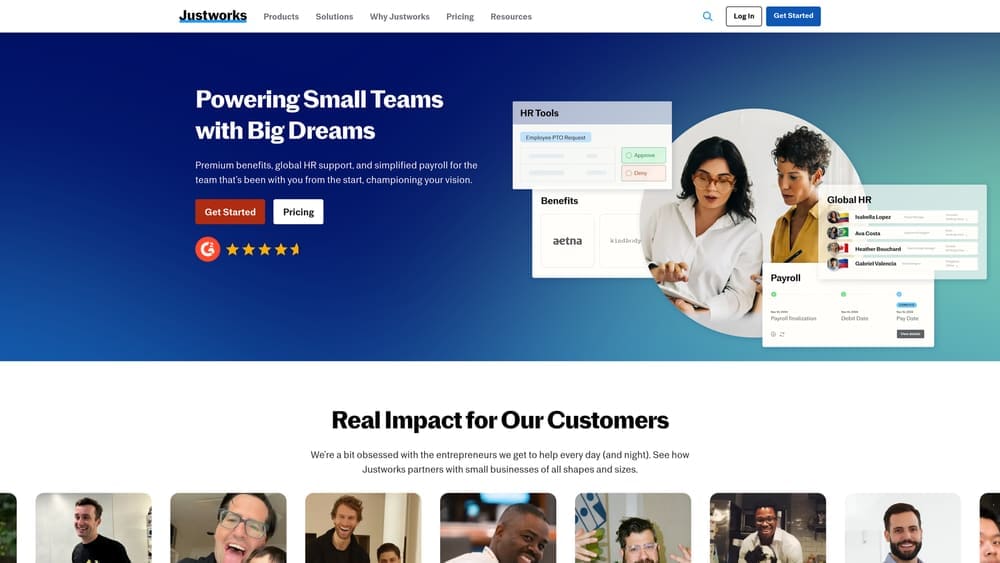
Justworks is a modern PEO built around flat per-employee pricing and fast onboarding — two things that matter a lot when you’re integrating a newly acquired company and need HR infrastructure operational within days.
Where This Tool Shines
The pricing model is the standout. Flat per-employee-per-month fees eliminate the variability that comes with percentage-of-payroll models, making cost modeling straightforward for CFOs and operating partners. You know exactly what you’re paying regardless of whether compensation increases during the hold period.
Onboarding speed is another genuine advantage. Justworks can get a company up and running in days rather than the weeks that larger PEOs often require. For bolt-on acquisitions where the clock is ticking and employees need benefits coverage immediately, that speed matters operationally and for employee retention during a transition.
Key Features
Flat Per-Employee Pricing: No percentage-of-payroll surprises — costs are fixed and predictable regardless of compensation levels.
Fast Onboarding: Operational within days, not weeks, which is critical for acquisition integrations with tight timelines.
National Carrier Access: Health plan options through Aetna, MetLife, and other major carriers, giving employees access to quality coverage despite the company’s small size.
Clean Platform: Minimal training required, which reduces the burden on portco HR staff or office managers handling HR responsibilities.
24/7 Compliance Support: Around-the-clock access to compliance guidance, useful for portcos without dedicated in-house HR expertise.
Best For
Portcos under 100 employees, bolt-on acquisitions needing rapid HR integration, and growth equity investments where cost predictability and platform simplicity are higher priorities than deep HR consulting.
Pricing
Starts at $59/employee/month for the Basic plan or $109/employee/month for the Plus plan, which includes benefits access. One of the few PEOs that publishes pricing publicly, which simplifies initial cost modeling.
5. TriNet
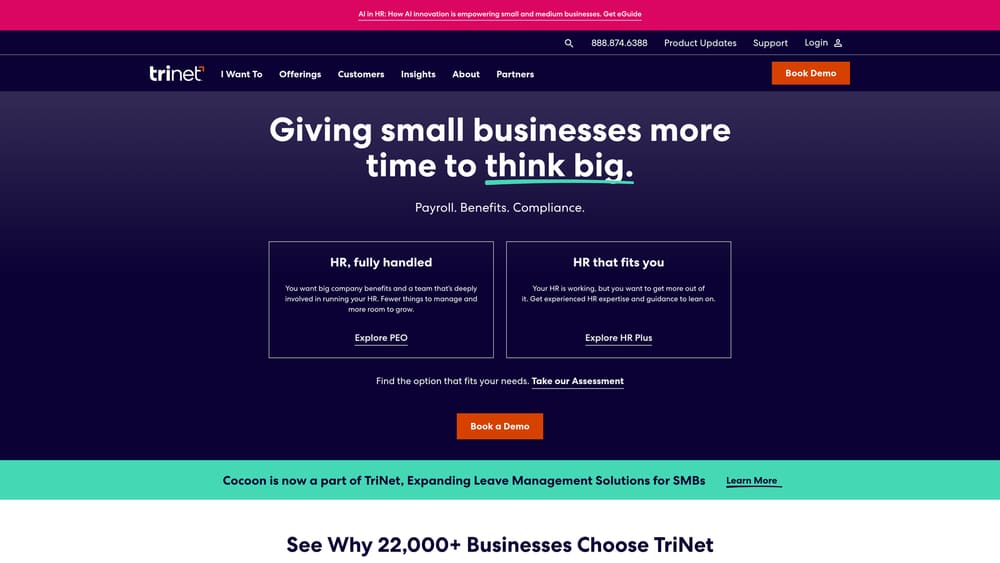
Best for: Portcos in specialized verticals like tech, financial services, or life sciences where generic benefits packages miss the mark on workforce demographics.
TriNet builds industry-specific benefits packages rather than offering a one-size-fits-all plan structure, which can reduce benefits waste when a portco’s workforce has specific coverage needs or expectations tied to their industry.
Where This Tool Shines
The industry-tailored approach is TriNet’s real differentiator. A tech portco competing for engineering talent has different benefits expectations than a manufacturing company or a healthcare services firm. TriNet structures plans around workforce demographics and industry norms, which can improve both cost efficiency and employee satisfaction — two things that directly affect retention during a hold period.
Their compliance coverage across all 50 states is comprehensive, and their strategic HR consulting layer can help portcos that are scaling quickly and need guidance on compensation benchmarking, benefits competitiveness, and regulatory compliance in new markets.
Key Features
Industry-Tailored Benefits: Plans structured around the specific workforce demographics and benefits expectations of your portco’s vertical.
Nationwide Compliance Coverage: Risk mitigation and regulatory support across all 50 states, including employment law updates and ACA compliance.
Strategic HR Consulting: Guidance on compensation benchmarking, talent strategy, and workforce planning for growing companies.
Integrated Platform: Unified payroll, benefits, and HR administration in a single system, reducing administrative fragmentation.
Flexible Plan Options: HMO, PPO, and HDHP options allow portcos to offer a meaningful benefits menu without overpaying for coverage employees won’t use.
Best For
PE-backed companies in tech, financial services, life sciences, or professional services where benefits competitiveness is a talent retention issue and generic PEO plans would underserve the workforce.
Pricing
Custom quote based on industry vertical and headcount. TriNet typically prices on a per-employee-per-month basis, with rates varying by industry. Ask specifically how benefits costs are structured and whether the PEO passes through actual carrier rates.
6. Paychex PEO
Best for: PE firms that need a clear PEO-to-ASO transition path as portcos approach exit.
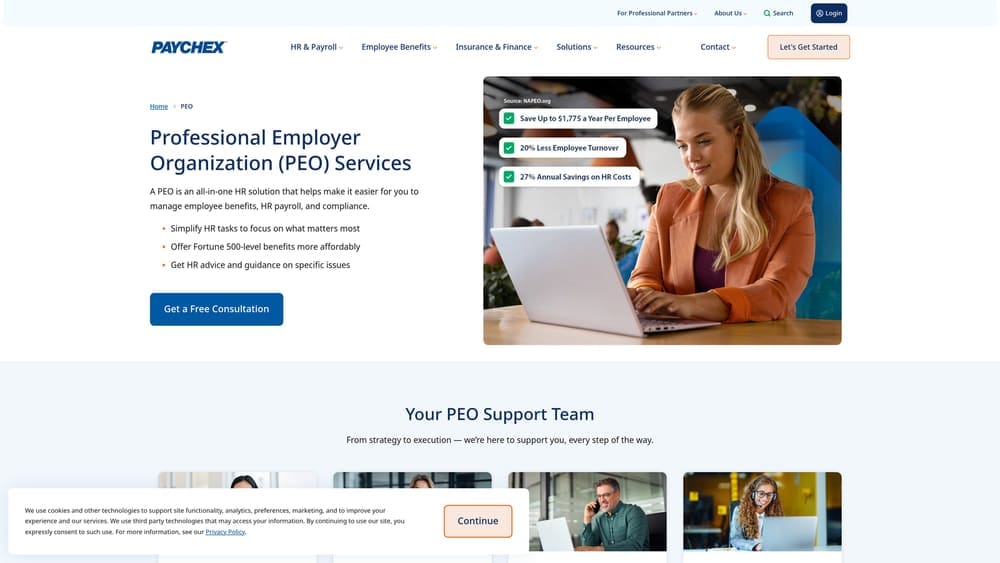
Paychex PEO offers both PEO and Administrative Services Organization (ASO) models under one roof, which gives PE firms an important structural option: the ability to transition a portco out of co-employment without switching platforms entirely as exit timing approaches.
Where This Tool Shines
Exit readiness is where Paychex differentiates. Most PEOs don’t make it easy to unwind the co-employment relationship when a strategic buyer or IPO is on the horizon. Paychex’s PEO-to-ASO transition path means a portco can maintain the same payroll and HR infrastructure while moving to a direct employment model — reducing disruption and preserving institutional knowledge in the HR system during a sensitive transition period.
The platform is also broadly capable. Payroll, benefits, workers’ comp, and HR administration are all integrated, and the geographic coverage handles multi-state complexity without requiring patchwork solutions.
Key Features
PEO-to-ASO Transition Path: A structured off-ramp from co-employment that preserves platform continuity during exit preparation — a genuinely underrated feature for PE use cases.
Integrated Platform: Payroll, benefits, workers’ comp, and HR administration unified under one system, reducing data fragmentation across portco operations.
Dedicated Account Team: Both a payroll specialist and an HR professional assigned per account, providing two distinct points of expertise.
Multi-State Capabilities: Broad geographic coverage for portcos operating across state lines or expanding through acquisition.
Retirement Plan Administration: 401(k) plan options managed within the same platform, simplifying benefits administration for portco leadership.
Best For
Portcos within two to three years of a planned exit where exit readiness is already a consideration. Also a solid fit for PE firms that value continuity of HR systems across the hold period and through the transition to new ownership.
Pricing
Custom quote available in both percentage-of-payroll and per-employee-per-month models. The flexibility to choose your pricing structure is worth noting — ask which model makes more sense given your portco’s compensation profile.
7. Rippling PEO
Best for: PE-backed tech companies where system integration, automation, and unified data are operational priorities.
Rippling PEO takes a fundamentally different approach than traditional PEOs: it unifies HR, IT, and finance data into a single employee platform, which creates operational efficiencies that go well beyond payroll and benefits administration.
Where This Tool Shines
For tech portcos, the integration depth is the story. Rippling connects HR data with IT device management, app provisioning, and finance systems in a way that no traditional PEO touches. When you onboard a new employee, Rippling can simultaneously set up payroll, enroll them in benefits, provision their laptop, and grant software access — all from a single workflow. That automation reduces administrative overhead and eliminates the manual handoffs that slow down fast-growing teams.
The reporting and analytics capabilities are also stronger than most traditional PEOs, and the API integrations with major ERP and finance tools make it easier to pull HR cost data into the financial reporting that PE sponsors need for quarterly reviews.
Key Features
Unified HR, IT, and Finance Platform: Connects employee data across HR administration, device management, app provisioning, and financial systems in a single source of truth.
Automated Workflows: Onboarding, offboarding, and compliance workflows that run automatically, reducing manual administrative work for portco HR teams.
Custom Reporting and Analytics: Flexible dashboards that can be configured to surface the cost and workforce data PE sponsors need for reporting.
Global Workforce Management: Handles international employees and contractors, useful for tech portcos with distributed or global teams.
API Integrations: Native connections with major finance and ERP platforms, making it easier to integrate HR cost data into broader financial reporting.
Best For
PE-backed software, SaaS, or technology services companies where system integration and automation efficiency are genuine value creation levers. Less suited for traditional industries where deep HR consulting is more valuable than tech infrastructure.
Pricing
Core platform starts at $35/employee/month; PEO pricing is custom based on headcount and services. Request a detailed breakdown of what’s included in the PEO tier versus the base platform.
8. Amplify PEO
Best for: PE sponsors who want a PEO built specifically for multi-entity portfolio management and consolidated sponsor-level reporting.
Amplify PEO is purpose-built for the private equity operating model — multi-entity dashboards, consolidated reporting across portfolio companies, and flexible plan structures that can vary by portco while still being managed centrally.
Where This Tool Shines
Most PEOs treat each client company as a standalone relationship. Amplify is designed around the sponsor layer: operating partners and portfolio operations teams can get consolidated visibility across all their portcos without having to log into separate systems or manually aggregate data. That’s a meaningful operational difference when you’re managing HR and benefits costs across eight or twelve portfolio companies simultaneously.
The bolt-on acquisition experience is also notable. Integrating a newly acquired company into an existing HR infrastructure is one of the messier parts of portfolio management, and Amplify has built processes specifically for that scenario rather than treating it as an edge case.
Key Features
Portfolio-Level Dashboards: Consolidated sponsor-facing reporting across all portfolio entities, giving operating partners a unified view of HR costs and workforce data.
Multi-Entity Reporting: Structured reporting that supports PE quarterly reviews, board presentations, and exit preparation without requiring manual data aggregation.
Flexible Benefits Structuring: Different plan structures can be maintained per portco as needed, accommodating the reality that portfolio companies may have different workforce demographics and benefits needs.
Bolt-On Acquisition Integration: Established processes for integrating newly acquired companies into the existing portfolio HR infrastructure quickly.
Transparent Fee Structures: Pricing designed to withstand PE-grade due diligence scrutiny, with clear separation between admin fees and benefits costs.
Best For
PE sponsors managing five or more portfolio companies who want a PEO partner that understands the operating model at the fund level, not just the portco level. Particularly valuable for firms doing multiple acquisitions per year where integration speed and consistency matter.
Pricing
Custom quote based on total portfolio headcount and entity count. The multi-entity structure means pricing is negotiated at the portfolio level rather than company by company.
Matching the Right PEO to Your Portfolio Strategy
The right answer here depends heavily on where your portfolio companies sit in terms of size, stage, and exit timeline.
For smaller portcos and bolt-on acquisitions under 100 employees, Justworks offers the fastest path to operational HR with predictable flat-fee pricing. For mid-market companies in professional services or distribution, Insperity’s consulting depth and Paychex’s exit-readiness features are worth prioritizing. Tech-heavy portfolios should take a serious look at Rippling’s integration capabilities. And if you’re managing a PE fund with multiple portcos and need sponsor-level visibility across the portfolio, Amplify PEO was built specifically for that problem.
For buyout-focused firms where EBITDA improvement is the mandate, ADP TotalSource and TriNet offer the benefits purchasing leverage that directly impacts per-employee health plan costs. For growth equity situations where speed and simplicity matter more than consulting depth, Justworks and Rippling tend to perform better operationally.
Before any of those decisions, though, the comparison layer matters. Most portcos sign PEO contracts without a rigorous side-by-side analysis, and that’s where margin gets left on the table — in hidden markups, opaque admin fee structures, and renewal terms that auto-escalate without scrutiny.
Don’t auto-renew. Make an informed, confident decision. PEO Metrics gives you the side-by-side cost and benefits comparison you need to evaluate providers on actual data — not vendor pitch decks — so your portcos are paying the right price for the right coverage, every time.
