
A finance lead opens a PEO proposal expecting a clean fee summary and gets a spreadsheet instead. One tab shows payroll-based admin fees. Another shows projected benefit costs. A third lists credits, assumptions, and footnotes about renewal terms. The quote looks precise, but the actual question is still unresolved. What do pro forma costs mean, and what will the company pay?
That confusion shows up most often when HR directors, CFOs, and owners compare PEOs side by side. One provider prices on payroll. Another uses PEPM. A third adds implementation costs outside the main schedule. On paper, all three can look competitive. In practice, the details hidden inside the pro forma model often decide whether the agreement stays affordable after go-live.
A clear reading of pro forma costs helps buyers separate projected operating cost from contract risk. It also helps them spot the fees that don’t show up cleanly in a headline quote, especially in service arrangements explained through a PEO relationship model. That matters before a renewal, during an RFP, and anytime a leadership team wants a stronger position in negotiations.
Table of Contents
- Introduction to Pro Forma Costs in PEO Agreements
- Understanding the Pro Forma Cost Concept
- Breaking Down Pro Forma Cost Components and Assumptions
- Step by Step Example Calculation with PEO Adjustments
- Common Pitfalls and Red Flags in PEO Pro Forma Costs
- Actionable Advice for Comparing and Negotiating Using Pro Forma Models
- Key Takeaways and Next Steps
Introduction to Pro Forma Costs in PEO Agreements
A PEO pro forma usually appears when a provider wants to show what employment costs would look like as if the new arrangement were already in place. That sounds simple. It rarely feels simple when the model blends current payroll, estimated workers’ compensation, benefit assumptions, and future credits into one forecast.
For HR and finance teams, pro forma costs meaning goes beyond “projected fees.” In a PEO agreement, it often means a quote built on assumptions about headcount, payroll mix, benefits elections, state tax exposure, and contract terms that haven’t happened yet. The numbers aren’t fake, but they aren’t historical results either. They’re conditional.
A good model helps a company evaluate likely cost under a defined scenario. A weak one can hide setup charges, understate future increases, or make one provider look cheaper because key variables sit outside the main schedule.
Practical rule: If a PEO quote can’t show which costs are recurring, which are one-time, and which depend on assumptions, the model isn’t decision-ready.
That distinction matters most when leadership needs a defensible answer to a board member, owner, or operating executive asking one direct question: what is the all-in employment cost if this vendor is selected?
Understanding the Pro Forma Cost Concept
The phrase pro forma sounds technical, but the core idea is straightforward. It describes a financial view built from assumptions rather than from completed history.
Where the term comes from
The term “pro forma” originates from Latin, translating to “as a matter of form” or “for the sake of form,” and in financial contexts, it specifically denotes financial statements based on assumptions or projections rather than actual historical data according to the definition of pro forma in financial usage.
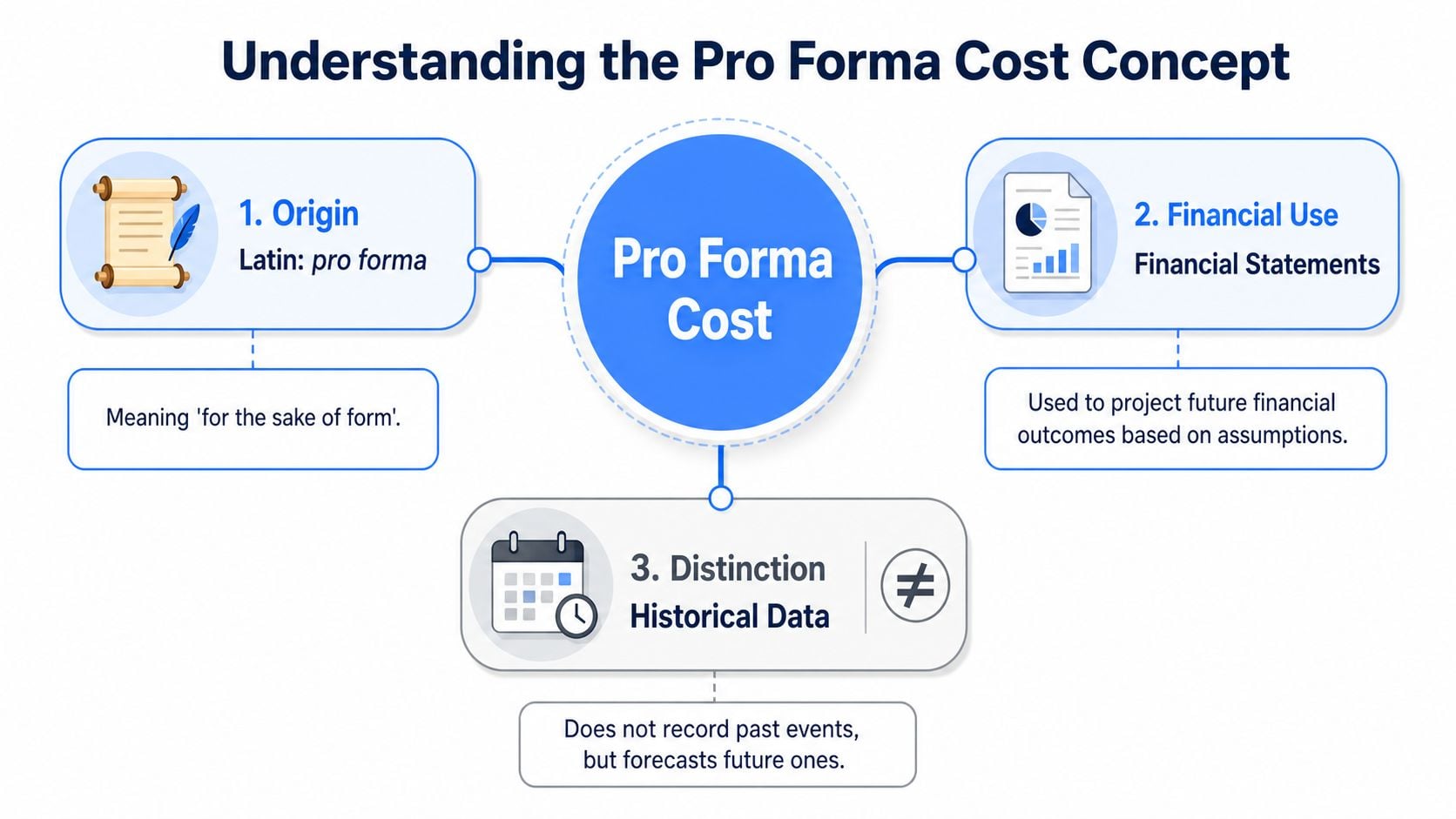
In plain language, a pro forma cost model answers a “what would happen if” question. What would payroll administration cost if the new PEO started on the first day of the quarter? What would benefits spend look like if the company moved to a different medical plan? What would total cost look like if implementation credits reduced early invoices?
That is why pro forma schedules show up in budgeting, valuation, lending, and M&A work. They don’t report what happened. They show what the business might look like under a specific set of assumptions.
How that applies to PEO pricing
In the PEO setting, the easiest analogy is a weather forecast for employment cost. A forecast uses available information and a defined model. It can still miss because conditions change.
A PEO pro forma works the same way. It may estimate total spend using payroll data, employee counts, benefit elections, and service fees. But if the assumptions shift, the actual invoices shift too. That is why teams comparing vendors should review both the math and the assumptions. The schedule isn’t just a fee sheet. It’s a financial forecast.
Teams building a stronger review process often benefit from broader guidance on how to build strong financial projections, especially when the same discipline needs to carry across budgeting and vendor selection. The same thinking applies when reviewing a PEO pricing cost structure. Consistent assumptions matter more than pretty spreadsheets.
A useful mental model is this:
- Historical statement: what the company paid
- Pro forma statement: what the company expects to pay under stated assumptions
- Decision risk: the gap between those two numbers
A clean pro forma isn’t meant to impress anyone. It’s meant to make future cost easier to challenge.
Breaking Down Pro Forma Cost Components and Assumptions
A PEO pro forma should be read line by line, not as a single bottom-line number. The cheapest-looking quote often becomes the most expensive one when a buyer discovers which costs were omitted, deferred, or softened through assumptions.
What usually sits inside the model
A pro forma income model focuses on recurring operational cost, not one-off accounting noise. In accounting terms, pro forma costs represent projected direct expenses calculated to verify the gross profit accuracy of a pro forma income statement, specifically by excluding unusual or nonrecurring transactions like restructuring fees or goodwill write-downs to present a clearer picture of typical operational performance, as explained in NetSuite’s overview of pro forma financial statements.
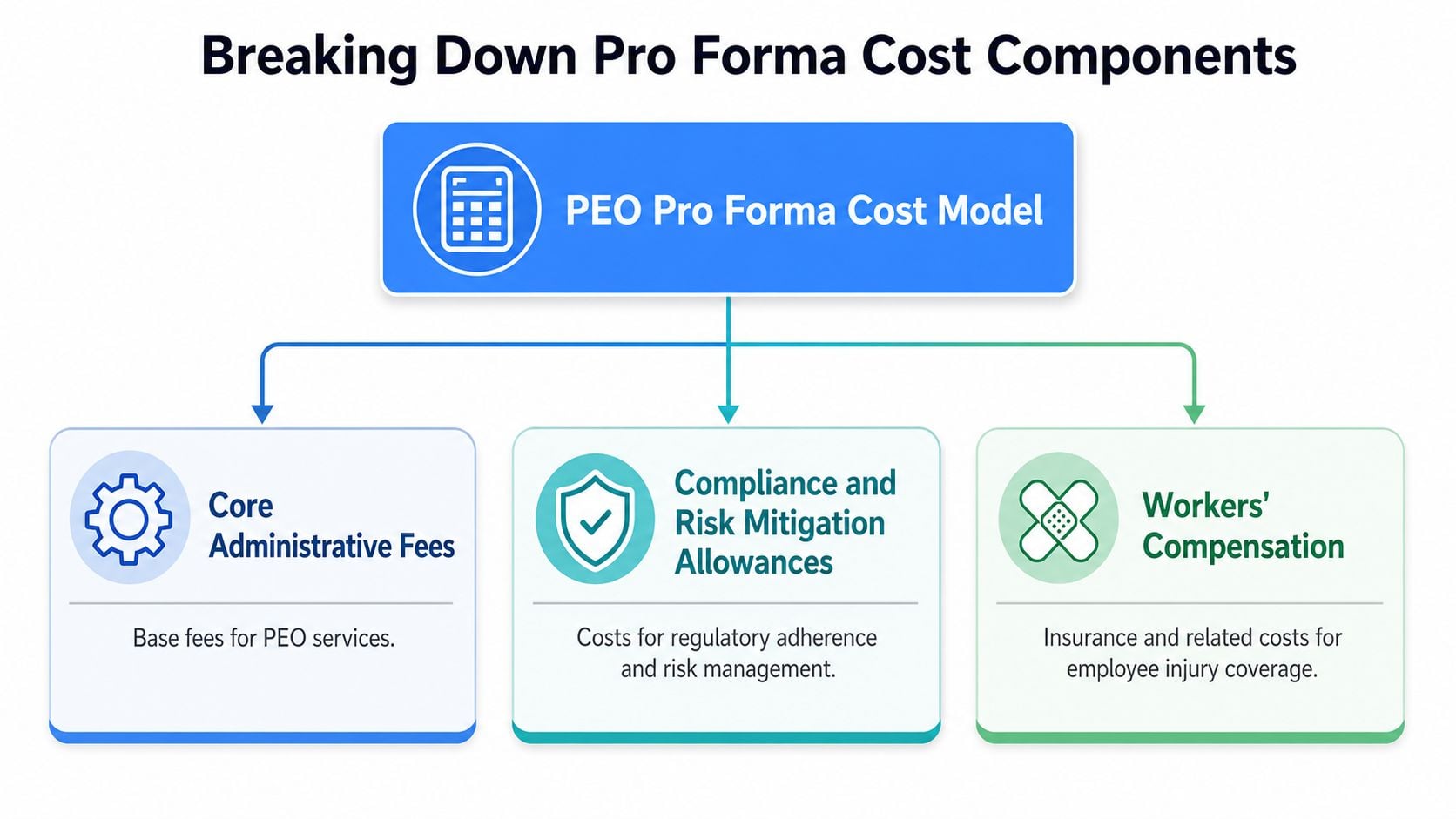
That same logic carries into PEO analysis. The model usually includes the following:
- Administrative fees: These are the recurring PEO charges for payroll, HR support, compliance administration, and platform access. Some providers quote them as a percentage of payroll. Others use PEPM.
- Benefits premiums: Medical, dental, vision, and ancillary elections usually appear here. The quote may reflect current enrollment or a projected enrollment mix.
- Workers’ compensation projections: These estimates may use class codes, historical claims, payroll by role, or a broad blended assumption.
- Tax and compliance loads: Multi-state employers often see payroll tax and state-specific compliance costs embedded here, though not always transparently.
- Implementation cost or credits: Some providers include onboarding fees or temporary credits. Others put them in footnotes, which makes the first-year economics harder to compare.
- Exit-related items: Not every quote includes these. That omission is one reason finance teams should ask for them explicitly.
Assumptions that should sit outside the model
The strongest pro forma schedules separate numbers from assumptions. That way, finance can update one variable without rebuilding the whole workbook.
A working assumption schedule should include:
| Assumption | Why it matters |
|---|---|
| Headcount changes | Affects PEPM cost, benefits participation, and payroll-based fees |
| Payroll growth | Changes percentage-of-payroll pricing outcomes |
| State footprint | Can alter tax handling, compliance burden, and workers’ compensation assumptions |
| Benefit elections | Shifts total premium cost and employer contribution levels |
| Contract timing | Affects credits, partial-month billing, and renewal alignment |
| One-time items | Prevents setup or transition cost from being confused with recurring spend |
This is the accounting discipline many teams miss. The schedule isn’t just there to support the quote. It should let HR and finance test alternate scenarios quickly, including current-state, renewal-state, and switch-state comparisons.
A useful benchmark for this kind of review is a structured PEO cost allocation methodology. The point isn’t to create a perfect forecast. The point is to make every assumption visible enough that leadership can challenge it.
If a provider changes one assumption and the whole proposal suddenly looks better, the issue isn’t the spreadsheet. The issue is control over the inputs.
Step by Step Example Calculation with PEO Adjustments
The easiest way to understand pro forma costs meaning in a PEO agreement is to build a simple working model. The example below uses a hypothetical company with 100 employees, because that headcount is large enough to show the moving parts without making the spreadsheet unreadable.
In PEO service agreements, pro forma costs often appear as hypothetical administrative fees shown as if certain changes were already in place. Those fees are often structured as 2% to 12% of total payroll or $40 to $160 per employee per month, based on ADP’s explanation of PEO cost structures. That means a buyer may receive a quote that looks straightforward but relies on several timing and contract assumptions.
A working example for a 100 employee company
Start with a baseline.
Assume the company is comparing current internal HR and payroll administration costs against a proposed PEO arrangement. The current annual payroll is $6,000,000. The PEO quotes an administrative fee of 4% of payroll. The quote also includes a $5,000 implementation credit amortized over 12 months and assumes 4% annual benefit premium inflation. For internal planning, the model also tests a 2% monthly rate increase cap in the contract.
Those inputs create three categories:
- recurring PEO admin fees
- temporary credit adjustments
- projected benefit cost inflation
Step 1. Calculate recurring administrative fee
Annual payroll: $6,000,000
PEO administrative fee: 4% of payroll
Annual admin fee = $240,000
Monthly admin fee = $20,000
That is the clean recurring fee before any credits or future increases.
Step 2. Spread the implementation credit over the first year
Implementation credit: $5,000
Amortized over 12 months
Monthly credit effect = $416.67
Adjusted monthly admin fee in year one:
$20,000 – $416.67 = $19,583.33
Annualized first-year admin fee after credit:
$235,000.04
For practical review, that would be treated as roughly $235,000 in year one. The key point isn’t rounding. It’s classification. A temporary credit should never be mistaken for a lower underlying fee.
Working rule for finance teams: Strip out first-year credits, then evaluate whether the recurring cost still looks competitive.
Step 3. Add benefit inflation as a separate pro forma adjustment
Assume current annual employer-paid benefits cost is $1,200,000.
Projected annual benefit premium inflation: 4%
Inflation adjustment = $48,000
Projected annual benefits cost under the pro forma:
$1,248,000
Differing approaches often cause many quote comparisons to go sideways. One vendor may show current-year premium equivalents. Another may build in expected renewal movement. Unless every proposal uses the same inflation assumption, the comparison isn’t apples to apples.
Step 4. Test the contractual rate cap
Now assume the team wants to understand the protection created by a 2% monthly rate increase cap. This doesn’t mean the fee will rise each month. It means the model limits the effect if an increase trigger appears within the contract framework being tested.
Using the adjusted monthly admin fee of $19,583.33, a capped increase would produce:
Potential increase amount = $391.67 per month
Capped monthly admin fee after increase = $19,975.00
That is a useful pro forma sensitivity test. It shows leadership how much exposure remains even when the contract includes some protection.
Step 5. Layer in PEO-specific adjustments
PEO analysis gets more realistic when the model adds items that generic pro forma guides often ignore:
- Multi-state compliance load: If employees sit across several states, the company should create a separate line item or assumption note rather than bury the cost inside tax handling.
- Benefits administration fees: Some providers include administration in the core fee. Others treat pieces of it separately.
- Implementation timing: Credits only help if the contract language makes them usable and prorated correctly.
- Renewal treatment: A first-year credit can mask a weaker renewal position.
A construction or operating team used to spreadsheet modeling will recognize this immediately. The same discipline that supports scenario building in a construction pro forma template also helps in PEO review. Inputs should be isolated so the company can change one variable at a time and see the effect.
Pro Forma vs Actual Cost Comparison
| Cost Item | Actual Cost | Pro Forma Cost |
|---|---|---|
| Annual payroll | $6,000,000 | $6,000,000 |
| PEO admin fee | N/A | $240,000 |
| Monthly admin fee | N/A | $20,000 |
| Implementation credit | N/A | ($5,000) |
| First-year admin fee after credit | N/A | $235,000.04 |
| Employer-paid benefits | $1,200,000 | $1,248,000 |
| Monthly admin fee after capped increase test | N/A | $19,975.00 |
The lesson from the table is simple. The pro forma isn’t just a quote. It’s a forecast shaped by fee mechanics, timing rules, and assumptions. If even one of those items is hidden in a footnote, the forecast stops being reliable enough for a contract decision.
Common Pitfalls and Red Flags in PEO Pro Forma Costs
Most PEO buyers don’t get tripped up by the visible fee. They get tripped up by the part of the model that looked too minor to question.
Research shows 68% of SMBs encounter unexpected cost increases within the first 18 months of a PEO contract, according to Pease Bell’s discussion of using pro formas effectively. That number explains why a polished quote isn’t enough. A buyer has to inspect the quote for missing variables and weak definitions.
Where quotes usually hide variable cost
Some traps show up repeatedly:
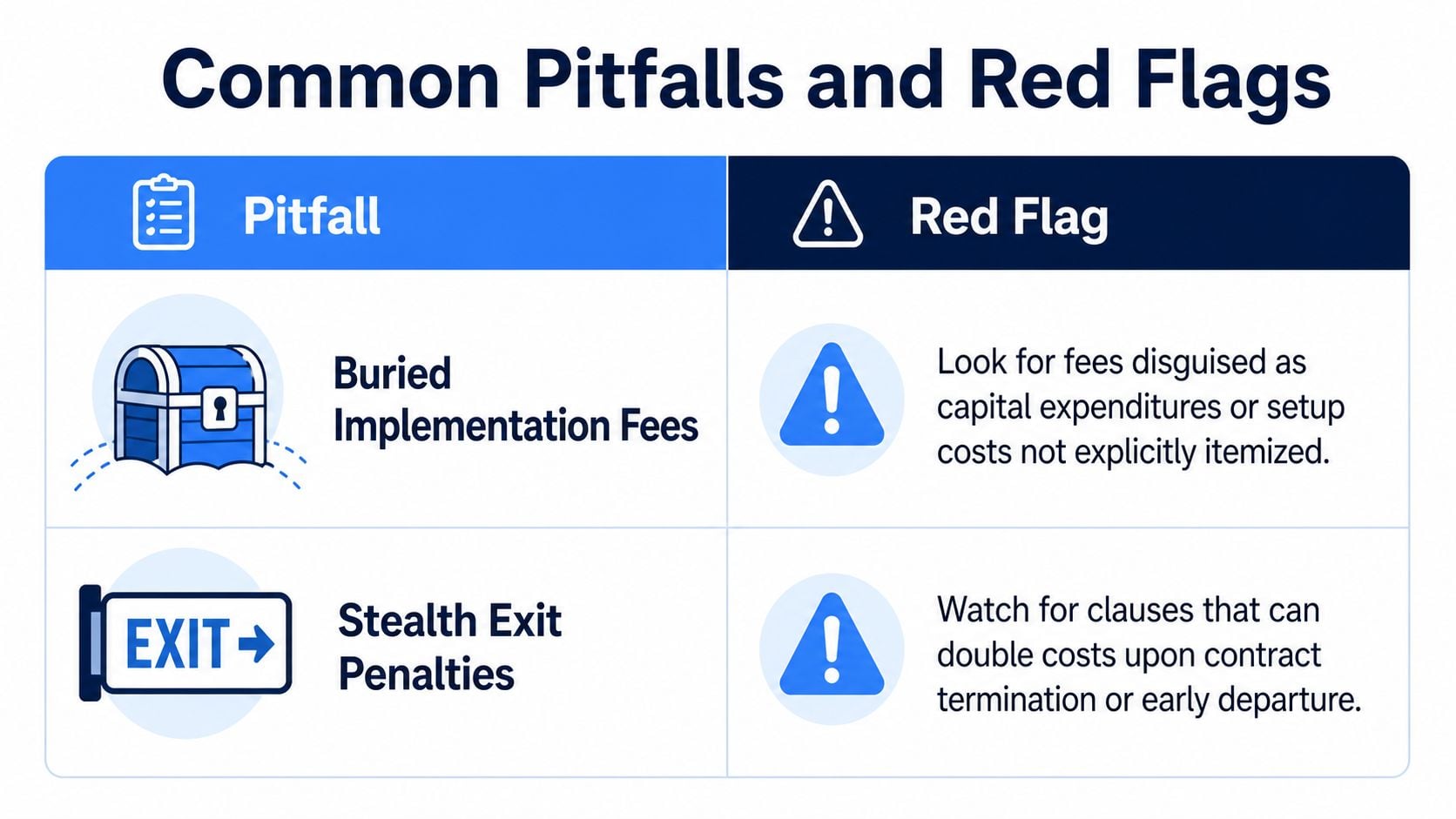
- Buried implementation fees: The proposal references “setup,” “migration,” or “launch support” without placing the amount in the main financial schedule.
- Softened renewal assumptions: The first-year quote includes credits, but the model doesn’t show what happens when they expire.
- Incomplete compliance load: State-specific requirements are described generally instead of being tied to a clear cost assumption.
- Exit economics pushed off-page: Termination charges and runout obligations sit in the contract, not in the financial model.
A similar pattern appears in hiring decisions. The visible cost gets attention, while secondary consequences arrive later. Teams reviewing workforce economics often find value in related insights on costly hiring mistakes, because the same decision error shows up in vendor selection. The headline number gets over-weighted. The downstream risk gets under-modeled.
Clauses worth flagging before signature
A red-flag review should be specific. Generic concerns don’t help much in contract negotiation.
Watch any quote that uses detailed numbers in the summary but vague language in the assumptions.
The most important items to call out are:
| Pitfall | Red flag |
|---|---|
| Buried implementation fees | Fees appear as setup support, transition cost, or capitalized onboarding items instead of a direct line item |
| Stealth exit penalties | Termination language creates added charges that don’t appear in the pro forma |
| Non-prorated credits | Credits sound generous but disappear if timing shifts |
| Automatic fee hikes | The model excludes renewal movement or escalation triggers |
| Vague compliance charges | Multi-state or regulatory costs appear as broad estimates without method |
For teams reviewing contracts at renewal or before selection, a focused checklist of PEO contract negotiation red flags can help turn those concerns into direct edits and vendor questions.
Actionable Advice for Comparing and Negotiating Using Pro Forma Models
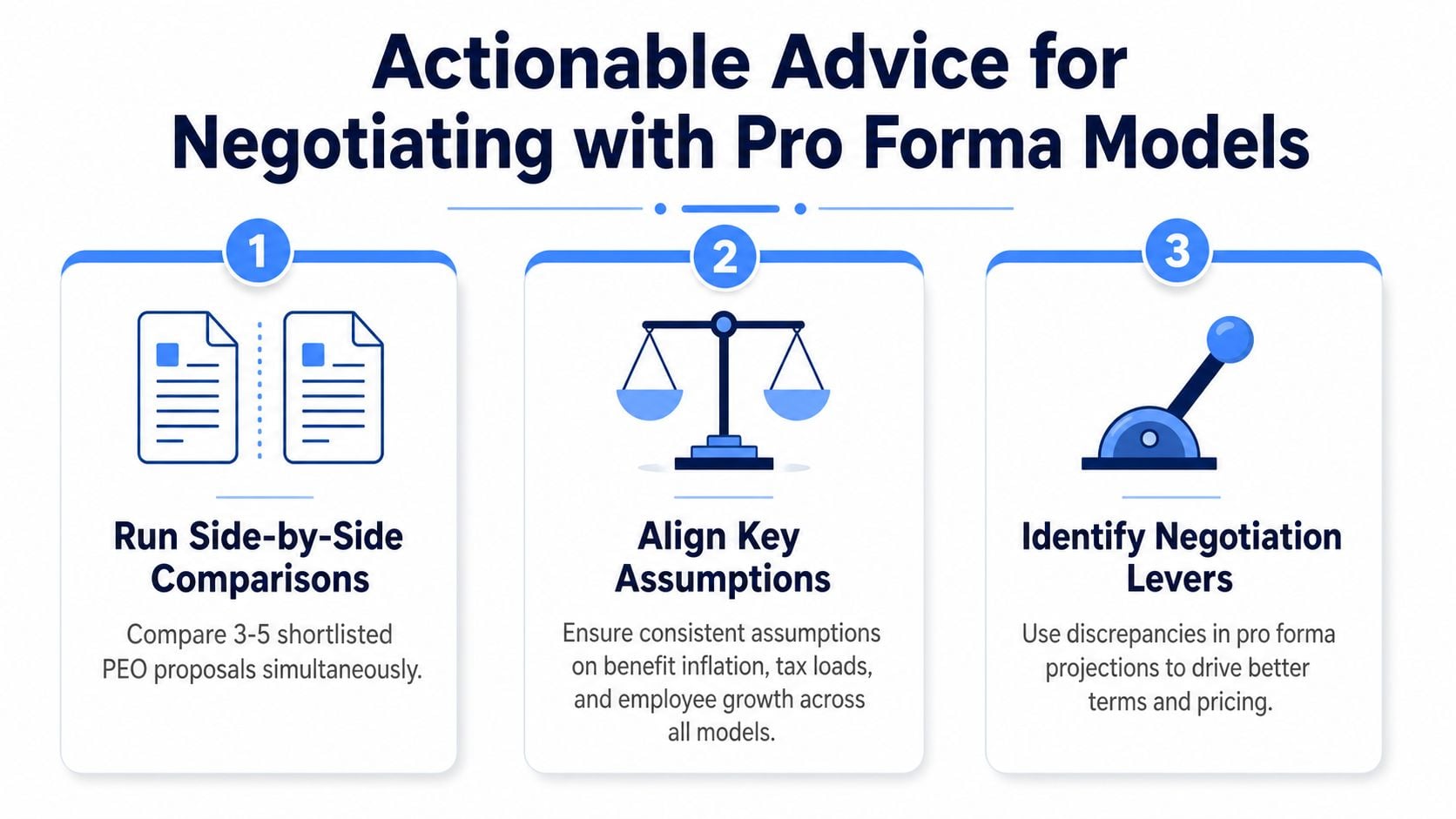
A pro forma should do more than explain a quote. It should establish an advantageous position. That only happens when all shortlisted PEOs are forced into the same modeling structure.
Emerging 2025 data indicates that 57% of multi-state SMBs underestimated their total PEO cost burden by 15% to 25% due to unaccounted state-specific compliance premiums, based on the cited Louisiana document discussing simple pro formas. For multi-state employers, that means one of the biggest negotiation wins is getting each vendor to show state-level assumptions clearly instead of blending them into a broad total.
How to compare proposals on equal terms
A disciplined comparison process usually works best in a side-by-side matrix.
Use one model for all providers and hold these assumptions constant:
- Same census data: Employee count, payroll, and state footprint should match.
- Same benefit assumptions: If one quote uses current elections and another uses a richer enrollment mix, the result is distorted.
- Same contract period: Align effective dates and renewal windows.
- Same treatment of credits: Show credits below recurring fees, not inside them.
- Same treatment of one-time items: Keep implementation and transition items separate from run-rate cost.
A short checklist before awarding a contract helps:
- Confirm pricing unit. Is the fee based on payroll or PEPM?
- Request assumption schedule. Ask for every variable in writing.
- Separate recurring and one-time cost. The model should show both.
- Stress-test multi-state exposure. Ask for any state-driven premium assumptions.
- Model post-credit year-two cost. First-year savings can disappear fast.
- Review exit terms alongside fees. Leaving a weak contract can be expensive.
Teams also benefit from adjacent planning disciplines. Broader guidance on optimise your 2026 business tax can be useful when tax planning and employment cost modeling need to align during budgeting cycles.
Negotiation language teams can use immediately
The best vendor questions are direct and narrow. For example:
“Please provide a revised pro forma that separates recurring admin fees, benefit costs, implementation charges, credits, and any state-specific compliance assumptions into distinct line items.”
Another useful request:
“Please show this proposal under the same employee census and benefit assumptions used in the other finalist models, and identify any renewal or escalation assumptions embedded in the pricing.”
A short email can do a lot of work:
- Request visibility: “Please break out all one-time fees and credits separately from recurring charges.”
- Press on escalation: “Please identify any annual fee increase mechanism, cap, or exception.”
- Clarify contract risk: “Please show any exit-related charges that could apply under standard termination scenarios.”
- Test the assumptions: “Please provide the state-by-state compliance assumptions used in the quote.”
The strongest negotiation lever is often not a lower sticker price. It’s a cleaner contract with fewer cost surprises.
Key Takeaways and Next Steps
Pro forma costs meaning in a PEO agreement comes down to one idea. The quote is a projection, not a receipt. It shows what the company may pay if the provider’s assumptions hold and if the contract behaves the way the summary says it will.
The practical next steps are straightforward:
- Update RFP templates so vendors must separate recurring fees, one-time fees, credits, and exit terms
- Run one standardized comparison model across every finalist
- Stress-test multi-state assumptions if the workforce isn’t confined to one jurisdiction
- Review year-two cost, not just the first-year credited view
- Schedule a contract review meeting before final approval, with HR, finance, and legal in the same discussion
A pro forma is useful when it makes cost easier to challenge. If it makes cost harder to understand, the model needs revision before the contract moves forward.
PEO decisions get easier when pricing, benefits, service terms, and contract risk are reviewed in one place. PEO Metrics helps employers compare PEO options side by side, pressure-test pro forma assumptions, and identify the fee increases, implementation costs, and contract terms that can change the total cost after signing.
