
Construction companies face HR challenges that most industries never encounter—fluctuating crew sizes, multi-state jobsites, high workers’ comp exposure, and prevailing wage requirements that can trip up even experienced payroll teams. A PEO built for construction understands these realities.
This guide breaks down eight providers that specialize in or have strong track records with construction businesses, from general contractors running $50M projects to specialty trades with 15-person crews. We’ve evaluated each based on workers’ comp handling, certified payroll capabilities, safety program support, and overall fit for the construction industry’s unique operational demands.
1. PEO Metrics
Best for: Construction companies comparing multiple PEO providers to find the best workers’ comp rates and service fit
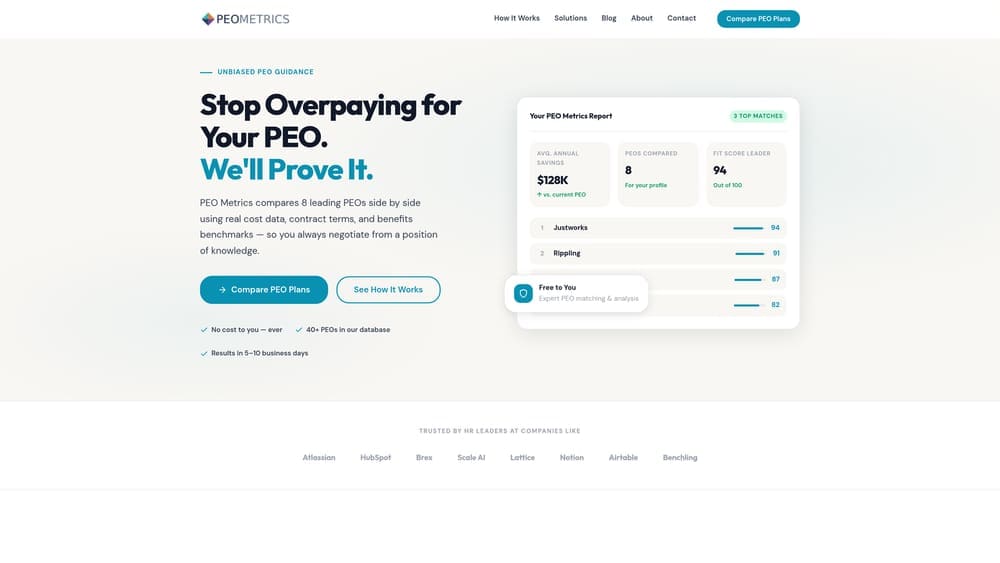
PEO Metrics is a comparison platform that helps construction businesses evaluate PEO providers side-by-side with detailed analysis of workers’ comp rates, service capabilities, and construction-specific features.
Where This Tool Shines
Construction companies often get locked into PEO contracts without understanding how rates and service levels compare across providers. PEO Metrics addresses this by providing transparent, side-by-side comparisons focused on factors that actually matter to contractors—workers’ comp pricing for specific class codes, certified payroll capabilities, and safety program depth.
The platform’s construction-specific criteria help you evaluate whether a PEO has real experience with your industry or just claims they do. You can see how different providers structure workers’ comp programs, handle multi-state payroll, and support government contract compliance requirements.
Key Features
Side-by-Side PEO Comparison: Evaluate multiple providers using construction-specific criteria like workers’ comp experience with high-risk class codes and certified payroll capabilities.
Workers’ Comp Rate Analysis: Compare how different PEOs price workers’ comp for your specific construction classifications across multiple providers.
Certified Payroll Evaluation: Assess which providers have proven Davis-Bacon and prevailing wage reporting capabilities versus those that claim they can handle it.
Transparent Pricing Breakdowns: See detailed cost structures to understand what you’re actually paying for beyond the per-employee-per-month quote.
Unbiased Provider Assessment: Get objective evaluations without sales pressure or commission-based recommendations.
Best For
Construction companies evaluating their first PEO, contractors unhappy with their current provider’s workers’ comp rates, and businesses running government projects who need certified payroll capabilities. Particularly valuable if you’re renewing a PEO contract and want to confirm you’re getting competitive rates.
Pricing
Free comparison service with no obligation to select any particular provider.
2. TriNet
Best for: Mid-sized contractors seeking comprehensive HR support with established construction industry experience
TriNet is a full-service PEO with established construction industry experience, offering comprehensive HR, benefits, and risk management for mid-sized contractors.
Where This Tool Shines
TriNet brings the infrastructure and resources you’d expect from a large PEO, with actual experience serving construction companies. Their platform handles the administrative complexity that comes with running crews across multiple states—payroll tax compliance, benefits administration, and workers’ comp management in a single system.
The dedicated HR consultant model means you’re not navigating construction-specific compliance questions alone. When you’re dealing with multi-state licensing, OSHA recordkeeping, or benefits enrollment for a workforce that’s half in the field and half in the office, having someone who understands construction operations makes a difference.
Key Features
Industry-Specific HR Expertise: Access to HR consultants with construction industry knowledge who understand the operational realities of contractor businesses.
Multi-State Payroll Management: Handle payroll and tax compliance across multiple states where your crews work, with automated jurisdiction tracking.
Comprehensive Benefits Packages: Offer competitive health insurance, retirement plans, and other benefits that help attract skilled labor in a tight construction market.
Dedicated HR Consultants: Work with assigned advisors who learn your business and provide guidance on compliance, employee relations, and workforce management.
Technology Platform: Employee self-service portal and mobile access for field crews to manage time, benefits, and HR tasks.
Best For
Mid-sized general contractors and specialty contractors with 20-200 employees who need comprehensive HR support and can benefit from enterprise-grade benefits packages. Works well for companies operating in multiple states or managing both field crews and office staff.
Pricing
Custom pricing based on headcount and services selected. Generally ranges from $150-$250 per employee per month depending on benefit selections and service level.
3. Insperity
Best for: Construction companies focused on reducing EMR and workers’ comp costs through proactive safety programs
Insperity is an enterprise-grade PEO known for strong safety and risk management programs, well-suited for construction companies focused on reducing EMR and workers’ comp costs.
Where This Tool Shines
Insperity’s approach to workers’ comp goes beyond basic administration. They provide proactive safety consulting designed to reduce incidents before they happen, which directly impacts your Experience Modification Rate over time. For construction companies tired of watching their workers’ comp premiums climb every renewal, this preventive focus can drive real cost savings.
Their OSHA compliance support helps contractors stay ahead of regulatory requirements rather than scrambling to respond after an inspection. The combination of safety consulting, loss control programs, and return-to-work coordination creates a comprehensive approach to managing construction’s biggest cost driver.
Key Features
Proactive Safety Consulting: On-site safety assessments and program development designed to reduce workplace incidents and improve EMR over time.
Workers’ Comp Administration with Loss Control: Comprehensive claims management paired with programs to reduce frequency and severity of incidents.
OSHA Compliance Support: Help maintaining required documentation, conducting safety training, and preparing for potential inspections.
Performance Management Tools: Systems designed for construction supervisors to manage field crew performance, training, and development.
Scalable Service Tiers: Different service levels to match company size and complexity, from small contractors to large operations.
Best For
Construction companies with 5-5,000 employees who view workers’ comp as a strategic cost to manage, not just an unavoidable expense. Particularly valuable for contractors with rising EMR rates or those looking to build stronger safety cultures to reduce long-term insurance costs.
Pricing
Custom quotes based on company size, industry risk profile, and service tier selected. Generally positioned as a premium option with pricing that reflects comprehensive service.
4. BBSI
Best for: West Coast contractors seeking hands-on, consultative support with local branch access
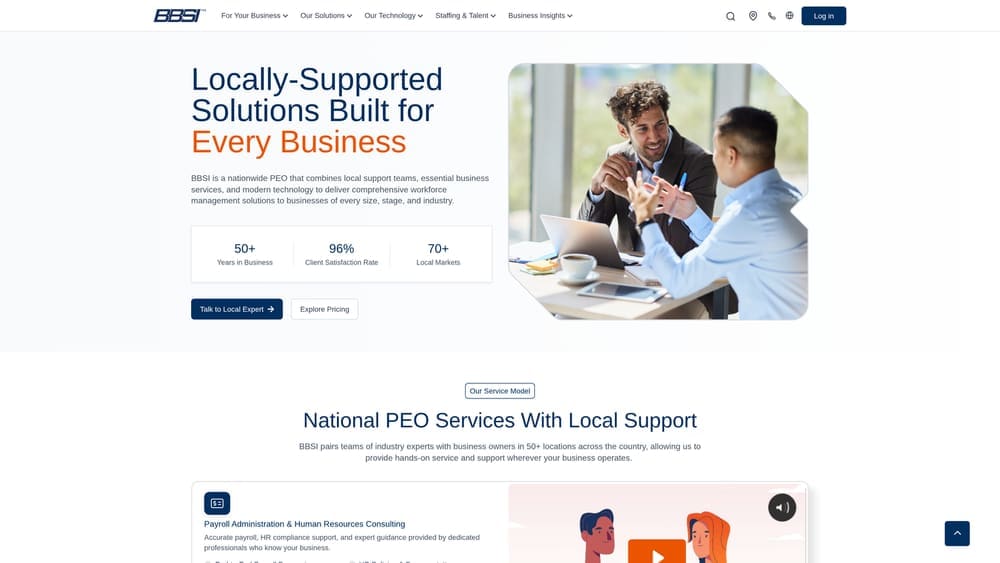
BBSI is a regional PEO with strong West Coast presence offering hands-on, consultative support for construction businesses seeking local expertise and personalized service.
Where This Tool Shines
BBSI operates through a local branch model, which means you’re working with a dedicated business advisor who’s based in your area and understands regional construction market dynamics. This matters when you’re dealing with state-specific prevailing wage laws, local union relationships, or regional workers’ comp regulations that vary significantly across Western states.
The consultative approach feels more like having an HR partner than a vendor relationship. Your advisor learns your business, understands seasonal patterns in your workload, and provides guidance that accounts for how construction actually operates—not generic HR advice adapted from office environments.
Key Features
Local Branch Model: Work with dedicated business advisors based in your region who understand local construction market conditions and regulations.
Construction-Specific Risk Management: Safety programs and workers’ comp management designed around construction industry hazards and operational realities.
Workers’ Comp Programs with Safety Incentives: Programs that reward safety performance and help reduce long-term workers’ comp costs through prevention.
Payroll Flexibility for Seasonal Fluctuations: Billing structures that accommodate the headcount swings common in construction without penalizing you during slow periods.
Hands-On Consulting: Regular check-ins and proactive guidance rather than reactive support only when you call with problems.
Best For
Construction companies with 5 to several hundred employees operating primarily on the West Coast who value relationship-driven service and local expertise. Works well for contractors who prefer working with someone they can meet face-to-face rather than managing everything through call centers.
Pricing
Custom pricing based on company size, industry classification, and service needs. Generally competitive for small to mid-sized contractors.
5. CoAdvantage
Best for: Specialty trade contractors with smaller crews and high-risk workers’ comp classifications
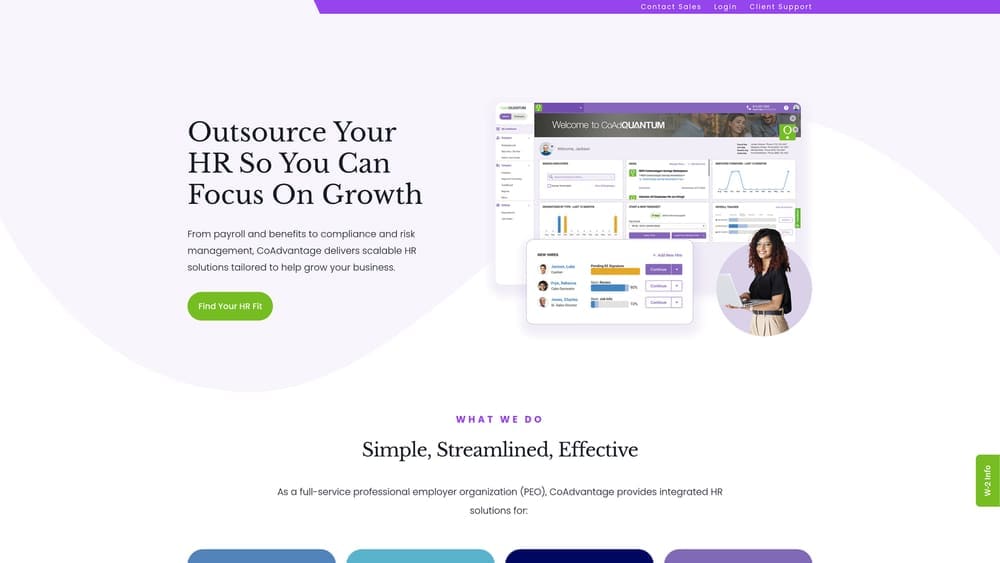
CoAdvantage is a flexible PEO option for specialty trade contractors, with experience handling high-risk classification codes and smaller crew sizes.
Where This Tool Shines
Many PEOs shy away from high-risk construction classifications or require minimum headcounts that exclude smaller specialty contractors. CoAdvantage works with businesses that other providers often turn down—roofing companies, demolition contractors, and other specialty trades with elevated risk profiles.
Their service packages scale to match smaller operations without forcing you to pay for enterprise-level services you don’t need. If you’re running a 12-person electrical contracting business or a 20-person HVAC company, you get access to benefits and HR support without the overhead structure designed for 200-employee general contractors.
Key Features
High-Risk Classification Experience: Willingness and expertise to work with construction classifications that many PEOs avoid or price prohibitively.
Flexible Service Packages: Service tiers that match the needs and budgets of smaller specialty contractors without unnecessary complexity.
Scaled HR Support: HR assistance appropriate for small contractor operations—practical guidance without enterprise-level bureaucracy.
Benefits Access for Small Teams: Ability to offer competitive health insurance and benefits even with smaller employee counts.
Straightforward Implementation: Onboarding process designed for businesses without dedicated HR staff to manage complex transitions.
Best For
Specialty trade contractors with 5-50 employees in high-risk classifications like roofing, demolition, or excavation. Good fit for small businesses that have been turned down by other PEOs or quoted unworkable rates due to classification codes.
Pricing
Competitive rates for small to mid-sized businesses with custom quotes based on industry classification and headcount. Generally more accessible for smaller contractors than enterprise-focused PEOs.
6. Employer Services Corporation (ESC)
Best for: Contractors working on government projects requiring certified payroll and prevailing wage compliance
Employer Services Corporation (ESC) is a PEO with specialized expertise in certified payroll and prevailing wage compliance, ideal for contractors working on government projects.
Where This Tool Shines
If you’re bidding on or working government contracts, certified payroll isn’t optional—it’s a compliance requirement that can get you disqualified or penalized if handled incorrectly. ESC built their service around this specific need, with systems and expertise designed for Davis-Bacon Act requirements, state prevailing wage laws, and the detailed documentation government projects demand.
They understand the complexity of managing union and non-union workers on the same project, tracking multiple wage rates for different classifications, and producing the certified payroll reports that government agencies require. This isn’t a feature they added to their platform—it’s core to what they do.
Key Features
Davis-Bacon and Prevailing Wage Expertise: Specialized knowledge and systems for federal and state prevailing wage compliance on government construction projects.
Certified Payroll Reporting: Automated generation of certified payroll reports with the detailed documentation and attestations government contracts require.
Government Contractor Compliance Support: Guidance on contractor responsibilities, record retention, and audit preparation for government projects.
Union and Non-Union Workforce Management: Systems to handle the complexity of managing different pay structures and reporting requirements for union and non-union employees.
Multi-Tier Wage Rate Management: Ability to track and apply different wage rates based on classification, location, and project requirements.
Best For
General contractors and specialty contractors who regularly work on government projects at federal, state, or local levels. Essential for businesses where certified payroll is a regular requirement rather than an occasional exception.
Pricing
Custom pricing based on payroll complexity and compliance requirements. Generally reflects the specialized nature of certified payroll services.
7. Oasis (Paychex PEO)
Best for: Construction companies wanting mobile-friendly tools for field-based crews backed by established payroll infrastructure
Oasis (Paychex PEO) is a technology-forward PEO backed by Paychex infrastructure, offering mobile-friendly tools for construction companies with field-based crews.
Where This Tool Shines
Construction crews don’t work at desks with computer access, which makes traditional HR systems frustrating to use. Oasis built their platform with mobile accessibility as a priority—time tracking, job costing, benefits management, and HR tasks accessible from phones that field workers actually carry.
The Paychex backing provides the infrastructure reliability and payroll processing expertise you’d expect from a major provider, while Oasis brings the service model and construction industry focus. The combination works well for contractors who need modern technology without sacrificing the support that comes with an established platform.
Key Features
Mobile Time Tracking and Job Costing: Field crews can clock in/out and allocate time to specific jobs from their phones, feeding data directly into payroll and project costing.
Paychex Payroll Platform: Backed by Paychex’s established payroll processing infrastructure and technology systems.
Scalable for Growing Contractors: Service structure that accommodates growth from small contractor to larger operations without forced platform changes.
Field Crew Accessibility: HR functions, benefits enrollment, and employee information accessible via mobile devices rather than requiring desktop access.
Integrated Technology Stack: Payroll, HR, benefits, and time tracking in a unified system rather than multiple disconnected tools.
Best For
Construction companies with 20+ employees who want modern, mobile-friendly technology for field crews while maintaining the reliability of established payroll infrastructure. Good fit for contractors focused on job costing accuracy and real-time labor tracking.
Pricing
Tiered pricing based on company size and service level selected. Generally competitive for companies with 20+ employees, with costs scaling as you add headcount.
8. Justworks
Best for: Construction startups and small specialty contractors seeking transparent pricing without complex service tiers
Justworks is a straightforward PEO option for construction startups and small specialty contractors seeking transparent pricing without complex service tiers.
Where This Tool Shines
Most PEO pricing requires custom quotes, sales calls, and negotiations before you know what you’ll actually pay. Justworks publishes their pricing upfront—flat per-employee rates with no hidden fees or surprise charges. For small contractors tired of opaque pricing structures, this transparency is refreshing.
The service is intentionally simple. You’re not getting construction-specific safety consulting or certified payroll expertise, but you are getting basic HR support, benefits access, and payroll processing without the complexity that often comes with larger PEOs. If you’re a small specialty contractor who needs the fundamentals handled correctly, Justworks delivers that without overselling services you don’t need.
Key Features
Flat Per-Employee Pricing: Published rates with no hidden fees, percentage markups, or surprise charges at renewal.
Simple Onboarding Process: Straightforward setup designed for small businesses without dedicated HR staff to manage complex implementations.
Basic HR and Compliance Support: Core HR assistance, compliance guidance, and employee handbook templates covering fundamental requirements.
Benefits Access for Small Teams: Ability to offer health insurance, 401(k), and other benefits even with small employee counts.
Self-Service Platform: Employee portal for managing benefits, accessing pay stubs, and handling HR tasks without constant administrator involvement.
Best For
Construction startups and small specialty contractors with 5-25 employees who need basic PEO services without the complexity and cost of enterprise-focused providers. Works well for businesses that don’t require certified payroll or extensive construction-specific safety programs.
Pricing
Starts at $59 per employee per month for the basic plan. Plus plan with enhanced benefits and support is $99 per employee per month. Pricing is transparent and published on their website.
Making the Right Choice for Your Construction Business
The right PEO depends on what you actually need, not what sounds impressive in a sales pitch.
If you’re working government contracts regularly, ESC’s certified payroll expertise matters more than any other feature. If your EMR is climbing and workers’ comp is eating your margins, Insperity’s safety programs and loss control focus could save you more than you pay in fees. If you’re a small specialty contractor in a high-risk classification, CoAdvantage’s willingness to work with your industry might be the deciding factor.
Workers’ comp is the central cost driver for construction PEOs. Don’t evaluate providers based on the per-employee-per-month quote alone—understand how they structure workers’ comp, what your actual class codes will cost, and whether they offer loss-sensitive programs that reward good safety performance. The difference in workers’ comp pricing between providers can easily exceed the difference in administrative fees.
Multi-state operations add complexity that not all PEOs handle well. If your crews work across state lines regularly, verify the provider has actual experience managing multi-state payroll tax compliance, not just theoretical capability.
Before you sign that PEO renewal, make sure you’re not leaving money on the table. Many businesses unknowingly overpay because of bundled fees, hidden administrative markups, and contracts designed to limit flexibility. We give you a clear, side-by-side breakdown of pricing, services, and contract terms—so you can see exactly what you’re paying for and choose the option that truly fits your business.
