
Towing is one of those industries where the wrong PEO decision doesn’t just cost you money — it can leave you exposed on compliance, underwater on workers’ comp premiums, and locked into a contract that doesn’t fit how your business actually operates. Drivers working active roadways at odd hours, DOT requirements most general PEOs have never touched, and payroll complexity that changes week to week. The stakes are higher here than in most industries.
The problem is that most PEO evaluation resources aren’t built with towing in mind. Generic comparison sites and broker-driven referrals may point you toward providers with no real experience underwriting transportation workers or supporting FMCSA compliance workflows. You end up comparing apples to oranges without realizing it.
This guide covers the top resources for finding and comparing PEO providers that actually serve towing companies. Whether you’re running a small roadside assistance operation or managing a multi-truck fleet across multiple states, here are the tools worth using before you sign anything.
What Towing Operators Should Actually Evaluate Before Picking a PEO
Before getting into the tools, it’s worth being direct about what makes PEO selection different for towing companies. This isn’t just a payroll and benefits decision.
Workers’ comp classification: Tow truck operators carry some of the highest workers’ comp classification codes in the trades. If a PEO is pricing you based on general labor or light-industrial pools rather than transportation-specific underwriting, you may be overpaying significantly — or you may be in a pool that reprices against you at renewal.
DOT and FMCSA compliance support: Commercial towing operations above certain weight thresholds fall under FMCSA jurisdiction. That means driver qualification files, random drug and alcohol testing consortiums, hours-of-service recordkeeping, and vehicle inspection logs. Many general PEOs have no infrastructure for this. You need to ask directly whether the PEO supports DOT compliance workflows or leaves you to handle it separately.
Payroll complexity: On-call scheduling, split shifts, and irregular hours create payroll structures that generic platforms handle poorly. Multi-truck operations with employees in multiple states add another layer of payroll tax and compliance complexity that not every PEO is equipped to manage cleanly.
Independent contractor exposure: If you’re running a mix of W-2 drivers and 1099 contractors, you need to understand how co-employment status interacts with your existing contractor arrangements before signing a PEO agreement. Misclassification risk is real in this sector, and a PEO agreement won’t automatically protect you if your classification practices are already shaky.
Pricing transparency: Towing operators — especially owner-operators scaling to 5-15 employees — often lack the HR background to audit PEO pricing structures. Bundled models that embed insurance markups are common and difficult to evaluate without a direct comparison framework. In high-risk industries like towing, the variance between proposals from different providers can be substantial.
With that context in mind, here are the tools that can actually help.
1. PEO Metrics
Best for: Towing operators who want unbiased, side-by-side PEO comparisons without broker influence
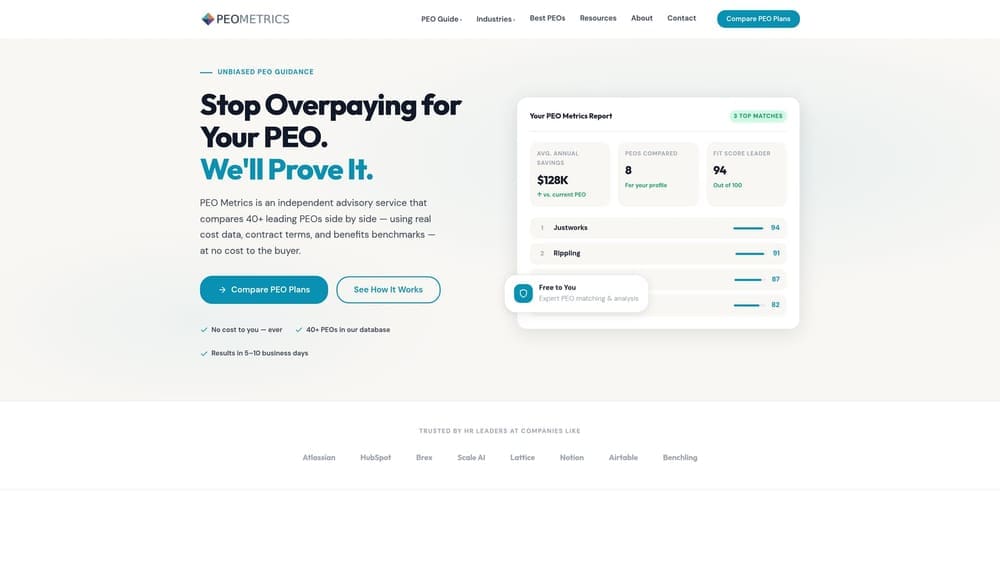
PEO Metrics is an independent PEO comparison platform that gives business owners direct access to pricing, features, and provider fit data — without the referral bias that comes with broker-driven recommendations.
Where This Tool Shines
The core difference here is independence. PEO Metrics isn’t affiliated with any PEO provider and doesn’t earn commissions for steering you toward a particular option. That matters in an industry like towing, where the stakes on workers’ comp pricing are high enough that a biased recommendation can cost you real money over a multi-year contract.
For towing operators specifically, the ability to filter by industry experience and compare providers on a level playing field is genuinely useful. You can identify which providers have experience underwriting transportation workers versus those who are essentially guessing at your risk profile. That’s the kind of detail that doesn’t show up in a broker’s pitch deck.
Key Features
Unbiased, non-affiliated comparisons: Not paid by PEO providers, so the data reflects actual fit rather than referral incentives.
Side-by-side pricing and feature analysis: Allows direct comparison across multiple providers on cost structure, services, and contract terms simultaneously.
Industry-specific filtering: Helps identify PEOs with experience in high-risk sectors like towing and transportation, rather than defaulting to general-purpose providers.
Overpayment identification: Detailed metrics designed to surface where your current or prospective PEO arrangement may be costing more than it should.
Consultative guidance: Access to guidance that’s focused on your decision, not on closing a sale for a particular provider.
Best For
Towing companies of any size that are actively evaluating PEO options or approaching a contract renewal. Particularly valuable for operators who suspect they’re overpaying but don’t have an internal HR team to audit the numbers. Also useful for multi-truck fleets comparing several providers simultaneously before committing.
Pricing
Free to use the comparison tools. Consultative services are available for operators who want more hands-on guidance through the evaluation process.
2. PEOcompare
Best for: Towing operators early in the research process who want a broad view of available providers
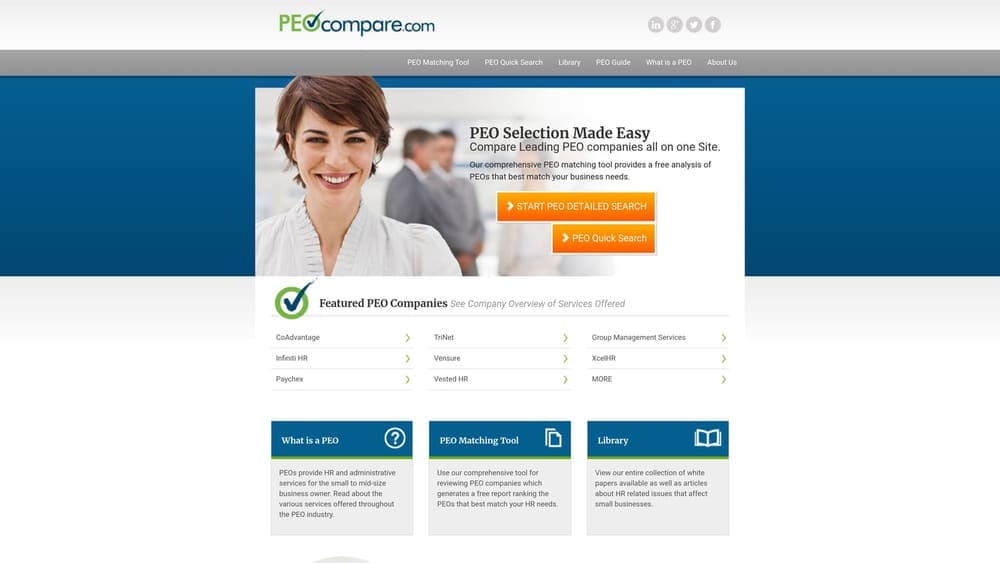
PEOcompare is a marketplace-style platform that aggregates PEO provider profiles, giving business owners a centralized place to browse and compare options.
Where This Tool Shines
PEOcompare works well as an orientation tool. If you’re a towing operator who’s just starting to evaluate PEOs and you want to understand what providers exist before narrowing your options, this is a reasonable starting point. The aggregated directory format makes it easy to get a sense of the landscape without having to contact individual providers one by one.
That said, it functions more like a directory than a deep comparison engine. The information is profile-based, which means you’re largely seeing what providers choose to present about themselves. It’s useful for initial research, but you’ll likely need additional tools to get into the kind of pricing and contract detail that matters for a high-risk industry like towing.
Key Features
Aggregated PEO provider directory: Centralized listing of multiple PEO providers in one browsable interface.
Comparison browsing: Allows side-by-side review of provider profiles for operators in early evaluation stages.
Profile-based provider information: Gives a structured overview of each provider’s offerings and positioning.
Low barrier to entry: No signup friction for operators who just want to get oriented quickly.
Best For
Towing business owners who are new to PEO evaluation and want a broad starting point before diving into detailed comparisons. Less suited for operators who are ready to negotiate contracts or need granular pricing data specific to transportation industry risk profiles.
Pricing
Free to use.
3. HR Guide
Best for: Towing operators building internal HR knowledge alongside their PEO evaluation
HR Guide is an educational HR resource covering PEO-related topics, compliance guidance, and HR best practices — useful as a reference tool rather than a comparison engine.
Where This Tool Shines
Most towing operators don’t have a dedicated HR person. That means when you’re evaluating a PEO contract, you may not have the background to assess what the compliance language actually means, whether the benefits structure is standard, or what questions to ask about workers’ comp administration. HR Guide helps close that knowledge gap.
For transportation and field-service employers specifically, the compliance content can be useful context — particularly around topics like employer obligations, classification issues, and what co-employment actually means in practice. It won’t replace a detailed PEO comparison, but it gives you a better foundation for evaluating what you’re being sold.
Key Features
HR compliance educational content: Covers topics relevant to transportation and field-service employers, including classification and employer obligations.
PEO topic coverage: Explains PEO structures, co-employment concepts, and what business owners should understand before signing.
Practical guidance for operators without HR staff: Written to be accessible for business owners who are managing HR decisions without dedicated support.
Reference material for contract evaluation: Useful background for reviewing PEO agreements and understanding standard versus non-standard terms.
Best For
Towing operators who want to build enough HR literacy to evaluate PEO proposals intelligently. Works best as a complement to an active comparison process, not as a standalone evaluation tool. Particularly helpful for owner-operators who are new to the PEO space entirely.
Pricing
Free educational resource.
Which Option Fits Your Situation
The right starting point depends on where you are in the process and what you’re trying to solve.
If you’re a single-truck or small roadside operation just getting familiar with PEOs, HR Guide gives you the foundational knowledge to understand what you’re evaluating, and PEOcompare gives you a broad view of what providers exist. Start there, get oriented, and then move to a more detailed comparison before you talk to any provider directly.
If you’re running a multi-truck fleet and approaching a contract renewal — or if you suspect your current PEO is overcharging you on workers’ comp or administrative fees — PEO Metrics is where to start. The side-by-side comparison data and industry-specific filtering are built for exactly this situation. In a high-risk industry like towing, the variance between PEO proposals can be significant, and going into negotiations without a comparison framework puts you at a disadvantage.
For cost-focused buyers, the priority is identifying where bundled pricing models are embedding insurance markups that aren’t easy to see on the surface. For compliance-focused buyers, the priority is confirming that a prospective PEO actually has infrastructure for DOT and FMCSA requirements — not just a general promise to “handle compliance.”
Either way, the worst move is auto-renewing with your current provider without checking what else is available. Before you sign that PEO renewal, make sure you’re not leaving money on the table. Don’t auto-renew. Make an informed, confident decision.
Before you sign that PEO renewal, make sure you’re not leaving money on the table.
Many businesses unknowingly overpay because of bundled fees, hidden administrative markups, and contracts designed to limit flexibility. We give you a clear, side-by-side breakdown of pricing, services, and contract terms—so you can see exactly what you’re paying for and choose the option that truly fits your business.
