
Most leadership teams ask the wrong first question about a PEO. They ask, “What’s the admin fee?” The better question is, “What operational risk, cost structure, and flexibility are being bought, and what is being given up?”
That gap matters because a PEO isn’t just software with payroll attached. It’s a co-employment relationship that changes how benefits are delivered, how compliance is handled, how workers’ comp is structured, and how difficult it may be to unwind later. Evaluating it like a line-item subscription usually leads to bad decisions.
The market has made that clear. As of 2026, more than 230,000 US businesses partner with a PEO, collectively employing 4.5 million workers. This rapid adoption, up from 175,000 businesses in 2021, shows a clear market shift toward strategic HR outsourcing according to PEO adoption data summarized from NAPEO figures. The model is mainstream. The mistake isn’t considering a PEO. The mistake is considering one too narrowly.
For HR directors, CFOs, and owners in the 10 to 2,000 employee range, the key work is separating surface-level convenience from durable value. Sometimes a PEO is the right move. Sometimes it’s an expensive way to outsource problems that could be handled better through an ASO, broker, payroll platform, or stronger in-house HR operations.
Table of Contents
- Introduction Is a PEO a Partner or Just Another Vendor
- What a PEO Is The Co-Employment Model Explained
- The Four Core Reasons Companies Choose a PEO
- Deconstructing PEO Costs and Contract Trade-Offs
- PEO vs ASO vs In-House HR A Decision Framework
- Red Flags and Negotiation Levers in a PEO Agreement
- Your Next Steps How to Evaluate PEOs Without Guesswork
Introduction Is a PEO a Partner or Just Another Vendor
A PEO can act like a strategic partner. It can also behave like a bundled vendor that looks simple at signing and becomes hard to exit later. The difference usually has less to do with the logo on the proposal and more to do with fit, contract quality, and how clearly leadership understands the trade-offs.
Teams often buy on relief. Payroll is messy, open enrollment is painful, compliance questions are stacking up, and the internal HR bench is thin. In that situation, a PEO can feel like immediate oxygen. That reaction is understandable, but it also creates blind spots. Buyers focus on speed and relief, then overlook renewal language, service scope, benefit continuity, and implementation realities.
The wrong comparison creates the wrong decision
A software mindset causes most of the trouble. Software can usually be turned on, optimized, and replaced with limited disruption. A PEO touches payroll processing, tax filings, benefits, workers’ comp administration, onboarding workflows, and employee communications. That means a bad choice doesn’t just waste budget. It creates operational drag.
A useful test is simple. If replacing the provider would require payroll remapping, benefits transition planning, and contract review by finance, HR, and legal, it isn’t “just another vendor.”
What good buyers ask instead
Stronger evaluation questions sound different:
- Risk question: What liability is being shared, and what stays with the employer?
- Finance question: Which costs are fixed admin charges versus pass-through spend that would exist anyway?
- Operational question: Will the PEO reduce workload for HR and finance, or just move the work into a different system?
- Exit question: How hard will it be to leave if service declines or renewal pricing changes?
That’s the frame behind the question why do PEO at all. The answer isn’t “because it saves time.” It is that some companies need infrastructure, buying power, and administrative support badly enough that the co-employment trade-off is worth it. Others don’t.
What a PEO Is The Co-Employment Model Explained
A PEO is a co-employment arrangement. That means the business and the PEO split specific employer duties instead of handing all HR responsibility to an outside firm.
In practice, the division is straightforward. The client company still runs the business, manages employees, sets schedules, decides who gets hired, and decides who gets fired. The PEO handles defined administrative functions that are harder and more expensive to manage well at smaller scale, including payroll processing, tax administration, benefits administration, workers’ comp administration in many arrangements, and parts of HR compliance support.
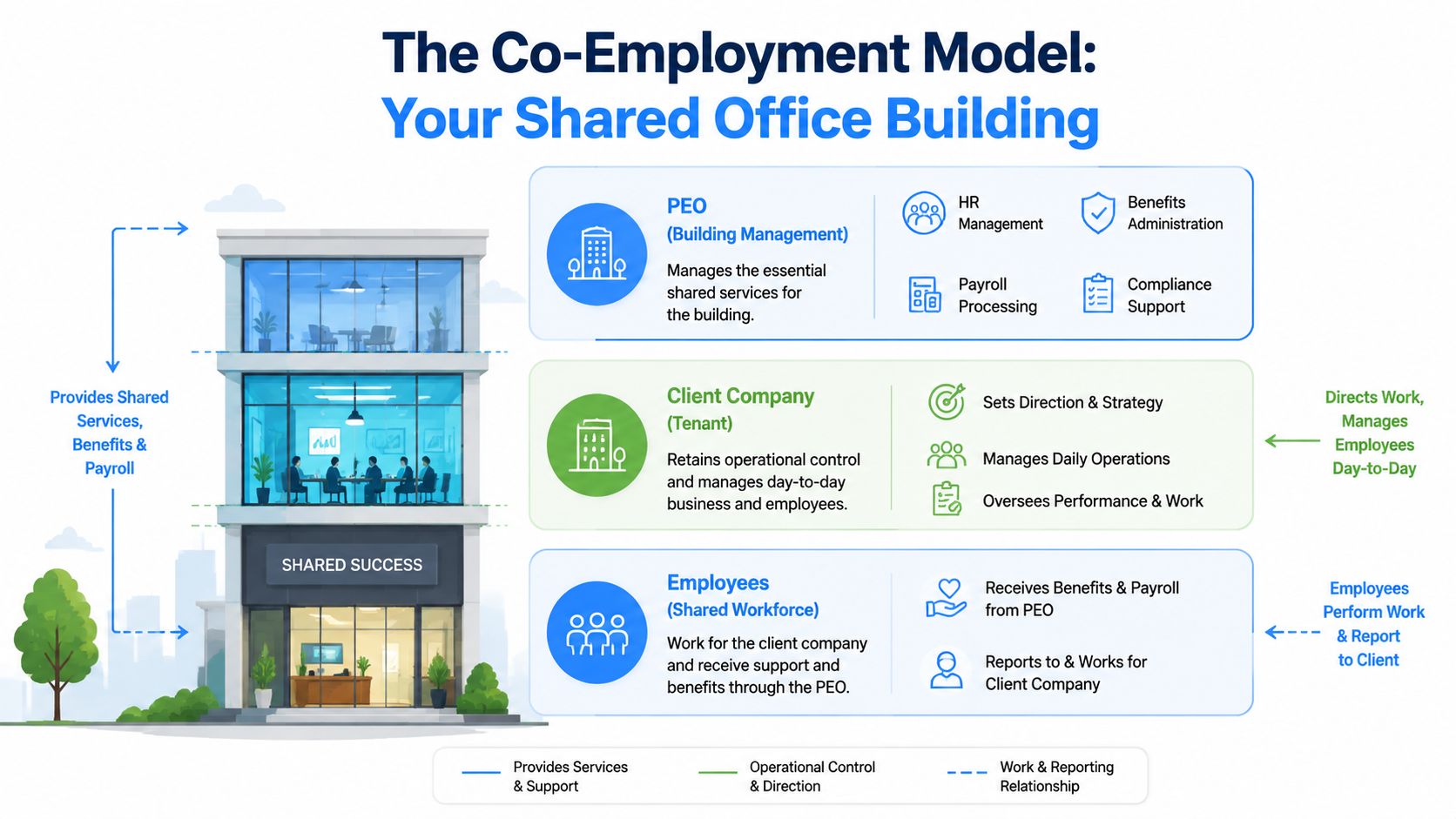
The legal label matters because it drives who does what, who signs which filings, and where risk sits. A PEO often becomes the employer of record for certain tax, payroll, and benefits administration purposes, while the client remains the worksite employer responsible for day-to-day direction and business decisions. Buyers who want the baseline definition can review what a professional employer organization is.
This is also where buyers make expensive assumptions. Co-employment does not mean the PEO absorbs all employer risk. It does not remove the need for manager discipline, clean documentation, or sound pay practices. If a supervisor mishandles a termination or ignores wage and hour rules in the field, the client company still has exposure even if the PEO processes payroll correctly.
Who owns what in practice
The client company usually retains control over:
- Hiring and firing decisions: The business decides who joins and who leaves.
- Compensation strategy: Pay philosophy, bonuses, and role design stay with management.
- Culture and performance management: Managers still coach, review, promote, and discipline employees.
- Operational supervision: Employees report to company leadership, not to the PEO service team.
The PEO usually takes responsibility for administrative execution tied to those decisions:
- Payroll processing and tax administration
- Benefits enrollment and plan administration
- HR systems and employee records support
- Compliance guidance and policy infrastructure
- Workers’ comp administration in many arrangements
Practical rule: A PEO should reduce administrative failure points. It should not become a substitute for management.
That distinction matters later, especially at renewal or exit. If the PEO owns the system of record for payroll history, benefits enrollment workflows, onboarding documents, and policy acknowledgments, leaving the relationship can become a real project. Files have to be migrated. Carriers may change. Payroll IDs and tax setup may need to be rebuilt. The co-employment model creates operating efficiency, but it also creates dependency if the handoff back to an internal team or a new provider was never planned.
A simple example makes the trade-off clearer. A regional services firm with employees in several states may keep a lean internal HR team focused on recruiting, manager support, and employee relations while the PEO handles payroll deadlines, standard compliance workflows, and enrollment administration. That is a good fit. A company that expects a PEO to fix weak managers, inconsistent pay decisions, or poor documentation usually gets a cleaner process, but not a better operating model.
The right way to read co-employment is this: the PEO can take administrative load off the company, improve process reliability, and give access to infrastructure the business may not want to build on its own. It also changes how responsibilities are split, where data lives, and how hard it is to unwind the arrangement later. Those second-order effects are part of the model, not an exception to it.
The Four Core Reasons Companies Choose a PEO
Companies don’t choose a PEO for one reason. They usually choose it because several operational pressures are hitting at once. Benefits are getting harder to manage, compliance is spreading across states, payroll errors create downstream problems, and leadership wants internal staff focused on growth rather than administration.
Benefits buying power with a real limitation
The most common reason is benefits access. Smaller employers often struggle to build competitive medical, dental, vision, and ancillary offerings on their own. A PEO can aggregate many client groups into a larger purchasing structure and make a benefits package feel more like what a larger employer can offer.
That matters in hiring and retention. Candidates compare plans. Existing employees compare deductions, coverage, and enrollment experience. A stronger package can help a company look larger and more stable than its standalone headcount would suggest. A fuller explanation of that dynamic appears in this guide to PEO benefits meaning.
But there’s a trade-off buyers miss. While PEOs provide access to large-group benefits, a critical trade-off is the “coverage cliff” where employees lose access to the group plan immediately upon separation, a nuance in benefits continuity often omitted in sales pitches according to ADP’s discussion of PEO benefits considerations.
That issue matters more than it seems. If a company has frequent turnover, complicated leave situations, or employees working across multiple states, benefits continuity questions need to be handled early, not after implementation.
Compliance support when the footprint gets messy
The second driver is compliance. This becomes urgent when a company adds remote employees in new states, grows beyond a single payroll pattern, or has managers who need clearer HR process guardrails.
A PEO can help standardize onboarding, handbook structure, tax administration workflows, and recurring HR tasks. That support won’t eliminate employer responsibility, but it can reduce avoidable mistakes. For a finance leader, this often matters less because of fear of penalties and more because internal teams stop spending so much time chasing exceptions and fixing preventable errors.
HR efficiency and risk support
The third reason is operational focus. Many growing companies reach a point where the founder, controller, office manager, or lone HR generalist is still carrying too much administrative work. That setup works for a while, then breaks under volume.
A PEO can centralize repetitive tasks such as payroll processing, employee onboarding administration, routine benefits questions, and document workflows. The value isn’t abstract. It shows up when the HR lead can spend time on manager coaching, recruiting, compensation planning, and employee relations instead of being buried in forms and escalations.
The fourth reason is employment-related risk administration. Many buyers want support around workers’ comp, policy consistency, and the discipline that comes with a formal HR structure. A PEO can improve process and documentation. It cannot rescue a company that tolerates poor managers, inconsistent documentation, or weak termination practices.
Good PEO outcomes usually come from one mindset. Use the provider to strengthen internal discipline, not to substitute for it.
Deconstructing PEO Costs and Contract Trade-Offs
What does a PEO really cost once the sales deck is out of the way?
The answer usually has less to do with the headline admin fee than buyers expect. A PEO invoice blends true outsourcing fees with pass-through spend the employer would carry in some form anyway. According to TriNet’s breakdown of PEO costs, administrative fees often represent a small share of total PEO spend, while the larger share comes from items such as health insurance, payroll taxes, and workers’ compensation.
That distinction matters because many executive teams compare quotes at the wrong level. They focus on the visible fee line and miss the harder question: did the PEO lower total employment cost, improve service levels enough to justify the price, or repackage existing spend into a cleaner bill?
What the fee covers
Most proposals bundle payroll administration, benefits administration, HR support, compliance workflows, and workers’ compensation handling into one service model. The pricing usually shows up in one of three formats:
- Percentage of payroll
- Flat per employee per month
- Hybrid pricing, with a base charge plus payroll-related components
TriNet notes that percentage-of-payroll and PEPM structures are both common. According to the same TriNet analysis, mid-market buyers often see percentage pricing in the low single digits to mid single digits, while PEPM pricing is common for employers that want a cleaner forecasting model.
For employers building an early budget range, this overview of how much it costs to outsource HR is a useful starting point.
The trade-off between pricing models is practical, not cosmetic. Percentage pricing rises as payroll rises, even if service demand does not. PEPM pricing is easier to budget, but can look expensive if the workforce is stable, low-touch, and already supported by solid internal systems. Hybrid pricing often gives the provider room to protect margin in both directions.
Sample cost breakdown for a 50-employee company
A 50-person company is where cost confusion shows up fast. The base fee may look manageable, then add-ons, annual charges, and payroll exceptions start to widen the gap between the quoted rate and the lived cost.
| Cost Component | Typical Pricing Model | Example Monthly Cost |
|---|---|---|
| Administrative fee | PEPM | $7,500 to $12,500 |
| Add-on services such as recruiting or dedicated account management | PEPM add-on | $2,500 to $5,000 |
| Annual admin or compliance fee | Annual charge spread monthly for budgeting | starts at about $208 monthly equivalent |
| Off-cycle payroll fee | Per occurrence | $25 to $100 per occurrence |
For a 50-employee company, market pricing published in 50-employee PEO pricing data shows a wide admin fee range, with additional monthly cost for services such as recruiting support or dedicated account management.
The larger point is not whether those figures are high or low. It is whether the buyer can tie them to measurable value. If the provider reduces benefits spend, lowers workers’ comp volatility, cuts payroll rework, and keeps HR headcount from being added too early, the premium may pencil out. If those gains never materialize, the PEO becomes an expensive operating layer.
The charges buyers miss
The biggest pricing mistakes happen in the margins of the contract.
Many PEO agreements include smaller fees that were not central in the sales process: implementation charges, annual platform or compliance fees, year-end processing fees, and off-cycle payroll fees. Native Teams’ summary of PEO pricing add-ons outlines several of these common extras.
A disciplined review puts every proposal into the same cost buckets:
- Admin fee
- Benefit premium treatment
- Workers’ comp structure
- Payroll tax handling
- Implementation cost
- Annual or renewal fees
- Off-cycle payroll charges
- Add-on service pricing
- Exit terms and notice requirements
That last item gets overlooked too often. Exit costs are part of total cost. If the contract locks the company into a long notice period, charges conversion fees, or creates a messy benefits transition, the cheapest first-year quote can become the most expensive decision over a two-year period.
This is also the point where some employers should pause and compare HR software options. If the company mainly needs payroll, onboarding, and benefits administration, software plus a lean internal team may produce a better financial result than a co-employment model with layered fees.
The right finance view is simple. Price the PEO over the full contract term, include implementation and exit friction, separate pass-through costs from true service fees, and ask what would need to improve operationally for the model to earn its keep.
PEO vs ASO vs In-House HR A Decision Framework
A PEO is only one answer. In many evaluations, the better question isn’t “Which PEO?” It’s “Does this company need a PEO, or does it need administrative support without co-employment?”
How the models differ operationally
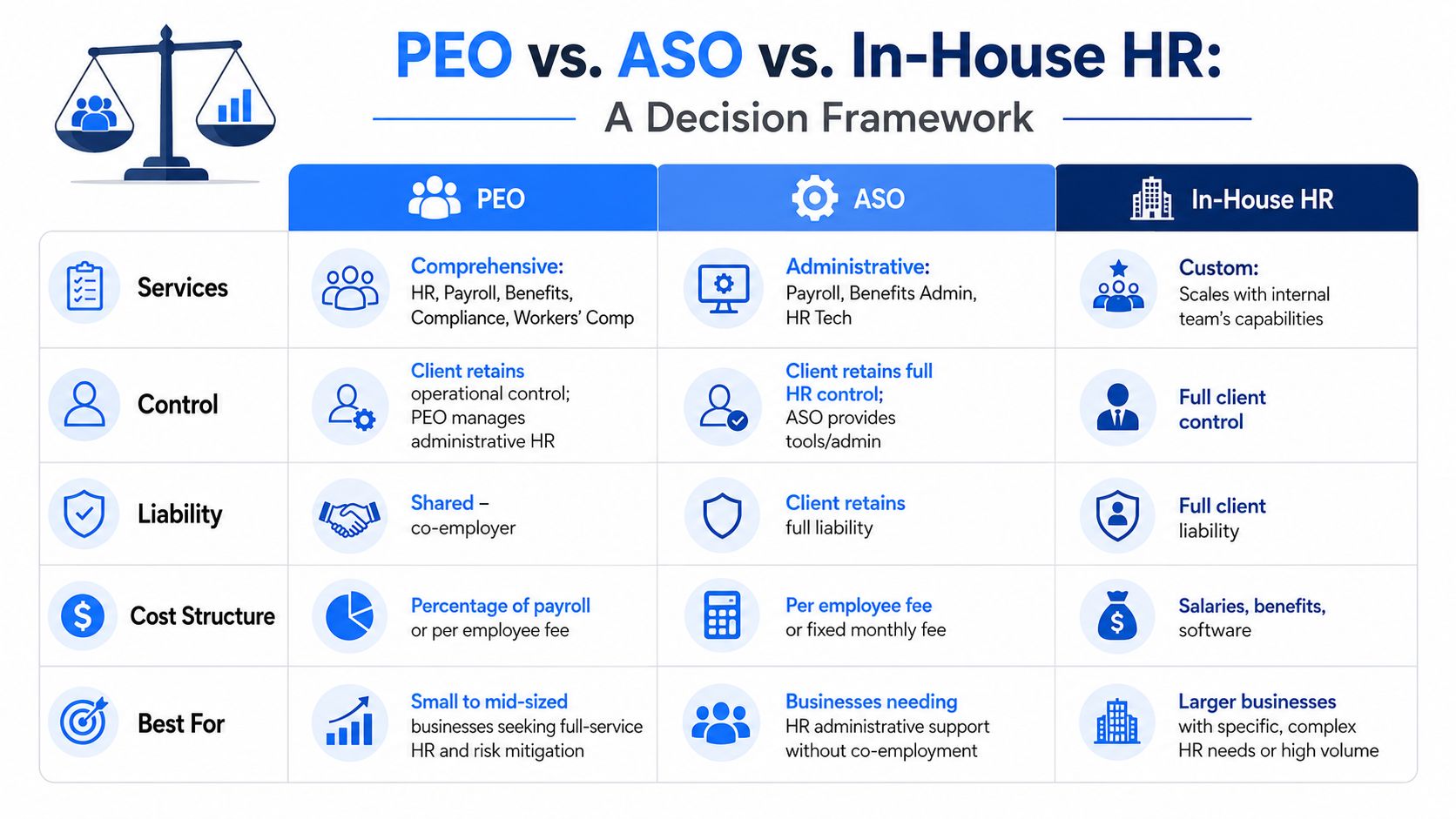
The cleanest comparison is across control, liability structure, and service depth.
| Model | Services | Control | Liability | Cost Structure | Best For |
|---|---|---|---|---|---|
| PEO | Comprehensive HR, payroll, benefits, compliance, workers’ comp support | Client keeps operational control, PEO manages administrative HR | Shared through co-employment | Percentage of payroll or PEPM | Employers that want full-service support and risk-sharing structure |
| ASO | Payroll, benefits admin, HR tech, admin support | Client retains full HR control | Client retains full liability | PEPM or fixed monthly fee | Employers that want outsourcing support without co-employment |
| In-house HR | Custom, based on team capability | Full control | Full liability | Salaries, benefits, software | Employers with internal depth or specialized complexity |
A company shopping among these models should also compare the underlying systems involved. For teams evaluating tech stacks alongside service models, this outside guide to compare HR software options can help frame what belongs in software versus what belongs in outsourced service.
For a more direct service-model comparison, this explainer on the difference between PEO and ASO covers the baseline distinctions.
Which model fits which company
A PEO tends to fit when a company wants one integrated relationship to handle payroll administration, benefits structure, compliance support, and some degree of risk-sharing. This is often attractive to firms that are growing quickly, operating in multiple states, or trying to avoid hiring a larger internal HR team too early.
An ASO tends to fit when leadership wants help with administration and technology but doesn’t want the co-employment framework. That’s common when the company already has a broker it likes, wants to keep more direct control over benefits and insurance relationships, or has enough internal HR maturity to manage policy and employee relations.
In-house HR tends to fit when control matters more than bundled convenience. Companies with strong HR leadership, specialized workforce needs, or a clear preference for direct vendor management often choose this path. They may still outsource payroll or benefits administration, but they don’t want a shared-employment structure.
If leadership values flexibility above all else, a PEO can feel restrictive. If leadership values integrated support and fewer moving parts, a PEO can feel efficient.
The right choice depends less on headcount alone and more on how the business wants to manage risk, control, and complexity.
Red Flags and Negotiation Levers in a PEO Agreement
Most expensive PEO mistakes aren’t made in the demo. They’re made in the service agreement.
Contract terms that deserve a hard review
The biggest issue is exit language. Industry analysis reveals that 40% of PEO contract disputes arise from ambiguous exit terms. Many buyers are unaware of hidden 6–12 month transition costs and liability gaps when switching providers according to Business.com’s analysis of PEO pros, cons, and switching risks.
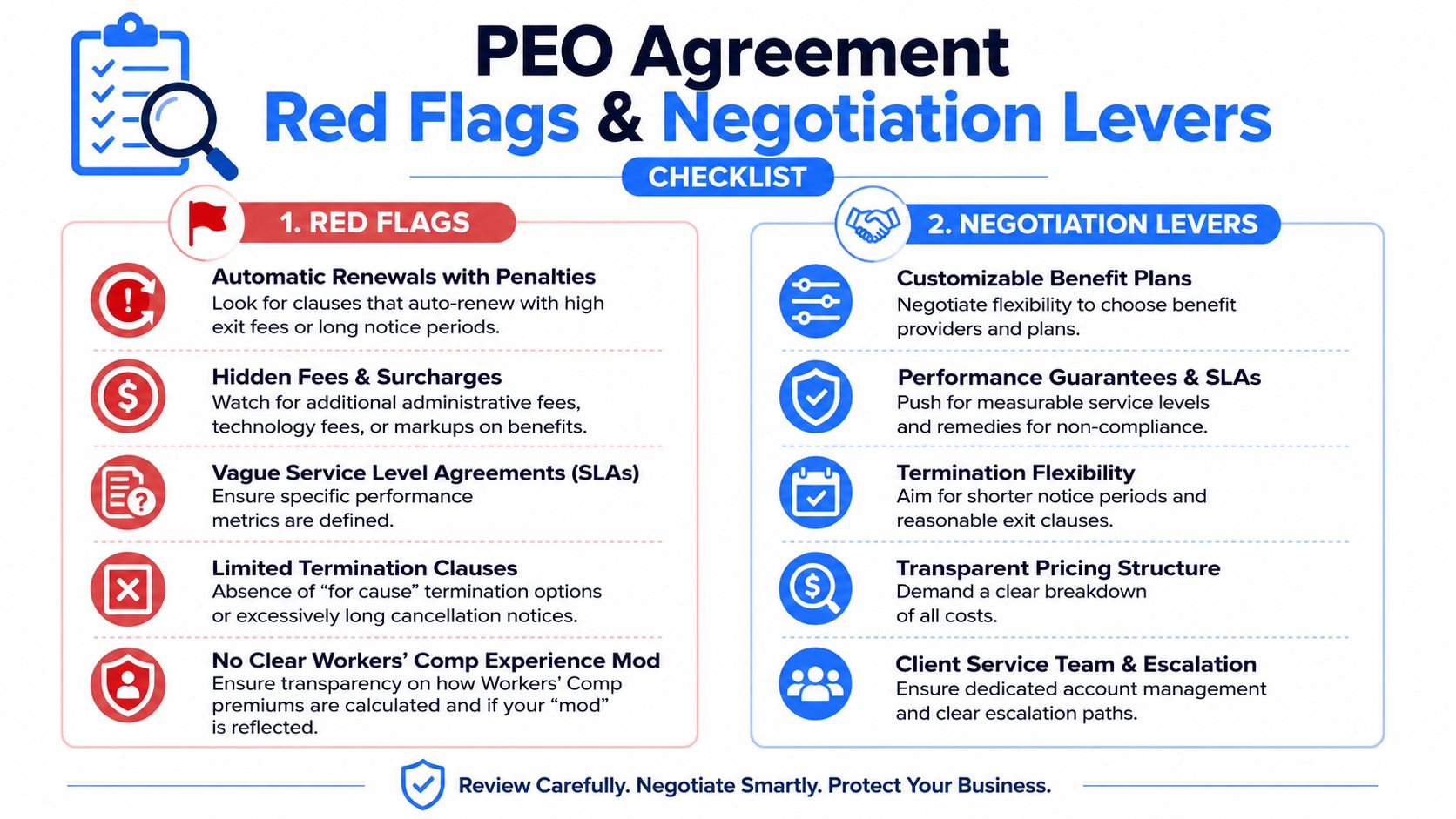
That risk shows up in a few recurring places:
- Automatic renewal clauses: These can lock a company into the next term if notice windows are missed.
- Vague termination rights: If “for cause” standards are unclear, the client may have limited power when service slips.
- Data ownership and extraction language: Payroll records, employee history, and reporting access need to be portable on exit.
- Unclear fee schedules: Contracts sometimes refer to ancillary charges without spelling them out.
- Loose service definitions: If response times, escalation paths, and support responsibilities aren’t specific, accountability gets weak fast.
A sharp contract review should also test how workers’ comp treatment, benefits renewals, and implementation commitments are documented. Sales presentations often sound precise. Agreements are where precision matters.
Levers that improve the deal before signature
Negotiation works best before the employer is emotionally committed to a provider. Once implementation planning starts, negotiating power diminishes.
Useful asks include:
- Rate protection: Ask for multi-year pricing stability or at least tighter language around renewal increases.
- Implementation concessions: Push to waive implementation charges where possible.
- Service accountability: Define response expectations, escalation contacts, and support ownership.
- Exit clarity: Require a written process for termination, data delivery, and transition support.
- Fee transparency: Get every recurring and one-time charge listed in the agreement or attached exhibit.
A detailed review of PEO contract negotiation red flags becomes useful. The strongest buyers don’t just compare rates. They compare the legal and operational friction built into the deal.
The best negotiated PEO agreement isn’t the one with the friendliest demo. It’s the one that stays workable at renewal and survivable on exit.
Your Next Steps How to Evaluate PEOs Without Guesswork
A disciplined PEO evaluation process is straightforward, but it has to be structured.
Start by defining the actual problem. Is the business trying to improve benefits, reduce HR admin load, support multi-state compliance, gain workers’ comp structure, or replace an underperforming provider? Different problems point to different solutions.
Then gather multiple detailed proposals and normalize them. Compare admin fees, pass-through costs, implementation charges, annual fees, off-cycle payroll fees, support model, renewal language, termination rights, and data portability. If a proposal can’t be translated into a clean side-by-side comparison, that’s already a warning sign.
A useful working checklist looks like this:
- Clarify priorities first: Benefits strength, compliance support, service model, flexibility, and exit risk.
- Request proposal detail: Don’t accept summary pricing without fee schedules and contract language.
- Build a comparison sheet: Put every provider into the same financial and operational template.
- Review the agreement before selection: Not after verbal approval.
- Pressure-test the exit: Ask what happens if the relationship ends after one renewal cycle.
Leaders who want to keep researching should spend time on cost calculators, switching guidance, and service-model comparisons before choosing a finalist.
PEO evaluations go better when someone independent translates sales language into an an apples-to-apples decision. PEO Metrics helps employers compare providers, benchmark pricing, review contract terms, and negotiate stronger agreements so the final choice is based on fit and advantage, not guesswork.
