
A culture of empathy is not a morale program. It is a retention control, a management system, and a contract issue. The hard part is that it only works when leaders stop treating empathy like a personality trait and start treating it like an operating model, because employees who see their organization as unempathetic are 1.5 times more likely to change jobs within six months, according to Businessolver’s 2025 workplace empathy research summarized by Speakwise, and that attrition exposure was estimated at about $180 billion in annual U.S. retention costs (Speakwise summary of Businessolver’s 2025 State of Workplace Empathy research).
For HR directors, CFOs, and owners, the key question is not whether people care. The key question is whether the company has repeatable routines that make employees feel heard before problems turn into resignations, complaints, or avoidable manager churn.
Table of Contents
- What a Culture of Empathy Means at Work
- Why Empathy Is a Financial Issue, Not a Soft One
- The Three Pillars of a Data-Driven Empathy Model
- Behavioral Metrics That Make Empathy Visible
- When Empathy Backfires Without Power and Boundaries
- How to Evaluate a PEO for Empathetic Practices
- A 90-Day Plan to Operationalize Empathy
- Common Pitfalls That Quietly Kill Empathy Programs
What a Culture of Empathy Means at Work
A culture of empathy is not a slogan about kindness. It is a set of documented management routines that force leaders to understand employee reality before decisions are made. In practice, that means the company has agreed ways to listen, interpret, escalate, and change policy when the evidence shows people are stuck, confused, overworked, or ignored.
The strongest comparison is healthcare. A hospital does not run on goodwill alone, it runs on triage protocols, escalation rules, and repeatable handoffs. A workplace works the same way when empathy is real. Managers do not improvise compassion on bad days, they follow a system that makes understanding more likely than guesswork.
Personal trait versus organizational capability
Individuals can be empathic, and that matters. A strong culture does not depend on a few emotionally gifted managers. It depends on whether any manager can follow the same playbook, whether in onboarding, a compensation dispute, or a difficult leave conversation. That distinction matters because empathy as a personal trait disappears when a leader is busy, stressed, or replaced.
The more useful definition is operational. Empathy is the ability to understand what people are experiencing, then use that understanding to change behavior, process, or policy. That matches the core mechanism described in the peer-reviewed review The Science of Empathy, which defines empathy as a complex capability that helps people understand and feel others’ emotional states, supporting compassionate behavior (PMC review).
Practical rule: if a company cannot name the meeting cadence, data source, and escalation path for people issues, it does not have a culture of empathy, it has a hope.
For readers who want a clean vocabulary distinction between compassion, sympathy, and empathy, DeTalks’ complete guide is a useful reference point for internal leadership discussions. In policy terms, the culture should also protect confidential reporting, which is why confidentiality at work has to sit alongside empathy, not after it.
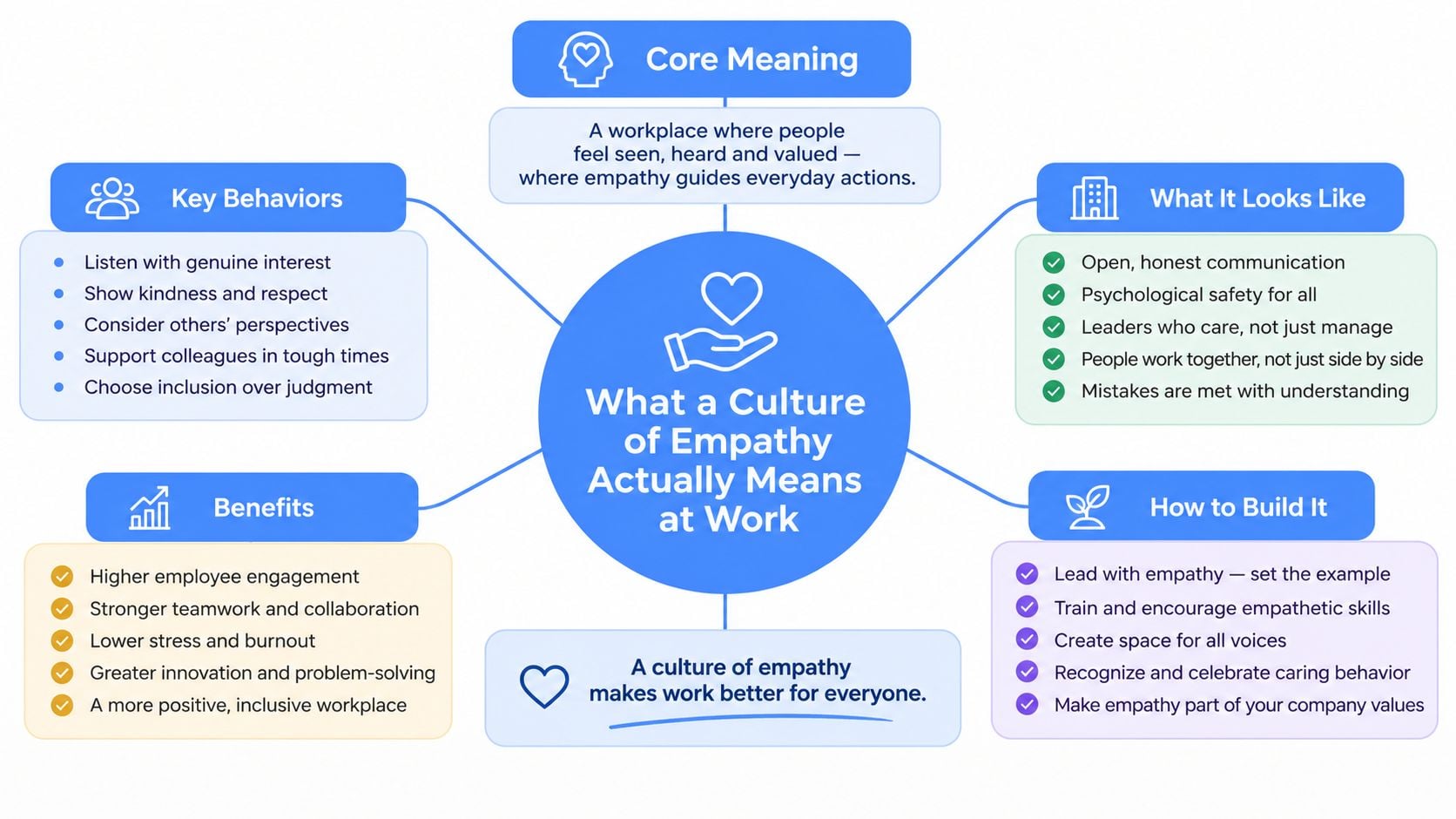
The leadership test is simple. If the answer to a problem is always “be more understanding,” there is no system. If the answer is “here’s how the company hears it, reviews it, and acts on it,” empathy has become an operating capability.
Why Empathy Is a Financial Issue, Not a Soft One
CFOs often get sold empathy as a culture benefit. That framing is too small. If employees describe their organization as unempathetic, they are more likely to look for another job within months, and the cost shows up in recruiting, ramp time, manager instability, and service disruption, not in the HR feel-good bucket. A separate retention-focused guide also makes the cost side plain, because every avoidable departure adds pressure to backfill, retrain, and keep work moving while the role is empty.
That is why empathy belongs in the P&L conversation. A company with a 200-person workforce does not need a philosophical debate about empathy. It needs to know where poor manager experience is driving overtime, backfills, and lost productivity, and it needs that answer fast enough to act before margin gets squeezed. The board may never ask for an empathy score, but it notices when employee relations volume keeps rising and replacement costs keep eating into the budget.
What to demand in a PEO renewal
A PEO contract should do more than promise admin support. It should help the company see the warning signs that empathy is breaking down. Ask for reporting on turnover themes, service response patterns, complaint categories, and the ability to separate noise from recurring pain points. If the PEO cannot show how its service model helps leaders spot friction early, it is adding to the cost problem, even if the sticker price looks efficient.
A smarter renewal conversation ties empathy to contract terms that can be audited. If an employer is paying for access to HR expertise, the agreement should spell out who reviews exit-interview themes, how quickly manager escalations are answered, and whether repeated people issues appear in a usable dashboard. That is the level of detail that turns a soft promise into a financial control.
A company does not need to prove that empathy makes people nicer. It needs to prove that empathy lowers avoidable turnover and reduces the churn tax that CFOs already know how to model.
For a sharper internal lens on the retention side of the equation, this retention-focused guide gives a useful way to trace where money is leaking.
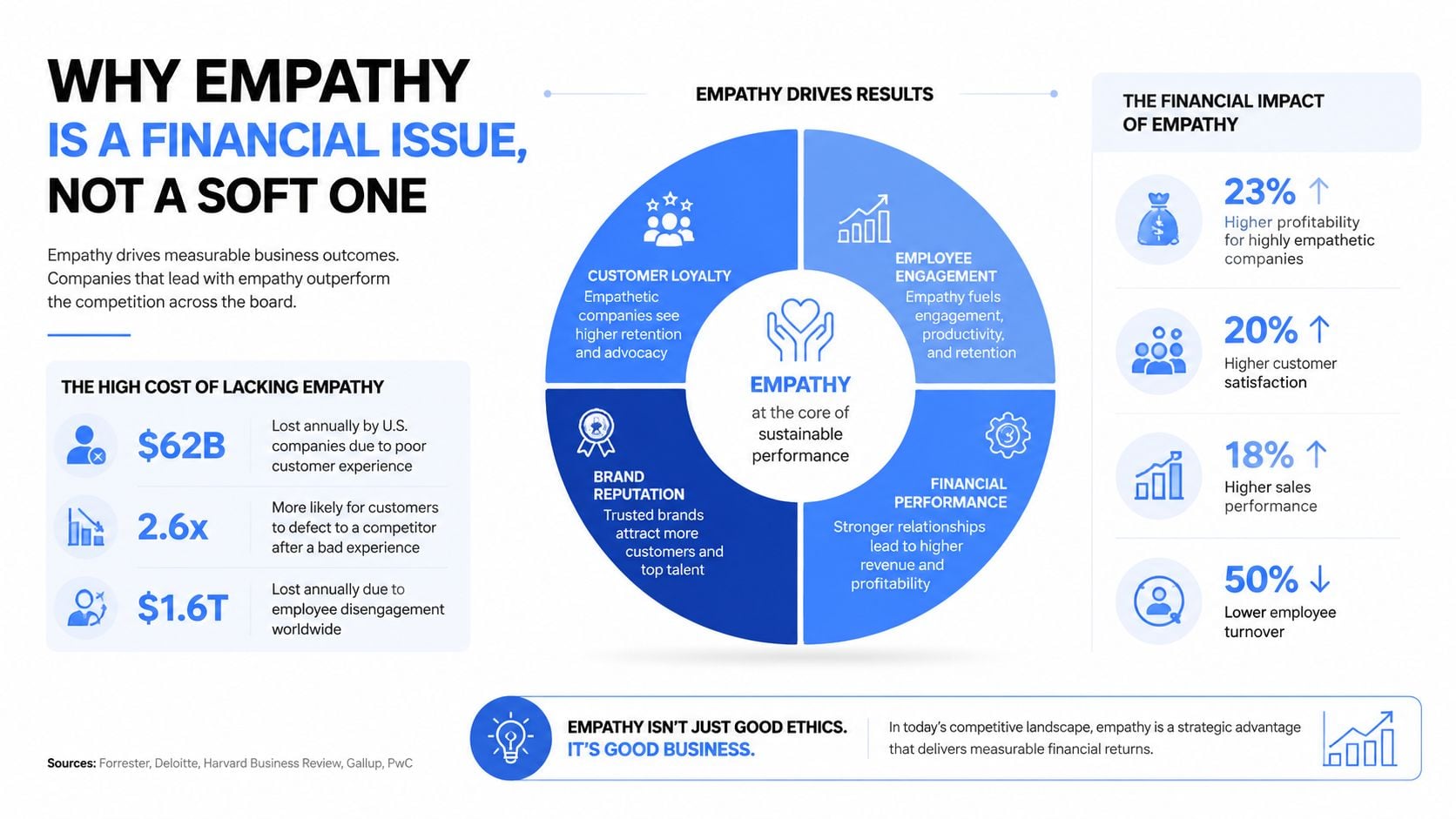
The blunt takeaway is this. Empathy is not a cultural ornament. It is a decision-quality issue, and every PEO renewal is a chance to make that decision quality visible in the numbers.
The Three Pillars of a Data-Driven Empathy Model
A data-driven empathy model works only when companies do three things in sequence, not in isolation. First, they listen across the employee journey. Second, they translate what they hear into decisions. Third, they connect the signals through one system so leaders can see patterns instead of fragments. Harvard Business Review’s framework for building data-driven empathy centers on exactly that logic, listening, translating, and connecting through an integrated stack (HBR framework).
Listen across the journey
The listening layer should be broad but disciplined. Onboarding surveys catch early mismatch. Exit interviews reveal recurring friction. Manager one-on-ones expose workload pressure before it becomes resignation. Anonymous pulse tools help surface issues people won’t raise in a group setting.
The mistake most companies make is collecting too much from the wrong places. They ask broad questions, then bury the results. Better practice is to prioritize the touchpoints where the company has the most influence. If new managers keep stumbling, the listening stack should focus on team lead check-ins, not another generic annual survey.
Translate signals into decisions
Raw comments are not insights. Themes are. Someone has to cluster the feedback into repeated patterns, separate symptoms from causes, and assign an owner. A complaint about “communication” may be a workload problem, a role-clarity problem, or a manager follow-through problem.
That translation work is where empathy becomes managerial. A recurring issue should trigger a decision, not a debate. If new hires keep saying they felt left in the dark, the fix may be a tighter onboarding checklist, a better first-30-day manager cadence, or clearer written expectations. The point is to act on what the data keeps saying.
Connect the stack into one source of truth
If the HRIS, engagement platform, ticketing system, and PEO portal each hold part of the story, leaders will miss the pattern. The integrated stack matters because empathy breaks down when data lives in silos. Cross-functional governance is not a luxury, it is the mechanism that keeps one team from solving a problem another team cannot see.
Operational standard: if a recurring people issue shows up in three systems but no one owns the cross-system view, the company is paying for data without paying for understanding.
For teams comparing their technology and service setup, this PEO dashboard model is the right kind of benchmark. The practical Monday-morning checklist is simple, too. Identify the top three listening posts, define the owner for theme synthesis, and decide which system becomes the master record for action items.
Behavioral Metrics That Make Empathy Visible
Empathy becomes manageable when leaders stop asking whether people “feel the culture” and start watching the behaviors that signal friction. The most useful metrics are not abstract sentiment scores. They are repeatable signals that show whether employees feel heard, whether managers are present, and whether the organization responds before resentment hardens into turnover.
| Metric | Data Source | Owner | Trigger Threshold |
|---|---|---|---|
| Pulse score for feeling heard or valued | Short pulse surveys | HRBP or People Ops | A sustained drop across two cycles |
| Complaint theme frequency | HR case logs, service desk notes | Employee relations lead | The same issue repeats across teams |
| Exit-interview theme frequency | Exit interview summaries | HR leadership | Repeated mention in a single quarter |
| After-hours communication volume | Email and chat pattern review | Department manager | Persistent off-hours escalation |
| Manager check-in response time | One-on-one logs or workflow tool | Direct manager | Delays that keep repeating |
Those metrics matter because repeated pain-point data tells leaders where support, autonomy, or workload changes will reduce friction before disengagement turns into turnover (VocationalQuest on data-driven empathy metrics). A company does not need perfect data to act. It needs enough signal to know where the problem is sticking.
Build a one-page scorecard
A good scorecard keeps leaders honest. It should show the metric, the owner, the trend, and the action taken. If pulse scores are low but nothing changes, the scorecard is theater. If after-hours communication is rising in one function, that function should be forced to explain why.
The best use of these metrics is not surveillance, it is intervention. A manager with high after-hours volume may need workload redistribution, not a reminder to “model balance.” A team with repeated complaint themes may need a better decision-rights map, not another listening session.
For employers using a PEO, the question is who can see the data and act on it. This turnover reduction model is a useful reference for how the measurement layer should connect to retention work.
Empathy should be tracked like any other operational risk. If the company can’t see it, it can’t correct it.
When Empathy Backfires Without Power and Boundaries
Empathy without structure can become emotional labor. That is the problem many organizations miss. They ask underrepresented employees to keep explaining what feels unfair, then call that listening. They ask managers to care more, but never give them the authority or policy tools to change the situation.
Research focused on marginalized groups and racial justice is clear about the gap. Understanding lived experience requires attention to systemic barriers, intersectionality, and socioeconomic factors, not sympathy alone (Elsevier blog on empathy and marginalized groups). A company can host a thoughtful listening circle and still leave the actual barrier in place.
Boundaries are part of empathy
People cannot be the company’s permanent education department. If one group keeps being asked to narrate pain without seeing changes, trust erodes quickly. That is why empathy programs need boundaries, such as clear escalation channels, rules for how often employees are asked to retell difficult stories, and manager training that prevents emotional dumping.
For leaders who want a practical companion on limits and self-protection, strategies for healthy boundaries is a useful read before designing any empathy initiative. The point is not to avoid hard conversations. The point is to avoid making the same people carry all the emotional and administrative weight.
Evaluate empathy by behavior change
The right test is whether the program reduces inequity, improves trust, and changes behavior. If employees say leadership is more caring but bias complaints keep recurring, the culture has not improved. If the company gathers better stories but never changes policy, it has built a performance, not a system.
Structural action matters. Restorative practices, equity impact assessments, and policy changes do more than sympathy ever can. They make it harder for the organization to hide behind good intentions.
A PEO can either help here or get in the way. Ask whether the service desk routes bias complaints cleanly, whether benefits design reveals structural barriers, and whether reporting makes recurring inequities visible. If the answer is vague, the service model is not supporting a culture of empathy, it is only processing tickets.
How to Evaluate a PEO for Empathetic Practices
Two PEOs can quote the same price and still deliver totally different employee experiences. One helps managers respond quickly, surfaces themes, and supports better decisions. The other stays transactional, resolves tickets, and leaves leaders to guess why morale keeps slipping.
| Dimension | Empathetic PEO | Transactional PEO | Contract or RFP Question |
|---|---|---|---|
| Service model | Dedicated account support with clear ownership | Generic call-center model | Who owns recurring people issues? |
| Response expectations | Written response times for escalations | Best-effort language | What is the SLA for manager and employee escalations? |
| Reporting depth | Themes on engagement, turnover, and complaints | Basic utilization summaries | What reporting shows recurring friction points? |
| Governance | Regular review cadence with action tracking | Ad hoc communication | Who reviews exit themes and follow-up actions? |
| Compliance support | Strong multi-state guidance for hybrid teams | Narrow transactional support | How are hybrid and multi-state issues handled? |
The details matter because empathy is operational. A contract that ignores escalation paths for bias complaints or exit-interview review rights is telling leaders where the vendor’s priorities stop. A better agreement spells out how service issues are routed, how quickly they are answered, and what visibility leaders get into patterns that affect retention.
For buyers comparing options, these PEO reviews are the right kind of lens. The point is not brand recognition. The point is whether the vendor’s operating model helps managers see and solve people issues faster.
Ask for these clauses
- Service ownership: specify who handles repeated complaints, not just first-contact tickets.
- Escalation path: require a written route for bias, workload, and manager-conduct concerns.
- Reporting rights: ask for access to trend summaries on turnover, engagement, and complaint themes.
- Review cadence: lock in quarterly people-issue reviews, not informal “check-ins.”
- Follow-up accountability: require action logs so issues do not disappear after the call.
A transactional PEO may still be fine for a company that only wants payroll administration. But if the goal is a real culture of empathy, the contract has to support the work. Otherwise, leadership is paying for a service layer that cannot tell the difference between a one-off complaint and a broken pattern.
A 90-Day Plan to Operationalize Empathy
A culture of empathy does not appear after one town hall. It gets built through a sequence. The first 90 days should be enough to establish sponsorship, define metrics, train managers, and prove that feedback can turn into action.
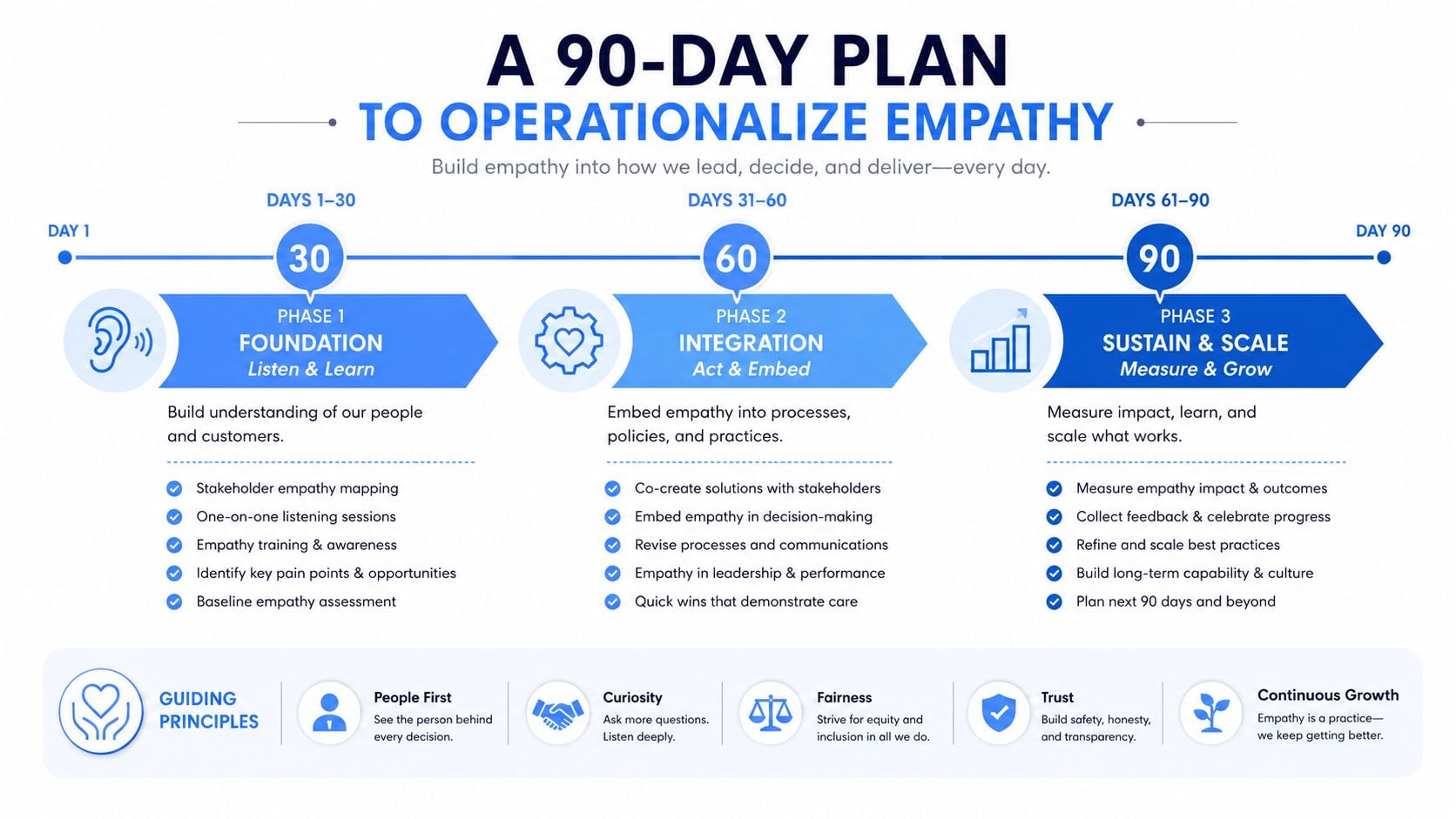
Days 1 to 21
Leadership needs to define the operating target. That means choosing the first three empathy KPIs, naming the owner for each one, and deciding where those numbers will live. This is also the moment to confirm whether the PEO, HRIS, or engagement platform will carry the reporting burden.
The executive team should also set the expectation that empathy is not a one-off campaign. It is a recurring management routine. If leaders do not say that clearly, the program will get treated like another HR initiative with a short half-life.
Days 22 to 49
Managers should be trained on repeatable behaviors. McKinsey’s interview with empathy researcher Jamil Zaki is useful here because it stresses that empathy improves through habitual practice, not one big event, and it recommends prompts in regular conversations, better questions, and recognition of empathic behavior (McKinsey on empathy at work).
That means the manager toolkit should include a better one-on-one template, a recognition routine, and a follow-up expectation after difficult conversations. If the organization cannot tell managers what to do on Tuesday morning, it does not have a program.
Days 50 to 90
This is the closing-the-loop phase. Publish the recurring themes, identify the first actions, and show employees what changed. The scorecard should connect the empathy work to engagement and retention signals, even if the first readout is messy.
A simple weekly checklist helps:
- Week 1: executive sponsor named, KPIs selected, data owners assigned.
- Week 2: listening posts mapped, manager routines drafted, PEO reporting request sent.
- Week 3: first baseline pulled, escalation paths documented, scorecard layout approved.
- Weeks 4 to 7: manager training launched, check-in cadence enforced, recognition routine used.
- Weeks 8 to 10: theme review completed, policy fixes proposed, unresolved issues escalated.
- Weeks 11 to 12: first empathy scorecard reviewed with leadership, next-quarter actions set.
If the PEO partner is doing its job, it should be supporting the reporting, helping surface themes, and clarifying the service route for recurring issues. If it isn’t doing those things, the company is paying for administration while expecting transformation.
Common Pitfalls That Quietly Kill Empathy Programs
Most empathy programs fail for familiar reasons. The people running them usually mean well, but they design for intent instead of execution. That is why the same mistakes keep showing up.
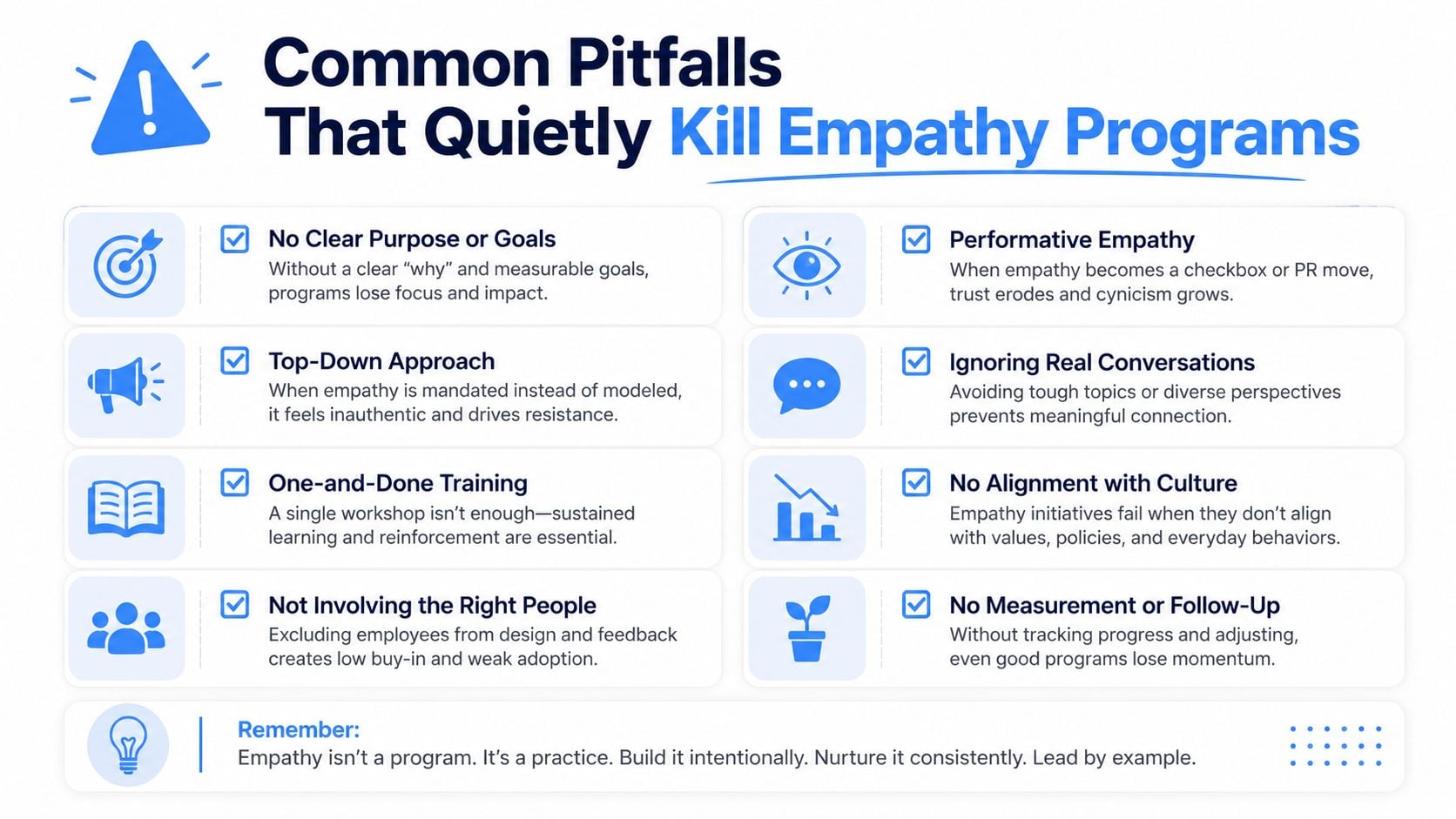
The seven failures to audit
- Values speech, no measurement: If leadership launches with a speech but no scorecard, the program will drift. Fix it by naming two or three behavioral KPIs before the rollout.
- One-time manager training: A single workshop doesn’t change habits. Fix it with monthly prompts, reinforcement, and recognition.
- Emotional labor falling on the same people: Underrepresented employees get asked to explain everything. Fix it by giving managers and executives explicit responsibility for synthesis and action.
- Pulse surveys as decoration: If employees answer surveys and never see changes, trust drops. Fix it by publishing themes and actions within a defined cadence.
- PEO contracts with no service standards: Vague support promises create slow response and hidden friction. Fix it by negotiating response-time SLAs and escalation rights.
- Ignoring cross-cultural differences: Empathy isn’t expressed the same way in every team or region, as the cross-cultural research shows. Fix it by training leaders to observe before assuming.
- Listening without structural change: Feedback that never becomes policy is theater. Fix it by tying complaints to decision rights, workload, and manager accountability.
For a practical audit mindset, WebAbility.io’s website audit guide is a reminder that the same discipline used to inspect a digital system should be used to inspect a people system. The pattern is the same, check the inputs, the handoffs, and the fixes.
The fastest way to kill a culture of empathy is to treat it as a branding exercise. The smarter move is to review it like any other operating system, with owners, thresholds, escalation paths, and consequences when the numbers do not move.
PEO Metrics helps companies compare, select, and negotiate the right PEO, and that matters when a culture of empathy depends on reporting, service response, and contract terms that managers can use. If a company wants a sharper view of how its current PEO supports retention, employee experience, and the data behind both, visit PEO Metrics and use that benchmark to pressure-test the next renewal.
