
A remote employee is sharing a screen during a compensation review. One wrong click opens a spreadsheet with salaries, bonus notes, and manager comments for half the company. The HR director gets the message within minutes. The CFO wants to know who saw it. The owner wants to know whether the PEO should handle it. Legal wants to know whether names, pay details, or medical notes were exposed. Nobody cares that every employee signed an NDA.
That scene is ordinary now. Confidentiality at work no longer lives in locked file cabinets, sealed envelopes, or a policy page in the handbook that nobody reads after onboarding. It lives in Zoom rooms, cloud drives, HRIS permissions, screen shares from home offices, and PEO workflows that move employee data between employer, vendor, broker, payroll, and benefits systems all day long.
That’s where many employers get caught. They assume the PEO’s standard paperwork covers the issue. It rarely does. Most standard confidentiality language tells employees what not to do, but says little about who carries liability when a vendor admin account is over-permissioned, when a terminated manager still has access, or when a remote worker handles protected data from a kitchen table.
For HR directors, CFOs, and owners in the 10 to 2,000 employee range, confidentiality at work has become an operational discipline. It affects retention, claim exposure, vendor management, and contractual advantage. It also affects which risks stay with the employer and which should be shifted, narrowed, or clarified in the PEO agreement.
A practical starting point is reviewing how current policies function in daily operations, not just on paper. This overview of how to maintain confidentiality in the workplace is useful because it frames confidentiality as a system, not a signature.
Table of Contents
- Introduction
- Redefining Confidentiality Beyond the NDA
- Your Legal and Regulatory Obligations
- Anatomy of an Effective Confidentiality Policy
- Daily Best Practices for Employees and Managers
- When Breaches Happen Detection and Response
- The PEO Angle Negotiating Smarter Confidentiality Terms
- Turning Confidentiality into a Strategic Asset
Introduction
Most employers still treat confidentiality at work as a legal document problem. They collect signed agreements, store them in the HR folder, and assume the issue is handled. That approach breaks down fast once employee data passes through a PEO, payroll platform, benefits portal, ticketing system, shared drive, and manager inbox before lunch.
The primary risk sits in daily movement. A benefits specialist exports enrollment data to answer a coverage question. A manager forwards a disciplinary note to a personal email to work from home. A payroll admin keeps broad access after changing roles. None of those failures are dramatic. All of them create exposure.
For PEO-powered companies, that exposure is more complicated because confidentiality is shared across parties that don’t always have clean lines of responsibility. The employer may own the workforce relationship. The PEO may host or process payroll, benefits, and onboarding data. Another vendor may handle devices, security, or storage. When something leaks, the contract decides who pays, who notifies, and who gets blamed.
Practical rule: If a confidentiality obligation can’t be tied to a named person, a system permission, and a contract clause, it probably won’t hold up under stress.
That’s why generic advice doesn’t help much. Leaders need to know what information deserves the highest protection, what laws create actual financial exposure, what operating controls matter, and what PEO terms should never be accepted as boilerplate.
Redefining Confidentiality Beyond the NDA
An NDA has value. It can support discipline, strengthen a breach claim, and set expectations. It can’t stop a manager from screen-sharing the wrong tab, and it won’t fix a PEO portal with loose permissions.
An NDA is a remedy, not a system
Most confidentiality failures at work aren’t deliberate theft. They’re access mistakes, process shortcuts, or poor judgment. That’s why relying on an NDA as the main safeguard is backwards.
The gap is wider in hybrid work. Employees report 40% higher anxiety about accidentally breaching confidentiality when sharing screens or discussing sensitive HR and compensation data in home environments, yet 68% of companies lack updated remote-specific confidentiality policies according to this hybrid work confidentiality discussion. Employers that still use office-era policy language are managing a current risk with an outdated playbook.
A stronger starting point is reviewing whether the PEO agreement and related documents define data ownership, control, and access in a way that matches actual workflows. Such a close look at PEO data ownership clauses often reveals gaps that the employee handbook never addresses.
What employers are actually protecting
Confidentiality at work usually covers three buckets, and each behaves differently when something goes wrong.
| Category | Common examples | Typical failure point |
|---|---|---|
| Employee data | Pay records, health information, Social Security numbers, performance notes | HR exports, manager sharing, overbroad admin access |
| Business data | Forecasts, margin reports, customer pricing, acquisition plans | Email forwarding, shared drives, unsecured discussions |
| Intellectual property | Trade secrets, internal methods, source material, client lists | Departing employees, weak return-of-data process |
A smart policy treats those categories differently. Medical information needs stricter handling than a draft sales deck. Compensation data can be highly sensitive even when it isn’t a trade secret. Home-office conversations create different risks than on-site locked storage.
The employers with the fewest surprises are the ones that map where confidential data lives, who touches it, and which vendor contract governs each handoff.
That’s the shift. Confidentiality at work is not just about secrecy. It’s about controlled access, defensible process, and clear responsibility across the employer and the PEO.
Your Legal and Regulatory Obligations
Legal exposure doesn’t begin when a lawsuit arrives. It starts when the company collects data it hasn’t structured itself to protect.
The expensive part is often outside the handbook
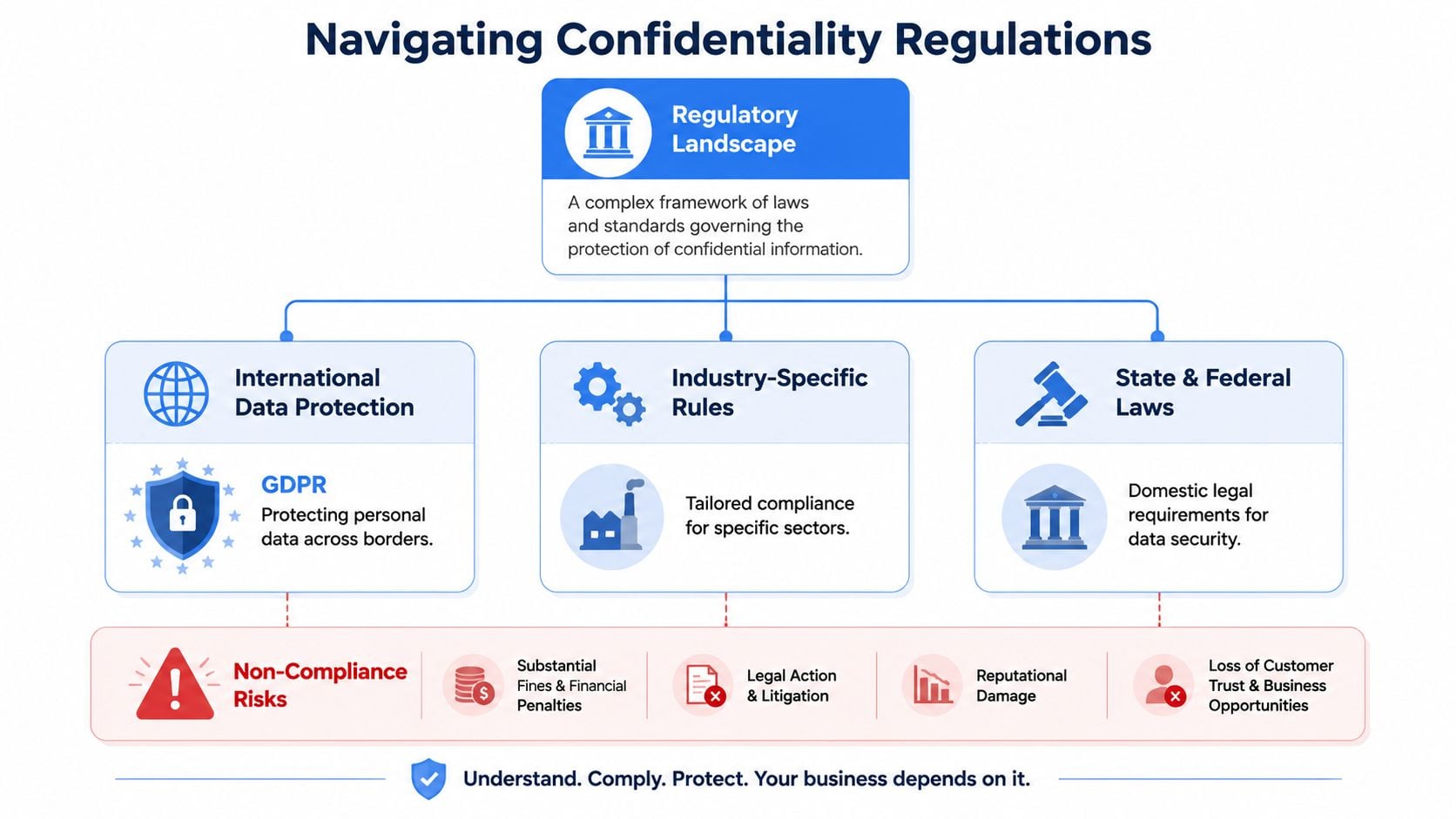
For multi-state or international employers, confidentiality obligations can attach even when leadership assumes the issue is “just HR.” The clearest example is GDPR. The regulation established a global benchmark for workplace confidentiality, applies to organizations processing data of EU residents regardless of location, and requires a privacy-by-design approach. Failure to maintain confidentiality can result in penalties of up to €20 million or 4% of total global annual turnover under the GDPR analysis published by Sage.
That number gets a CFO’s attention for a reason. It changes how vendor risk should be negotiated. If a PEO handles employee data tied to EU residents, the employer shouldn’t assume the PEO’s standard agreement fully absorbs the exposure. Many don’t. Some limit liability aggressively. Some place notification duties on the employer even when the incident originated in a vendor-controlled environment.
A practical legal review should include more than the handbook. It should include service agreements, data processing terms, admin-user permissions, and the employment-side rules summarized in these HR confidentiality law considerations.
Medical confidentiality has separate rules
Medical information requires stricter treatment than ordinary personnel data. In the United States, the ADA requires employers to keep employee medical information confidential. EEOC and CDC guidance reinforced that during the pandemic. Employers could collect necessary medical data, but they could not widely disclose the identity of an employee who tested positive unless that disclosure was absolutely required for safety. Aggregate, non-identifying counts could be shared without violating medical confidentiality, as explained in this employee data privacy FAQ from Ogletree.
That distinction matters operationally. A manager saying “someone on your team tested positive” is different from saying “John in accounting tested positive.” One can be handled carefully. The other can create immediate legal trouble.
A few legal boundaries are often overlooked in day-to-day management:
- ADA file separation: Medical records and related documentation must be kept confidential and physically separate from general personnel files, as outlined in this employment privacy overview from Justia.
- Personal account access: In Illinois, employers can’t request or coerce usernames, passwords, or other access methods for employees’ personal online accounts under the Illinois Right to Privacy in the Workplace Act summary.
- Trade secret enforcement: If the company doesn’t control and protect confidential business information, later enforcement becomes much harder.
The legal takeaway is simple. Confidentiality at work isn’t one rule. It’s a stack of rules with different triggers, and a PEO relationship doesn’t remove the employer from that stack.
Anatomy of an Effective Confidentiality Policy
A workable confidentiality policy reads like an operating manual. A weak one reads like a warning sign.
What strong policy language covers
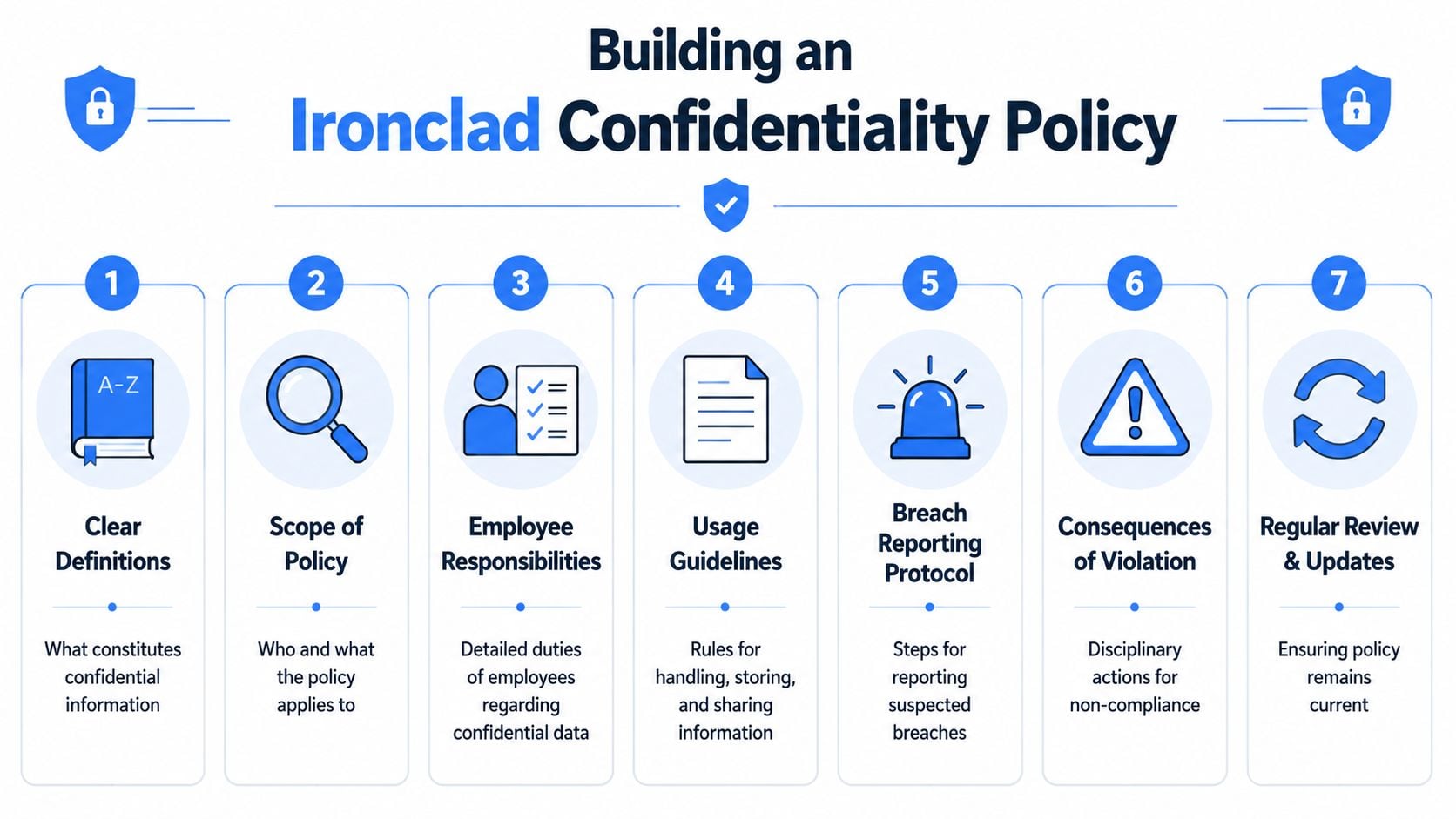
The first test is definition. If “confidential information” is vague, enforcement will be too. A policy should name the categories that matter in plain language, including employee medical information, payroll data, compensation records, investigation files, customer lists, financial reports, and non-public business plans.
The second test is scope. The policy should state who is covered and when. That usually includes employees, managers, temporary staff, contractors, and anyone using employer or PEO systems. It should also clarify that confidentiality duties apply during employment and after separation, especially for downloaded files, copied reports, and retained credentials.
A useful companion document is the employee handbook structure itself. Many employers bury confidentiality in a short conduct section when it really belongs in a larger operational framework. This guide to what belongs in an employee handbook helps show where confidentiality should connect to discipline, technology use, records retention, and reporting.
What weak policies get wrong
Weak policies usually fail in the details. They prohibit disclosure in broad terms but don’t tell employees what daily conduct is banned.
A stronger policy addresses concrete behaviors such as:
- Personal email use: Employees may not send confidential files to personal email accounts for convenience.
- Home printing: Sensitive records shouldn’t be printed in remote settings unless there’s a documented business need and a secure disposal process.
- Screen sharing: Compensation spreadsheets, medical notes, and investigation logs must be closed before meetings begin.
- Termination procedures: Access removal, return of company property, and data certification should happen as part of offboarding, not days later.
Here’s the difference in practice:
| Weak language | Stronger language |
|---|---|
| “Employees must keep company information confidential.” | “Employees may access confidential information only for assigned business duties and may not copy, forward, download, print, store, or discuss such information outside approved systems or authorized business need.” |
| “Violations may lead to discipline.” | “Violations may result in access suspension, investigation, corrective action, termination, and legal action where applicable.” |
A policy shouldn’t merely say “be careful.” It should tell people exactly what careful looks like on a laptop, in a meeting, and during offboarding.
The final check is whether the policy includes a reporting path. Employees need to know where to report accidental disclosure, suspicious access, or a lost device. If they have to guess, they’ll wait. Delay is where small incidents become expensive ones.
Daily Best Practices for Employees and Managers
A policy only matters if systems and habits enforce it.
Technical controls that should already be in place
Confidentiality at work depends on layered controls, not trust alone. Role-Based Access Control, AES-256 encryption for data at rest, TLS 1.3 for data in transit, and Multi-Factor Authentication collectively reduce unauthorized access risks by over 99% according to security benchmarks in this data confidentiality overview from Atlan.
That matters because many confidentiality breaches don’t start with malicious intent. They start because too many people can see too much.
Three controls deserve special attention:
- RBAC: A payroll specialist shouldn’t automatically have access to investigation notes. A manager shouldn’t see company-wide compensation data because they supervise one team. Least-privilege access is not an IT preference. It’s a business control.
- MFA: Shared credentials and password-only access create obvious failure points, especially when a PEO portal, benefits system, and HRIS are all connected.
- Encryption: If a laptop is lost or a file is intercepted, encryption can determine whether the event becomes a reportable crisis or a contained issue.
For teams that need a practical refresher on day-to-day handling, this roundup of practical advice for data handling is a useful supplement because it translates policy language into ordinary work behavior.
Manager habits that prevent avoidable exposure
Managers create more confidentiality risk than most employers admit. They handle performance notes, accommodation issues, pay decisions, complaints, and investigation follow-up. They also improvise.
A disciplined manager routine looks like this:
- Prepare before calls. Close unrelated files before screen-sharing. Don’t assume the right window is already selected.
- Use approved channels. Sensitive follow-up belongs in company systems, not text threads or personal inboxes.
- Hold private conversations carefully. Performance or medical discussions should happen where others can’t overhear, whether that’s in an office or at home.
- Escalate uncertainty fast. If a manager isn’t sure whether information can be shared, the answer is to pause and ask HR or legal.
One additional point often gets missed. Employers need to train managers on what not to say after learning confidential information. Curiosity from peers isn’t a business need. “I can’t discuss that” is a valid operational answer.
When Breaches Happen Detection and Response
Every employer says confidentiality matters. The ultimate test comes in the first hours after a breach.
The first day matters most
Take the screen-share mistake from the opening example. The wrong first move is sending a panicked all-company email or confronting the employee before facts are gathered. The right move is controlled triage.
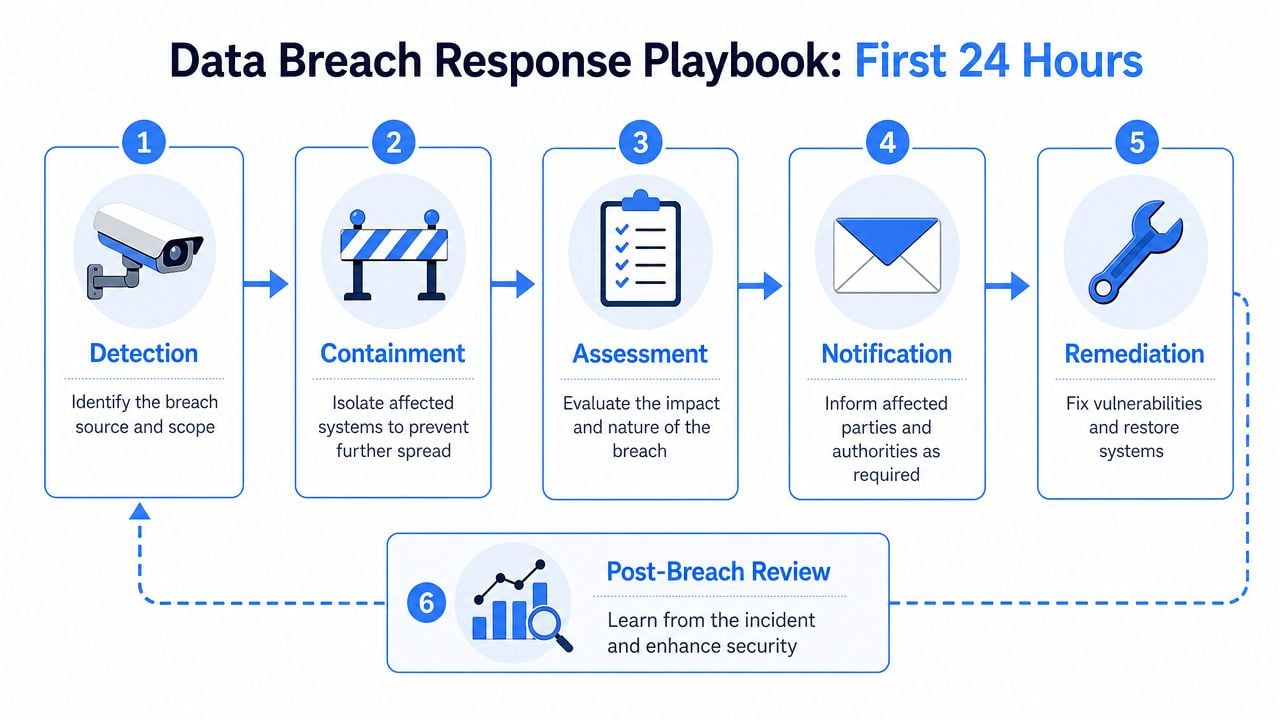
A practical first-day sequence usually looks like this:
- Contain the exposure: Disable links, revoke access, stop forwarding, and preserve the file version involved.
- Identify the audience: Determine who had access, who viewed the data, and whether the information was downloaded or redistributed.
- Assemble the response team: HR, IT, legal, and the relevant business leader should be aligned quickly. If the PEO hosts the affected system, bring them in early and document the timeline.
- Preserve evidence: Keep logs, screenshots, access reports, and communication records.
- Assess notification duties: Legal and compliance teams should evaluate whether any employee, customer, regulator, or vendor notice is required.
Teams that haven’t built this process internally often benefit from reviewing a structured IT Cloud Global data breach response plan because it provides a clean operational sequence that many HR-led incidents otherwise lack.
How discipline and escalation usually unfold
Not every breach leads to termination. Not every breach should be treated as a training issue either. Context matters. So does intent.
When an employee breaches confidentiality obligations, employers commonly move through a five-step escalation path: (1) direct communication, (2) a cease-and-desist letter, (3) court action for breach of contract, (4) reporting to law enforcement, or (5) asserting an after-acquired evidence defense, as outlined by Buchanan Ingersoll & Rooney’s discussion of confidentiality enforcement.
There are exceptions. Good faith whistleblowing, protected concerted activity, and protected disclosures about harassment narrow what an employer can punish.
A severe medical privacy breach can justify immediate termination. Duke’s HIPAA guidance gives a useful example of a level 4 breach, where malicious or repeated unauthorized access or disclosure of protected health information for personal gain, theft, or harm results in immediate termination and no rehire eligibility under its confidentiality policy framework.
The response should match the conduct. Careless handling needs correction. Intentional misuse needs decisive action. Employers lose credibility when they confuse the two.
The companies that recover best are not the ones with perfect policies. They’re the ones that can identify the breach, document the facts, and act without improvising.
The PEO Angle Negotiating Smarter Confidentiality Terms
Confidentiality at work becomes a contract issue, not just an HR issue.
Where standard PEO language usually falls short
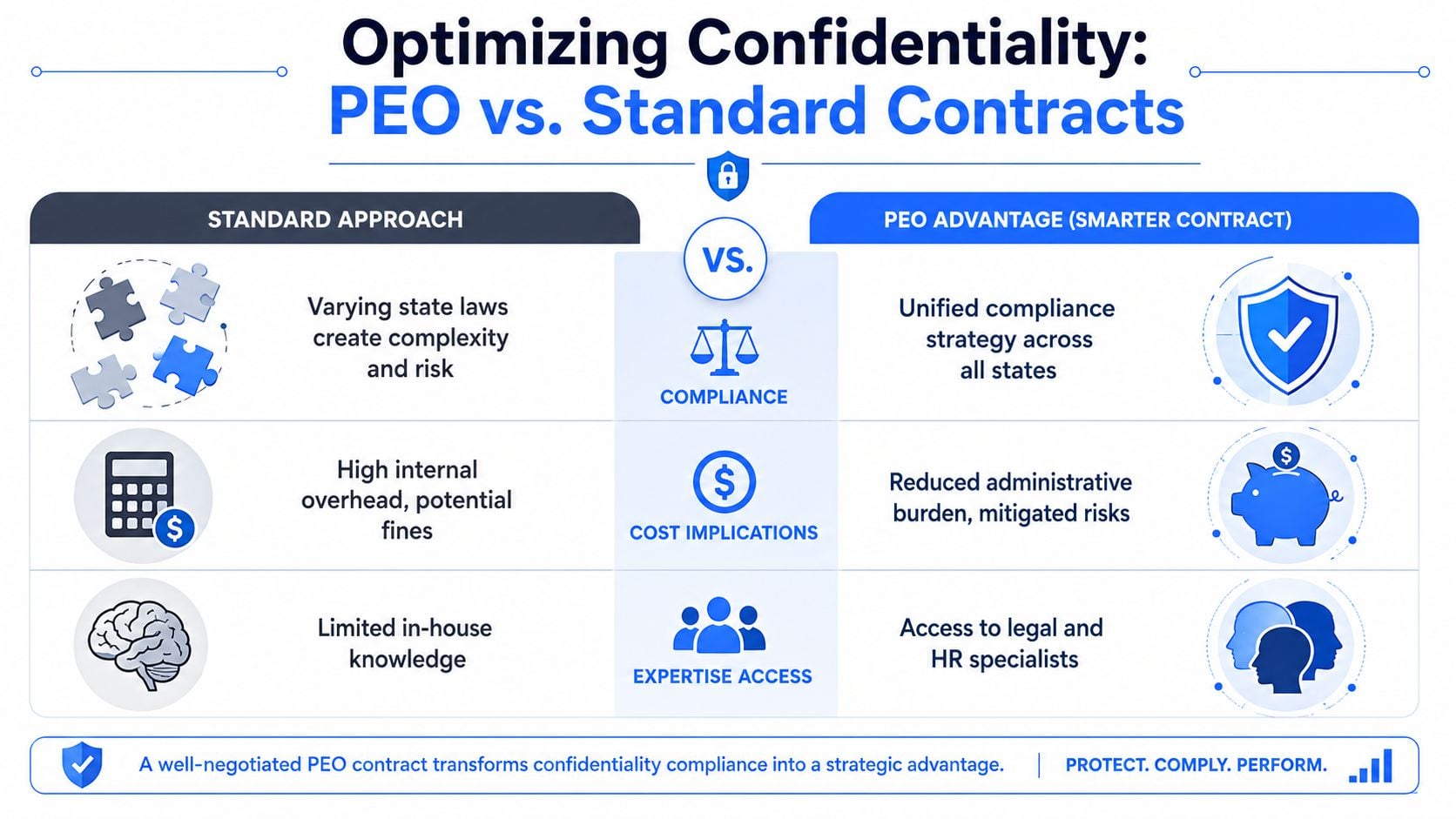
Most PEO agreements contain confidentiality language. Many are too broad where the employer needs flexibility and too vague where the employer needs protection.
A common problem is one-sided drafting. The employer must protect PEO information, follow security procedures, and notify the PEO promptly. Meanwhile, the agreement may say far less about the PEO’s liability if its personnel mishandle employee data, if access controls are poorly configured, or if a downstream vendor creates the problem.
Another issue is process mismatch. The contract may say the PEO provides secure systems, but it often doesn’t specify approval workflows, role permissions, audit rights, or incident cooperation standards. That leaves the employer exposed during a dispute over who caused the breach and who pays for the response.
Employers should also review how confidentiality functions inside the user environment itself. A polished login experience can hide weak role design and broad visibility. This is why it helps to look at the practical implications of the PEO employee portal rather than treating it as a neutral convenience tool.
Terms worth negotiating before renewal
A smarter confidentiality negotiation focuses on risk transfer and operational clarity.
Start with these pressure points:
| Contract issue | Weak position | Better position |
|---|---|---|
| Liability for vendor-caused breach | Broad disclaimer or capped responsibility | Clear allocation when the PEO or its subcontractor caused the event |
| Incident response duties | General cooperation language | Defined notice timing, named contacts, evidence preservation, and investigation support |
| Data access rights | Broad admin permissions by default | Role-based permission structure with employer approval for elevated access |
| Remote work handling | Generic confidentiality clause | Remote-specific controls for screen sharing, home printing, and secure disposal |
| Return and deletion | Vague post-termination language | Timelines for data export, deletion, certification, and access shutdown |
A useful negotiation question is direct: if the PEO’s system exposes compensation or medical information due to a misconfiguration, who covers legal review, employee notice, remediation, and related costs? If the answer is murky, the contract needs work.
The hidden retention and liability issue
Many employers assume stricter confidentiality always means lower risk. That’s not what current data suggests. Companies with zero-tolerance confidentiality policies see 23% higher voluntary turnover, while those with need-to-know frameworks report 31% higher engagement. In addition, 62% of existing PEO agreements still lack updates for new state laws requiring safe-channel exceptions, creating a $12K to $45K average liability risk per entity, according to SkillPath’s discussion of confidentiality and leadership.
That has direct contract implications.
If the PEO’s confidentiality language is so rigid that employees believe they can’t raise safety concerns, mental health issues, or workplace complaints through protected channels, the employer may inherit retention damage and legal exposure at the same time. Boilerplate language often ignores the difference between protecting confidential business information and silencing legitimate internal reporting.
That’s where “need-to-know” beats “say nothing.” Employers should push for explicit carve-outs that preserve lawful reporting, whistleblowing, protected workplace discussions, and confidential mental health disclosures where required. They should also ask whether the PEO has updated templates for the states where the workforce sits, especially if the company has remote employees spread across multiple jurisdictions.
The best confidentiality clause doesn’t lock down every conversation. It draws a defensible line between protected information and protected reporting.
PEO renewals offer bargaining power because changing terms is easier before signature than after an incident. Confidentiality language should be negotiated with the same seriousness as fees, rate caps, and termination rights. For many employers, it carries just as much financial consequence.
Turning Confidentiality into a Strategic Asset
Confidentiality at work is usually framed as damage control. That’s too narrow. Handled well, it becomes a trust signal for employees, a credibility marker for clients, and a governance advantage for leadership.
Employees notice when access is disciplined, medical information stays private, and managers know when to stay silent. Leadership notices when an incident doesn’t turn into a scramble because the response path already exists. Buyers, investors, and partners notice when data handling looks deliberate instead of improvised.
Three actions matter most:
- Audit the current policy: Check whether it addresses modern workflows, remote work, actual data categories, and reporting paths.
- Review access and system controls: Confirm that permissions, MFA, encryption, and offboarding steps match the policy.
- Read the PEO contract like a risk document: Look closely at liability allocation, breach cooperation, data return, and carve-outs for lawful disclosures.
The companies that manage confidentiality well don’t treat it as a side issue for legal to clean up later. They build it into operations, management habits, and vendor negotiation from the start.
Companies comparing or renegotiating a PEO don’t need to guess whether confidentiality language is market standard or one-sided. PEO Metrics helps employers evaluate PEO agreements, benchmark terms, and spot risk areas such as liability allocation, data ownership, renewal language, and service gaps before those issues become expensive.
