
Pricing analysis is the structured practice of comparing prices, contract terms, and total cost against benchmarks to decide whether a quote is fair and reasonable. For PEO buyers, that makes it a procurement tool, not a seller's pricing exercise.
Most advice on pricing analysis assumes the buyer is the one setting the price. That misses the pressure point in PEO selection, where HR directors and CFOs are usually staring at three or four proposals that look close on the surface but diverge badly once minimums, escalators, benefits fees, workers' comp treatment, and exit terms are added up. In that setting, the job is not to guess what a PEO should charge. The job is to catch what the quote is hiding.
The reason price deserves this much scrutiny is simple. In one pricing-statistics review, 60% of online shoppers worldwide consider ecommerce pricing their first criterion, 20% of ecommerce traffic comes from price-comparison engines, and 65% of consumers compare prices on Amazon before checking any other site, all of which show how strongly price drives behavior in competitive markets (Paddle pricing analytics overview). That same source says a 1% price increase can produce an 11% increase in operating profit. PEO buyers should read that as a warning, not a promise. Small pricing errors can turn into large budget mistakes.
Table of Contents
- Why Pricing Analysis Matters More for PEO Buyers Than for Sellers
- The Working Definition of a Pricing Analysis
- The Core Components a PEO Pricing Analysis Must Capture
- Comparison Techniques You Can Run on Any PEO Proposal
- Benchmarking PEO Proposals Side by Side
- Risk Flags and Common Pitfalls in PEO Pricing
- Next Steps for Using Pricing Analysis in Your PEO Decision
Why Pricing Analysis Matters More for PEO Buyers Than for Sellers
A PEO proposal is rarely one clean number. It's a bundle of payroll administration, benefits access, workers' comp structure, HR support, compliance language, and contract terms that can shift the economics long after the sales deck is gone. That's why pricing analysis matters more on the buy side than the sell side. Sellers already know their model. Buyers need a way to tell whether the model is workable for their headcount, geography, claims profile, and renewal tolerance.
The buyer's real problem is hidden spread
An HR director usually feels the issue first. One proposal shows a low headline PEPM rate, another looks slightly higher, and a third comes with better benefit language but a minimum fee that makes the quote behave like a much larger employer. The gap is often not in the first page of the proposal. It shows up in the fine print on implementation charges, renewal escalators, commission treatment, and exit language.
That is why a buyer-side pricing analysis is a procurement discipline. The serious question isn't, “What price do they want to charge?” It's, “What will this contract really cost once the business grows, shrinks, or changes carrier strategy?” In services like PEO, the quoted rate can be misleading unless total cost and contract risk are analyzed together. For background on how buyers think about linked financial inputs, the founder guide to financial analytics is a useful reference point.
Practical rule: If a PEO won't make its pricing structure legible enough for comparison, the quote is already working against the buyer.
Why PEOs are harder than ordinary vendors
A PEO contract mixes multiple commercial layers into one recurring bill. That makes it much harder to judge than a simple software subscription. Payroll, benefits pooling, workers' comp, HR support, and co-employment terms all affect the total economics, but they don't all sit in the same line item.
That's also why the usual seller-side content misses the point. Many general explanations of pricing analysis focus on maximizing the seller's revenue or optimizing a list price. Buyers in the PEO market need something different. They need a defensible way to compare contract economics across providers and push for rate locks, implementation credits, and stronger exit protections. A useful internal companion to that kind of review is this overview of pro forma costs meaning, because the logic is the same: compare the expected cash outlay, not the sales pitch.
A strong pricing analysis gives the buyer greater negotiating power before the contract is signed and again at renewal. Without it, the buyer is negotiating blind.
The Working Definition of a Pricing Analysis
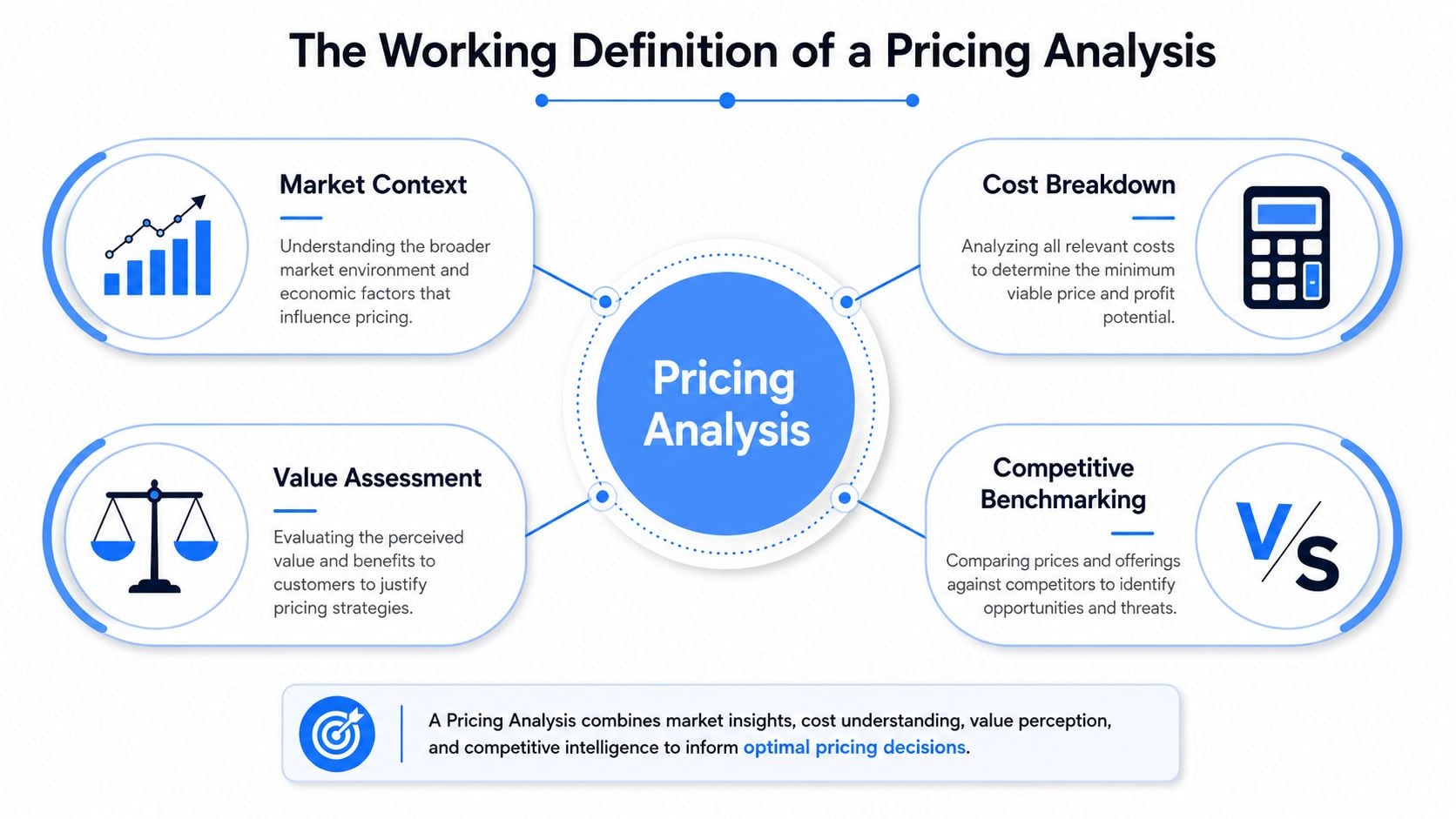
At the broadest level, pricing analysis uses pricing history, customer behavior, market signals, and benchmark data to estimate whether a price makes sense relative to value and market conditions. In modern business settings, it's a data-driven way to avoid underpricing, over-discounting, and margin leakage. In procurement, though, the meaning gets sharper. The question becomes whether the proposed total price is fair and reasonable.
Price analysis is not cost analysis
That distinction matters. Under federal contracting guidance, price analysis evaluates the total offered price, while cost analysis examines separate cost elements and can require certified cost or pricing data. The Defense Contract Audit Agency's small-business guidance says price analysis looks at the total price and does not require certified cost or pricing data, whereas cost analysis goes inside the quote to review individual elements (DCAA small-business cost and price analysis guide).
For a PEO buyer, that is useful because most providers won't hand over a full internal cost build. They will hand over a rate. That's enough to work with. The buyer can compare the total offered price against historical contracts, competitive quotes, parametric measures, and an independent estimate.
U.S. procurement guidance also recognizes concrete comparison methods such as competitive quotations, historical contract prices, unit-price measures, and independently developed estimates. FAA guidance reproduced in a public reference lists those approaches explicitly (price analysis methods reference). The NCMA also gives a plain example of how market-supported material and labor pricing can justify a proposed price without exposing every internal cost component (NCMA price analysis article).
What that means for a PEO quote
A good working definition for a buyer is simple. A pricing analysis is the structured comparison of a PEO's quoted rates, fees, and contract terms against market benchmarks and internal expectations to decide whether the proposal is fair, reasonable, and worth negotiating.
That definition fits the buying problem. A quoted PEPM rate by itself tells almost nothing. The buyer has to know whether the rate is comparable, whether benefits are pass-through, whether renewal terms are capped, and whether the service scope matches the business. The point is not to find a perfect price. It's to know which price is defensible and which one is padded.
A useful way to think about it is this. Sellers use price to drive revenue. Buyers use price analysis to protect budget, reduce contract risk, and stop hidden fees from becoming the default.
The Core Components a PEO Pricing Analysis Must Capture
A PEO pricing analysis that stops at the headline PEPM number is incomplete. It gives the appearance of discipline while leaving the most expensive terms untouched. The buyer needs to capture every recurring charge, every setup fee, every escalation trigger, and every clause that can move the total cost later.
The line items that belong on the spreadsheet
| Line Item | What It Represents | Why It Matters |
|---|---|---|
| Base admin PEPM rate | The core per-employee recurring charge | Sets the starting point for cost comparison |
| Minimum monthly fee | The floor the buyer pays regardless of headcount | Can make a small or growing company pay like a larger one |
| Workers' comp structure | Paid-loss, guaranteed-cost, or other structure | Changes volatility and the way claims flow through the bill |
| Benefits pooling or pass-through | Whether benefits are bundled or billed separately | Affects transparency and benchmarking |
| Benefits commissions | Compensation embedded in benefits placement | Can hide margin inside the overall package |
| Technology and HRIS fees | Platform or system charges | Often appear small until they recur across the contract term |
| Implementation and onboarding costs | Setup, migration, and launch charges | Matters if the project slips or change orders appear |
| Year-two and year-three escalators | Contractual increases after the first term | Can reshape the economics of a “good” first-year quote |
| Co-employment liability allocation | Allocation of risk and responsibility | Important for legal and operational exposure |
| Exit and transfer terms | Offboarding, data transfer, and successor-provider terms | Protects the company if it switches providers |
| Service guarantees | Commitments tied to responsiveness or delivery | Gives the buyer leverage if service quality slips |
For a company with 150 employees, even a $20 PEPM gap means about $36,000 a year before benefits and workers' comp are even considered. That's why buyers should never let the first-page number end the discussion. The right question is whether that number is the actual number once the contract runs for a year, then a renewal cycle, then a transition out.
The terms that usually get steered
The most aggressively sold terms are the ones that sound operational rather than financial. “Implementation support” often hides a one-time fee. “Enhanced service” can mask a higher base rate. “Bundled benefits access” may be attractive, but if the buyer can't independently see how the commissions work, the analysis is not finished.
A procurement-minded buyer should also review contract language for claims responsibility, audit rights, notice periods, and transfer assistance. Those clauses do not always show up as direct dollars, but they affect real cost. For a deeper look at how pricing components stack up, see this PEO pricing cost structure guide.
The best practice is straightforward. Build the proposal out line by line, then compare the total annualized cost under realistic headcount and benefit assumptions. If the seller cannot make that comparison easy, the buyer should treat the quote as incomplete.
Comparison Techniques You Can Run on Any PEO Proposal
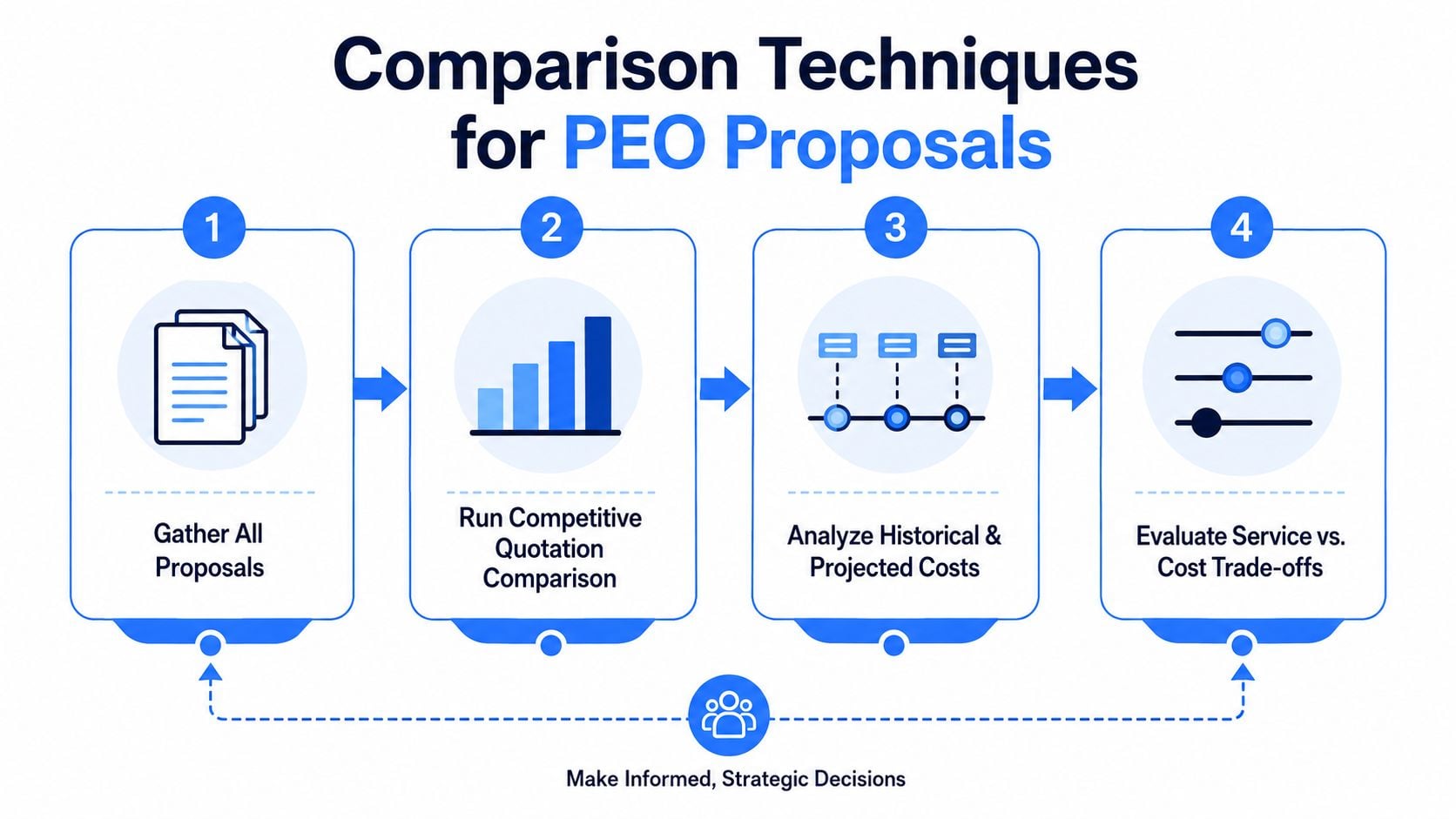
A PEO buyer does not need exotic modeling to run a legitimate price analysis. Four comparison methods are enough to expose most weak proposals. The key is to use them in sequence, not in isolation.
Start with the cleanest comparisons first
The simplest method is competitive quotation comparison. Put two or more proposals side by side and normalize them to the same basis. That means stripping out temporary concessions, separating PEPM from pass-through benefits, and showing any minimums in annual terms. A quote that looks cheaper on paper can become more expensive once the minimum fee bites.
Next comes historical versus current contract comparison. If the company is renewing, compare the new offer against the original term and the actual run-rate. If the new deal looks flat on the first-year PEPM but adds an escalator later, the renewal is not flat at all. A buyer should always test the deal against what the company paid last year and what the contract says it will pay next year.
The third method is parametric unit-price comparison. This approach involves the buyer benchmarking dollars per employee, per payroll run, or per benefit-covered life. It is not a substitute for a full review, but it is a fast way to catch outliers. The PEO financial benchmarking tool is the kind of resource that helps structure that view without pretending every employer is identical.
Build an internal estimate before the sales calls end
The fourth method is the independent estimate. Before the final selection, finance should build a rough internal model of what the PEO should cost based on headcount, states, benefits approach, and service requirements. That estimate does not need to be perfect. It needs to be defensible.
A clean workflow looks like this:
- Normalize each proposal to annual cost.
- Separate recurring fees from one-time charges.
- Separate pass-through benefits from admin fees.
- Add the likely renewal effect, not just year one.
- Compare the total against the internal estimate.
- Flag any quote that needs a special explanation.
If the seller refuses to separate recurring fees from pass-through items, the buyer should assume the proposal is designed to be harder to compare than it should be.
A high-level market benchmark is enough when the proposals are very similar and the business only needs a sanity check. A full side-by-side is necessary when the providers differ on benefit structure, workers' comp treatment, or contract lock-in. The buyer who can explain the difference in plain English will negotiate better than the one who only asks for a discount.
Benchmarking PEO Proposals Side by Side
A side-by-side benchmark works best when the buyer treats the proposals as contracts, not brochures. The headline rate matters, but only after the recurring fees, service scope, and exit friction are aligned. Otherwise, the lowest quote can be the most expensive mistake.

A realistic 150-person comparison
Take a 150-person professional services firm operating in multiple states. Proposal A offers a lower headline admin PEPM rate but includes a minimum monthly fee, a year-two escalator, and a fairly opaque benefits structure. Proposal B starts a little higher on PEPM, but the contract is cleaner, the benefits pass-through is easier to validate, and the exit terms are less restrictive.
That's not a trivial difference. It changes how the finance team should read the quote. A buyer who only looks at the first-year PEPM can miss the compounding effect of the other terms. A buyer who normalizes the proposals across the full contract term can tell which provider is cheaper and which one just looks cheaper.
The market context also matters. In many SMB and mid-market PEO reviews, admin PEPM often clusters in a broad range around $40 to $80 per employee per month, but the outcome depends on industry fit, claims history, benefit design, and state mix. That range is only useful as a starting point, not a verdict. For a broader expense comparison frame, the PEO expense benchmarking resource is a natural companion to side-by-side analysis.
How to read the trade-offs
A good shortlist should usually include three to five options, not one “winner.” The reason is simple. PEO selection is rarely a pure price race. Service quality, compliance support, benefits access, and contract risk all move the answer.
A strong recommendation usually looks like this:
- Lowest total cost: Best when the proposal is clean and the service scope is sufficient.
- Best value: Best when a slightly higher cost buys materially better terms or lower risk.
- Best operational fit: Best when the provider understands the company's states, industry, and growth plan.
- Fallback option: Best when the buyer wants a stronger position in final negotiation.
The buyer's job is to present the economics plainly. If Proposal B costs a bit more but removes the renewal trap, caps the escalator, and clarifies transfer terms, that's not a weakness. It's often the better contract.
Risk Flags and Common Pitfalls in PEO Pricing
The biggest pricing mistakes are rarely mathematical. They're contractual. Buyers get steered by the first-page rate, then discover too late that the bill sits in the language around it.
The clauses that deserve immediate scrutiny
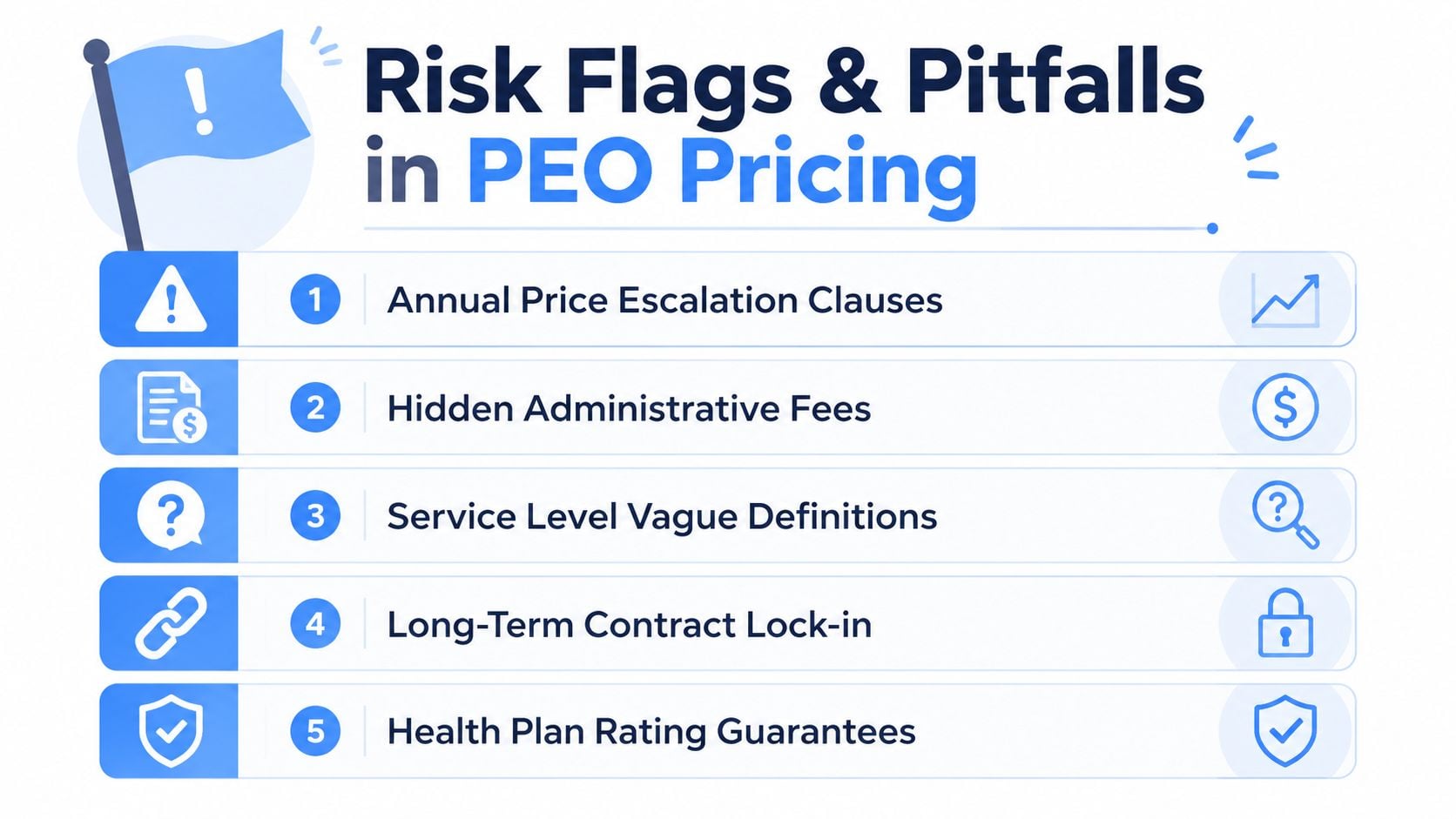
Annual escalators are the first red flag. A clause that increases the PEPM every year can turn a tolerable first-year price into a poor long-term contract. Buyers should ask for the exact escalation formula and push for a cap, not a vague “market adjustment.”
Minimum monthly fees are the second trap. They can lock a smaller employer into paying as though the company were larger than it is. If headcount is volatile, the minimum should be visible in the annual model from day one.
Pass-through benefits pricing is the third issue. If benefits are bundled in a way that prevents independent verification, the buyer can't tell whether the cost is competitive or padded. That is the right moment to use a resource like address sales rep pricing gaps as a reminder that different reps can present different commercial pictures.
A clean quote isn't always a fair quote, but an unclear quote is almost never a buyer-friendly one.
The analytical mistakes that cost real money
The most common mistake is anchoring on the headline PEPM and calling the review done. The second is ignoring workers' comp structure, especially when the proposal dresses up risk in pleasant language. The third is treating benefits as a black box and assuming the seller's bundle is automatically efficient.
A pricing analysis should also surface implementation fees billed even when launch delays happen, broad co-employment liability language, and restrictive exit or successor-provider terms. Those details do not read like pricing at first glance, but they absolutely affect the cost of the relationship. The same goes for service-level definitions that sound strong but don't commit the provider to anything measurable.
A useful internal guide here is the PEO pricing opacity analysis, because opacity is often where the seller earns its margin. The buyer should respond with clarity, not frustration. Ask for the specific clause, the specific fee, and the specific benchmark that justifies it. That's how a subjective complaint becomes a fair-and-reasonable concern.
Next Steps for Using Pricing Analysis in Your PEO Decision
A buyer does not need a six-month consulting project to use pricing analysis well. A focused 30-to-60-day process is enough to separate a clean proposal from a loaded one, then turn that conclusion into negotiation power.
A practical sequence for the next 30 to 60 days
Start by confirming the scope of services under review. Payroll, benefits administration, workers' comp, HR support, compliance help, onboarding, and exit support should all be in the same frame. If one proposal includes a service and another leaves it out, the comparison is already distorted.
Next, capture every proposal in a normalized spreadsheet. Put the recurring fees, minimums, implementation charges, renewal terms, and exit language in separate columns. Then benchmark each line item against market expectations and against the company's own staffing plan.
The third move is to narrow the field to the three to five strongest matches. At that point, the buyer should weigh total cost against contract risk, not just headline price. A provider with a slightly higher fee can still win if the contract is cleaner and the service model is stronger.
Then run a short internal estimate. Finance should test the cost under realistic headcount, state mix, and renewal assumptions. If the estimate and the seller's quote are far apart, the buyer should know exactly why before signing anything.
Use the result as leverage, not as a decoration
The output should support negotiation on specific terms:
- Rate locks for the agreed term.
- Implementation credits if the launch is delayed.
- Caps on annual escalators.
- Strengthened exit provisions and data transfer support.
- Service guarantees tied to SLA language.
That is the value of pricing analysis in a PEO decision. It gives HR and finance a fair-and-reasonable story they can use in the room, instead of a vague feeling that one quote "seems high."
For companies with a simple renewal and a small proposal set, an internal review can be enough. For multi-state employers, fast growers, or any contract with meaningful implementation costs and renewal exposure, an independent benchmark is the safer move. PEO Metrics gives buyers side-by-side PEO comparisons, cost benchmarking, and contract-term review so the final decision is based on economics instead of pressure. Visit PEO Metrics if the current proposal set needs a sharper comparison before anyone signs.
