
A 120-person SaaS company closes a major deal that requires a dedicated customer success manager in Germany and a sales engineer in Colorado. The CEO assumes HR can add both employees to payroll. Then the domestic payroll provider confirms it doesn't support German statutory benefits, the workers' compensation policy excludes remote hires outside the company's home state, and the existing employment agreements lack jurisdiction-specific terms.
That scenario creates more than administrative inconvenience. Missed social security registrations, incorrect tax withholdings, incomplete benefits coverage, and worker-classification exposure can turn an ordinary hiring plan into a compliance problem. Employer of record services provide a legal employment bridge for companies entering jurisdictions where they don't yet have a local entity, while the company keeps control over the employee's daily work.
The market reflects that shift. The global EOR market grew from about USD 4.13 billion in 2021 to an estimated USD 5.12 billion in 2025, with one forecast projecting USD 7.84 billion by 2033 at a 5.482% CAGR (Cognitive Market Research). Buyers should still treat an EOR as infrastructure, not as a substitute for a long-term employment strategy.
Table of Contents
- When Your HR Stack Hits a Border
- How Employer of Record Services Actually Work
- EOR vs PEO vs ASO vs Direct Entity
- Hidden Cost Layers Behind EOR Pricing
- When an EOR Is the Wrong Solution
- How to Evaluate and Select an EOR Vendor
- Your EOR Decision Framework
When Your HR Stack Hits a Border
The SaaS company's German hire needs an employment agreement that reflects local labor requirements, statutory leave, payroll deductions, and benefits. The Colorado hire creates a different problem. A remote employee working there may require state-specific payroll registration, unemployment insurance handling, workers' compensation coverage, and withholding that the company's existing setup never supported.
The failure usually appears in stages. HR enters the German employee into a payroll system designed for the company's home country. Finance assumes the existing tax workflow covers the new hire. The manager starts assigning work before anyone confirms whether the employment contract, insurance, and local registrations are complete. By the time the issue reaches legal counsel, payroll may already have been processed incorrectly.
The operational gap
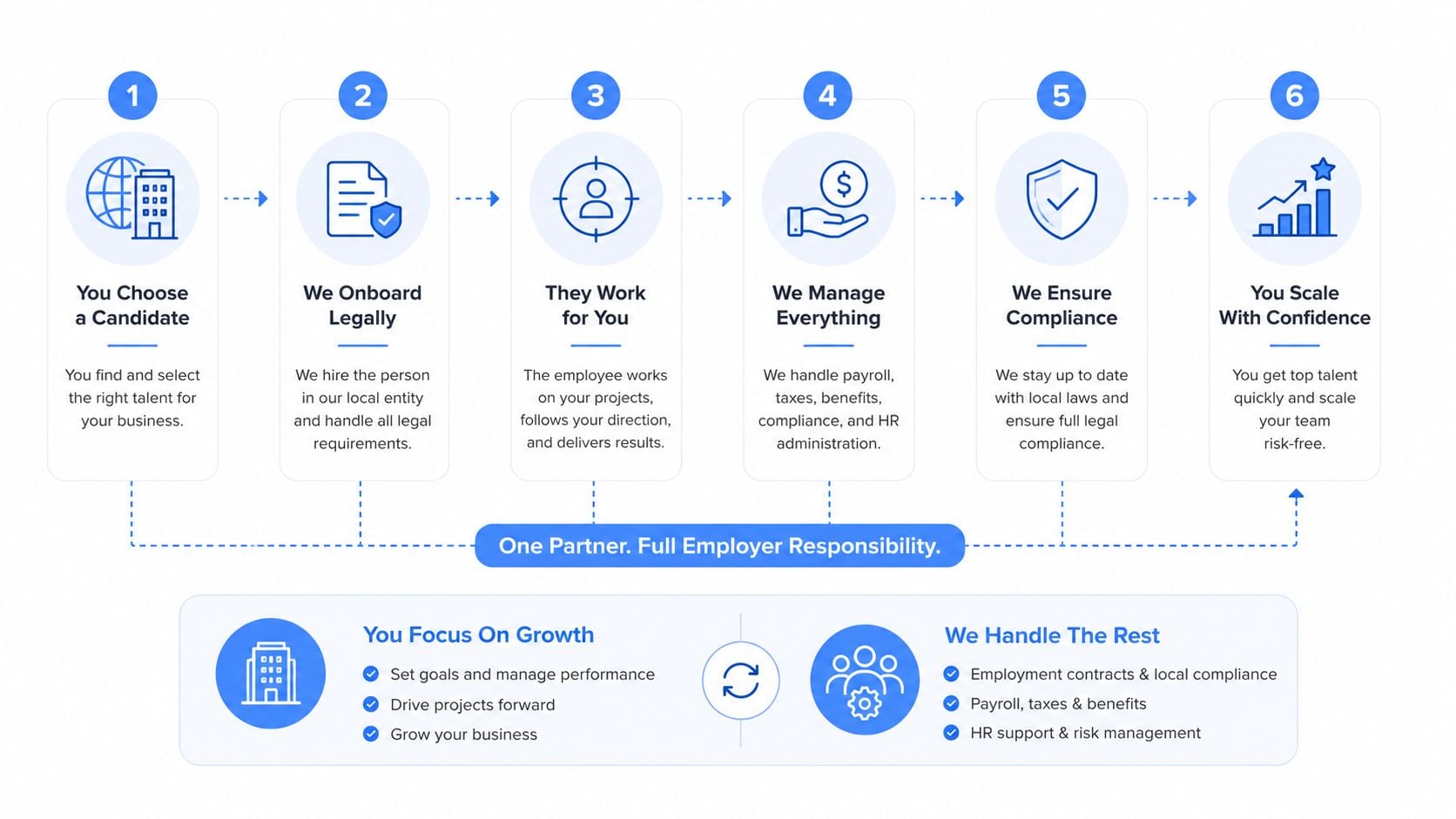
An EOR becomes the legal employer in the relevant jurisdiction. It signs or administers the local employment agreement, runs payroll, handles statutory deductions, supports benefits administration, and manages employment-law obligations. The client company still selects the candidate, sets goals, assigns work, evaluates performance, and manages the relationship day to day.
That split matters because an EOR doesn't take responsibility for the quality of the manager's decisions. It provides the legal and payroll layer, not the operating model. The company remains responsible for workplace safety, proper supervision, intellectual property arrangements, and accurate instructions to the worker.
Practical rule: If a company can't explain who is legally employing the worker, who controls the work, and who files the required payroll returns, the hiring structure isn't ready.
The EOR market is expanding as employers seek faster international hiring and lower entity-setup friction. More recent estimates place the global market at USD 6.24 billion in 2026, with a projection of USD 10.33 billion by 2031 at a 10.55% CAGR (Business Research Insights). That growth doesn't make every EOR arrangement appropriate, but it does show why the model has become a standard bridge for mid-market expansion.
Companies considering broader European structures may also benefit from reviewing the benefits of the EU single company form, particularly when comparing an EOR bridge with a future entity strategy. For a deeper comparison of international employment models, the international professional employer organization guide offers useful context.
How Employer of Record Services Actually Work
The cleanest way to understand an EOR is to separate legal employment from operational management. The EOR holds the formal employment relationship. The client company directs the work.
The process in practice
- The client chooses the worker. The company defines the role, interviews candidates, agrees on compensation, and decides whether the person should be an employee or contractor.
- The EOR confirms the employment structure. It reviews the role, location, compensation, and required local terms before issuing or administering a compliant employment agreement.
- The worker joins the EOR's local payroll. The EOR onboards the employee through its own entity or approved local structure and collects the documentation required in that jurisdiction.
- Payroll and statutory obligations are processed. The EOR calculates gross pay, deductions, employer contributions, benefits, and reimbursements, then pays the worker in the applicable local currency.
- The client manages performance. The employee reports to the client's manager, follows the client's workflow, and receives direction from the client's leadership team.
- The EOR supports changes and exits. Promotions, leave, payroll changes, disciplinary matters, and termination should be reviewed through the EOR so local procedures are followed.
What liability shifts
In the United States, the legal employer is responsible for jurisdiction-level payroll tax compliance, including withholding federal, state, and local income taxes, paying the employer share of FICA, registering for and paying state unemployment insurance, and filing returns such as Forms 941, 940, and W-2 (Symmetry). An EOR arrangement moves much of that administrative responsibility away from the client.
A useful example is a California employee earning $90,000. The employer-side payroll taxes and insurance costs are roughly $12,000, but the exact amount depends on the worker's circumstances and applicable coverage. Under an EOR model, the provider calculates and remits the required amounts rather than leaving the client to manage every filing and deadline.
The client still owns important risks. A manager who creates a hostile workplace, mishandles confidential information, or assigns work that violates safety requirements hasn't transferred those decisions to the EOR. The employment structure also doesn't automatically solve intellectual property ownership. The contract must address assignment rights, confidentiality, invention ownership, and access to company systems. Teams managing remote work should also review guidance on managing distributed teams.
EOR vs PEO vs ASO vs Direct Entity
The right model depends on whether the company needs a legal employer, administrative help, or a durable local operating structure. Confusing those purposes leads to overspending or incomplete protection.
| Employment Model | Legal Control | Liability Transfer | Typical Cost | Setup Time | Best For |
|---|---|---|---|---|---|
| EOR | Provider is the legal employer in the target jurisdiction | Broad employment, payroll, and statutory liability shifts to the provider, subject to contract | Per-employee fee plus statutory employer costs and add-ons | Fast deployment compared with entity formation | Short-term market entry, market testing, and small teams without a local entity |
| PEO | Client generally remains the common-law employer, with shared administrative responsibilities | Liability is shared and contract-dependent | Flat PEPM fee or percentage of payroll | Requires an eligible client entity | Domestic scaling where the company already operates |
| ASO | Client remains the employer and controls the legal relationship | Little or no employer liability transfers | Administrative service fee | Usually quick | Payroll and HR administration without compliance protection |
| Direct Entity | Client owns the employment structure and local operations | Client carries the legal and compliance burden | Setup, professional fees, payroll, benefits, and ongoing local administration | Entity formation commonly requires substantial lead time | Permanent, high-volume operations in strategic markets |
The important distinction with PEOs
A PEO doesn't automatically become the legal employer under IRS common-law rules. The IRS says the client generally remains the common-law employer unless the PEO has authority over day-to-day performance, hiring and firing, and wage-setting decisions (IRS guidance on third-party payer arrangements).
A Certified Professional Employer Organization receives different treatment for employment tax purposes, but the client can still be treated as an employer for certain workers and remain liable for federal employment taxes on wages paid by the CPEO (IRS Publication 15). Buyers should read the contract instead of assuming that payroll administration equals legal protection.
An EOR is the fastest option when a company needs to hire abroad without its own entity. A PEO is appropriate when the company already has the entity and wants help with payroll, benefits, and HR operations. An ASO is appropriate when the company wants software and administration but accepts the compliance burden. A direct entity makes sense when headcount, revenue, and strategic permanence justify ownership of the local infrastructure. The PEO and EOR difference provides a useful model comparison for buyers weighing those paths.
Hidden Cost Layers Behind EOR Pricing
A monthly EOR quote can understate the employer's total cost. Buyers should separate the provider's charge, mandatory country-level obligations, currency effects, and optional services before comparing vendors.
Four layers buyers must isolate
The first layer is the provider fee. Independent market summaries place monthly EOR service fees at roughly $299 to $1,200 per employee, depending on the country and service scope (Remote People). The second is the statutory employer burden, including social contributions, payroll taxes, mandatory insurance, and required benefits in the employee's country.
Currency conversion creates a third layer. Foreign exchange markups of about 1% to 4% can increase labor cost when the provider converts funds instead of passing through the exact payroll amount, as noted in the same Remote People source. The fourth layer covers optional benefits, equity administration, expedited onboarding, immigration support, expense processing, and special compliance work.
Request an itemized quote. If the vendor combines these amounts, its base fee may look attractive while margin appears through exchange rates or add-ons.
| Cost Component | Germany | Singapore | United Kingdom |
|---|---|---|---|
| Base EOR fee | Provider fee, quoted separately | Provider fee, quoted separately | Provider fee, quoted separately |
| Statutory employer burden | Country-specific social contributions and benefits | Country-specific statutory contributions and benefits | Country-specific employer contributions and benefits |
| Currency conversion | Applies if payroll is funded or converted through the provider | Applies if the billing currency differs from payroll currency | Applies if the billing currency differs from payroll currency |
| Optional services | Benefits beyond statutory requirements, equity, special onboarding | Benefits beyond statutory requirements, equity, special onboarding | Benefits beyond statutory requirements, equity, special onboarding |
| Buyer's comparison question | Which costs are pass-through amounts, and which are marked up? | Which local benefits are mandatory, and which are optional? | Which payroll and benefit services trigger extra fees? |
The same $80,000 salary can produce different all-in costs in Germany and Singapore because statutory contributions, required benefits, payroll rules, and currency handling differ. A single global fee without country-level detail is not a usable benchmark.
Companies comparing employees with contractors should review how to pay international contractors in 2025. The comparison should account for classification risk, payment logistics, taxes, and administration rather than focusing only on the contractor's stated rate. For a structured total-cost comparison, use a pricing analysis that models each employer cost layer and tests the assumptions behind the quote.
One market summary reports that payroll and benefits administration represents 39.84% of EOR revenue, while compliance management is growing at a 12.74% CAGR (Mordor Intelligence). Buyers should treat compliance scope as a pricing variable. The contract should specify which filings, worker records, policy updates, audits, corrections, and penalties the provider monitors or handles, and which remain with the client.
A practical benchmark asks four questions: what is mandatory, what is pass-through, what is marked up, and what happens when a worker's classification or location changes. That review exposes cost layers that headline pricing leaves out.
When an EOR Is the Wrong Solution
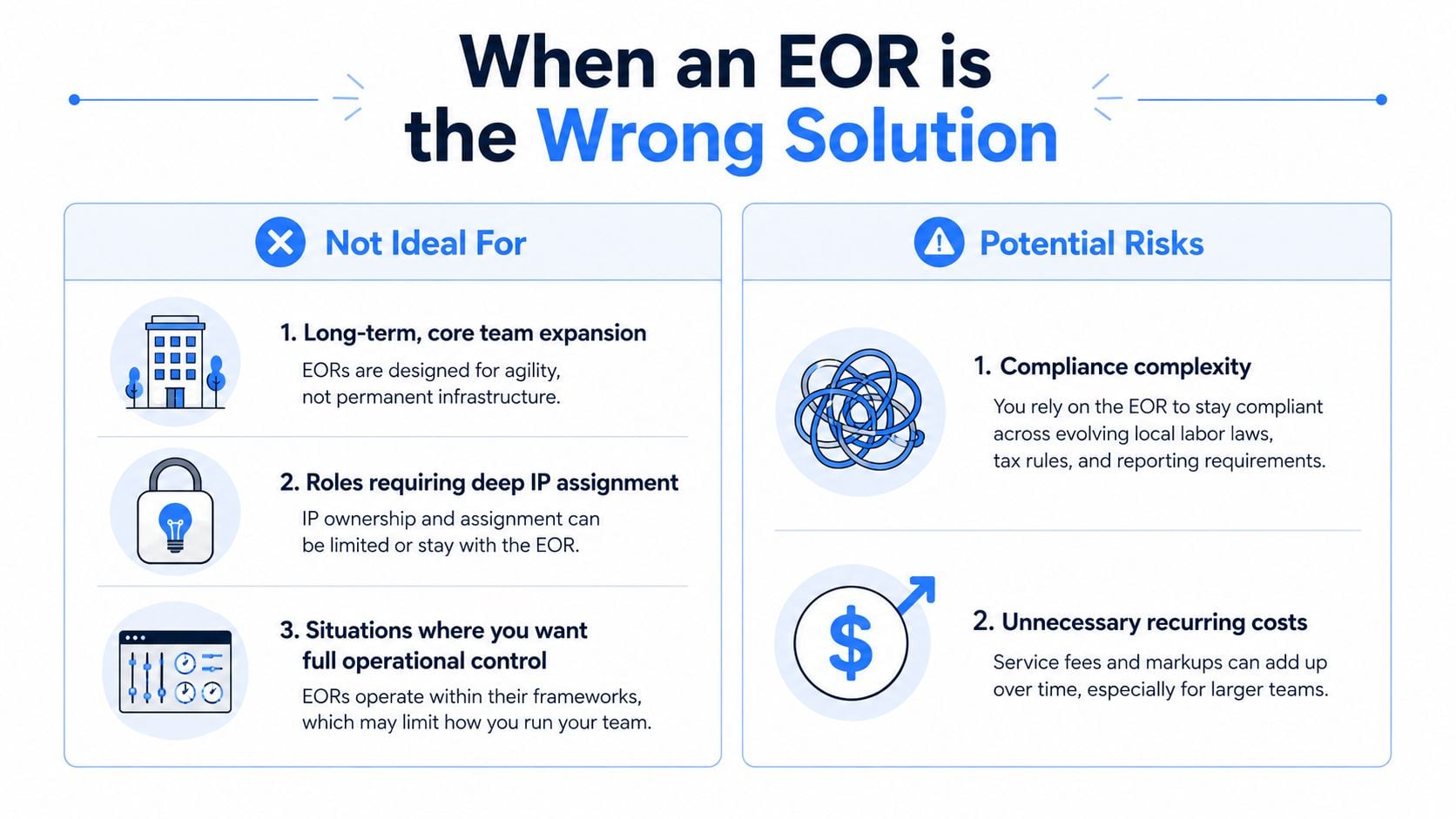
An EOR works well for a defined hiring need. It becomes the wrong structure when the company needs permanent control, the worker should not be an employee, or the provider's legal model leaves key risks unresolved.
Classification comes first
An EOR cannot turn a contractor relationship into compliant employment by label alone. If the worker controls how the work is performed, operates independently, serves multiple clients, and falls outside the legal definition of an employee, putting that person on an EOR payroll may add cost without solving the underlying issue. If the worker functions like a core employee under the company's direction, a contractor agreement can create misclassification exposure.
Classify the relationship before choosing the employment vehicle. Review control, independence, economic dependence, work location, and the duties the person performs under the relevant jurisdiction's rules. The EOR supplies employment infrastructure. It does not make an incorrect classification safe.
Other warning signs
An EOR deserves close scrutiny in these situations:
- Permanent market expansion: If leadership expects a large, enduring team in the country, forming an entity may provide stronger control and a clearer employment strategy than recurring EOR fees. Compare expected headcount, setup costs, local administration, and the cost of moving employees later.
- Detailed intellectual property needs: Product engineers, researchers, and executives may need assignment terms covering inventions, code, confidential information, and work created across jurisdictions. Have counsel review the ownership language before issuing an offer. Do not assume an EOR template protects the company's position.
- Equity-heavy compensation: Stock options, restricted stock, and local securities rules can complicate the arrangement. Require the provider to identify who administers awards, who handles tax reporting, and what happens when the worker leaves.
- Permanent establishment concerns: A worker who negotiates contracts, closes sales, or performs core revenue-generating activities may create tax-presence questions for the client company, even when an EOR is the formal employer.
- Tighter regulatory scrutiny: Automated compliance monitoring and AI-supported onboarding are becoming more common, while regulators continue examining worker classification and documentation. EU pay-transparency requirements and renewed U.S. classification probes increase the need for clear records, consistent processes, and an audit trail. Research and Markets
Ask whether the EOR removes a defined risk or postpones a strategic decision. If the company already expects to establish an entity, negotiate a migration path before signing. The contract should cover employee transfers, records, benefits continuity, data handoff, termination rights, and every fee charged during the transition.
How to Evaluate and Select an EOR Vendor
Vendor selection should begin with the contract, not the product demonstration. Marketing pages describe global coverage, but the agreement determines who pays for a correction, who owns the records, and what happens when the relationship ends.
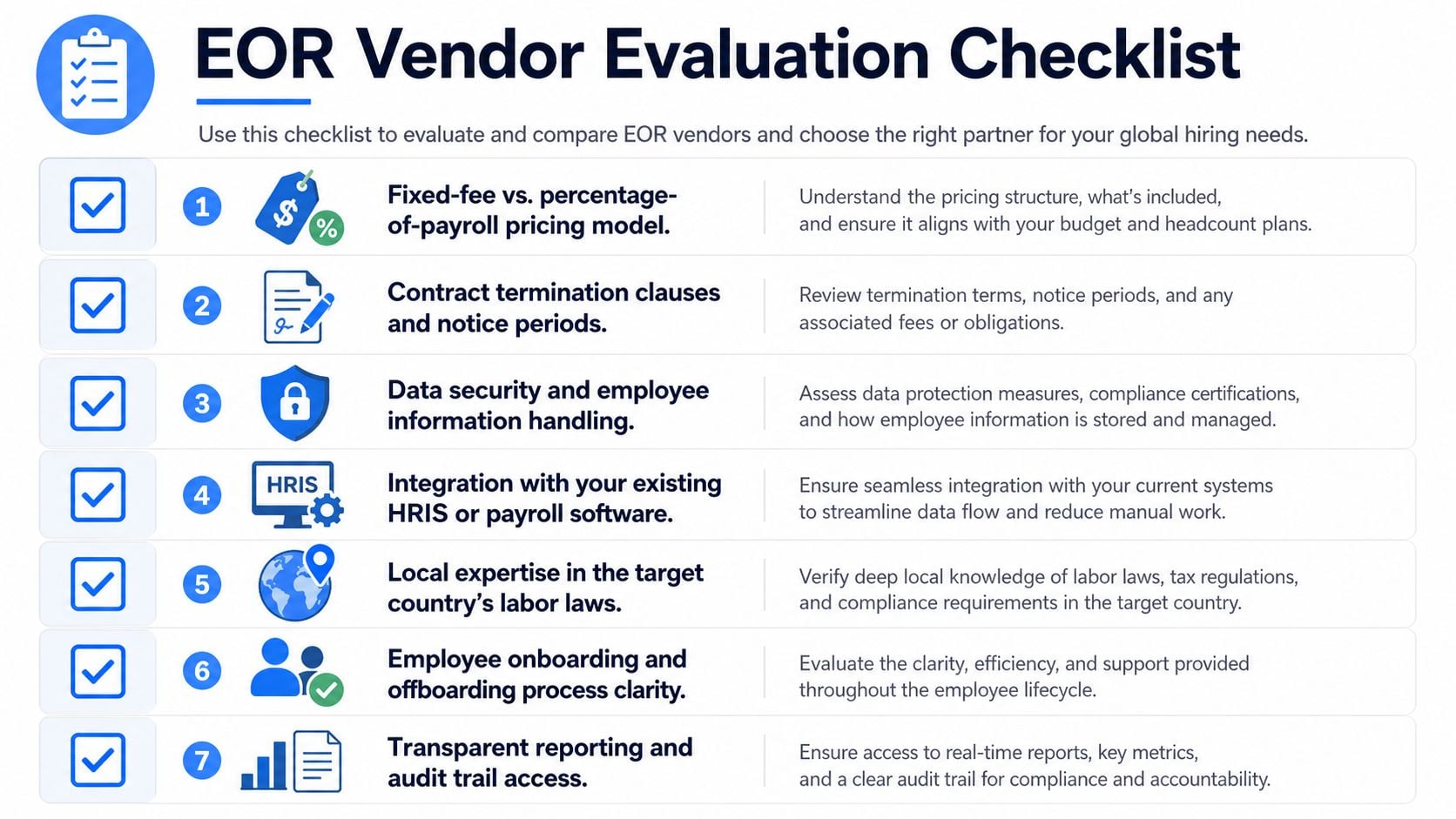
The due diligence checklist
- Pricing mechanics: Compare a fixed fee with a percentage-of-payroll model. A fixed fee gives the buyer more predictable pricing as compensation rises, while a percentage model may align the fee with payroll scale but can become expensive for highly paid employees.
- Local legal presence: Ask whether the provider owns or controls the employing entity in each target country. If it uses a local partner, the contract should identify that partner and explain who remains liable for payroll errors and employment-law failures.
- Compliance evidence: Request proof of registrations, sample filings, payroll controls, benefits administration procedures, and correction protocols. A vendor that won't provide an auditable explanation of its process shouldn't receive sensitive employee data.
- Data handling: Review GDPR obligations for European workers, security controls, subprocessors, breach notification, retention, and access rights. Payroll files contain information that deserves stronger protection than ordinary business records.
- Service levels: Define payroll approval deadlines, payment timing, error correction, response times, escalation paths, and service credits. “Dedicated support” isn't a service level.
- Scope boundaries: Identify charges for equity, bonuses, expenses, benefits upgrades, immigration, severance support, expedited onboarding, and off-cycle payroll. Every undefined service becomes a potential change order.
- Exit rights: Specify termination notice, employee transfer assistance, data export, final payroll, benefits continuity, and cooperation with a new provider or entity.
Don't ignore benefits reporting
Benefits administration can create obligations that buyers assume the vendor handles automatically. For PEO-managed benefits, responsibility for Form 5500 filings depends on whether the PEO plan or the client's plan is the ERISA plan sponsor and administrator. The Department of Labor requires electronic filing through EFAST2-approved software or IFILE (Department of Labor Form 5500 guidance).
That principle carries into EOR evaluation. The contract should identify the record owner, filing party, audit response process, and deadline for producing documentation. A buyer changing providers should also examine the process for switching service providers before signing a long notice period or restrictive transition clause.
PEO Metrics is one independent option for companies comparing employment providers, pricing, benefits, contract terms, service quality, and compliance support across PEO and related workforce models. The useful output isn't a vendor name by itself. It's a documented comparison of total cost, liability language, implementation requirements, and exit risk.
Your EOR Decision Framework
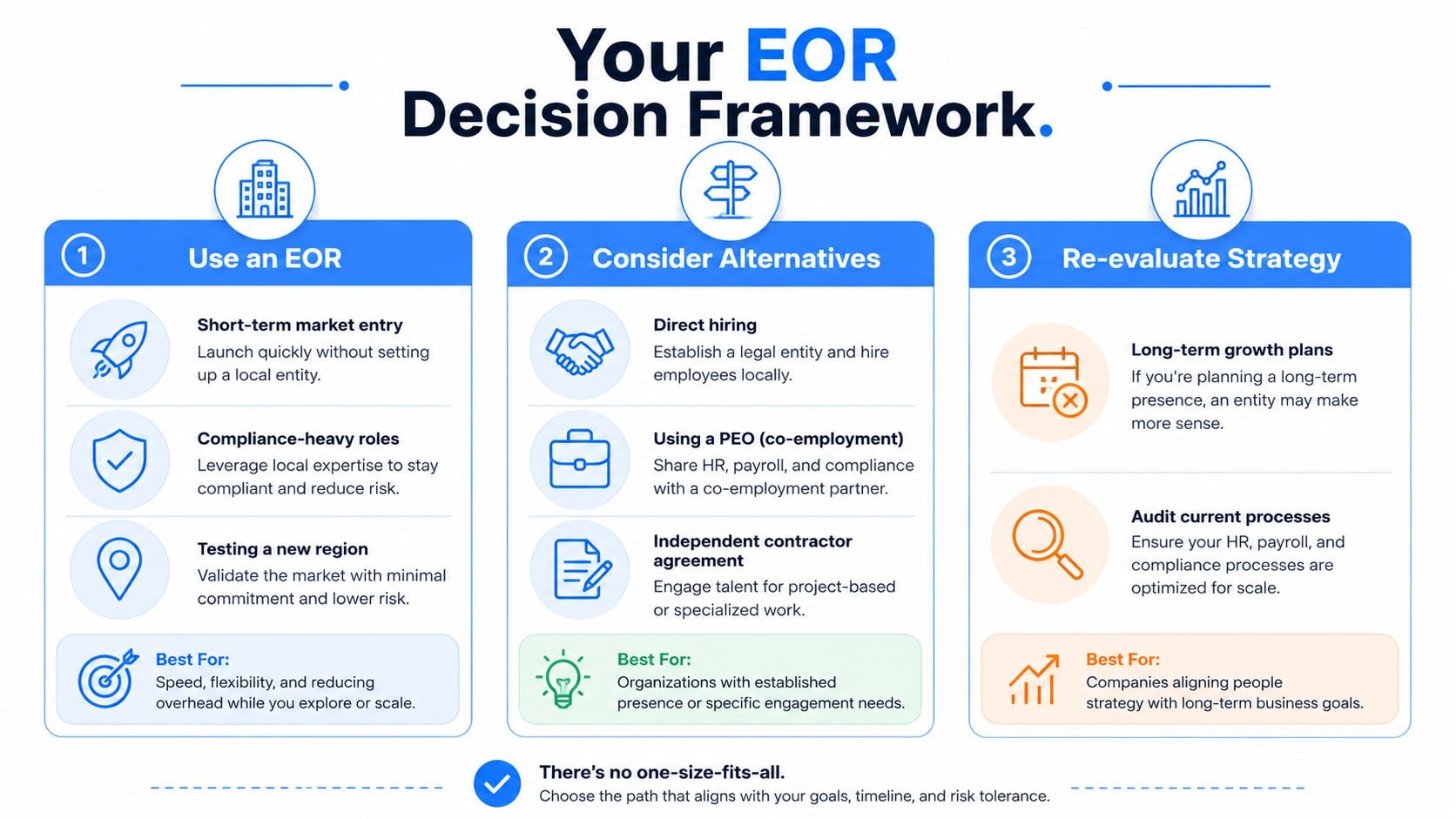
The decision can be made using three questions: How quickly must the worker start? How long will the role exist in that country? How much classification and permanent-establishment risk does the role create?
Choose the path that matches the risk
- Use an EOR when the company needs a short-term market entry, a small initial team in a new region, or employment support in a compliance-heavy jurisdiction. The structure works particularly well when speed matters and the company isn't ready to establish an entity.
- Negotiate aggressively when the company expects a predictable group of hires for a defined period. Push for fixed fees, transparent statutory pass-throughs, rate locks, capped add-ons, payroll error remedies, audit rights, and practical exit assistance.
- Pursue an alternative when the market is strategically permanent, the role creates meaningful tax-presence concerns, classification is uncertain, or equity and IP requirements exceed the provider's standard model. A direct entity, PEO, ASO, or properly structured contractor arrangement may fit better.
A simple internal scorecard should rank time-to-hire urgency, projected total employment cost, legal exposure, expected duration, and operational control. A high urgency score supports an EOR. A high permanence and volume score supports entity analysis. A high classification or permanent-establishment risk score requires legal review before any provider is selected.
The market is scaling quickly, with one forecast estimating growth from about USD 4.71 billion in 2025 to USD 7.8 billion by 2033, while another projects growth from USD 6.9 billion in 2025 to USD 12 billion by 2030 (Research and Markets). Those projections don't change the central discipline: treat an EOR as transitional infrastructure unless the economics and legal strategy support using it permanently.
Companies should build internal capability as they scale, including ownership of workforce data, contract review, payroll governance, classification controls, and entity planning. Third-party infrastructure can accelerate hiring, but disciplined governance determines whether that acceleration creates durable value or recurring dependence.
PEO Metrics helps HR, finance, and leadership teams compare PEOs and related workforce options across pricing, benefits, contract terms, compliance support, and service quality. Visit PEO Metrics to benchmark alternatives, identify contract risks, and negotiate stronger terms before committing to an EOR, PEO, ASO, or provider switch.
