
An HR director has three payroll proposals open on the same screen. One vendor charges a low per-employee fee, another bundles payroll with HR tools, and a PEO quotes a percentage of payroll. All three promise compliant filings, fast implementation, and responsive support. The proposals look comparable until the buyer checks who pays a tax penalty, what an off-cycle run costs, how year-end fees are calculated, and whether adding a remote employee creates a new registration obligation.
That's the core problem with a typical payroll service comparison. Payroll isn't just software that calculates wages. It's a decision about cost ownership, compliance responsibility, data controls, and contract risk. A provider can offer every expected feature and still create an expensive operating model if the agreement leaves variable charges or filing liabilities with the employer.
The comparison below is a better starting point for HR directors, CFOs, and business owners managing teams from 10 to 2,000 employees.
| Payroll service model | Best operating profile | Typical commercial structure | Main risk question |
|---|---|---|---|
| Standalone payroll software | Small, simple workforce with internal payroll ownership | Base fee plus employee or payroll-run charges | Can the internal team manage filings and exceptions? |
| Full-service payroll provider | Growing employer needing processing and tax support | Base fee plus per-employee charges or modules | Which filing errors does the vendor actually cover? |
| PEO | Employer seeking broader HR, benefits, and risk support | Percentage of payroll or PEPM arrangement | Which liabilities transfer, and which remain with the client? |
| Enterprise HCM suite | Larger, multi-entity, global, or highly structured organization | Base platform plus modules and implementation | Will configuration and integration costs remain controlled? |
Table of Contents
- Why Most Payroll Service Comparisons Miss the Mark
- Mapping Payroll Service Models to Your Company Size
- Comparing Payroll Providers on the Metrics That Matter
- Uncovering the True Total Cost of Payroll Services
- When Compliance Complexity Changes the Payroll Decision
- Building a Payroll Vendor Evaluation and Negotiation Plan
- Making a Confident Payroll Service Decision
Why Most Payroll Service Comparisons Miss the Mark
Feature parity hides the expensive decisions
A buyer can compare direct deposit, employee self-service, mobile access, time tracking, and standard reports across three vendors and find little meaningful separation. Those features matter, but they're usually table stakes. They don't answer the questions that disrupt a pay run or create an unexpected invoice.
Consider a mid-market employer hiring across several states. Vendor A includes state tax filing but charges separately for new registrations. Vendor B handles registration but excludes local filings. Vendor C offers a broad guarantee, yet the contract limits reimbursement to penalties caused by the vendor's “gross negligence.” The sales presentations may sound similar, while the financial exposure is entirely different.
Payroll errors already have a measurable cost history. An EY survey reported that one in five U.S. payrolls contained errors, with an average correction cost of USD 291 per error. EY also estimated combined direct and indirect payroll error costs at about USD 250,000 annually for every 1,000 employees, including mistakes involving time and attendance, PTO, and benefits, as summarized by Digital Minds BPO's payroll error analysis.
Practical rule: A payroll vendor comparison should show who absorbs the cost of failure, not just who offers the most features.
Payroll is a risk allocation decision
The decisive contract questions are operational:
- Tax liability: Does the vendor pay penalties and interest when it causes a late or incorrect filing?
- Exception handling: Are corrections included, or does each amendment trigger a service charge?
- Expansion: Who registers the employer when a new state or locality becomes relevant?
- Year-end work: Are W-2, 1099, ACA, and reconciliation services included in the quoted price?
- Exit mechanics: Can the employer retrieve complete payroll records in a usable format after termination?
Reviewers already recognize that reporting and reconciliation deserve separate attention. One published evaluation model assigns ledger report tools 4% weight, while many other core payroll capabilities receive 2% to 3%, showing that reporting depth is treated as a differentiator rather than a cosmetic add-on. The Forbes Advisor payroll services comparison provides useful context for building a more operational scorecard.
A serious comparison therefore starts with the employer's workflow, exposure, and contract language. The vendor with the lowest advertised fee may be the wrong choice if the finance team must manually reconcile filings, absorb correction fees, or manage every new jurisdiction.
Mapping Payroll Service Models to Your Company Size
The right payroll model depends less on employee count alone than on administrative capacity, jurisdictional complexity, and the amount of risk the employer wants to retain. A 15-person company with remote employees in several states may need more support than a 40-person company operating in one state.
The following matrix gives buyers a practical first filter.
| Service model | Ideal company size | Pricing structure | Compliance coverage | Best for |
|---|---|---|---|---|
| Standalone payroll software | Under 20 employees | Usually base fee plus usage or employee charges | Software support, limited employer-owned compliance work | A single-state business with an experienced bookkeeper |
| Full-service payroll provider | 20 to 150 employees | Base fee plus PEPM charges and optional modules | Payroll processing, tax filing support, selected registrations | Growing companies with straightforward benefits |
| PEO | Often compelling beyond 50 employees | Percentage of payroll, PEPM, or bundled charges | Payroll, benefits, workers' compensation, and shared HR responsibilities | Employers seeking broader risk and HR support |
| Enterprise HCM suite | Above 500 employees | Platform fee plus modules, implementation, and integrations | Configurable compliance workflows across entities and jurisdictions | Complex, global, union, or multi-entity organizations |
Standalone software
Standalone software can work well for a small, single-state employer with an internal bookkeeper who understands withholding, deposits, reconciliations, and year-end reporting. The software may automate calculations, but it doesn't eliminate the employer's responsibility for accurate setup and timely action.
That distinction matters. A useful primer on employer obligations is Tax Attorney Stephen A Weisberg's payroll tax guide. Buyers should use resources like this to identify which responsibilities remain internal before assuming that a software subscription provides full compliance coverage.
Full-service providers
Providers such as Gusto and ADP Run suit employers that want the vendor to process payroll and manage routine tax filings while the internal team retains control of broader HR decisions. This model becomes attractive as hiring crosses state lines, payroll exceptions increase, or finance needs dependable accounting exports.
A company should consider moving beyond basic software when its payroll administrator spends more time correcting setup issues than reviewing payroll, or when a new jurisdiction requires registrations and unfamiliar filing schedules.
PEOs and enterprise platforms
A PEO becomes more compelling when benefits access, workers' compensation administration, HR guidance, and shared employment responsibilities justify percentage-based pricing. PEOs typically charge a fee tied to payroll costs, so the buyer must compare the full arrangement, including benefits and pass-through charges, rather than judging the administrative fee in isolation.
An enterprise HCM suite fits organizations with complex approval structures, multiple entities, global operations, union rules, or advanced workforce planning. It can provide deeper configuration, but implementation, integrations, and module governance require disciplined ownership. Employers comparing broader payroll and HR options can also review employer payroll solutions before narrowing the shortlist.
Comparing Payroll Providers on the Metrics That Matter
A vendor's demo environment is rarely the best predictor of production performance. The more useful test is whether the provider can execute a clean pay run, resolve an exception, file correctly in every required jurisdiction, and produce records finance can audit.
The table below offers a structured view of representative providers. It deliberately avoids treating marketing language as a contractual promise. “Confirm” means the buyer should require written scope, service levels, and liability language before signing.
| Provider | Implementation timeline | Tax filing guarantee | Multi-state handling | Integration depth | Reporting flexibility |
|---|---|---|---|---|---|
| Gusto | Generally suited to simpler implementations, confirm assigned support and first-run ownership | Confirm filing liability and correction limits | Appropriate for routine needs, verify local tax scope | Stronger where native accounting and HR connections exist, verify API needs | Standard reports are accessible, confirm custom reporting limits |
| Rippling | Modular implementation can expand with selected HR and IT components | Confirm which tax errors and penalties are covered | Verify automated jurisdiction workflows and registration support | Broad platform orientation, assess middleware and module dependencies | Better suited to connected workflows, confirm custom query capabilities |
| ADP Workforce Now | Formal implementation process, confirm named project ownership and milestones | Review guarantee exclusions, reimbursement caps, and client duties | Established multi-state capability, verify local filing and registration scope | Mature integration ecosystem, price each required connection | Strong reporting potential, confirm access to custom tools and exports |
| Paylocity | Confirm migration responsibilities, testing schedule, and support model | Require precise penalty and interest language | Verify state, local, and new-jurisdiction procedures | Assess HRIS, time, benefits, and accounting connections separately | Confirm scheduled exports, audit trails, and custom report access |
| Justworks | PEO-oriented implementation, confirm benefits and payroll dependencies | Clarify allocation under the PEO agreement | Useful for supported jurisdictions, confirm expansion boundaries | Usually centered on its bundled ecosystem, verify external systems | Confirm finance reporting, custom fields, and historical data access |
Five production tests
- First successful pay run: The proposal should identify the target timeline, test cycles, approval owners, and fallback process.
- Named implementation support: A dedicated manager is materially different from a queue-based ticket system when payroll data fails validation.
- Tax error responsibility: “We'll help correct it” is not the same as paying penalties and interest under a defined guarantee.
- Integration economics: A native connection may be preferable to third-party middleware, but the quote should show setup, licensing, and ongoing support costs.
- Audit-ready reporting: Benchmark datasets increasingly examine error rates, pay-run turnaround, traceable records, input and output variance, and reports that can be audited against baseline data. WorldMetrics' payroll benchmark overview reflects that shift away from feature lists.
A buyer evaluating vendor performance should score these dimensions independently. The PEO and HR vendor performance evaluation model can help structure that review, especially when service quality and contract commitments need to sit beside price.
Uncovering the True Total Cost of Payroll Services
A payroll proposal can look inexpensive until the first implementation change, off-cycle run, tax amendment, or year-end correction appears on the invoice. The quoted PEPM rate is only the entry point. Buyers need a three-year total that assigns every variable charge and contract risk to the party responsible for it.
Build a fully loaded cost model
Give every shortlisted provider identical operating assumptions. Include:
- Core processing: Base fee, employee charges, payroll frequency, and minimum billing levels.
- Jurisdictional work: State and local filings, registrations, amendments, and new-state setup.
- Year-end activity: W-2, 1099, ACA, reconciliation, and employee correction processing.
- Change volume: Off-cycle payrolls, bonuses, retroactive adjustments, garnishments, and manual checks.
- Technology: Time tracking, HRIS, benefits administration, accounting exports, APIs, and implementation support.
- Lifecycle costs: Data migration, training, renewal increases, termination assistance, and historical record delivery.
The comparison should also separate percentage-based pricing, fixed platform fees, per-employee charges, and pass-through costs. A PEO cost breakdown and three-year pricing model helps buyers test whether a bundled quote remains economical after headcount, benefits, and administrative charges change.
A 2026 independent comparison shows why the exercise matters. In a 10-employee scenario, estimated annual totals ranged from about USD 1,513 for QuickBooks to USD 2,178 for ADP, according to Payroll Service Cost's total cost comparison. Those figures are not universal quotes, but they show how provider totals can diverge even for a small workforce.
| Cost category | Standalone payroll | Bundled HRIS | PEO model |
|---|---|---|---|
| Implementation | Often separate or limited | Frequently project-based | May include a setup charge |
| Off-cycle payroll | Common usage charge | Often plan-dependent | Contract-specific |
| Year-end forms | May be billed separately | May be bundled or modular | Review agreement and employee volume rules |
| Benefits administration | Usually separate | Often an add-on module | Commonly integrated, with pass-through costs |
| Tax amendments | Usually charged per event | Scope varies by plan | Confirm responsibility and correction terms |
| Price increases | Subscription renewal language | Module and platform escalation language | Admin fee escalators and carrier changes require review |
Cloud payroll is now the dominant delivery model. A 2026 market report estimated cloud solutions at 66.95% of global payroll services share, with annual growth of 12.2%, as reported in OpenPR's payroll services market coverage. The buying decision should turn on the resulting cost and risk, not cloud branding. Examine modular pricing, integrations, automation, security, compliance support, and the employer's three-year total.
Finance test: Ask each vendor to price the same employee file, pay frequency, jurisdictions, off-cycle events, integrations, and year-end services. If the assumptions differ, the quotes are not comparable.
Contract mechanics can erase a first-year saving. Require advance notice for unilateral increases, define when modules can be repriced after implementation, and identify every pass-through charge. Model the base fee, variable charges, permitted increases, and termination costs separately before accepting the proposal.
When Compliance Complexity Changes the Payroll Decision
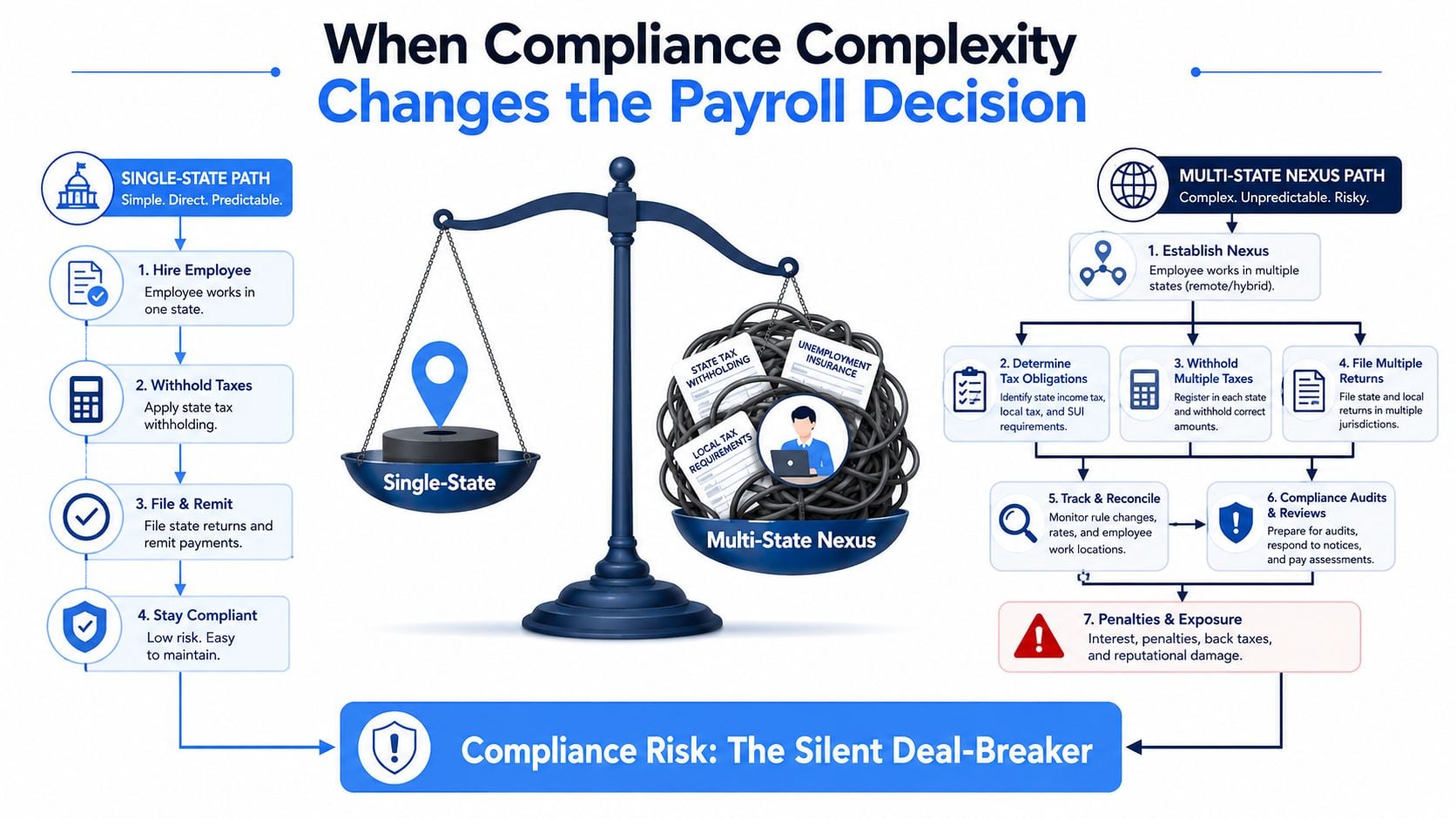
A single-state payroll operation and a distributed workforce create different risk profiles. The second an employer hires a remote worker, enters a new state, engages contractors across borders, or manages multiple legal entities, the payroll decision becomes a compliance architecture decision.
Match the model to the exposure
A basic payroll provider may process wages accurately while leaving the employer responsible for registrations, worker classification, employment policies, and broader labor compliance. A PEO can assume defined responsibilities through co-employment, but the client still controls daily work, management decisions, and many operational duties.
The IRS states that a Certified Professional Employer Organization, or CPEO, pays a USD 1,000 annual fee to apply for and maintain certification and must provide a surety bond of up to USD 1 million for federal employment tax liabilities. Those requirements are described in the IRS guidance on Certified Professional Employer Organizations. Certification should be evaluated as one risk indicator, not treated as a substitute for contract review.
A CPEO's legal position also differs from a standard PEO arrangement. Under Internal Revenue Code Section 3511, a CPEO is treated as the employer for worksite employees only regarding remuneration it remits to those workers, a distinction explained in the overview of certified PEO structures. That language makes tax-risk allocation particularly important during negotiations.
Use a scenario matrix
| Compliance scenario | Better-fit model | Contract question |
|---|---|---|
| Single-state employees and stable payroll | Standalone software or full-service payroll | Who owns deposits, reconciliations, and corrections? |
| Remote employees in additional states | Full-service provider or PEO | Who handles registration, withholding, and local filings? |
| Rapid multi-state expansion | PEO or enterprise payroll platform | What implementation support and indemnification apply? |
| Contractor classification concerns | Payroll provider with advisory support or PEO | Who reviews classification, and what remains employer liability? |
| Employees in countries without a local entity | Global payroll aggregator or EOR structure | Who is the legal employer and who issues compliant contracts? |
Buyers researching cross-border contractor rules should review who must follow IR35 rules before selecting a provider for UK-related work. A vendor that handles payroll calculations may not resolve classification or off-payroll obligations.
The contract should define responsibility for late filings, incorrect withholding, tax notices, registration failures, and penalties. Employers should also review regulatory update procedures, unemployment claims support, workers' compensation integration, privacy controls, and audit access. A wage and hour compliance framework can help finance and HR teams separate payroll processing from broader employment obligations.
Building a Payroll Vendor Evaluation and Negotiation Plan
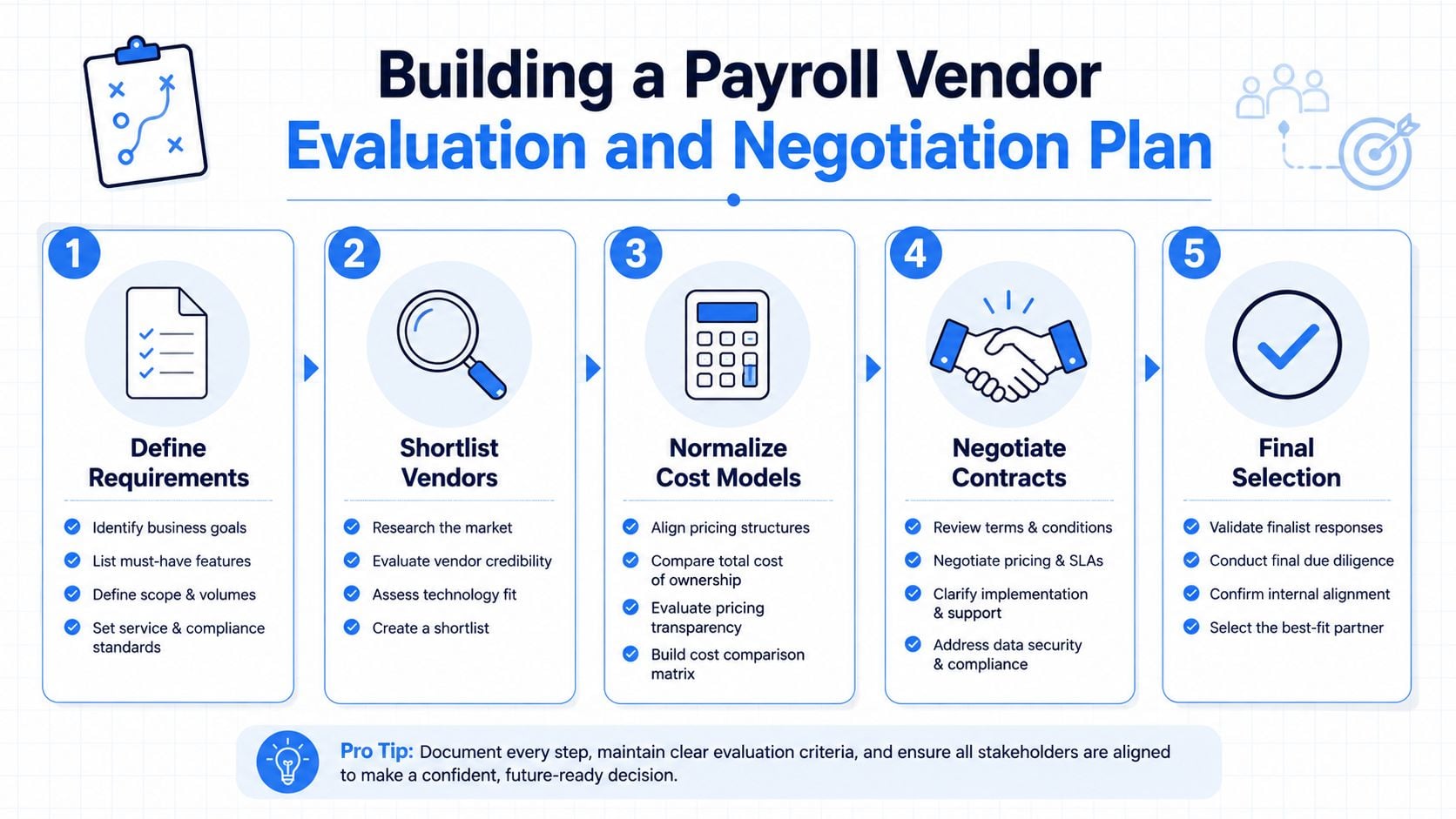
A strong negotiation starts before the vendor's preferred contract arrives. The buyer should create a shared requirements document, distribute identical assumptions to every finalist, and preserve parallel negotiations until the commercial terms are genuinely comparable.
Use a disciplined RFP sequence
Define requirements first. HR should document pay groups, employee types, jurisdictions, benefits, time systems, accounting outputs, historical data, approval workflows, and year-end obligations. Finance should add billing assumptions and a three-year cost model. Legal should identify indemnification, data ownership, renewal, and termination requirements.
Shortlist by operating fit. A polished demo doesn't qualify a vendor. The shortlist should include only providers that can support the actual workforce structure, integration environment, filing footprint, and desired service model. Reference calls should ask about implementation failures, escalation speed, billing surprises, and exit support.
Normalize the economics. Each provider should quote the same scenario, including employee changes, off-cycle activity, new-jurisdiction setup, amendments, and year-end processing. The scoring sheet should separate recurring fees, usage fees, pass-through charges, implementation costs, and permitted increases.
Negotiate the clauses that protect the buyer
- Price lock: Freeze core fees for a defined period and restrict increases to clearly stated circumstances.
- Penalty-backed SLA: Define response times, pay-run deadlines, filing obligations, remedies, and exclusions.
- Data portability: Require complete historical payroll, tax, employee, and audit records in usable formats.
- Termination for convenience: Avoid a structure that makes switching impractical after service quality declines.
- Scope clarity: Attach a schedule listing included filings, registrations, corrections, reports, integrations, and support channels.
Red flags include automatic renewal without a meaningful notice window, vague language around tax liability, “custom” pricing that excludes basic operating events, per-incident support charges, and a vendor's refusal to provide a sample invoice. The agreement should also explain how the provider handles a failed payment, rejected filing, tax notice, data breach, or missed implementation milestone.
A buyer switching providers should plan the transition around parallel validation, employee communications, bank and tax account controls, and historical data retention. The payroll service provider switching guide can support that project planning.
Making a Confident Payroll Service Decision
The right provider is not the one with the longest feature list. It's the one whose pricing, implementation plan, compliance coverage, reporting, and liability terms survive a detailed review of the employer's actual operating conditions.
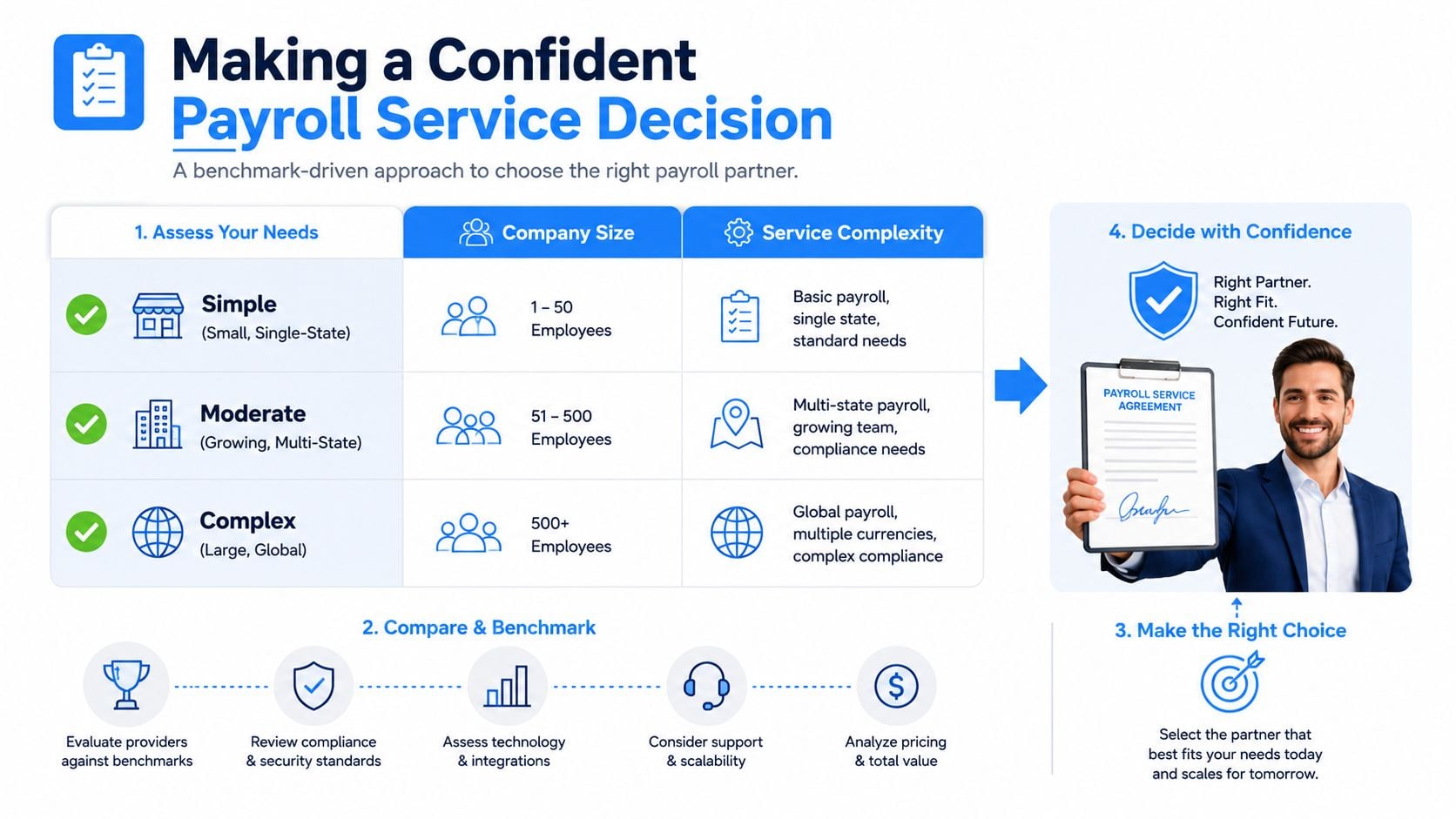
Before signing, the decision team should lock in five points:
- Fully loaded pricing, including implementation, off-cycle work, year-end services, amendments, integrations, and renewal increases.
- Tax filing liability, with clear responsibility for penalties, interest, notices, and correction work.
- Jurisdiction coverage, including registrations and the process for adding states, localities, or countries.
- Service-level commitments, including implementation ownership, response times, escalation, and pay-run support.
- Data and exit rights, including access to records, export formats, transition assistance, and termination terms.
Three warning signs justify walking away: the vendor won't disclose variable charges, refuses to define its tax guarantee, or cannot explain who owns implementation errors. HR, finance, legal, payroll operations, IT, and executive leadership should sign off on the final choice because each group sees a different category of risk.
The review shouldn't end at signature. An annual vendor assessment should compare actual invoices with the original model, review filing performance and support tickets, test reporting and data exports, and confirm that the provider still fits the company's growth. A disciplined payroll service comparison turns renewal from a routine event into a documented decision about whether the vendor continues to earn the business.
PEO Metrics helps employers compare PEO and payroll-only providers using pricing structures, contract terms, benefits, service quality, compliance support, and projected total cost. Visit PEO Metrics to benchmark options, identify contract risk, and prepare stronger terms before selecting or renewing a payroll partner.
