
A payroll renewal lands on the CFO's desk with an attractive per-employee rate. At the same time, the HR director is still correcting data between an HRIS, a separate payroll system, a benefits broker, and a workers' compensation carrier. The vendor's scorecard looks strong, but nobody can explain who owns a missed tax filing, how quickly an employee inquiry must be resolved, or what happens if the company leaves before the automatic renewal date.
That situation is common for organizations with 10 to 2,000 employees. The visible comparison usually focuses on features, user counts, and implementation promises. The expensive differences sit elsewhere, in governance, liability, pass-through charges, rate increases, service-level language, and exit rights. A company may buy an integrated platform and retain every employment liability, or join a PEO and still discover that the contract limits the provider's responsibility for operational failures.
This guide gives HR directors, CFOs, and business owners a practical way to compare HR and payroll services. It defines the main service models, compares their trade-offs, shows how pricing can change total cost, identifies contract clauses worth negotiating, and provides a decision process for selecting a structure that matches the company's risk tolerance. Leaders looking for a broader overview of outsourced HR support can also review HR services for small businesses.
Table of Contents
- Introduction
- Overview of Combined Service Models
- Comparative Analysis of Service Models
- Cost Structures and Pricing Considerations
- Navigating Contract Terms and Risk
- Use Cases and Situational Recommendations
- Decision Framework and Next Steps
Introduction
The right model isn't the one with the longest feature list. It's the one that makes ownership clear when employee data changes, payroll is approved, taxes are filed, and a problem reaches the finance team.
A 90-employee software company, for example, may have an HR director managing employee records in one system, payroll in another, benefits through a broker, and compliance questions routed to outside counsel. Every handoff creates another opportunity for a terminated employee to remain active, a bonus to miss payroll, or a tax filing to rely on outdated information. The company may have several capable vendors and still lack a single accountable operating model.
A PEO can consolidate administration and assume a co-employment role, but it doesn't eliminate the buyer's responsibility to understand the agreement. An ASO can preserve the company's employment relationship while adding experienced payroll support, but internal leaders still own compliance decisions and vendor coordination. An integrated HRIS may provide clean workflows, yet the company remains responsible for the underlying process and liability.
Practical rule: A service model should be evaluated by asking who owns each decision, each data handoff, and each failure, not only by asking what the software can do.
The comparison also needs financial discipline. A low recurring fee can be offset by implementation charges, benefits commissions, workers' compensation adjustments, annual escalators, or an expensive exit. A higher fee can be rational if it transfers risk the company intends to transfer, but that value should appear in the contract rather than remain a sales promise.
Overview of Combined Service Models
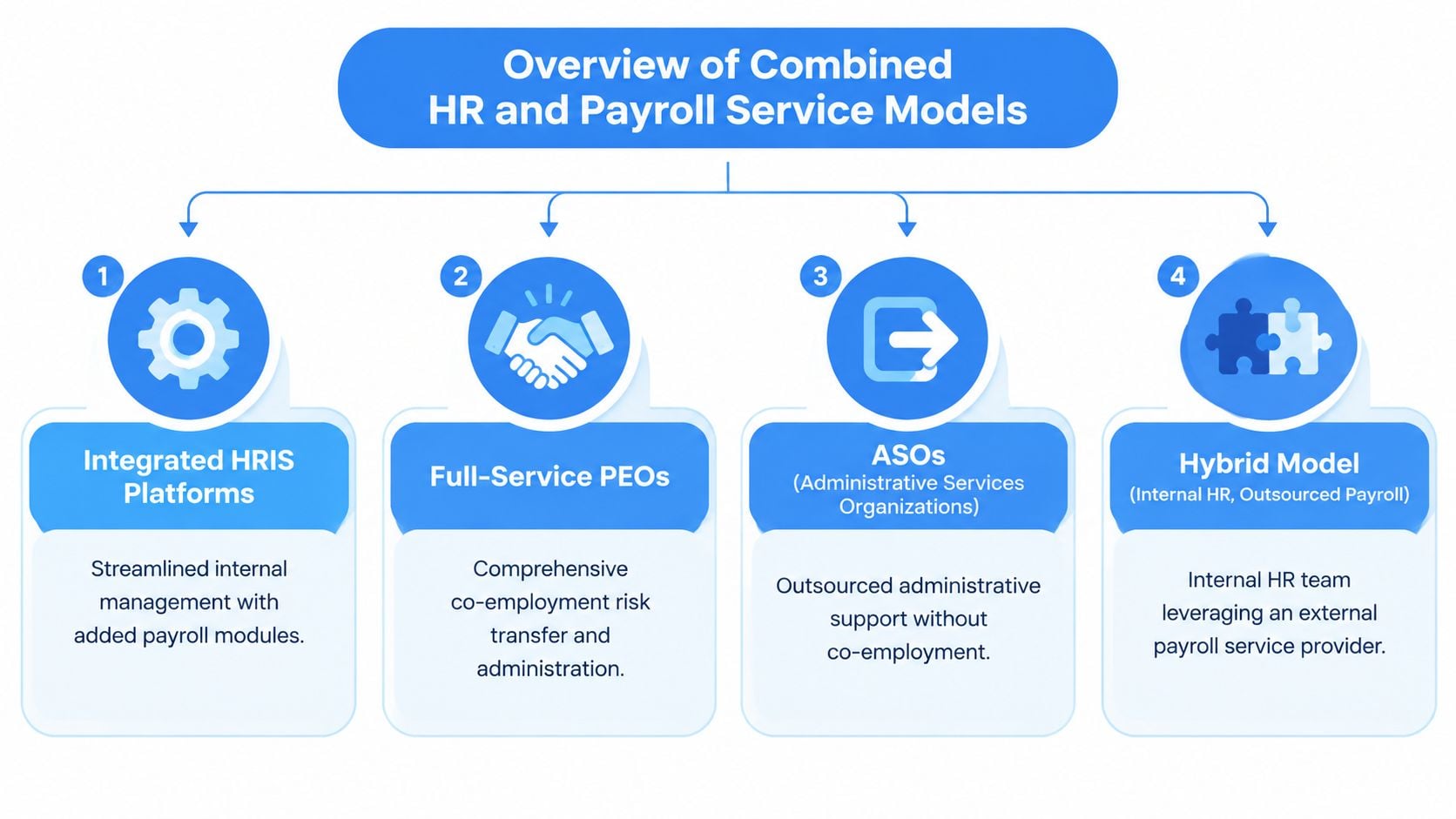
Four structures dominate the way growing employers combine HR and payroll administration. Each creates a different balance between control, outsourcing, integration, and employment liability.
Integrated HRIS platforms with payroll
An integrated HRIS keeps the employer as the operating owner and adds payroll capabilities to the employee system. The company typically controls hiring data, compensation changes, approvals, policies, and reporting, while the provider supplies software, calculations, workflows, and technical support.
A simple package might charge $6 per employee per month for core HR and an additional $2 for payroll. That example shows the structure, not a universal market price. The buyer must still determine whether tax filings, year-end forms, garnishments, implementation, and support are included or separately priced.
This model suits an organization with a capable HR or finance team that wants system consolidation without transferring employment risk. It doesn't automatically solve weak approval controls or unclear ownership. If HR enters incorrect data, the integrated platform may process it accurately and still produce the wrong result.
Full-service PEOs
A full-service PEO combines HR administration, payroll, benefits access, workers' compensation support, and compliance services under a co-employment arrangement. The PEO becomes a formal employer of record for specified administrative and tax purposes, while the client generally continues directing daily work, compensation decisions, hiring, and business operations.
The attraction is risk coordination. A PEO can give a smaller employer access to structured processes, benefits administration, and specialized support that would otherwise require several vendors. The trade-off is reduced control over some workflows, contractual dependence on the provider, and the need to understand liability allocation in detail.
ASOs
An Administrative Services Organization outsources selected administrative tasks without creating co-employment. The client remains the employer and retains responsibility for employment decisions, compliance oversight, and the legal consequences of its policies.
An ASO can be configured narrowly, such as payroll processing and tax filing, or broadly, including HR support, benefits administration, and compliance assistance. It offers more flexibility than a PEO, but the company must keep clear internal ownership. A provider's assistance with compliance isn't the same as a transfer of liability.
Bundled and hybrid providers
A bundled provider may combine standalone payroll with brokered benefits, HR support, or selected technology. A hybrid model can also leave HR inside the company while outsourcing payroll to a specialist. These arrangements can work well when internal HR has strong business-partner capability but lacks payroll depth.
System integration deserves special attention. If employee status changes in an HRIS but payroll receives the change through a manual file, the arrangement isn't fully integrated. For teams linking operational tools, resources on how to connect Workday with Slack can help clarify where workflow notifications belong, although notifications shouldn't replace payroll controls or formal approvals.
Demand for unified platforms continues to expand. A market projection places payroll and HR solutions at USD 34.9 billion by 2026 and USD 80.4 billion by 2036, according to market projections for integrated payroll and HR platforms. That growth doesn't make one model universally superior. It shows why buyers need to separate platform convenience from governance quality.
Comparative Analysis of Service Models
A comparison becomes useful only when the criteria reflect operating reality. Service scope matters, but so do employment liability, integration ownership, compliance support, governance workload, and implementation speed.
| Criteria | HRIS | PEO | ASO | Bundled Provider |
|---|---|---|---|---|
| Service scope | Software-led HR and payroll workflows | Broad HR, payroll, benefits, workers' compensation, and compliance administration | Selected administrative services | Payroll combined with brokered benefits and optional HR support |
| Co-employment risk | Remains with the company | Shared through a co-employment structure, subject to contract terms | Remains with the company | Usually remains with the company |
| System integration | Strong when modules share one data model | Depends on the PEO's technology and connected systems | Depends on selected tools and file flows | Often varies by provider and broker relationship |
| Compliance support | Software and support, with employer oversight | Centralized assistance and administration | Advisory or administrative assistance without liability transfer | Scope depends on the package |
| Governance responsibility | Internal HR and finance own controls | Shared operational governance, with client ownership of business decisions | Mostly internal ownership | Split across employer, provider, and broker |
| Typical implementation timeline | Can be relatively quick for a straightforward rollout | More involved because of payroll, benefits, tax, and co-employment setup | Often modular and configurable | Varies with the number of connected vendors |
The table is a starting point, not a contract interpretation. A PEO may offer broad support while limiting responsibility for certain losses. An HRIS may appear simple but require extensive data cleanup before payroll can run reliably. An ASO may launch quickly yet leave the company with more work than expected if approvals, reconciliations, and compliance calendars aren't assigned.
Implementation time should also be treated as a range rather than a promise. A straightforward HRIS rollout may take less time than a PEO onboarding, while a complex multi-state conversion can make either process substantially longer. The buyer should request a dated workback plan showing data validation, parallel payroll, employee communications, benefits enrollment, tax account setup, and sign-off responsibilities.
Payroll quality needs measurable standards. One benchmark source states that high-performing providers target at least 99.5% payroll accuracy and track on-time tax filing and error resolution under 24 hours as SLA commitments, as described in payroll outsourcing KPI benchmarks. Those figures are useful negotiation anchors, but the contract should define the measurement method, exclusions, cure process, and remedy.
Employers comparing PEO and ASO structures should also distinguish co-employment from administrative outsourcing rather than treating them as interchangeable. A detailed comparison of PEO and ASO models can help frame that distinction before vendors present their own terminology.
Cost Structures and Pricing Considerations
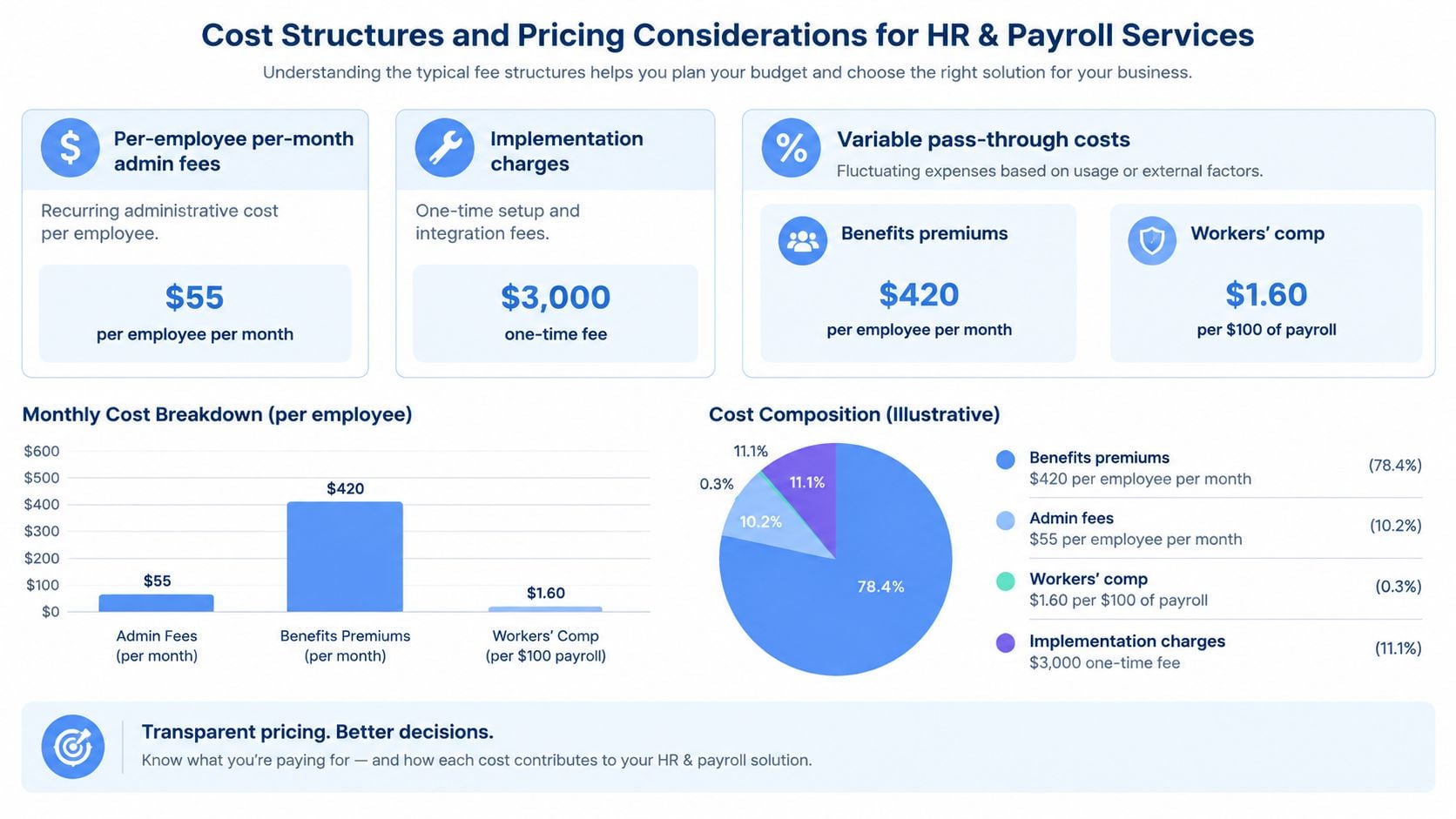
A finance model should show more than the headline administrative fee. The recurring charge, implementation cost, benefits economics, workers' compensation treatment, commissions, escalators, credits, and termination costs all belong in the same analysis.
Consider a hypothetical PEO proposal charging $15 per employee per month, plus a 2% broker commission. An ASO proposal may instead charge $8 per employee per month and a $4 flat monthly benefits administration fee. Neither offer can be judged from those figures alone. The PEO commission may apply to a benefits base that changes over time, while the ASO may leave the employer carrying more responsibility for plan administration, compliance, and vendor coordination.
The cost categories that change the answer
A useful model separates fixed, variable, and one-time charges:
- Administrative fees: Multiply the per-employee charge by the billing population and document whether seasonal workers, owners, inactive employees, and terminated employees are included.
- Implementation fees: Identify configuration, data conversion, parallel payroll, integration, training, and employee communication charges.
- Pass-through costs: Review benefits premiums, workers' compensation, background checks, tax services, garnishments, courier fees, and other external costs.
- Broker and transaction charges: Ask whether commissions are embedded, disclosed, capped, or subject to change.
- Renewal mechanics: Apply every stated escalator to the recurring fee, not only the first-year quote.
The required calculations are straightforward. Total cost of ownership should include recurring administration, one-time setup, variable pass-through expenses, commissions, and expected switching costs. If a contract includes a 3% annual increase, the finance team should model it across the full expected term rather than comparing only the first invoice. A setup credit may improve the first year while leaving the long-term rate untouched.
The market is mature enough that buyers should demand operational benchmarks, not just feature comparisons. APQC payroll benchmarking guidance focuses on total cost to process payroll and cycle time in business days, which gives finance teams a stronger basis for comparing internal processing with outsourced alternatives.
Workers' compensation deserves separate scrutiny because classification, payroll estimates, audits, and exclusions can create unexpected adjustments. Finance and HR teams reviewing the process can use guidance on avoiding costly workers comp audit errors to identify documentation gaps before signing a new arrangement.
A buyer should request a sample invoice, not just a rate card. The invoice should show every fee line, the population used for billing, benefits and workers' compensation pass-throughs, taxes, credits, and any reconciliation adjustments. A side-by-side payroll service comparison is most useful when each provider's charges are normalized into the same categories and time horizon.
Navigating Contract Terms and Risk
The contract determines whether a vendor's promise has operational value. A proposal may advertise responsive support and reliable systems, but the agreement may contain a narrow service definition, automatic renewal, a short notice window, and a liability cap that leaves the buyer exposed.
Automatic renewal is the first clause to inspect. The agreement should state the renewal date, notice deadline, permitted notice method, and consequences of missing that deadline. A buyer negotiating near renewal should request a short extension or a written waiver of the notice requirement rather than accepting a rushed decision.
Rate language deserves equal attention. A clause allowing annual increases should identify the base fee, maximum adjustment, timing, excluded pass-through costs, and notice process. A rate lock can be more valuable than a small opening discount if the company expects headcount or service volume to remain stable.
Service guarantees and liability
Service-level commitments need a remedy. For example, a contract might promise 99.9% system uptime but cap remediation liability at $2,500. That combination may provide little protection if a system outage disrupts payroll for a larger workforce. The buyer should ask whether uptime excludes scheduled maintenance, third-party failures, customer-caused incidents, and security events, and should require service credits or escalation rights that match the practical harm.
Payroll SLAs should cover more than availability. They should define accuracy measurement, tax filing timeliness, error response, correction ownership, employee inquiry handling, data delivery, and reporting deadlines. The contract should distinguish a provider calculation error from incorrect client input, while still requiring the provider to flag suspicious or incomplete data.
A PEO's certification status is another verification point. The IRS requires a Certified Professional Employer Organization to use Form 8973 when a customer contract starts or ends, generally within 30 days of the start or termination date, as explained in the IRS Form 8973 guidance. Newly certified CPEOs receive a six-month window from the notice of certification to file forms for existing customers.
The buyer should verify the provider on the IRS public listing of currently certified CPEOs, using the IRS information on certified professional employer organizations. Certification is a formal IRS program status, not just a label used in sales materials.
Exit terms should cover data export, employee records, tax documents, benefits transition, cooperation with the successor provider, final reconciliations, and post-termination support. Negotiators should also review indemnification, confidentiality, cybersecurity responsibilities, insurance, audit rights, dispute procedures, and whether the provider can change subcontractors without notice.
Use Cases and Situational Recommendations
A 25-employee technology startup often wants access to benefits and HR guidance without building a full internal function. A PEO may offer the broadest package, but the founders should compare the total administrative and benefits economics with an HRIS plus broker arrangement. The key questions are whether the startup values consolidated administration, how much control it needs over plan selection, and whether the contract makes it easy to leave after hiring accelerates.
An integrated HRIS can be appropriate when the startup has a finance leader who can own payroll approvals and a people leader who can manage employee records. An ASO can add hands-on support without changing the employer relationship. The decision should follow the startup's operating capacity, not the size of the vendor's platform.
A multi-state manufacturer with compliance gaps
A 300-employee manufacturer operating across several states faces a different problem. Payroll may involve hourly employees, overtime, variable schedules, multiple work locations, workers' compensation classifications, and frequent employee changes. A basic payroll module may calculate pay, but it won't necessarily resolve weak timekeeping governance or unclear responsibility for state filings.
A PEO may provide stronger coordination across payroll, benefits, workers' compensation, and HR administration. An ASO may be preferable if the manufacturer has an established HR department and wants specialist payroll support while keeping employment control. Either way, the implementation plan should include time and attendance integration, job and location coding, approval controls, audit trails, and a documented escalation path.
A 1,200-employee services firm renegotiating
A 1,200-employee services firm renewing a PEO agreement should avoid treating renewal as a binary decision between accepting the incumbent's rate and starting over. The firm can request an itemized invoice, separate pass-through costs from administrative revenue, benchmark service failures, and ask for concessions tied to term length.
Useful concessions may include a rate lock, implementation credits for new modules, clearer service credits, improved reporting, a shorter renewal notice requirement, and defined transition assistance. If the incumbent won't move on the administrative fee, the buyer can negotiate liability language, support coverage, or exit flexibility instead.
The firm should also compare a competitive PEO process with an ASO or standalone payroll alternative. A PEO may remain the right model, but the comparison strengthens the firm's position and identifies the services the organization truly uses. Leaders evaluating broader employment structures can review the PEO and EOR distinction before discussing international or domestic employment responsibilities.
These examples don't justify invented savings or performance promises. They show how the same product category produces different outcomes depending on workforce complexity, internal capability, benefits priorities, and contract discipline.
Decision Framework and Next Steps
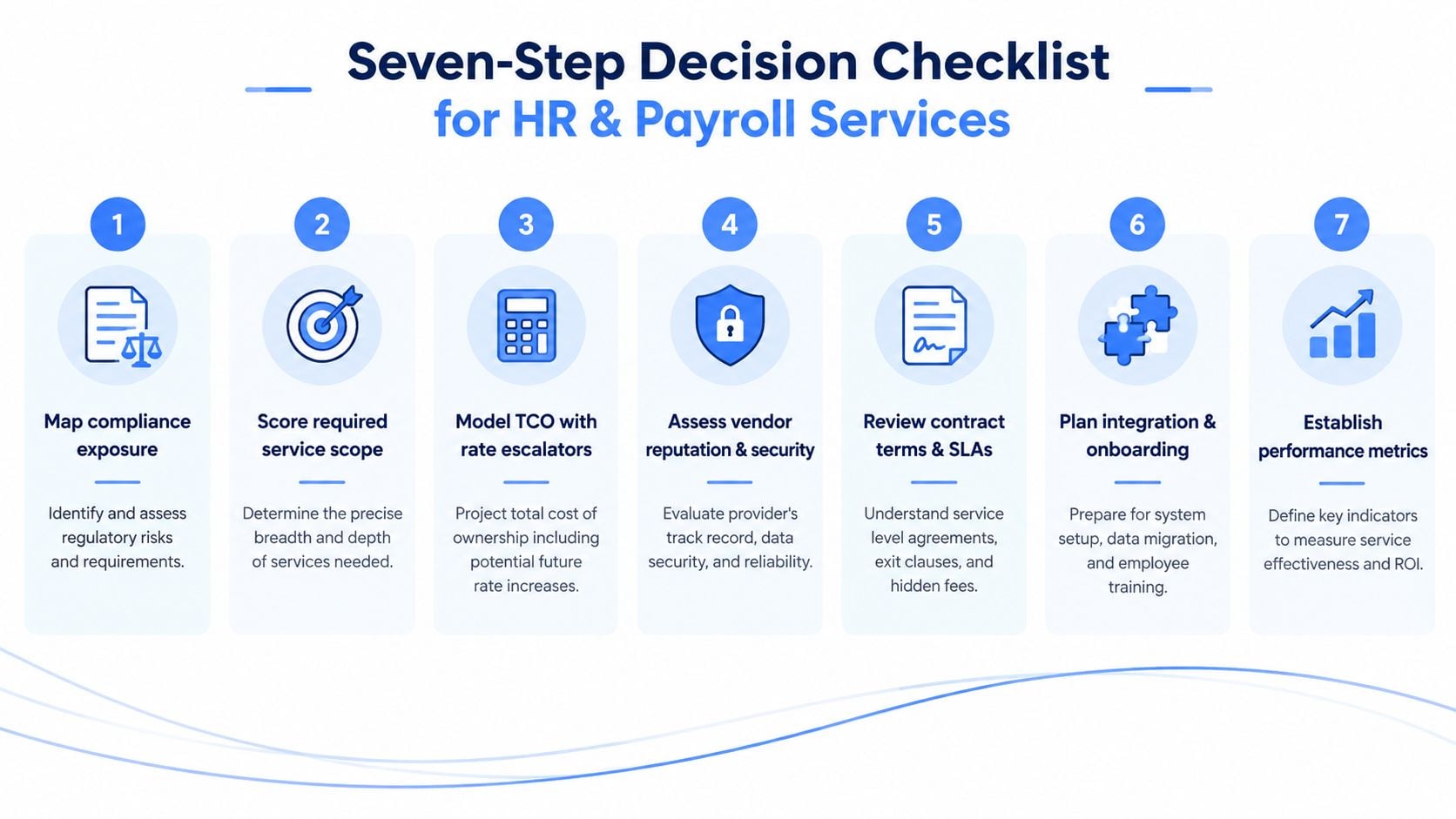
A practical evaluation can be completed through seven decisions. Each one should produce a document that the next negotiation step can use.
Map compliance exposure. List jurisdictions, tax filings, workers' compensation classifications, benefits obligations, timekeeping dependencies, and recurring payroll exceptions. Gather current tax filing error rates and payroll correction records so proposed SLA targets reflect actual risk.
Score required service scope. Separate must-have administration from optional features. Mark whether the company needs payroll only, HR support, benefits administration, workers' compensation assistance, employee self-service, or strategic reporting.
Model total cost of ownership. Put recurring fees, pass-through charges, implementation, commissions, credits, escalators, and exit costs into one model. Use a sample invoice and test alternative headcount assumptions.
Assess vendor reputation and security. Review audit materials, incident response, data retention, subcontractors, access controls, business continuity, and references from employers with similar complexity.
Review contract terms and SLAs. Negotiate renewal notice, rate locks, implementation credits, liability language, service remedies, data export, transition support, and the definition of payroll accuracy.
Plan integration and onboarding. Assign owners for data cleanup, testing, parallel payroll, employee communication, benefits enrollment, approvals, tax setup, and go-live sign-off. A vendor should provide dates and dependencies rather than a single launch promise.
Establish performance metrics. Track accuracy, filing timeliness, correction speed, system availability, employee inquiry response, payroll cycle time, total processing cost, and unresolved issues. Governance should continue after implementation.
Only 43% of organizations operate payroll as a standalone function, according to global payroll governance findings. That makes ownership mapping essential when HR, finance, shared services, brokers, and providers share the workflow.
For companies that need structured support comparing providers, HR outsourcing and payroll guidance can help organize pricing, service scope, contract terms, and negotiation priorities before a decision is signed.
PEO Metrics helps companies compare, select, and negotiate PEO relationships by analyzing pricing, benefits, service models, compliance support, and contract risks side by side. Visit PEO Metrics to benchmark available options and identify negotiation points before renewing or switching an HR and payroll services provider.
