
Most advice on professional services staffing starts with the vacancy. That's the wrong starting point. The core question isn't how to fill a seat. It's how to deploy labor dollars without locking the business into the wrong cost structure, the wrong risk profile, or the wrong delivery model.
That matters because professional services staffing sits inside a very large market. The U.S. office staffing and temp agencies industry generated $260.1 billion in revenue in 2025, with a projection of $290.4 billion by 2030 according to IBISWorld's industry outlook for office staffing and temp agencies. Businesses don't spend at that scale because staffing is a clerical HR task. They spend because talent access changes utilization, margins, client delivery, and operating flexibility.
For a CFO, the choice between agency talent, direct employees, independent contractors, and a co-employment structure is a capital allocation decision. For HR leaders, it's an operating model decision. For owners, it's both.
Table of Contents
- Rethinking Professional Services Staffing
- The Three Core Staffing Models Explained
- Comparing Your Four Staffing Execution Approaches
- Calculating the True Cost of Professional Staffing
- Key Metrics and Negotiating with Partners
- Your Partner Evaluation Checklist
- Frequently Asked Questions
Rethinking Professional Services Staffing
Professional services staffing is usually treated as a recruiting problem. It's closer to a balance-sheet discipline. Every staffing decision changes fixed versus variable cost, exposure to employment risk, and how quickly the company can respond when revenue opportunities appear or disappear.
That's why the common advice to “hire for growth” often backfires. If demand is tied to client projects, implementations, audits, seasonal spikes, or short-duration transformations, permanent headcount can become an expensive answer to a temporary problem. A business may solve a short-term delivery gap and create a long-term overhead issue.
Why this belongs in the finance conversation
Professional services roles carry a different cost profile from commodity labor. A controller, ERP project manager, cybersecurity specialist, or fractional HR leader doesn't just add payroll. That person affects client work quality, internal controls, speed of execution, and sometimes regulatory exposure.
A CFO should look at staffing choices through four lenses:
- Cost structure: Is the company buying fixed payroll, variable project labor, or a bundled employment service?
- Risk transfer: Who handles payroll tax administration, benefits administration, workers' comp, and day-to-day compliance?
- Speed: Can the business staff a revenue-producing project before the opportunity window closes?
- Flexibility: Can labor capacity be reduced without carrying long-term cost after the work ends?
Practical rule: If the work has a defined end date, defined deliverables, or unstable demand, the staffing decision shouldn't default to permanent headcount.
Professional services staffing also overlaps with broader HR infrastructure. Many smaller and mid-sized firms discover that the staffing model only solves sourcing, while the harder problem is employment administration across payroll, benefits, onboarding, and compliance. That's where leaders often compare staffing against broader outsourcing options such as human resources outsourcing for growing employers.
What strong operators do differently
Strong operators separate the talent question from the employment platform question. They ask:
- Does the company need capability, capacity, or both?
- Is this work temporary, trial-based, or permanent?
- Should the business buy recruiting help only, or also buy employment administration and risk support?
That framing leads to better decisions than “Can someone fill this role fast?” Speed matters. But speed without model fit usually shows up later as margin erosion, turnover, or expensive cleanup.
The Three Core Staffing Models Explained
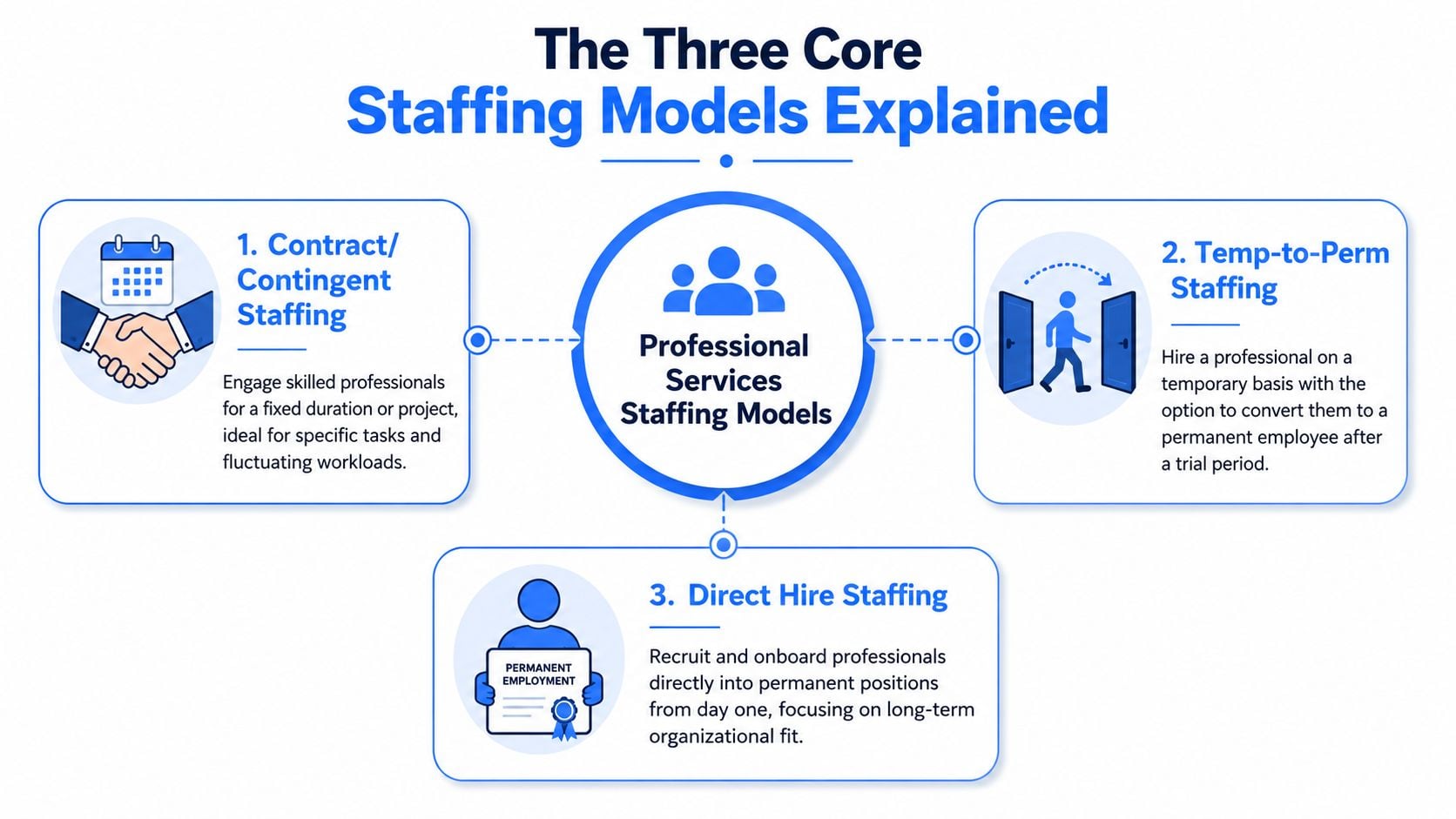
Three models cover most professional services staffing decisions. Contract, temp-to-perm, and direct hire all solve different business problems. The mistake is using one model by habit.
Recent market behavior supports that shift toward flexibility. Staffing Hub's 2025 review of staffing and recruiting trends reported that U.S. staffing employment was 4.7% higher in November 2025 than the same week in 2024, while clients increasingly preferred contract and project-based arrangements over permanent roles.
Contract staffing for defined work
Contract staffing fits work with a clear scope, timeline, or temporary capacity gap. A six-month ERP implementation is a classic example. So is a tax-season accounting surge, a leave coverage assignment, or a software integration project.
This model works best when the business knows what needs to get done but doesn't need to own the role forever.
Use contract staffing when:
- The project has an end point: A migration, system rollout, remediation effort, or audit prep cycle.
- The skill is specialized: The company needs a niche analyst, consultant, or engineer that it won't require year-round.
- Demand is uneven: Client volume may justify added labor now, but not later.
Contract arrangements can also create classification risk if leaders try to manage independent workers like employees. For teams sorting through that line, employment law insights from UL Lawyers are a useful primer on how worker classification issues can become legal issues.
Temp-to-perm for uncertain fit
Temp-to-perm is the middle path. The company gets immediate help and also gets time to test performance, communication style, and team fit before extending a permanent offer.
This is useful when the role matters, but the business doesn't have enough confidence to hire directly on day one. A finance manager, operations lead, or client services supervisor often falls into this category. The role is important enough to become permanent, but a poor hire would be disruptive.
A sound temp-to-perm process usually includes:
- A defined evaluation window tied to real deliverables.
- Clear conversion economics so the fee structure isn't a surprise.
- Shared expectations on supervision, training, and decision timing.
Direct hire for roles that carry the business
Direct hire is still the right answer for positions with long-term ownership, cultural influence, or leadership accountability. A controller, director of HR, practice leader, or revenue operations head usually belongs here.
Direct hire makes the most sense when:
- The business wants long-term continuity.
- The role owns systems, people, or sensitive internal processes.
- Retention matters more than immediate staffing speed.
Companies evaluating whether to outsource recruiting alone or combine it with broader employment support often end up comparing these options against PEO versus HRO models for growing employers. That comparison becomes important once hiring isn't the only problem on the table.
Comparing Your Four Staffing Execution Approaches
Once the staffing model is clear, the next decision is execution. Four approaches show up most often in professional services staffing: in-house recruiting, staffing agencies, directly sourced independent contractors, and a PEO or ASO co-employment structure.
Many businesses often oversimplify. They compare visible fees and miss the operating consequences.
The contingent workforce is large enough that this isn't a niche issue. The American Staffing Association says staffing firms provided job opportunities for about 11 million employees in 2024, and 73% worked full time, according to ASA staffing industry statistics. In other words, these models aren't edge cases. They're mainstream workforce infrastructure.
What each approach is really buying
In-house recruiting buys control. The company owns sourcing, screening, compensation design, and the candidate experience. That can work well for repeat hiring in known roles. It usually works poorly when the team needs scarce technical talent fast.
Staffing agencies buy speed, reach, and labor flexibility. They're useful when the business needs qualified candidates immediately or when work may not justify a permanent employee. The trade-off is less pricing transparency and the risk of treating agency labor as a default rather than a tactical tool.
Independent contractors can look efficient on paper because the bill arrives without full employee overhead. The problem is supervision and classification. If the company controls schedule, methods, tools, and day-to-day work like an employee relationship, the “savings” can disappear quickly.
PEO or ASO co-employment structures solve a different layer of the problem. They don't replace sourcing by themselves. They make direct employment easier to administer by handling payroll, benefits administration, HR support, and some compliance functions. For companies hiring across states or trying to improve benefits access, that can materially change the economics of direct employment.
Fast hiring and sound hiring aren't the same purchase. One buys time. The other protects margin.
A practical comparison table
| Criterion | In-House Recruiting | Staffing Agency | Independent Contractor (1099) | PEO/ASO Co-Employment |
|---|---|---|---|---|
| Speed to hire | Best when role is common and pipeline exists | Often strongest for urgent needs | Can be fast if network is strong | Depends on sourcing method, but onboarding is usually more structured |
| Upfront visible cost | Salaries and internal recruiting expense | Markup, placement fee, or conversion fee | Hourly or project fee | Admin fees plus employee compensation and benefits costs |
| Cost predictability | Moderate | Moderate to low if terms are loose | Can look predictable, but scope creep is common | Usually more predictable once terms are set |
| Compliance exposure | High internal responsibility | Shared, depending on arrangement | Highest if misclassified | Lower admin burden for direct employees |
| Benefits access | Employer must build it | Usually limited relevance for temp labor decision | Typically not part of the arrangement | Often stronger due to larger benefit platform |
| Scalability | Slower to scale | Strong for surges and project work | Limited by network and management capacity | Strong for employee administration, not necessarily sourcing |
| Best use case | Repeated permanent hiring | Project spikes, temp-to-perm, hard-to-find talent | Narrow, truly independent specialist work | Growing firms that want direct employees without building full HR infrastructure |
Companies that need a blended model often compare agency staffing with PEO and ASO hybrid structures because the answer isn't always one approach. It may be agency talent for near-term delivery and co-employment for the employees the company intends to retain.
Where companies usually get this wrong
The first error is using agencies for work that has already become permanent. If the same “temporary” analyst has been billing month after month with no realistic end date, the company is often paying for flexibility it no longer needs.
The second error is pushing direct contractors into employee-like roles. That creates operational confusion first and legal exposure second.
The third error is assuming a PEO is a substitute for recruiting. It isn't. A PEO can make employment administration cleaner and more scalable. It doesn't magically produce candidates. Leaders still need a sourcing plan.
A better framework is simple. Use agencies to solve volatility. Use direct employment when continuity matters. Use independent contractors only when the work is independent. Use co-employment when the company wants employees, but not the full administrative burden of managing every HR function internally.
Calculating the True Cost of Professional Staffing
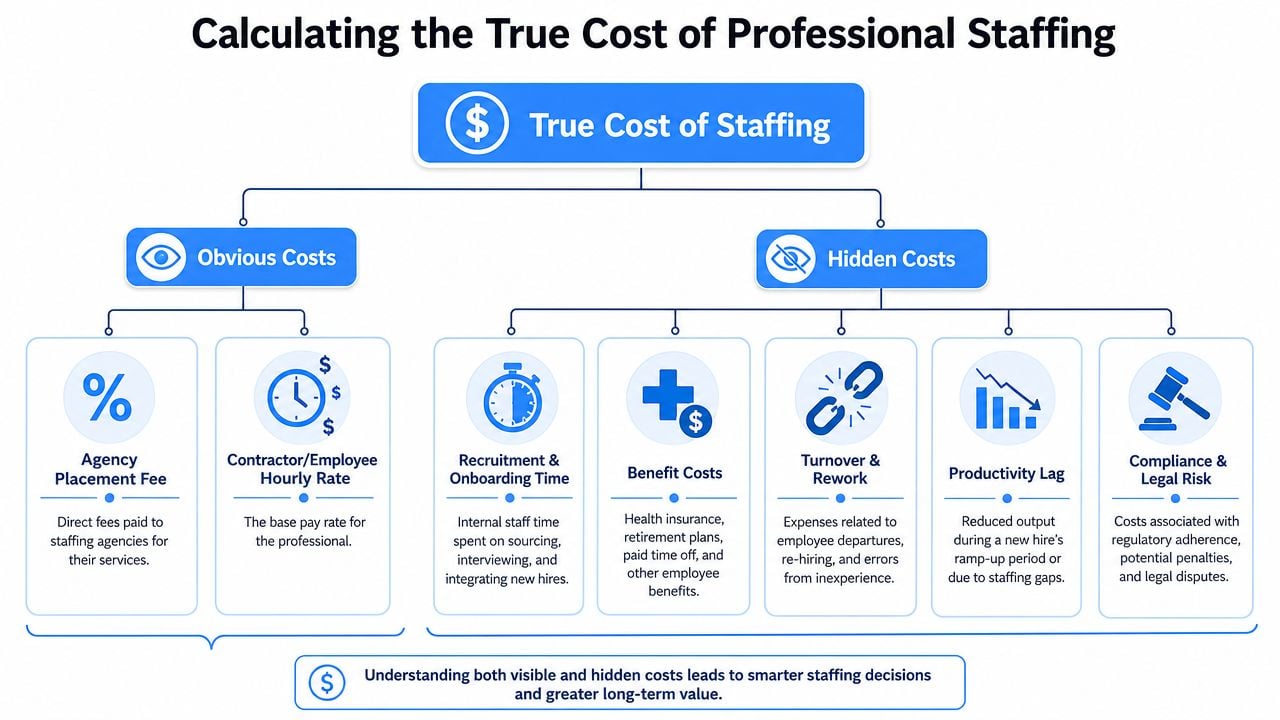
Most staffing decisions fail financially because companies compare rates instead of total cost. The hourly bill rate, annual salary, or placement fee is only the visible layer.
The hidden layer includes internal hiring time, onboarding drag, benefits load, rework from poor fit, and compliance exposure. In higher-risk functions such as finance and IT, those hidden costs rise because errors are more expensive and the bar for vetting is higher.
The American Staffing Association's 2025 trend research highlighted consolidation, AI and automation, regulatory uncertainty, staffing platforms, and flexible work models as major forces shaping the staffing market. That matters financially because it signals a more professionalized industry. Buyers should expect better matching and better process discipline, but they should also expect vendors to price for that sophistication.
Visible spend is only the starting point
A staffing invoice usually shows one number. Finance needs at least six:
- Direct labor cost: Salary, hourly pay, or contractor rate.
- Acquisition cost: Recruiter time, agency fee, job ads, interview hours.
- Onboarding cost: Payroll setup, equipment, systems access, manager ramp time.
- Benefit cost: Medical, retirement, paid leave, and administration.
- Productivity lag: Lower output while the person learns systems and clients.
- Risk cost: Worker classification, payroll tax handling, and insurance gaps.
Workers' comp is a good example of a cost category that many buyers notice only after a claim or audit. For a plain-language overview of what that exposure can look like in staffing environments, workers' comp for staffing firms gives useful context.
A more honest cost model
Consider a company deciding between three options for a senior systems analyst needed for a transformation project that may later become an ongoing role.
If the company hires through an agency, the visible cost may look high but the business buys speed and replacement access. If it hires directly, the visible compensation may look lower, but the company absorbs recruiting effort, onboarding, benefits, and employment administration. If it uses a PEO for a direct employee, the company still carries compensation cost, but gains a more predictable HR and benefits framework.
Finance lens: The cheapest line item often becomes the most expensive operating decision if the model creates turnover, delay, or avoidable compliance work.
A disciplined cost review should ask:
- How long is the work expected to last?
- What happens if the hire leaves during a critical project window?
- Which costs are fixed, and which disappear when demand drops?
- Who owns payroll tax filings, benefits administration, and employee paperwork?
- What internal labor is being consumed to manage the arrangement?
For firms evaluating co-employment economics, PEO cost structure for professional services firms is a useful companion topic because it helps translate a broad HR outsourcing conversation into line-item cost categories finance can model.
The practical takeaway is straightforward. Don't compare salary to bill rate. Compare all-in operating cost to all-in operating value.
Key Metrics and Negotiating with Partners
Many staffing partnerships are judged by one metric: time to fill. That's too shallow for professional services work. A provider can fill a role quickly and still create project disruption if the person exits early, misses quality expectations, or requires a replacement during a critical delivery phase.
The more useful question is whether the staffing choice protected continuity.
Workforce placement research summarized in this review found an important gap between initial placement and long-term retention. The takeaway for buyers is simple: filling the role doesn't prove the model worked.
The metrics that actually matter
Time to fill still matters, but it should sit beside stronger operating metrics:
- Quality of hire: Did the person meet the technical and business requirements without heavy rework?
- Ninety-day retention: Did the placement stabilize, or did the company restart the search?
- One-hundred-eighty-day retention: Did the role produce continuity through a meaningful operating window?
- Manager satisfaction: Would the hiring manager use the same channel again for a similar role?
- Project impact: Did staffing improve milestone delivery, client responsiveness, or backlog reduction?
- Replacement friction: How disruptive is a failed placement under the current contract?
If the provider reports speed but can't discuss retention, replacement terms, and post-placement support, the reporting is incomplete.
For finance teams, payroll complexity should also sit in the discussion, especially when comparing employee models across states or entities. A practical reference on how to calculate payroll taxes can help non-payroll leaders understand why labor cost assumptions often drift after hiring starts.
How to negotiate better terms
Agency contracts and PEO agreements should both be negotiated. Too many employers accept first-pass terms that stay in force long after the business has more power.
For staffing agencies, focus on:
- Markup clarity: Ask what the bill rate covers and what triggers additional charges.
- Conversion terms: Define when and how a temp can convert to direct employment.
- Replacement commitments: Require a clear process if the placement fails early.
- Candidate ownership: Limit vague ownership language that creates surprise fees months later.
For PEO or ASO arrangements, focus on:
- Administrative fee structure: Understand whether fees are flat, percentage-based, or bundled.
- Rate protection: Ask for fee locks or defined renewal caps.
- Implementation economics: Push for credits, waived setup items, or phased implementation charges.
- Exit language: Review termination notice periods, runout responsibilities, and data transfer obligations.
The strongest negotiators do one thing consistently. They tie commercial terms to operating reality. If the provider promises faster staffing, ask what happens when speed leads to turnover. If the provider promises compliance support, ask exactly which responsibilities remain with the employer.
Your Partner Evaluation Checklist
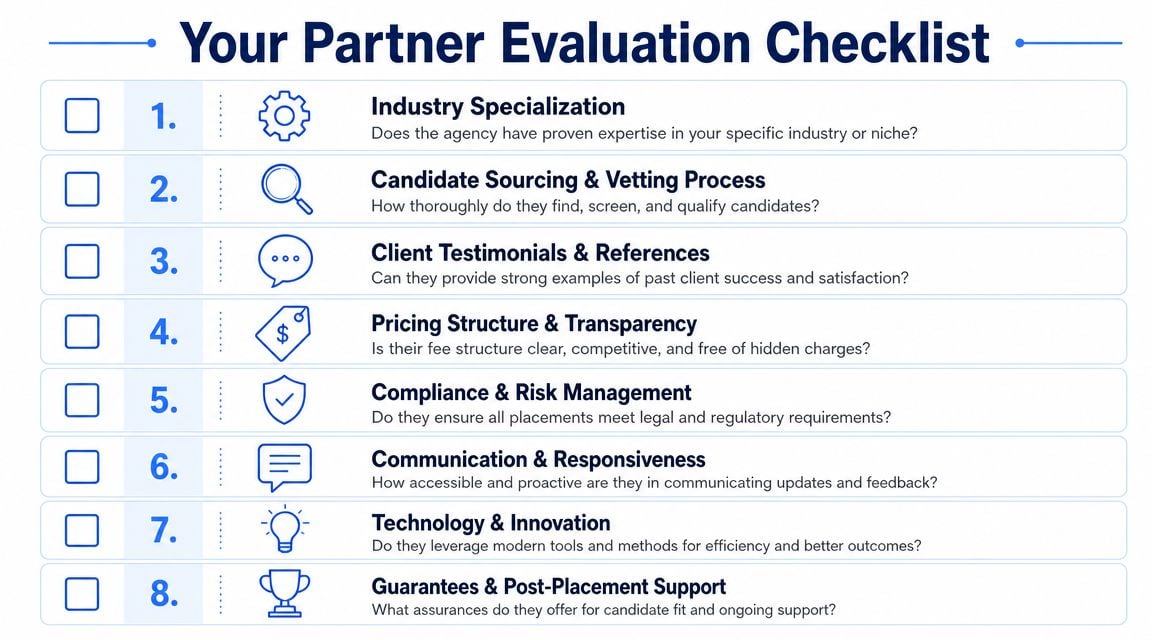
Choosing a staffing partner, PEO, or ASO isn't about who gives the best sales presentation. It's about whether the partner can support the company's actual labor model without introducing hidden cost or risk.
This checklist works best when legal, HR, finance, and the hiring manager all review the answers together.
Capability and fit questions
Use these to test whether the provider understands the work, not just recruiting language.
- Industry relevance: Can the partner explain the difference between staffing for accounting, IT, consulting, and operations roles?
- Role fluency: Do recruiters understand what good looks like in the specific positions being filled?
- Sourcing process: How are candidates found, screened, and presented?
- Vetting depth: What references, skills validation, or work-history checks are built into the process?
A weak provider usually answers these questions with generic process talk. A strong provider can explain how they qualify a controller differently from a project manager or business analyst.
Commercial and risk questions
Commercial details often decide whether the relationship stays healthy after the first hire.
Ask directly:
- What exactly is included in pricing, and what is billed separately?
- How are conversion fees handled?
- Who carries which compliance responsibilities?
- What support exists if a placement fails or a dispute arises?
- What reporting will the company receive after launch?
For co-employment buyers, a PEO due diligence checklist is worth reviewing alongside staffing questions because employment administration and sourcing can blur together during the sales process.
A reliable partner welcomes detailed diligence. Evasive answers usually forecast operational friction later.
The most useful final question is also the simplest: what kind of work should this provider not handle? Honest partners know their lane. That answer often tells more than the pitch deck.
Frequently Asked Questions
What is the difference between an ASO and a PEO for staffing?
An ASO handles outsourced HR functions such as payroll and benefits administration, but the employer remains the sole employer of record. A PEO uses a co-employment model, which means it becomes the employer of record for certain tax and benefits purposes. In staffing terms, a PEO can be especially useful when a company wants direct employees but doesn't want to build all HR and compliance administration internally.
Can a company use a staffing agency if it already has a PEO?
Yes. That's a common combination. The staffing agency can source temporary or temp-to-perm talent, while the PEO can handle payroll, benefits, onboarding, and HR administration for the employees the company ultimately hires directly.
How are staffing agency markups calculated?
A markup is the amount added on top of a worker's base pay rate to create the client bill rate. That spread typically covers the agency's overhead, payroll burden, insurance costs, and margin. The exact structure varies, which is why buyers should insist on clear written definitions of what the markup includes, how overtime is billed, and whether conversion fees apply later.
PEO decisions usually look straightforward until pricing, benefits, contract language, and service models are compared side by side. PEO Metrics helps employers evaluate those trade-offs, benchmark providers, and negotiate stronger terms without relying on a provider's sales process alone.
