
Federal contractors struggling with rising benefits costs, SCA/Davis-Bacon compliance, and unpredictable labor expenses can leverage a PEO for federal contractors benefits cost containment strategy by structuring co-employment arrangements that optimize fringe benefit calculations, improve insurance purchasing power, and reduce administrative overhead—ultimately protecting margins on competitively priced government contracts.
PEO transition planning for construction companies requires a different approach than standard business migrations, with workers’ comp continuity, certificate of insurance management, and project timelines driving every decision. This guide walks construction business owners through the specific sequencing needed to switch PEO providers without triggering coverage lapses, audit surprises, or jobsite shutdowns.
A peo pricing opacity analysis revealing how PEO quotes are structurally designed to resist comparison, with hidden margins buried across multiple cost layers that most business owners never examine. This forensic breakdown exposes exactly where costs hide between flat-fee and percentage-based quotes, helping you make accurate comparisons and avoid paying more than necessary for co-employment services.

Government contractors using a PEO for benefits cost containment strategy can reduce fringe rates, control overhead pools, and stay DCAA-compliant by leveraging co-employment purchasing power for health insurance, retirement, and workers’ comp. This guide outlines seven proven approaches to structuring a PEO relationship that lowers indirect costs without creating audit exposure or compliance conflicts with SCA, DBRA, or contract terms.
A PEO indemnification imbalance analysis reveals how service agreements often use “mutual” language to disguise heavily one-sided risk allocation, where clients absorb broad liability while PEO obligations are narrowly restricted to gross negligence. This guide explains how to identify these contractual disparities and negotiate more equitable terms before signing.
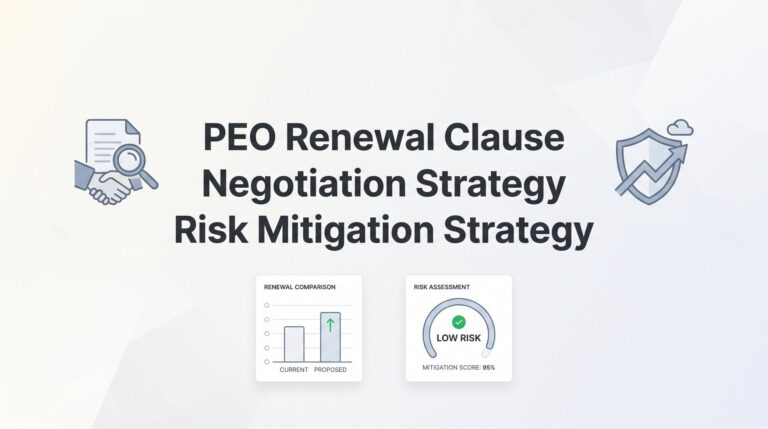
A practical step-by-step guide to PEO renewal clause negotiation strategy risk mitigation strategy, helping business owners identify hidden cost exposure, push back on unfavorable auto-renewal terms, and protect their company before re-signing. Learn where leverage exists in PEO agreements and how to use it effectively—whether your renewal is weeks away or months out.
Union employers navigating workers’ comp through a PEO face unique challenges that standard PEO arrangements rarely address, from CBA conflicts to shifting classification codes. This guide covers seven advanced strategies for PEO for union employers advanced workers comp structuring, helping you avoid costly payroll misclassifications, protect multi-employer trust fund contributions, and build a PEO arrangement that actually works alongside your collective bargaining obligations.
A PEO hidden insurance commissions review reveals that most business owners never see the commissions, overrides, and volume bonuses their PEO collects from insurance carriers — on top of standard admin fees. This guide breaks down how these undisclosed earnings affect your actual costs, where to find them in your billing, and what steps to take before your next renewal.
Union employers bound by collective bargaining agreements can still reduce benefits costs through a PEO for union employers benefits cost containment strategy—without violating CBA obligations or damaging labor relationships. This guide outlines seven practical approaches that work within Taft-Hartley constraints and union contract requirements, helping employers capture real savings through administrative efficiency, purchasing power, and compliance optimization rather than benefit reducti…

A PEO ROI analysis for manufacturing firms requires going beyond generic savings estimates to account for industry-specific cost drivers like workers’ comp exposure, EMR impact, OSHA compliance overhead, and skilled trades turnover. This guide provides a practical framework for calculating the true return on a PEO investment within the unique financial realities of manufacturing operations.
A thorough peo payroll tax error responsibility review reveals that business owners often remain personally liable for federal employment taxes even when outsourcing payroll to a PEO, due to IRS rules that ignore service agreements. This guide breaks down how co-employment arrangements create ambiguous accountability, what your PEO contract actually covers, and where financial exposure falls when payroll tax errors occur.
Employers with experience modification rates above 1.0 can leverage a PEO for high mod rate employers benefits cost containment strategy by accessing seven targeted approaches—including claims management infrastructure, reserve reduction tactics, and group purchasing leverage—that directly address the underlying factors driving inflated workers’ comp premiums and benefits costs rather than simply co-employing their workforce.