
Workers’ compensation represents the largest insurance cost for plumbing contractors, making proper PEO structuring critical for cost savings. This guide explains how to negotiate and structure workers’ comp coverage through a PEO for plumbing companies, addressing unique challenges like multiple job classifications, hazardous work conditions, and multi-state operations that require advanced workers’ comp structuring beyond standard office-based PEO arrangements.
HVAC companies operating across state lines face complex payroll challenges with varying withholding rules, workers’ comp classifications, and wage laws in each jurisdiction. A PEO for HVAC companies multi-state payroll governance streamlines this complexity by consolidating payroll administration, tax filings, and workers’ comp coverage under one system, helping contractors avoid costly penalties and administrative headaches when crews work across Pennsylvania, Maryland, Virginia, and other …
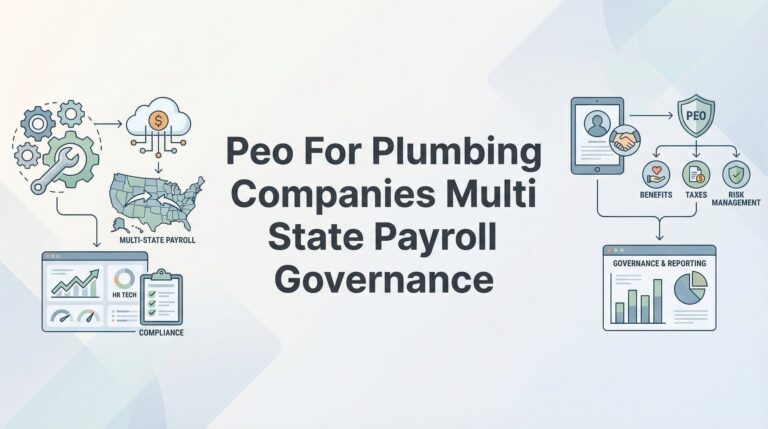
Plumbing companies operating across state lines face complex compliance challenges when crews work in multiple states during a single week, each with different workers’ comp classifications, withholding rules, and wage requirements. A PEO for plumbing companies multi state payroll governance centralizes this complexity by serving as the employer of record, though selecting the right provider requires finding one with proper state registrations and understanding of industry-specific requiremen…
Agricultural enterprises face uniquely complex compliance challenges—from H-2A visa requirements and pesticide certifications to state-specific heat illness mandates and fluctuating seasonal workforce regulations. This practical guide examines whether partnering with a PEO for agriculture enterprise compliance risk management genuinely reduces operational risk and prevents costly violations, or simply adds bureaucratic overhead when DOL audits, housing inspections, and worker classification i…
Managing seasonal agricultural workers across multiple states creates a payroll compliance nightmare—different withholding rules, unemployment registrations, and overtime interpretations in each location, compounded by H-2A visa requirements and fluctuating crew sizes. A PEO for agriculture multi-state payroll governance handles state registrations, workers’ compensation, and the unique compliance challenges that standard payroll systems can’t accommodate, from piece-rate compensation to hous…
A PEO governance framework for hybrid models establishes clear accountability between your internal team and your PEO partner, preventing costly gaps where critical HR tasks fall through the cracks. This framework defines decision-making authority, ownership of specific functions, and escalation paths—eliminating the confusion that leads to missed compliance deadlines, benefits enrollment failures, and unresolved employee issues when responsibilities aren’t clearly assigned.
Partnering with a PEO creates a shared responsibility for workplace policies, but without a clear PEO internal policy approval workflow, businesses face delays, compliance gaps, and frustrated employees as decisions bounce between teams. This guide shows you how to categorize policies by ownership type, establish approval chains, set realistic timelines, and create documentation that ensures accountability in your co-employment arrangement.
Most dental practices overpay on workers compensation insurance because carriers lump all employees—from front desk staff to dentists—into the highest-risk classification by default. A PEO for dental practices with advanced workers comp structuring can save thousands annually by separating class codes, optimizing experience modification rates, and creating multi-location arrangements that accurately reflect each role’s actual risk profile rather than accepting costly one-size-fits-all def…
A PEO with an internal recruiting team can work seamlessly when you understand their distinct roles: your recruiters focus on finding and hiring talent while the PEO handles benefits administration, compliance, and HR paperwork. The key is establishing clear boundaries upfront so both functions complement rather than compete with each other, allowing your recruiting team to maintain their candidate relationships and cultural expertise while offloading administrative complexity to the PEO.
Medical practices expanding across state lines face complex compliance challenges including varying tax withholding, healthcare worker wage laws, and leave policies. While a PEO for medical practices multi-state payroll governance can manage much of this complexity, success requires establishing clear governance structures from the start—including defined authority boundaries, documented handoff protocols, and regular compliance checkpoints to prevent costly issues before they arise.
If you’re using a PEO and have employees in North Dakota, Ohio, Washington, or Wyoming, you’ll need to navigate monopolistic state workers’ comp requirements separately since PEOs can’t provide coverage there. This guide explains the practical steps for handling PEO monopolistic state workers comp, including registration, coordination with your PEO, and ongoing administration to ensure compliance while maintaining seamless HR operations across all your locations.
Before signing a PEO contract, watch for critical warning signs that indicate a provider prioritizes profit over partnership. These nine PEO HR due diligence red flags—from hidden fee structures and compliance gaps to unresponsive support—help business owners identify providers that may create more problems than they solve. Recognizing these patterns during evaluation can save you from costly multi-year commitments with vendors who control your payroll, benefits, and workforce compliance but …