
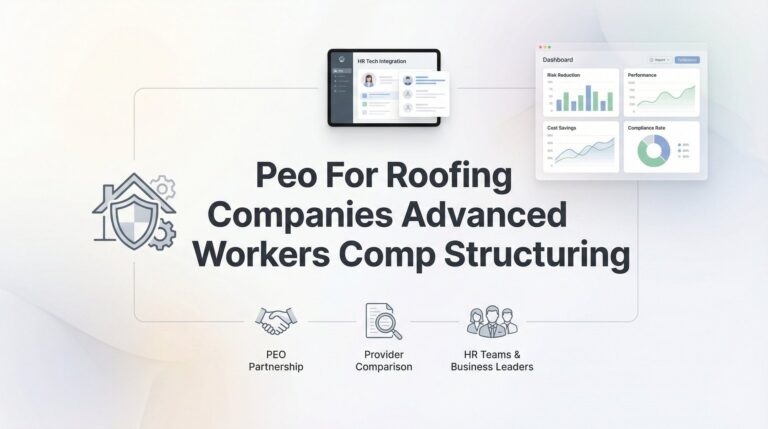
Roofing companies in NCCI class code 5551 face crushing workers’ comp premiums, but most contractors focus on choosing the wrong thing—the PEO itself rather than how workers’ comp gets structured within that partnership. This guide explains the specific structuring decisions for PEO workers’ comp programs that determine whether you access master policy pricing and loss-sensitive programs that reward your safety record, or end up subsidizing other contractors’ claims while your experience modi…
Enterprise roofing companies face compounding compliance challenges across multiple job sites, including rising workers’ comp costs, evolving OSHA requirements, and state-specific regulations. A PEO for roofing companies enterprise compliance risk management solution addresses these complexities through co-employment arrangements that handle multi-state licensing, safety documentation, HR administration, and experience modification rates—helping contractors maintain competitive bidding capabi…
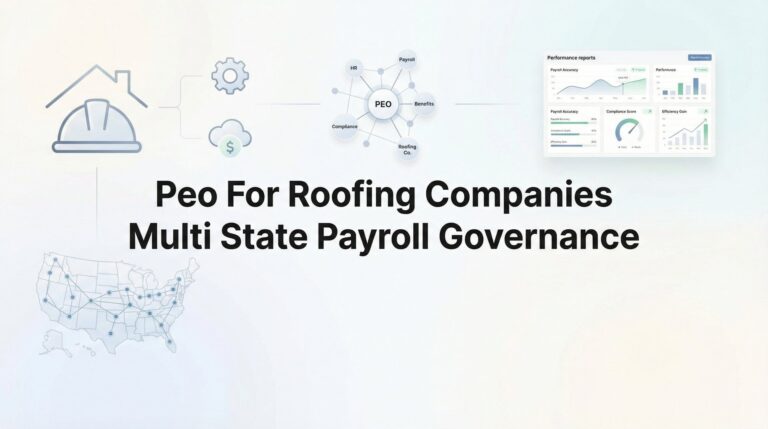
Roofing companies operating across state lines face complex multi-state payroll governance challenges, including varying withholding rules, workers’ comp requirements, and reporting obligations that can trigger penalties if mishandled. A PEO for roofing companies can centralize multi-state payroll governance and compliance burdens, though the value depends on your specific operational complexity and growth trajectory.
Acquiring a roofing company brings immediate workforce integration challenges—from mismatched payroll systems and benefits packages to workers’ comp policies and compliance across multiple states. A PEO for roofing companies M&A workforce integration strategy transforms post-acquisition chaos into a streamlined process, allowing you to consolidate HR systems, standardize benefits, and retain key crew members without spending months reconciling incompatible platforms or risking compliance gaps…
Landscaping companies paying 15-25% of payroll for workers’ comp can significantly reduce costs through a PEO for landscaping companies with advanced workers comp structuring. By joining a larger risk pool and accessing master policies, landscaping businesses can lower premiums on high-risk activities like tree removal and heavy equipment operation—but choosing the wrong PEO structure can actually increase costs or create coverage gaps for specialized services.
Acquiring a landscaping company brings immediate workforce challenges—30 new employees need paychecks, benefits, and compliance management your HR wasn’t built to handle. This guide explains how to use a PEO for landscaping companies M&A workforce integration strategy to absorb acquired crews, managing seasonal labor complexities, multi-state operations, workers’ comp classifications, and benefits harmonization that make landscaping acquisitions uniquely challenging without bleeding value thr…
Roofing companies struggling with workers’ comp costs consuming 15-25% of payroll and complex OSHA compliance can significantly reduce expenses through specialized PEOs. This guide evaluates seven PEOs specifically for their cost containment strategies in the roofing industry, ranking providers based on their proven ability to address construction-specific financial pressures rather than general popularity, helping contractors make informed decisions that directly impact their bottom line.
PEO workers comp coverage for subcontractors typically doesn’t exist because PEOs only cover W-2 employees through co-employment arrangements, not 1099 independent contractors. This creates a dangerous coverage gap where business owners assume everyone working under their direction is protected, but subcontractors who get injured on job sites remain completely uninsured—leaving the hiring company exposed to lawsuits and unexpected liability when the subcontractor lacks their own coverage.
Unclear service boundaries in PEO relationships lead to costly gaps in responsibility, especially during critical situations like harassment complaints or terminations. This PEO service boundary definition guide helps business owners map out exactly who handles what in the co-employment model, preventing the finger-pointing and compliance issues that arise when both parties assume the other is managing essential HR functions.
Warehousing operations typically spend 8-15% of payroll on workers’ comp, but standard PEO arrangements often misclassify facilities into generic categories that inflate costs. This guide reveals seven advanced PEO for warehousing advanced workers comp structuring techniques—including experience mod carve-outs, loss-sensitive programs, and precise workforce classifications—that help established warehousing operators optimize their workers’ compensation expenses beyond basic PEO enrollment.
When PEOs analyze your workers comp historical loss data, they often interpret your claims history very differently than you do—spotting liability patterns, open reserves, and classification mismatches that can drive quotes 30% higher than expected. Understanding how underwriters actually evaluate your loss runs before you shop for coverage helps you address fixable issues proactively and secure more accurate pricing.
A PEO risk review during due diligence is essential for M&A transactions because PEO relationships create co-employment structures that affect payroll tax liability, benefits continuity, and compliance exposure. Without proper review, acquirers face post-close surprises ranging from unexpected termination fees to unresolved tax liabilities and employee retention issues, making thorough PEO due diligence critical for accurately pricing deal risk and ensuring smooth workforce transitions.