
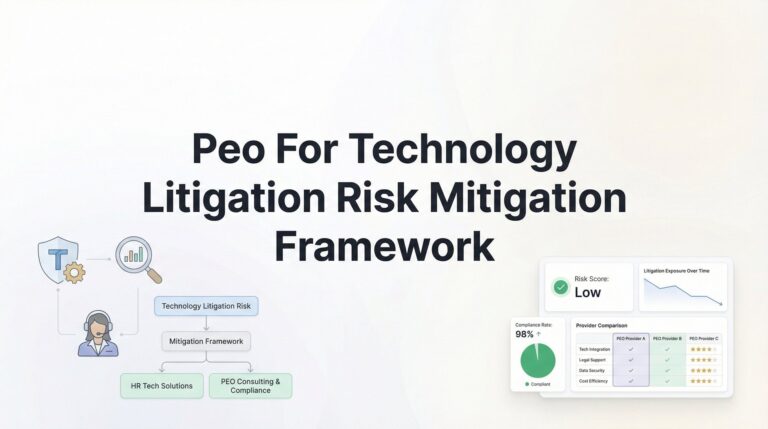
Technology companies face significant employment litigation risks, from IP theft claims to non-compete enforceability issues that can cost $80K+ to defend. This practical PEO for technology litigation risk mitigation framework helps tech companies distinguish between genuine risk reduction partnerships and basic payroll outsourcing, providing a structured approach to minimize employment-related legal exposure before investors start asking difficult questions.
Manufacturing firms expanding from 50 to 150+ workers face compounding HR challenges including shift management, safety certifications, workers’ comp exposure, and multi-state compliance. This guide presents seven targeted strategies for HR infrastructure scaling using PEO for manufacturing firms, addressing specific pain points like seasonal workforce fluctuations, OSHA requirements across locations, and shift-based compliance—without building costly internal HR departments that reduce opera…

Successfully merging construction workforces after an acquisition requires more than standard HR processes—you’re dealing with multi-state field workers, mismatched workers’ comp classifications, prevailing wage requirements, and union agreements that can’t afford payroll disruptions. A strategic PEO for construction M&A workforce integration helps provide the administrative infrastructure to unify different payroll systems, maintain safety compliance, and manage complex labor requirements wi…
Restaurant groups operating across multiple states face complex compliance challenges—from varying tip credit laws and predictive scheduling rules to jurisdiction-specific youth employment restrictions—that can result in costly DOL audits and settlements. A PEO for restaurants enterprise compliance risk management provides scalable, cost-effective solutions that deliver enterprise-grade HR infrastructure without requiring internal teams at every location, protecting multi-state operators from…
Staffing agencies experiencing rapid growth often struggle with HR infrastructure as payroll complexity, multi-site compliance, and benefits administration overwhelm back-office systems. This guide reveals seven strategic approaches to HR infrastructure scaling using PEO for staffing agencies, helping owners build scalable systems that handle worker placement growth from 50 to 150+ employees per quarter while maintaining compliance and freeing leadership to focus on revenue-generating client …
Restaurant operators face brutal 3-6% profit margins with labor costs consuming up to 35% of revenue, making every HR expense critical. A properly structured PEO for restaurants delivers measurable cost containment by directly reducing workers’ comp premiums, eliminating compliance penalties, and streamlining the expensive cycle of constant turnover—often saving more than the monthly fee by targeting the specific expense drivers that erode food service profitability.
Manufacturing M&A deals often collapse during workforce integration when HR teams face unexpected compliance gaps, varying safety protocols, and complex union considerations across 200+ inherited employees. This tactical guide shows how to structure a PEO engagement specifically for manufacturing acquisitions, addressing OSHA regulations, workers’ comp classifications, and legacy benefit structures to prevent the operational chaos that turns reasonable integration timelines into daily crises.
Technology companies experiencing rapid growth often struggle when HR infrastructure can’t keep pace with doubling headcount, multi-state hiring, and competitive benefits demands. This guide evaluates the nine best PEO providers for 2026 that specialize in hr infrastructure scaling using peo for technology companies, focusing on those that handle equity compensation, offer FAANG-competitive benefits, integrate with modern tech stacks, and manage the compliance complexities of distributed team…
Retail operators often overpay on workers comp because standard PEO arrangements misclassify multi-function employees, handle seasonal hiring poorly, and use generic retail codes that ignore store-specific risk profiles. Advanced PEO for retail workers comp structuring addresses job function ambiguity, experience mod volatility, and format-specific exposures to materially reduce premiums beyond what basic PEO switching achieves.
Tech companies often overpay for workers’ compensation because insurers use broad classification codes that don’t reflect actual risk profiles. A PEO for technology advanced workers’ comp structuring can significantly reduce premiums, but only when you actively manage workforce classifications and premium allocations rather than accepting default arrangements. This guide explains the tactical steps to align your workers’ comp costs with your company’s actual operations and risk exposure.
PEO contracts often contain data ownership clauses that can trigger unexpected costs—from five-figure extraction fees to operational disruptions during transitions. This guide provides seven practical strategies for conducting a thorough PEO data ownership clauses review financial impact analysis, helping business owners identify hidden expenses, negotiate better contract terms, and protect their employee data, payroll records, and compliance documentation before signing or renewing agreeme…

Logistics companies face structurally higher workers’ comp costs due to repetitive injuries, vehicle incidents, and multi-state complexity that drive experience mods upward. A PEO for logistics advanced workers comp structuring approach uses master policy pooling and classification optimization to fundamentally restructure how you access coverage, breaking the premium spiral that traditional risk management can’t solve—delivering actual cost reductions instead of incremental improvements.