
This article examines seven real-world PEO audit failure case examples — from workers’ comp surprises to payroll misclassification — explaining the root causes behind each costly mistake and providing actionable steps businesses can take to strengthen their PEO oversight before the next audit cycle.
PEO customer complaint pattern analysis goes beyond reading individual reviews to identifying recurring themes in billing errors, service failures, and response times that reveal how a provider truly operates. By examining complaint patterns across categories and timeframes, business owners can spot systemic operational problems before signing a contract — turning negative feedback into a powerful due diligence tool.
Manufacturing businesses face unique workers’ comp challenges that make a well-structured PEO workers’ comp strategy for manufacturing firms essential—from managing high-risk NCCI class codes and mod rates to negotiating comp structures that accurately reflect your facility’s actual exposure. This guide provides a practical, sequential framework for auditing current risk, evaluating PEO partnership terms, and implementing claims management processes tailored specifically to manufacturing envi…
PEO financial transparency concerns often go unnoticed until overpayments or accounting discrepancies surface, making proactive visibility essential. This guide outlines seven practical strategies to help business owners untangle bundled invoices, identify hidden costs, and gain clear insight into what they’re actually paying their PEO across payroll taxes, benefits, and administrative fees.
This PEO termination difficulty review examines why leaving a professional employer organization is far more complex than canceling a typical vendor contract, covering the specific friction points business owners face when dismantling co-employment structures. From tax ID transitions and benefits disruptions to contract clauses with significant financial exposure, understanding these challenges before signing—or before exiting—can save considerable time and money.
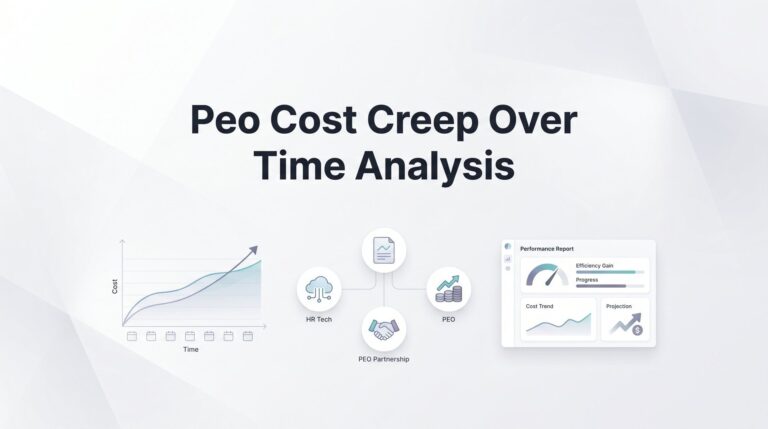
PEO cost creep over time analysis reveals how businesses often pay significantly more in years three and four of a PEO contract without any obvious rate increases or added services. This guide breaks down the structural pricing mechanisms that quietly drive up per-employee costs, how to measure the drift in your own invoices, and what steps you can take to stop overpaying before the gap widens further.
Many business owners mistakenly believe PEO agreements transfer their employment liability, but these co-employment arrangements create complex shared obligations that courts often ignore when naming defendants. This guide examines seven real-world PEO lawsuit exposure scenarios that repeatedly blindside business owners, helping them identify actual risk, negotiate stronger contracts, and avoid costly legal surprises.
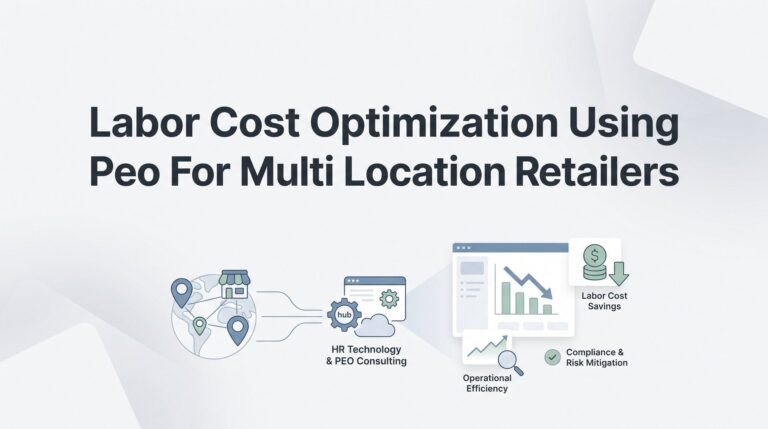
Multi-location retailers struggling with fragmented payroll, inconsistent benefits, and rising state-by-state compliance costs can achieve meaningful labor cost optimization using a PEO to consolidate workforce management across all stores. This guide breaks down exactly how franchisees and regional chains with 8 to 50+ locations can strategically leverage a Professional Employer Organization to reduce waste, standardize benefits enrollment, and control workers’ comp rates at scale.
PEO vendor lock-in risks are more complex than termination fees alone — co-employment structures tie your W-2s, health plans, and tax filings to your provider in ways that make switching costly and complicated. This guide explains exactly where dependencies form, what they actually cost when you want to leave, and practical steps to protect your flexibility before signing a PEO contract.
Identifying PEO service level agreement gaps before they create compliance exposure or operational disruptions requires the right analytical tools. This guide covers eight specialized solutions for reviewing PEO contracts, flagging vague language around payroll timelines, benefits administration, and termination clauses, and monitoring ongoing SLA performance—helping businesses avoid costly surprises hidden in dense PEO agreements.
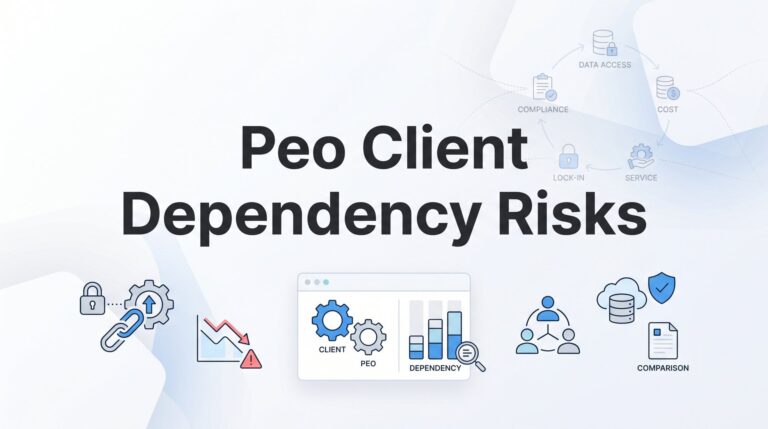
PEO client dependency risks become a serious concern when businesses realize how deeply integrated a Professional Employer Organization becomes across payroll, benefits, compliance, and HR systems after just a few years. This guide examines what it actually takes to exit a PEO relationship, why it’s more complicated than most business owners expect, and how to protect your flexibility before you need it.
A PEO ROI analysis for construction companies requires far more than plugging headcount into a generic calculator — it must account for trade-specific workers’ comp rates, seasonal workforce fluctuations, EMR impact, and prevailing wage compliance. This guide walks construction business owners through a realistic, industry-specific framework to accurately compare true costs before and after partnering with a PEO.