

The 8:58 a.m. parking lot sprint is a management problem wearing a personal-habits mask. Someone is locking the car, juggling a laptop, scanning Slack on a phone, and blaming traffic. HR sees the same story from the other side, a late badge swipe, a missed handoff, a manager who is tired of excuses, and a schedule that never left enough margin to begin with.
Getting to work on time is not mainly about willpower. It's about how much slack exists before the workday starts, how much of that slack is eaten by commute variability, and whether the company has built a system that can absorb normal disruption. That's why the practical answer has to serve both the individual trying to leave on time and the employer trying to stop lateness from becoming a recurring cost.
Practical rule: if a workday starts with zero buffer, it is already late.
Table of Contents
- Why Being on Time Is Harder Than It Looks
- The Night-Before Routine That Prevents Morning Chaos
- A Morning Protocol That Builds Real Slack
- Planning Your Commute and Backup Routes
- Employer-Level Schedule Options That Cut Lateness
- Writing an Attendance Policy That Actually Enforces
- Putting It Together This Week
Why Being on Time Is Harder Than It Looks
The 8:58 a.m. parking lot sprint is not a character test, it's what happens when too many mornings are designed with no margin. A worker can leave home “on time” and still walk in late because the commute, the parking, the elevator, the coffee run, and the last-minute message all stack up. That's why lateness should be treated as a systems failure, not a personality defect.
The numbers back that up. In Canada, Statistics Canada reported that in 2005 commuters spent an average of 63 minutes on the round trip between home and work, and in 2021 the average one-way commuting time across all modes was 23.7 minutes, down from 26.2 minutes in 2016, showing that even modest changes in commute conditions can shift the daily time burden in a meaningful way, according to Statistics Canada's published commuting data. In the U.S., the average one-way commute reached 27.6 minutes in 2019, which means many workers are already spending close to half an hour before parking, security, or an elevator is even part of the picture, as reported by the U.S. Census Bureau.
The practical point is simple. A person who leaves home at 8:00 a.m. for a 9:00 a.m. start is not working with a full hour of flexibility. The commute alone can consume most of that cushion, and one small delay turns into a late arrival fast.
One survey-based summary reported that 19% of Americans are late for work at least once a week, while 48% said they are never late. A later summary cited by Zippia found that 29% of employees admit to being late at least once per month, and that lateness costs the U.S. about $3 billion annually, or roughly $500 to $600 per employee each year, as summarized in Forbes. That is not a trivial annoyance. It affects productivity, attendance, and the tone managers bring into the day.
$3 billion annually is what chronic lateness costs the U.S. economy.
For HR directors and business owners, the lesson is blunt. Stop treating punctuality as a moral lecture. Start treating it as a design problem with a measurable cost.
The Night-Before Routine That Prevents Morning Chaos
Most morning lateness starts the night before, not at the alarm. The clothes are still in the dryer, the laptop is still on the kitchen counter, the lunch is still in the fridge in pieces, and nobody has checked tomorrow's calendar. By the time the first alarm goes off, the work of deciding is already creating delay.
Build the evening checklist around friction, not perfection
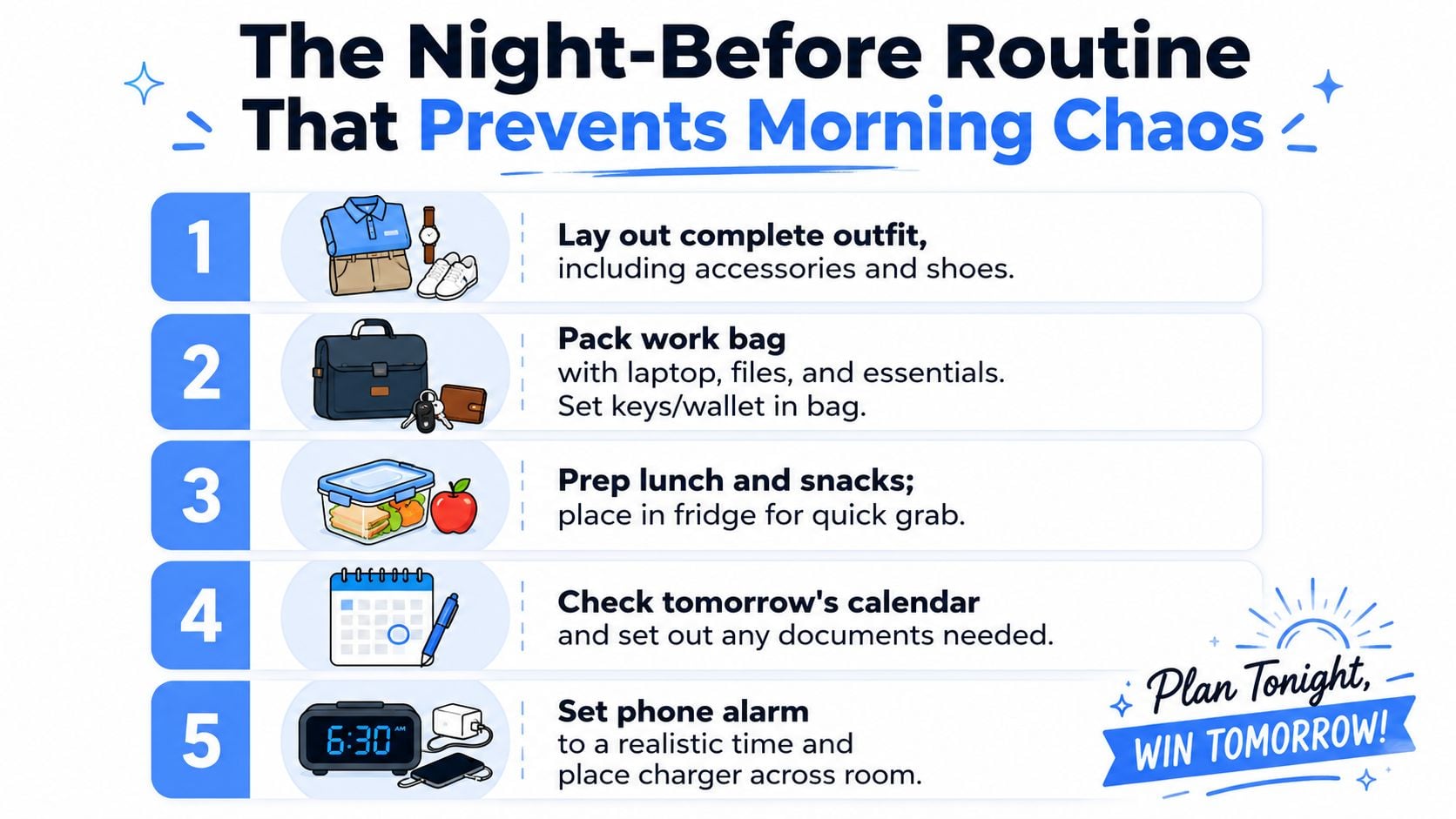
A useful night-before routine is short and repeatable. Lay out the full outfit, including shoes and accessories. Pack the work bag with the laptop, charger, notebook, files, and anything needed for the next day. Put keys, wallet, transit card, and badge in the bag or by the door so they aren't hunted for at 7:45 a.m.
That same routine should include lunch and a quick calendar scan. If the next day needs printed documents, a presentation folder, or a client file, set it out before bedtime. If the day starts early, load the phone and place the charger across the room so the alarm forces a real exit from bed.
A parent with two kids can cut a meaningful chunk of morning pressure by handling three simple prep steps after dinner, outfit, lunch, and bag. The point is not to make the evening busier. The point is to move low-value decisions out of the most rushed hour of the day.
Pack for the morning you'll actually have, not the one you hope will happen.
A lot of advice drifts into busywork, like reorganizing a bag for the sake of feeling organized. Skip that. Focus on the tasks that remove actual morning friction. If a step doesn't save a decision, a search, or a stop on the way out, it probably doesn't matter.
For employers building a broader attendance playbook, this is the employee-side habit that deserves reinforcement. A short checklist beats a lecture every time. Teams that need a structured policy foundation can also anchor it in a broader wage and hour compliance framework.
A Morning Protocol That Builds Real Slack
A workable morning is not a heroic rush. It's a sequence with buffers. The moment a person treats the morning as a point estimate, “I need 42 minutes,” the whole plan becomes fragile. The better model is departure planning with hard checkpoints.
Use two checkpoints, ready to leave and out the door
Start with a first alarm that is early enough to absorb the basic routine. A second alarm should mark the exact departure time, not just another reminder to keep moving. That creates two separate thresholds, one for being ready and one for leaving.
The final stretch should be screen-free. No email, no social media, no “quick” check of Slack. Those last five to ten minutes are where lateness multiplies because one tiny task spills into the next. A hard stop prevents that spillover.
A practical version looks like this. Spend about 25 minutes from first alarm to dressed, 10 minutes on breakfast and bag check, and the last 5 minutes as an exit window you commit to. That pattern mirrors guidance that favors staged alarms, commute buffers, and deliberate departure planning, as outlined in Schneider Jobs' punctuality protocol.
The same logic shows up in time-blocking guidance. Productivity advice recommends creating predictable transition points, including 25-minute focus blocks with 5-minute breaks or 52-minute work / 17-minute rest cycles, because fixed cycles make it easier to stop on time and leave without drift, as discussed by Fast Company. The point is not the exact cadence. The point is that a hard stop is easier to honor than a vague intention.
If there are only five minutes left, work stops. Save, close, leave.
For people who work from home some days and commute on others, the same protocol still matters. The out-the-door habit may become a meeting-join habit, but the underlying rule is unchanged. Build a buffer, set a hard checkpoint, and stop trying to squeeze one more task into the last minute.
Planning Your Commute and Backup Routes
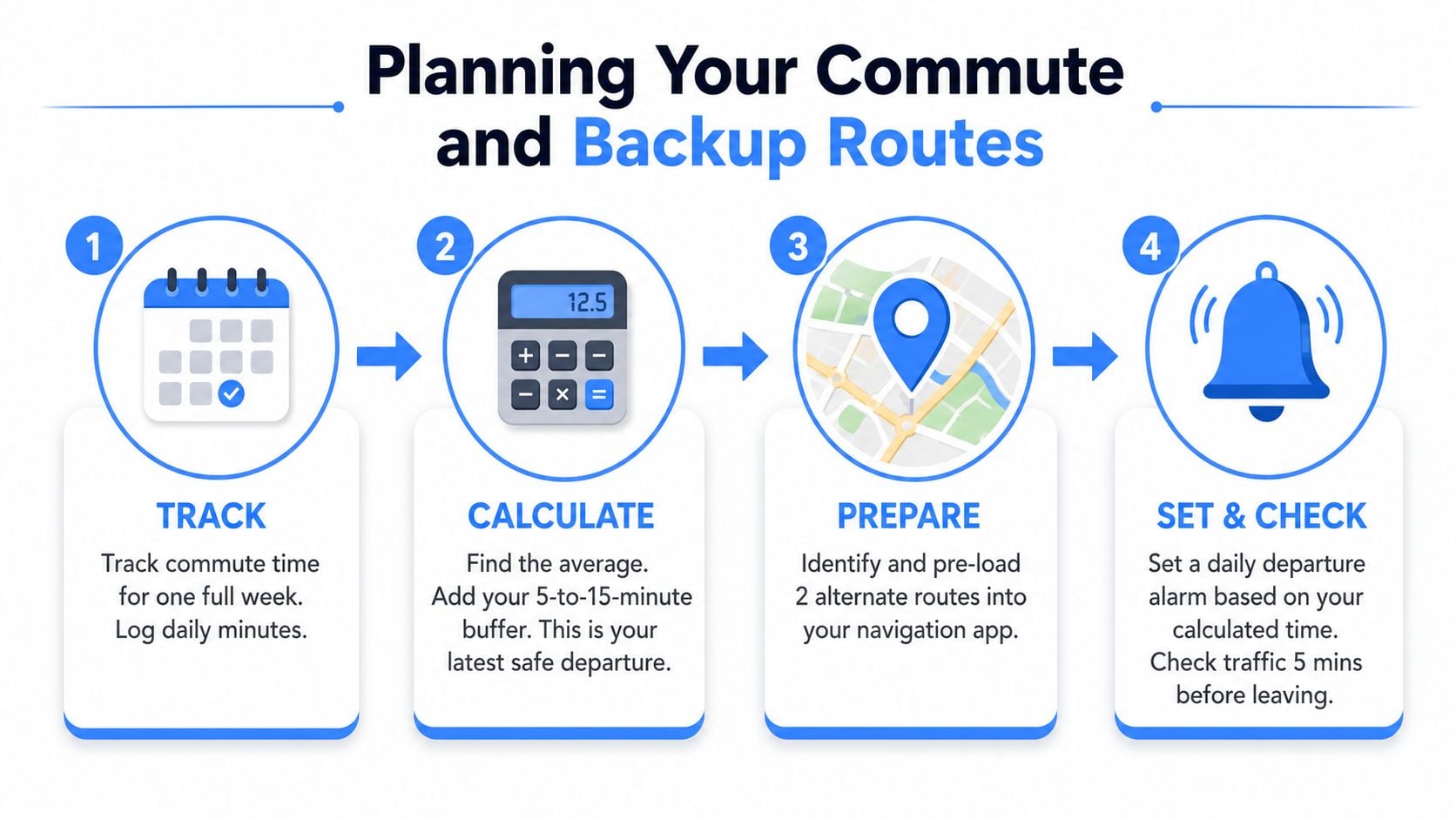
Commute time should be measured, not assumed. A person who guesses based on the best day of the week is building a lie into the morning. The better move is to time the trip across a full week, identify the average, and then add a buffer.
Time the trip before you trust it
Use a full week of commute times, not one good day. Then set the latest safe departure time and add a buffer of 5 to 15 minutes, which lines up with practical punctuality guidance to build slack into even conservative estimates, including Quartz's recommendation to add 5 minutes to your best timing guess and Indeed's advice to leave 10 to 15 minutes early when traffic is likely, along with its reminder guidance for meetings.
That buffer matters because commute time is only one part of the trip. Parking, security, elevators, weather, and transit handoffs all eat seconds and minutes that people rarely count. The more variable the route, the less confidence anyone should have in a bare-minimum departure time.
A useful adjacent resource for teams that manage newsletters and timing-heavy communications is NewsletterAsAService's timing research. The context is different, but the lesson is similar, timing is a system, not a guess.
Build a backup route and rehearse the decision
A backup plan should be specific enough to use under pressure. If traffic stalls, route B should already be saved in the navigation app. If transit fails, the rideshare fallback should already be costed out in the worker's head, even if it's only for true emergencies. If bad weather hits, the departure alarm should move earlier that day, not after the delay has already begun.
For distributed teams, the same discipline applies to handoffs and arrival expectations. Companies that manage hybrid staff need cleaner rules for timing and responsiveness, which is why a structured distributed team approach matters as much as commute planning.
A direct way to think about this is simple:
- Track the commute for one full week. Log the actual minutes.
- Add your buffer. Use 5 to 15 minutes, not wishful thinking.
- Preload two alternate routes. Don't improvise while stuck in traffic.
- Set the departure alarm. Check traffic five minutes before leaving.
Employer-Level Schedule Options That Cut Lateness
The fastest way to reduce lateness is often not another warning. It's a schedule design change. If the workforce mix includes caregivers, long commuters, and roles that don't require everyone on-site at the same second, rigidity creates lateness the business could have avoided.
Compare flexibility before you compare discipline
Flexible start windows usually deliver the most practical relief for knowledge workers because they absorb normal commute variability without lowering standards. Staggered shifts help when a company has overlapping teams, especially in operations, customer service, and light manufacturing. Hybrid arrangements can also reduce lateness pressure by cutting the number of days a worker has to beat traffic at all.
| Schedule Option | Best Fit | Implementation Effort | Expected Lateness Impact |
|---|---|---|---|
| Flexible start window | Salaried teams, client services, project work | Moderate | Strong when lateness comes from commute volatility |
| Staggered shifts | Hourly teams, shared equipment, multi-shift operations | Moderate to high | Strong when arrival congestion is the problem |
| Hybrid schedule | Knowledge workers, roles with digital output | High | Strong when commute burden is recurring |
| Compressed workweek | Roles with stable workload and manager buy-in | Moderate | Mixed, useful for reducing commute days rather than daily lateness |
A 180-person professional services firm that moved to a 30-minute flex window reduced monthly lateness incidents by 38%. That example matters because it shows what policy can do when the schedule matches the work. Discipline letters rarely solve a mismatch between start-time rigidity and real-world commute conditions.
Schedule design beats repeated reminders when the root problem is predictable delay.
For employers trying to evaluate whether stable scheduling helps the broader operation, TimeTackle's discussion of stable scheduling and productivity is a useful complement. The main point is consistent. Predictable schedules reduce scramble, and reduced scramble makes punctuality easier to sustain.
This is also where a structured human resources outsourcing model can help smaller firms. When a business does not have deep internal HR capacity, schedule policy often stays informal for too long, and informal policy is where enforcement gets messy.
Writing an Attendance Policy That Actually Enforces
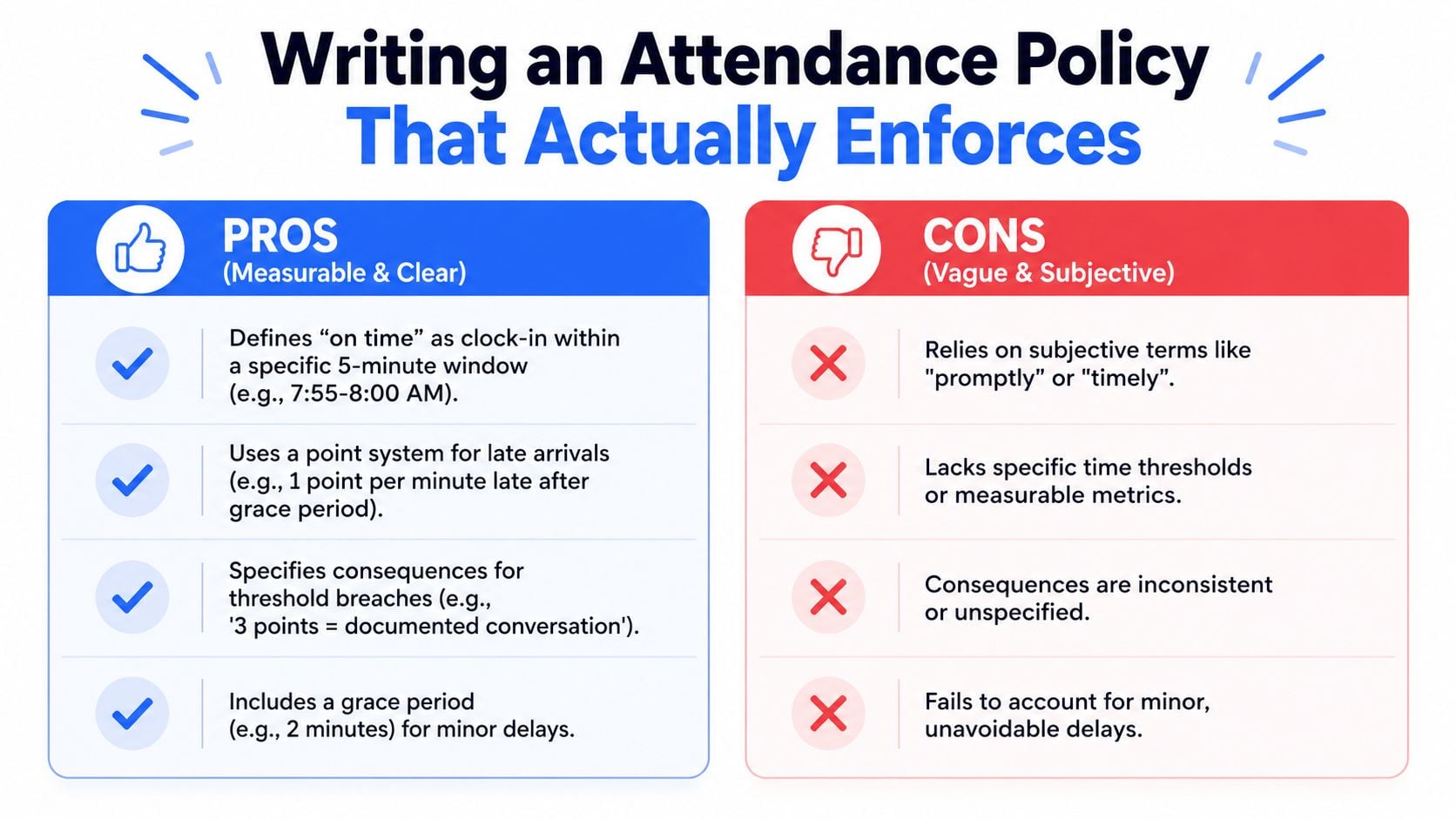
A policy that says “be on time” is not a policy. It's a complaint. If managers are supposed to enforce punctuality, the rule has to be written in minutes, not moods. That means defining the start time, the grace period if one exists, and the notification process before anyone starts arguing about intent.
Make the standard measurable and public
A useful baseline is to define on time in exact terms, then require a lateness notice through direct message to the manager within 15 minutes of the start time. A policy can also treat lateness as a pattern when it happens more than 3 times in a rolling 30-day window, which gives managers a cleaner trigger for escalation, consistent with documented workplace guidance.
That kind of specificity matters because it removes the guessing game. Managers stop deciding case by case whether a person “really” counts as late. The company also gets a defensible way to distinguish between an occasional bad day and a chronic pattern.
The policy should also reflect hybrid work. Punctuality no longer means only walking through a door. It also means responding on time in the channels the team uses, joining meetings when expected, and not creating bottlenecks in handoffs. Recent workplace commentary on Gen Z and modern coordination norms makes the broader point clear, punctuality now includes responsiveness across channels, not just physical arrival, as discussed by The Washington Post.
Pair the rule with progressive discipline
A strong attendance policy should not jump straight from one late arrival to termination. It should distinguish between occasional delay, repeated lateness, and failure to notify. That gives managers room to coach first, document second, and escalate when the pattern is clear.
The handbook also needs to tell employees where the standard lives. If that language is buried in a training slide, nobody will use it. A clearer version belongs in onboarding and the employee handbook, and companies can tighten that language with a handbook structure built for small businesses.
The best attendance policy is short enough to enforce and specific enough to survive a dispute.
For hybrid teams, one more rule helps. Define response expectations for asynchronous channels so “I saw it later” is not treated as punctual participation. That closes the gap between office time and digital time, which is where many modern lateness problems now live.
Putting It Together This Week
A lot of lateness problems look personal on the surface, then turn out to be a scheduling, handoff, or policy problem once you trace the week. The fix this week is straightforward. Strip out the obvious friction, write the attendance rules in plain language, and make sure managers can enforce them.
A 7-day starting plan
For employees, Monday through Wednesday should be commute-tracking days. Track the actual departure time, not the hoped-for one, and note where the delay starts. Thursday should be buffer-setting day, with a departure alarm and a screen-free final stretch. Friday should be a full dress rehearsal, outfit laid out, bag packed, route loaded, and departure time tested against reality.
For HR and operations leaders, the same week should expose whether the schedule is part of the problem. If everyone is racing the clock because the shift starts too early for the commute, fix the shift. If one team needs more flexibility than another, write that down instead of leaving it to manager discretion. A flex window, a staggered shift, or a tighter hybrid expectation usually does more than another round of reminders.
The attendance policy has to be written where people will find it. If it lives only in a training deck, it will be ignored the moment a manager needs to apply it. Put the rule in onboarding and the employee handbook, and use a employee handbook guide for small businesses if the company needs a clean starting point for attendance language, time-tracking rules, and the rest of the handbook structure.
A PEO relationship can help here if the company needs support with standardized employee handbook templates for small businesses, time-tracking integrations, and multi-state compliance review. That matters most when a business has no dedicated HR staff and still needs attendance rules that are consistent, readable, and safer to enforce than whatever a manager remembers from last quarter.
The takeaway is direct. Getting to work on time is a systems problem, and systems can be changed. Treat the commute like a variable, the morning like a protocol, and the workplace like a place where schedule design either supports punctuality or keeps creating the same late arrival.
