How PEOs work across industries like construction, healthcare, startups, and multi-state employers.
Choosing the right HVAC PEO for 100 employees requires evaluating partners based on industry-specific needs like workers’ comp experience mods, seasonal workforce management, and multi-state compliance rather than generic HR criteria. These seven targeted strategies help HVAC companies at this critical growth stage select a PEO that addresses field crew challenges, high-risk work classifications, and the unique operational demands of managing technicians across multiple job sites without the …
General Contractors PEO Payroll Services transform how construction businesses handle multi-site payroll by managing certified payroll requirements, project-based labor tracking, workers’ comp class code allocation, and prevailing wage compliance in one system. Unlike generic payroll solutions, construction-focused PEOs address the unique challenges of fluctuating crew sizes, mid-week project transfers, and Davis-Bacon reporting that office-based payroll systems can’t handle effectively.
General contractors facing tight margins and crew retention challenges can access Fortune 500-level health insurance and retirement benefits through a PEO (Professional Employer Organization) by pooling with other small businesses. This guide examines the real costs, coverage improvements, and specific scenarios where general contractors employee benefits through PEO arrangements make financial sense versus when traditional insurance remains the better option for construction operations.
Professional Employer Organizations (PEOs) offer general contractors potential benefits like reduced insurance costs and simplified compliance, but construction-specific challenges—including seasonal workforce fluctuations, high-risk trade coverage limitations, and specialized payroll requirements like certified payroll—mean these services don’t always deliver on their promises for GCs the way they do for other industries.
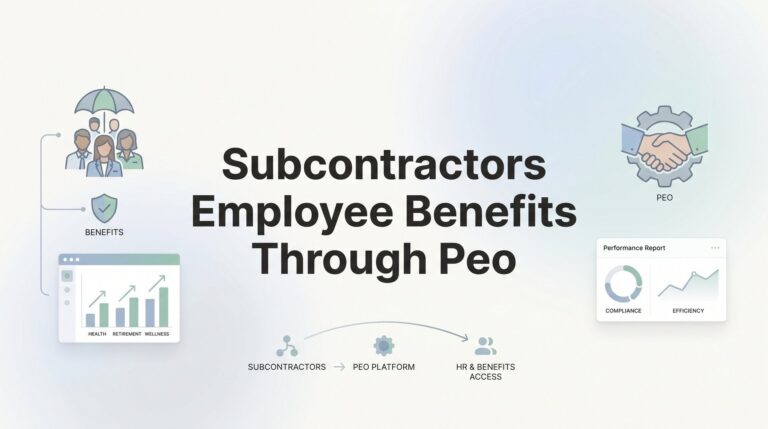
PEOs typically can’t provide subcontractors employee benefits through PEO arrangements because co-employment models are designed for W-2 employees, not 1099 workers. This guide clarifies the legal constraints, identifies the rare scenarios where PEO benefits might work for subcontractors, and presents practical alternatives to help you retain skilled workers without falling for marketing promises that don’t match reality.
A General Contractors PEO Workers Compensation Program offers master policy coverage that can stabilize premiums and reduce administrative burden, but it’s not a universal solution. This guide examines what these programs actually cover, their cost structures, and helps general contractors determine whether joining a PEO makes financial and operational sense compared to traditional workers comp policies—especially considering the trade-offs in control, flexibility, and long-term pricing.
Finding the right plumbing PEO for 15 employees requires strategies tailored to your unique challenges—high workers’ comp exposure, skilled labor shortages, prevailing wage compliance, and competitive benefits that retain licensed tradespeople. This guide provides seven plumbing-specific evaluation criteria to help mid-sized plumbing companies select a PEO partner that understands the realities of managing service crews, job site risks, and apprenticeship requirements, rather than applying ge…
Subcontractors with 15 employees face unique challenges when evaluating PEO services, including workers’ comp classification complexities, seasonal workforce fluctuations, and mixed W-2/1099 arrangements that don’t fit standard PEO models. This guide provides seven practical strategies to determine if a subcontractors PEO for 15 employees makes financial and operational sense for your business, addressing industry-specific complications like rotating crew sizes, multiple trade classifications…
Subcontracting businesses with 25 employees face unique HR challenges that generic PEO solutions often overlook, including fluctuating crew sizes, multi-state payroll complexities, and project-based hiring cycles. This guide provides seven targeted strategies to help subcontractors evaluate PEO services that accommodate their variable headcounts, mobile workforces, and contractor-specific insurance requirements—ensuring administrative efficiency without sacrificing the flexibility essential t…
Managing 100 employees as a subcontractor creates unique challenges with multi-site compliance, workers’ comp costs, and fluctuating cash flow between projects. This guide outlines seven strategic approaches to selecting and implementing a subcontractors PEO for 100 employees that addresses construction-specific needs like rapid insurance certificate delivery, classification management across job sites, and scalable HR support that aligns with your project pipeline rather than adding fixed ov…
