Deep dives into payroll, benefits administration, HR support, onboarding, and operational shifts inside a PEO arrangement.
Partial PEO services configuration allows businesses to outsource only specific HR functions—like benefits, compliance, or payroll—while maintaining control over other areas. This guide reviews the nine best platforms and providers offering modular, flexible PEO solutions that let you customize services to match your exact business needs without committing to a full-service package.
Most business owners receive overwhelming PEO payroll reports that don’t answer critical questions about correct charges, tax payments, or cost optimization. Understanding the right peo payroll reporting framework means knowing which reports to demand, how to interpret them, and what red flags indicate billing errors or compliance issues—turning confusing spreadsheets into actionable financial intelligence that protects your bottom line.
Many businesses assume they must choose between their trusted benefits broker and a PEO’s master health plan, but hybrid arrangements allow you to keep both when structured correctly. Understanding PEO plus benefits broker alignment helps you navigate this decision strategically—preserving valuable broker relationships while gaining PEO efficiencies in payroll and compliance, though neither party typically promotes these options due to conflicting financial incentives.
A PEO payroll-only hybrid structure allows businesses to keep payroll processing in-house while outsourcing benefits administration and HR compliance to a PEO through co-employment. This arrangement works best for companies with capable internal teams who want to maintain payroll control while accessing better benefits pricing and reducing compliance risk, though it requires managing two separate systems and coordinating between providers.
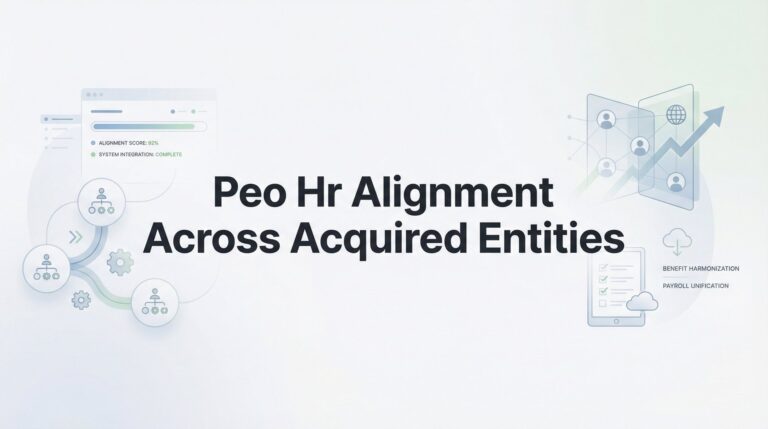
After acquiring multiple companies, scattered HR systems create operational chaos with misaligned payroll, benefits, and compliance across entities. This guide provides a strategic framework for using a PEO to consolidate HR operations across acquired entities, helping you determine when consolidation makes sense and avoid integration mistakes that turn successful acquisitions into administrative nightmares.
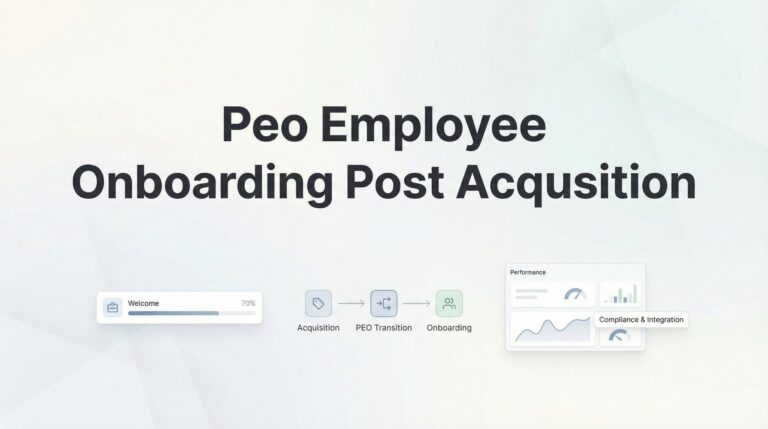
Successfully onboarding acquired employees through your PEO requires immediate action on payroll, benefits, and communication—not months of transition planning. This post-acquisition playbook shows how to leverage your existing PEO relationship to consolidate 47+ new employees into one unified system while preventing the retention crisis that happens when acquired staff face paycheck delays, insurance gaps, and uncertainty about their benefits during those critical first weeks.
Successfully integrating your PEO with an existing HRIS platform requires strategic planning from contract negotiation through ongoing maintenance. This practical walkthrough covers essential steps including pre-contract audits, data mapping protocols, technical decision points, and common sync error prevention—helping you avoid duplicate work and data conflicts while maintaining your current system investment in platforms like Workday, BambooHR, or UKG.

This practical guide shows you how to establish PEO integration with ATS systems to eliminate duplicate data entry and streamline the transition from candidate to employee. You’ll learn the realistic integration options available beyond vendor marketing claims, effective workarounds when direct API connections aren’t possible, and how to evaluate whether connecting your systems is worth the investment for your organization’s specific hiring volume and needs.
Building a PEO workforce harmonization strategy means aligning fragmented benefit plans, compliance frameworks, and HR processes across multiple states or merged teams without disrupting operations or losing talent. This practical guide covers the essential steps: auditing your current workforce structure, defining what harmonization means for your organization, negotiating the right PEO partnership, and managing employee transitions effectively—whether you’re consolidating after an acquisiti…
Post-acquisition HR consolidation through a PEO can accelerate integration and reduce administrative chaos when merging workforces, but requires strategic planning to avoid retention issues and benefits gaps. This step-by-step guide covers how to assess whether PEO HR consolidation after acquisition fits your deal, navigate benefits harmonization, align payroll systems, and execute a smooth transition that protects employee experience while delivering integration value on your timeline.
