
A Tampa HR director can sit in a pricing meeting with three PEO proposals and still leave with more questions than answers. The admin fee looks close. The benefits brochure looks polished. The sales rep keeps saying the service is “local,” as if a nearby office automatically means better outcomes.
That's the wrong filter for peo tampa fl buyers. Tampa is not a thin market where the nearest provider wins by default. It's a crowded Florida market with enough provider density to force real comparison, which means the buyer who gets sharp on service depth, contract flexibility, and total cost usually wins the deal.
Table of Contents
- Why Tampa Buyers Approach PEO Decisions the Wrong Way
- Mapping Your Tampa Workforce Profile Before You Shop
- Tampa-Based vs National PEOs Where Each Actually Wins
- Benchmarking Total Cost Beyond the Headline Rate
- Contract Risk Flags Tampa Employers Miss Most Often
- Negotiation Levers That Move PEO Pricing and Terms
- Your Next Step Toward an Independent Tampa PEO Analysis
Why Tampa Buyers Approach PEO Decisions the Wrong Way
A 180-employee Tampa company often gets three proposals that feel nearly identical at first glance. Same promise of payroll relief. Same benefits access. Same polished slide about compliance support. The HR director then hears a familiar sales line, “We're local, so service will be better,” and that's usually where the conversation goes sideways.
That claim is too lazy for a serious buyer. In a Florida PEO arrangement, the setup is co-employment, which means the PEO handles employer-side administrative functions for tax and HR purposes while the client still runs the business. Managers still direct hiring, scheduling, performance, and termination decisions, so the key question is not whether the PEO is physically near Tampa, it's whether the provider can execute the administrative side without creating payroll, benefits, or reporting friction.
A better standard is simple. Which PEO can explain its service model clearly, support implementation without hand-holding every week, and survive contract scrutiny when the buyer starts asking about rate changes and exit terms? That is where local and national providers separate.
Practical rule: proximity is a convenience, not a decision criterion. Service quality shows up in response times, clean reporting, and contract clarity, not in a Tampa zip code.
That's why a buyer should pressure-test the proposal against the actual operating model, not the sales script. A provider may be a smart fit for a 40-person Florida-only business and a poor fit for a company with even light multi-state complexity. For a useful outside lens on how advisors reduce noise in that process, how advisors save you money is a relevant comparison point because the same logic applies, separate the sales pitch from the economic value.
The right question isn't “Which PEO is local?” It's, “Which PEO can defend its pricing, benefits, and service model when the buyer asks for specifics?” That shift alone eliminates most weak-fit vendors.
Mapping Your Tampa Workforce Profile Before You Shop
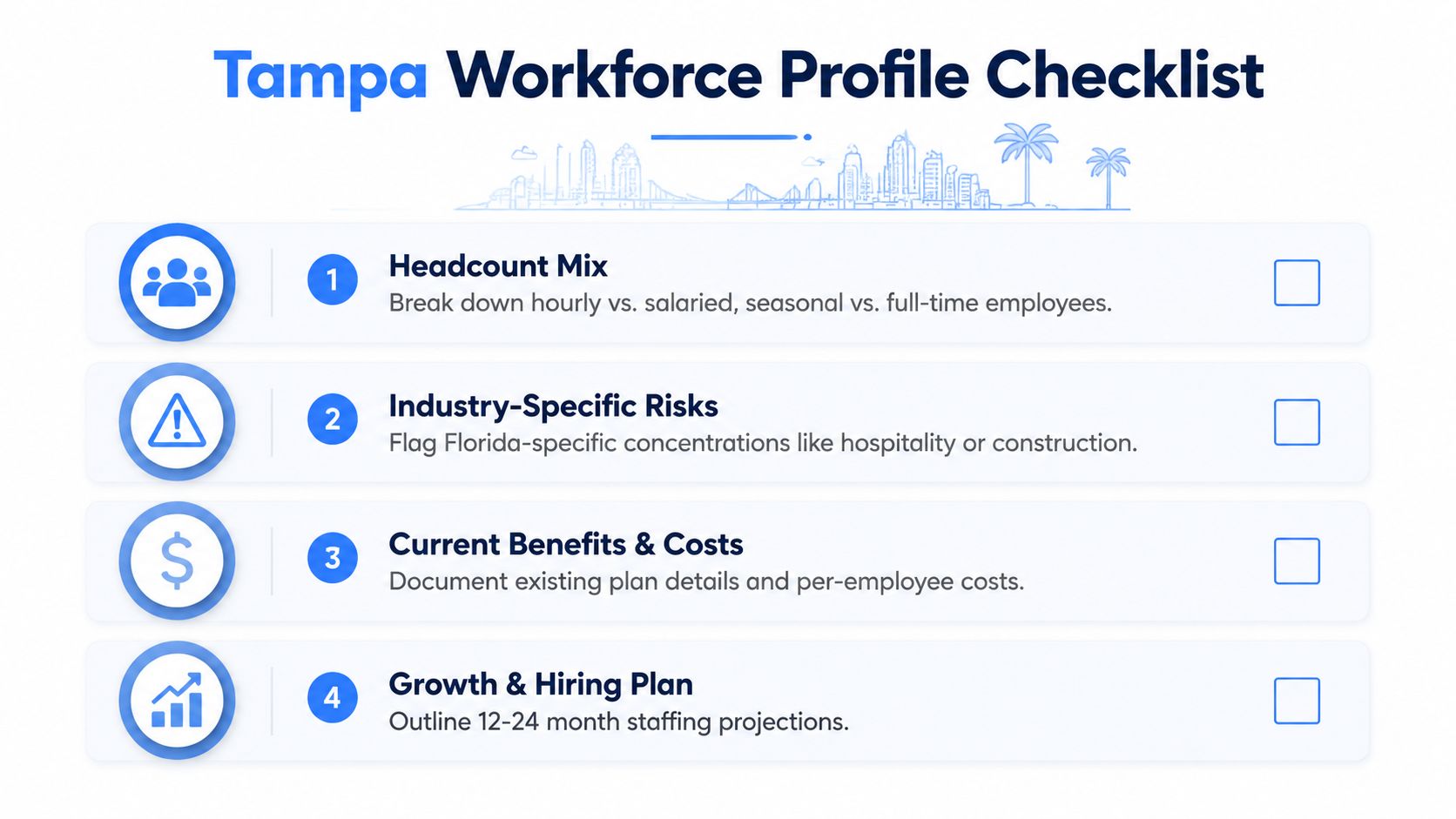
The first mistake Tampa buyers make is shopping before they know what they need. A PEO quote should match the workforce profile, not a vendor's default package. That means a written one-page summary before the RFP goes out, not after the first demo.
Headcount shape changes the answer
A 60-person Tampa manufacturing shop with seasonal swings will usually care more about onboarding speed, workers' comp handling, and payroll discipline than a 250-person professional services firm with steady headcount. The first team needs a provider that can absorb volatility without turning every change into an account service ticket. The second team needs clean benefits administration, stronger reporting, and contract terms that won't punish future growth.
A useful profile includes the following:
- Headcount mix: hourly or salaried, full-time or seasonal, Florida-only or multi-state.
- Industry risk: tourism, manufacturing, construction, healthcare, or office-based work all create different exposure points.
- Benefits posture: keep current plans, replace them, or use the PEO to consolidate offerings.
- Hiring plan: whether the business expects flat staffing or a meaningful change in the next 12 to 24 months.
The Tampa buyer should also think about Florida-specific pressure points. Multi-county payroll can create admin complexity. Tourism-heavy staffing can mean more turnover and more change management. Healthcare access matters too, because broad network promises don't automatically translate into practical access for employees.
For a smaller employer, the best starting point is a clean profile and a narrow RFP. The PEO for small business overview is useful only if it's used as a filter, not as a sales path. The point is to force vendors to quote against reality.
A one-page workforce profile saves weeks of proposal meetings because it stops vendors from selling their favorite configuration and starts making them price the employer's actual risk and staffing pattern.
If the profile is specific, the proposals become specific. If it's vague, every quote will look attractive and none of them will be decision-ready.
Tampa-Based vs National PEOs Where Each Actually Wins
The local-versus-national argument gets oversimplified fast. Tampa-based providers do not win just because they're nearby, and national providers do not win just because they're bigger. The primary distinction is service depth versus scale depth.
| Tampa PEO Comparison Criteria That Actually Matter | Local Florida PEO | National PEO |
|---|---|---|
| Decision Criterion | Often stronger on face-to-face access and faster local escalation | Often stronger on multi-state infrastructure and broader technology |
| Workers' Comp Handling | Can be attractive when the buyer wants close attention to Florida reporting details | Can be strong if the employer needs standardized handling across states |
| Benefits Access | May be narrower depending on carrier relationships | Often broader because of larger buying power and national carrier relationships |
| Implementation Support | Can feel more hands-on for Florida-only teams | Can be better for distributed rollouts with repeatable playbooks |
| Contract Flexibility | Varies widely, local does not automatically mean flexible | Varies widely, national does not automatically mean rigid |
For Florida buyers, the reporting side matters. NCCI's Florida guidance on PEO coverage shows that the policy model is not just a bundle, it requires separate handling of PEO and client policies and specific endorsement treatment. That matters because sloppy implementation can distort claims attribution and premium reporting, which is exactly the kind of pain that shows up after the contract is signed, not before.
National providers usually win when the workforce is spread out. A Tampa company with 120 employees split between Florida and Georgia should usually weight national options higher than a Florida-only provider unless the local firm has a proven multi-state service stack. The employer needs benefits consistency, payroll coordination, and a system that does not buckle when the footprint expands.
Local providers still have a place. A Florida-heavy company that wants tighter in-state claims handling and easier meetings with account teams can get real value from regional depth. The PEOs in Florida resource is relevant because it makes the market feel less abstract, but the buyer still needs to decide based on how work gets done.
The blunt takeaway is this. Geography is secondary. Service model is primary. A Tampa address is useful only if it improves execution on payroll, compliance, benefits, and contract responsiveness.
Benchmarking Total Cost Beyond the Headline Rate
The headline fee is where weak buyers stop. That is how they get burned. A PEO quote can look cheap while hiding a more expensive workers' comp structure, a soft benefits markup, or a renewal clause that resets the economics in year two.
Build the comparison around all-in cost
Florida's PEO market is crowded enough that Tampa buyers should expect real pressure on price and terms. Industry estimates place statewide payroll processing in the tens of billions annually, which is the kind of volume that forces vendors to compete instead of hiding behind a single sticker price.
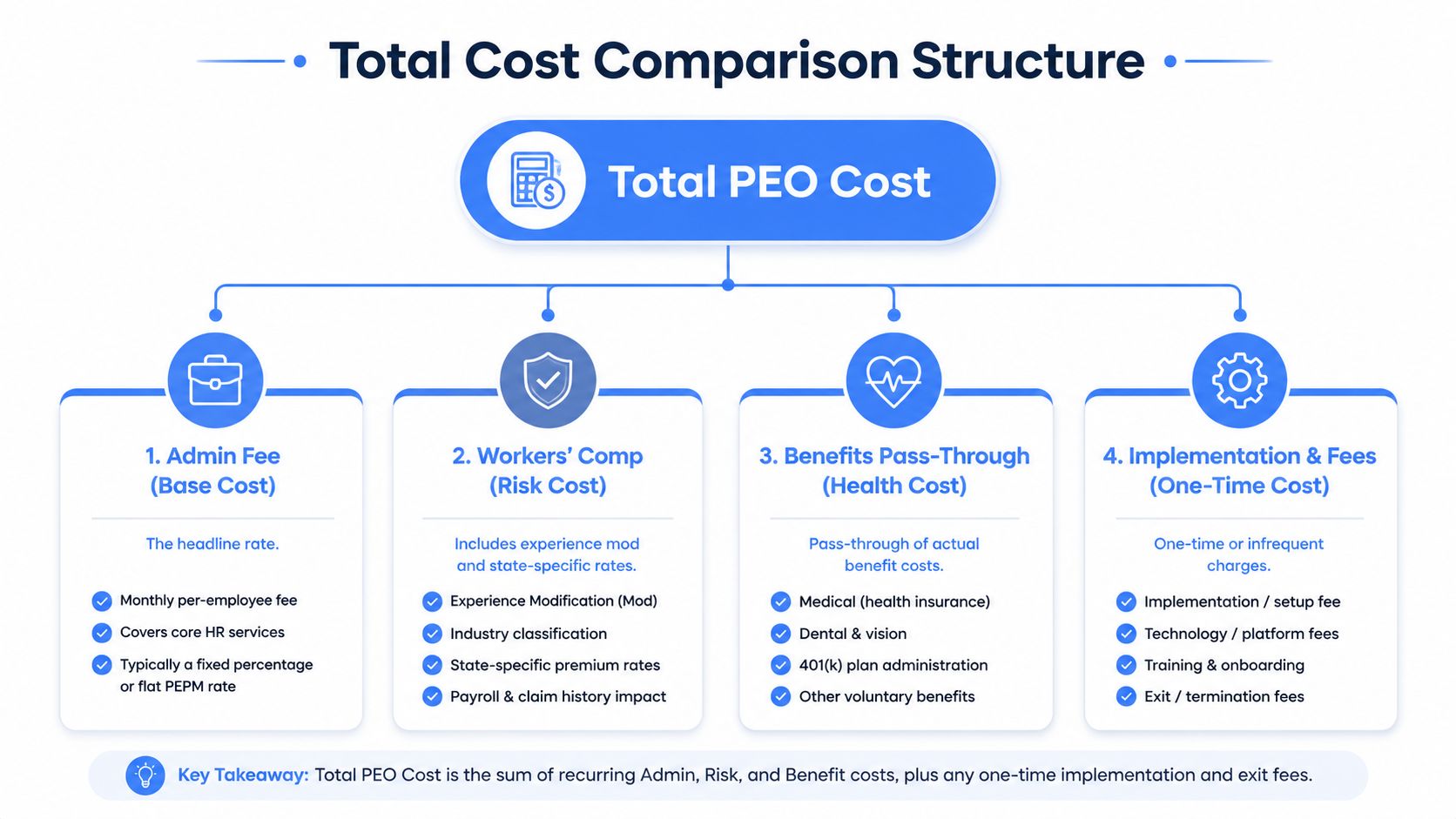
A real comparison for a 200-employee Tampa employer should separate four items:
- Admin fee. This is the headline number and the easiest thing to compare.
- Workers' comp treatment. Ask how the carrier, class codes, and experience-rating modification are handled.
- Benefits pass-through. Health, dental, and retirement administration can look clean in the pitch and messy in the invoice.
- Implementation and one-time charges. Setup fees, platform fees, and any charge tied to transition or exit belong in the math.
The cost to outsource HR should be normalized to the employer's actual headcount and benefit structure, not compared as a marketing number. The cheapest quote often loses once the buyer adds pass-through, comp assumptions, and contract escalation language.
A CFO should ask each vendor to quote the same employer scenario and the same renewal assumption. Otherwise, the proposals are not comparable, they are just differently formatted. If one PEO gives a low entry price but weak renewal protection, that is not savings, that is deferred pain.
Compare total annual cost, not monthly noise. A lower per-employee fee means nothing if the back-end terms erase the discount in year two.
Use a side-by-side worksheet with every cost bucket separated. If the vendor refuses to quantify something, that silence is part of the cost.
Contract Risk Flags Tampa Employers Miss Most Often
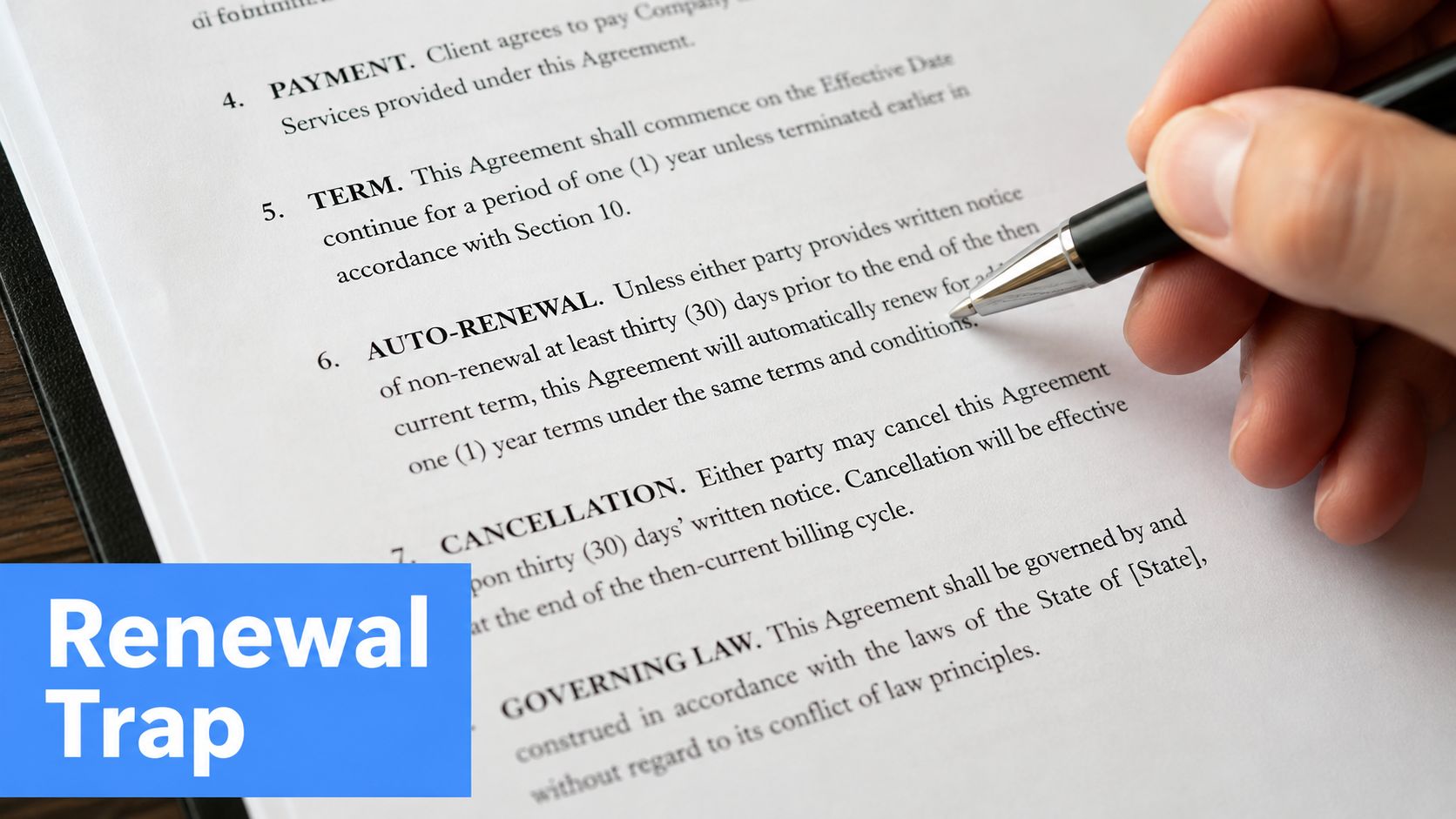
The contract is where the true cost lives. Sales reps discuss benefits, service, and compliance because those are easy selling points. They stay quiet about the clauses that create problems after signing, especially if the buyer never presses for them.
Start with the renewal and exit language. Those two sections decide whether a Tampa employer has real flexibility or just the illusion of it.
Auto-renewal clauses are the classic trap. If the notice window is too short, the employer can be locked into another term before it has a fair chance to rebid. Rate escalation language can do the same thing when it is broad, vague, or tied to triggers the buyer cannot verify before signing.
Exit terms deserve the same scrutiny. Some agreements look easy to leave on paper and expensive in practice because of runoff language, benefits continuity charges, or administrative fees that only appear at termination. Broad indemnification language creates another problem. If the PEO shifts too much liability back to the client, the client pays for control it never really got.
Florida workers' comp rules make the review even tighter. NCCI's guidance on the Florida PEO policy model means the buyer should verify whether the arrangement uses separate PEO and client policies, what endorsements sit on the policy record, and how the experience-rating modification is treated. If those items are unclear, claims attribution and premium cost can get distorted fast.
A Tampa owner should read the draft for these red flags:
- Auto-renewal notice periods that are too short for a real market check.
- Escalation clauses that permit broad price changes without a clear benchmark.
- Runoff or exit fees tied to benefits or payroll transition.
- Indemnity language that shifts risk without corresponding control.
- Workers' comp policy structure that is not written clearly enough to audit.
For a practical review checklist, start with the PEO contract red flags guide. Use it only after you have the draft in hand. That is the moment to read the terms the way a lender reads a loan covenant.
A Tampa employer that only negotiates the fee is negotiating in the wrong place. The contract sets the price.
Negotiation Levers That Move PEO Pricing and Terms
A crowded Florida market gives buyers an advantage when they know how to use it. The vendor is not selling into scarcity. In a state with many licensed PEOs, the buyer can press harder on price, service depth, and exit terms, because the provider wants the account and knows there are other firms in the room.
Ask for terms, not just discounts
A strong Tampa buyer brings competing quotes into the discussion and focuses on the parts of the deal that change the cost. A two-year rate lock is a fair ask when the vendor wants the relationship badly enough. Implementation credits, service-level guarantees with measurable credit triggers, and exit protections that reduce the penalty for switching later all belong on the table.
That matters even more when the employer already has a second proposal in hand. A PEO that knows it is competing for a Florida account may trade margin for certainty if the buyer commits quickly and gives the vendor clean onboarding data. That is not a courtesy. It is a pricing decision.
The person across the table matters, too. The negotiation personality types framework helps buyers read whether the rep can move on implementation, service credits, or exit language, because those levers are rarely controlled by the same person. Some reps can protect margin but not adjust onboarding terms. Others can soften service commitments but keep a hard line on renewal language.
Use the discussion in this order:
- Rate lock. Get stability on price before haggling over small fee differences.
- Implementation credits. If the transition is rough, the PEO should share the cost.
- Service guarantees. Press for clear credits when response times slip or open items stall.
- Exit language. Keep leaving workable without punishing runoff charges.
- Renewal protection. Remove surprise escalators before they become the default.
The best buyers do not ask for every concession in one pass. They trade volume, speed, or term length for the terms that matter most. In Florida, where provider density is real, the vendor usually has room to move if the buyer is organized and ready to walk.
Your Next Step Toward an Independent Tampa PEO Analysis
Start with the workforce profile. Then shortlist three to five providers, mixing local Florida firms and national operators that can serve the footprint. Normalize the cost proposals, read the contract terms line by line, and pressure-test the renewal and exit language before anyone signs.
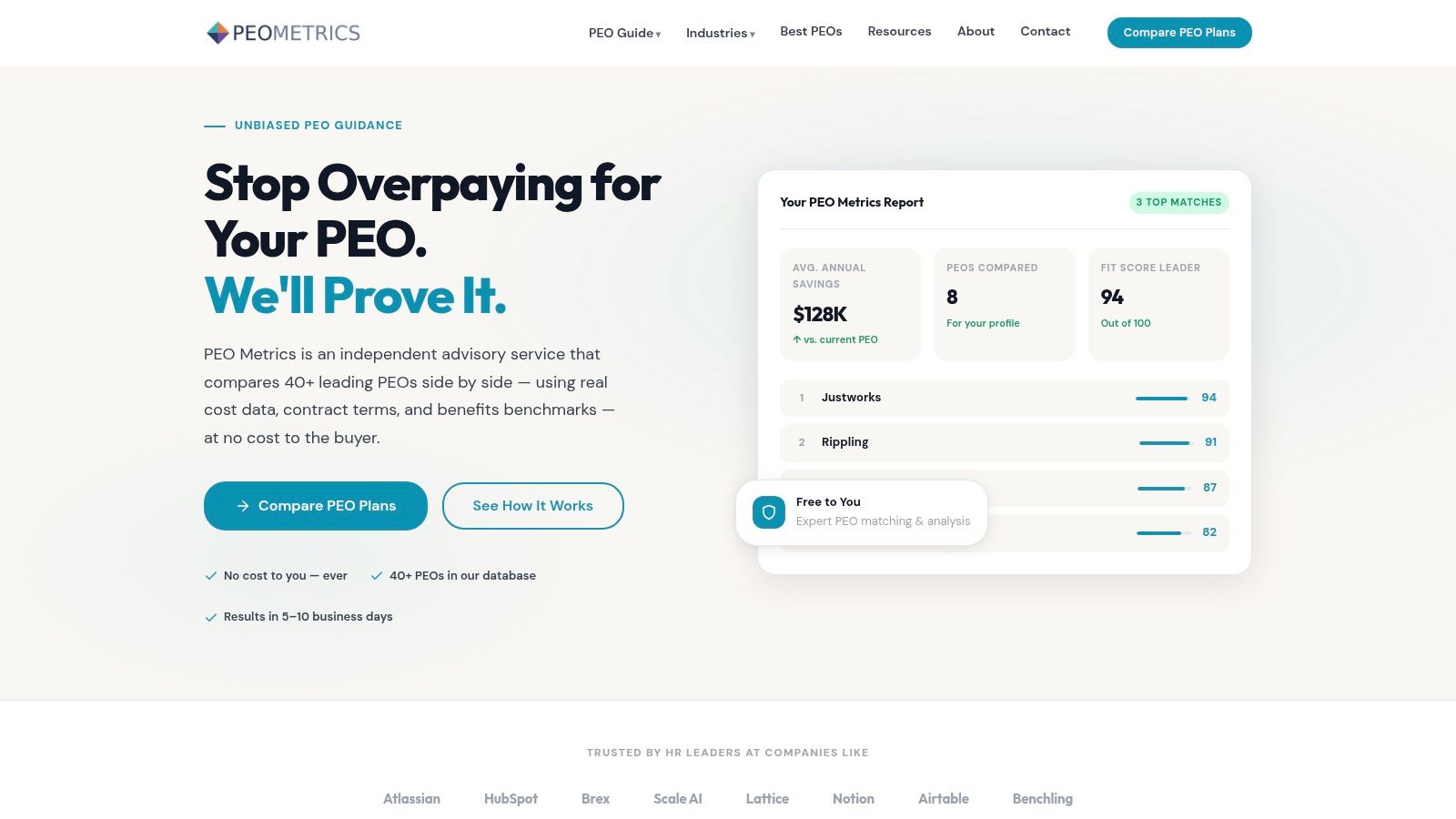
A Tampa buyer does not need another vendor demo. The buyer needs a side-by-side analysis built on actual headcount, benefits, and contract terms. Independent review can surface the trade-offs, including pricing gaps, service-model differences, and the clauses that usually get buried until renewal.
PEO Metrics helps Tampa buyers compare providers side by side, pressure-test contract language, and spot the cost and service differences that sales decks leave out. If a Tampa team is renewing, switching, or just trying to separate local claims from real value, visit PEO Metrics and use an independent analysis before the next proposal turns into a bad long-term contract.
