

A Colorado company usually starts looking at a PEO at the same point. Payroll has become a weekly fire drill. Benefits renewal is getting harder to explain to employees. HR is spending too much time chasing forms, leave questions, and tax notices. Finance wants cost predictability. Leadership wants risk off the table without building a larger internal HR stack.
That’s when the professional employer organization Colorado search starts. Not because the business wants to outsource culture or management. Because the business wants a cleaner operating model.
The category is large enough that buyers shouldn’t treat it like a niche experiment. The U.S. PEO industry is projected to reach $254.8 billion in 2026, with 6,675 businesses nationwide and projected 3.3% CAGR from 2021 through 2026, according to IBISWorld’s PEO industry outlook. For Colorado employers, that matters. It means there are many options, but also many ways to buy the wrong one.
A PEO can solve real problems. It can also create expensive ones if the contract is loose, the compliance team is generic, or the exit terms are weak. Buyers that understand the mechanics of PEO benefits meaning before taking provider demos tend to ask better questions and avoid the usual sales shortcuts.
Table of Contents
- Is a Colorado PEO the Right Move for Your Business
- How the PEO Co-Employment Model Actually Works
- Navigating Colorado PEO Regulations and Compliance
- Understanding PEO Costs and Pricing Models in Colorado
- How to Evaluate and Compare Colorado PEOs
- Negotiating Your PEO Contract and Avoiding Pitfalls
- Guidance for Multi-State Employers and Next Steps
Is a Colorado PEO the Right Move for Your Business
A Colorado PEO usually becomes relevant when the business has outgrown informal HR. The controller is reviewing payroll issues. The office manager is also handling onboarding. A founder is still approving leave questions that should have a process behind them. None of that breaks a company on day one. It does slow down hiring, increase compliance exposure, and make routine administration too dependent on a few overloaded people.
The right buyer profile is broader than many providers admit. This isn’t just for very small employers. Companies from early-growth teams to larger multi-site organizations can use a PEO when they want stronger benefits access, tighter payroll administration, and a clearer compliance workflow without building every function in-house.
Three situations usually justify a serious review:
- Growth is outrunning infrastructure. A company adds headcount faster than HR and payroll processes can mature.
- Benefits have become a recruiting problem. Candidates compare medical and retirement options against larger employers, and the business needs a competitive advantage.
- Compliance has become state-specific. Colorado employers have to manage state leave rules, payroll mechanics, and local requirements that generic national support often handles poorly.
A PEO is usually a good fit when leadership wants operating discipline, not when leadership wants to avoid managing employees.
That distinction matters. A PEO won’t run the company. It won’t supervise employees, fix a weak manager, or make poor hiring decisions disappear. What it can do is take recurring administrative burden and compliance execution off the client’s desk, provided the service model is strong and the agreement is written carefully.
For many Colorado buyers, the key question isn’t whether a PEO can help. It’s whether the provider can help without adding contract risk, cost creep, or a painful future exit.
How the PEO Co-Employment Model Actually Works
Most confusion around a professional employer organization in Colorado starts with the word co-employment. Buyers hear it and assume they’re giving up control. They aren’t.
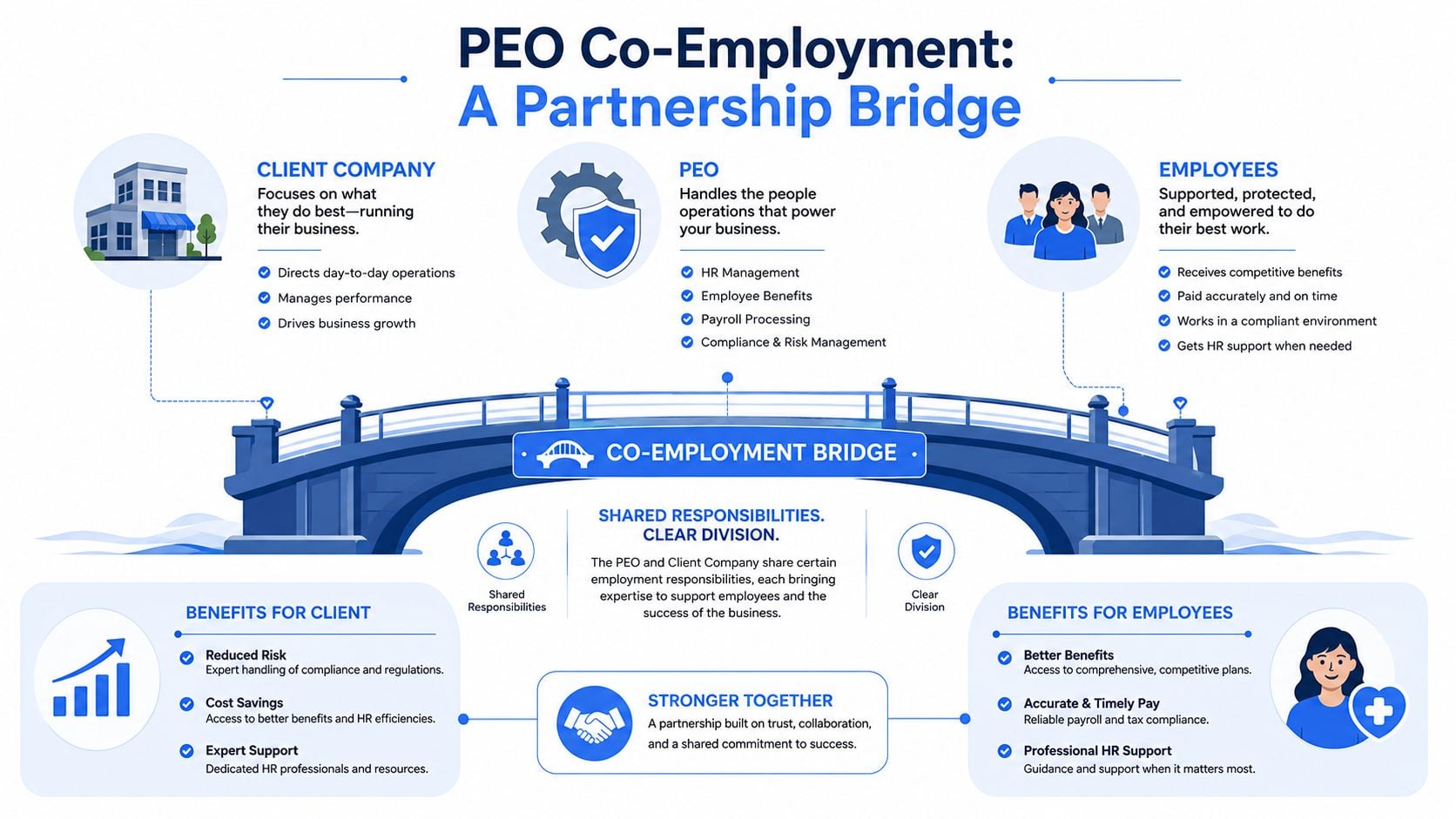
A better analogy is a property manager for a portfolio. The owner still owns the buildings, chooses tenants, sets strategy, and decides when to renovate or sell. The property manager handles operational layers like collection, vendor coordination, and compliance execution. A PEO works in a similar way. The client keeps control over hiring, pay strategy, performance management, and terminations. The PEO handles defined employer-side administrative functions such as payroll processing, certain tax administration, benefits administration, and HR support.
This visual makes the structure easier to see:
What changes and what doesn’t
What changes is the administrative framework. Employees may be paid through the PEO’s payroll platform. Benefits may sit under the PEO-sponsored plan structure. Workers’ compensation administration and tax filings may move into the co-employment arrangement.
What doesn’t change is business control. The client still directs day-to-day work. The client still sets compensation philosophy. The client still decides who gets hired, promoted, coached, or terminated.
That’s why buyers comparing a PEO to payroll software or an ASO need to get very specific. A payroll provider processes wages and filings. An ASO may support HR administration without entering a co-employment relationship. A PEO changes the operating structure and can change who carries specific administrative responsibilities and liabilities.
For buyers who want a cleaner walkthrough of the mechanics, a step-by-step explanation of how a PEO works is useful before comparing proposals.
Why aggregation matters in Colorado
Colorado law gives the model a major practical advantage. Under Colorado Revised Statutes § 8-70-114, a PEO acting as a coemployer may aggregate client employees to sponsor and administer a single workers’ compensation plan and fully insured health coverage. That statutory right is the mechanism behind the buying power many providers advertise.
In plain terms, a small or mid-sized employer isn’t always buying benefits or insurance as a stand-alone group. Through the PEO structure, it may access terms tied to the broader pool of covered workforces.
Practical rule: If a provider talks about better benefits access, ask exactly how the plan is structured, who sponsors it, and how the client’s employees are grouped.
That one question separates polished sales language from actual plan design.
Aggregation can help. It can also hide trade-offs. A stronger health plan network may come with narrower choice. Workers’ compensation administration may improve, but classification discipline still matters. A client that reports payroll inaccurately or handles job duties loosely can still create problems, even with a strong PEO behind the scenes.
The best buyers don’t ask whether co-employment is good or bad. They ask which responsibilities move, which risks remain, and how the provider proves it in writing.
Navigating Colorado PEO Regulations and Compliance
Colorado is where generic compliance support starts to show its limits. A provider can be excellent in a broad national sense and still create headaches for Colorado clients if the service team doesn’t know the local rules well enough to execute them cleanly.
That’s especially true when payroll, leave administration, unemployment handling, workers’ compensation, and local employment requirements intersect.
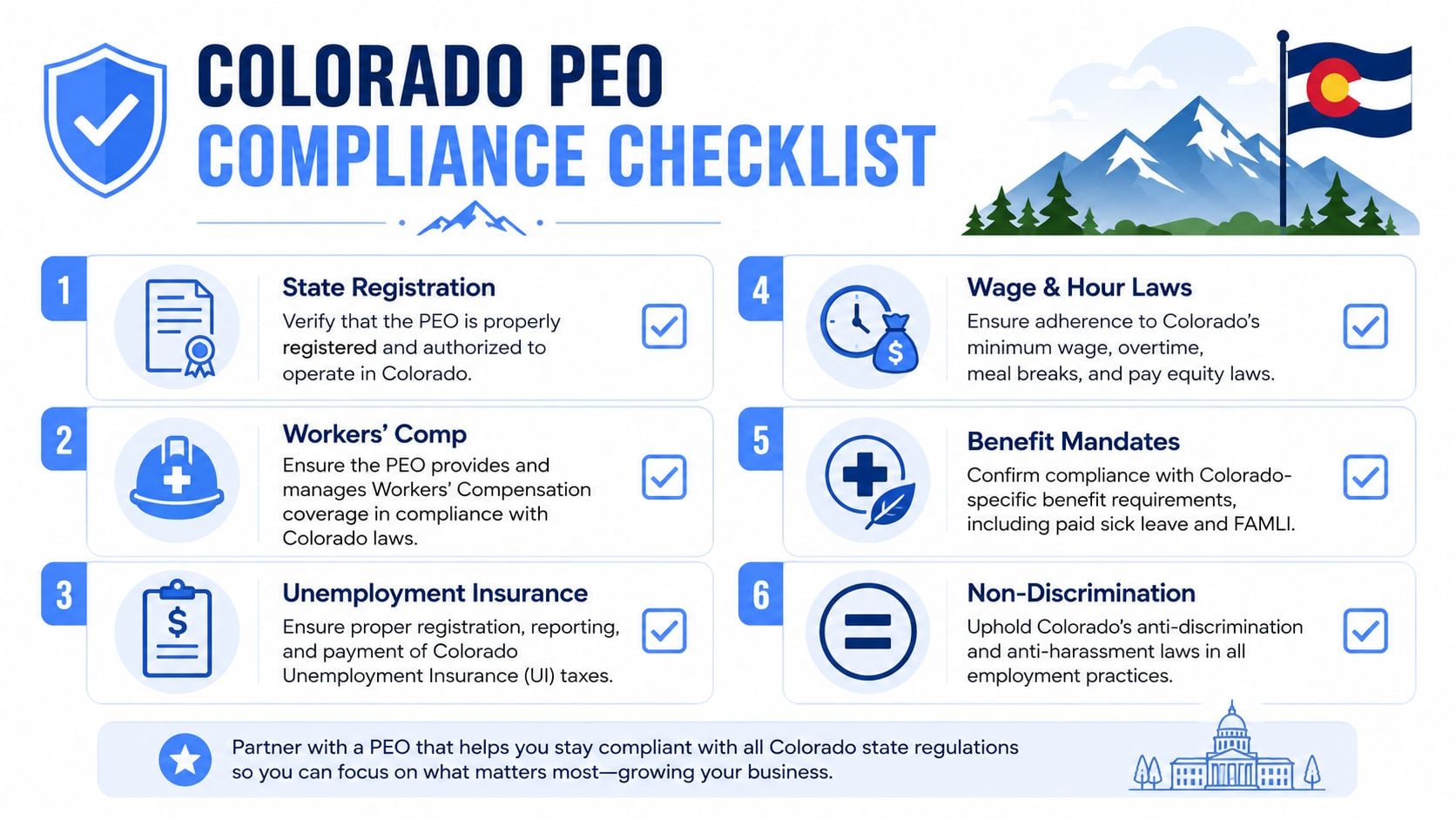
Colorado compliance is not plug and play
Colorado PEOs need to manage state-mandated benefits such as the FAMLI Act and other state-specific obligations. The quality gap shows up in staffing. According to the state-specific PEO guidance referenced by NCCI’s requirements overview, providers without local expertise can face 15% to 20% higher administrative surcharges for mandatory trainings and local filings than providers with dedicated regional support. For a buyer, that means “national platform” can become more expensive, not less, if the local execution isn’t there.
That number matters less as a talking point than as a warning. Colorado compliance has operating detail behind it. Leave rules, payroll tax handling, and state filing mechanics aren’t interchangeable with other states.
One practical example is unemployment insurance liability. Colorado requires coverage when an employer pays at least $1,500 in a calendar quarter in the prior or current year, or has one person working any part of a day in 20 weeks during that period, as outlined in the Colorado Department of Labor and Employment employer FAQ. Seasonal employers and project-based firms miss that trigger more often than they expect. A PEO should know exactly when the obligation starts and how it flows through payroll and reporting.
Where national providers often miss
The usual failure points are not dramatic. They’re procedural.
A provider may have a good central support desk but no Colorado specialist who understands how state leave administration and local rules affect payroll operations. Another may offer broad HR consulting but rely on the client to catch local filing details. A third may be strong on benefits and weak on wage-and-hour execution.
The risk isn’t just fines. The risk is internal distraction. Finance has to reconcile notices. HR has to explain mistakes to employees. Leadership loses confidence in the vendor and starts double-checking work that was supposed to be outsourced.
Common trouble spots include:
- Local nuance gaps. Denver and Boulder employers often need support that goes beyond a general handbook template.
- Workers’ comp reporting errors. A provider may handle the policy well but still rely on the client for accurate class and payroll reporting.
- Leave administration confusion. If the support team treats Colorado leave administration like a generic national workflow, employee issues can escalate quickly.
- Training and filing add-ons. What looked bundled in the proposal can reappear as extra administrative charges when local requirements surface.
A useful outside resource for payroll teams reviewing obligations is Allied Tax Advisors’ guide to mastering 2026 payroll compliance. It’s a practical checklist for the parts that often fall between HR, payroll, and finance.
A practical compliance screen
A buyer doesn’t need a legal seminar during vendor selection. A short operational screen is usually enough.
Ask the provider to answer these in writing:
| Compliance question | Why it matters |
|---|---|
| Who on the account owns Colorado-specific compliance support? | This reveals whether there’s actual local expertise or just a shared service queue. |
| How are Colorado leave and payroll obligations operationalized in the platform? | Buyers need process detail, not a promise that the system handles it. |
| What remains with the client? | Strong providers are clear about what they do not own. |
| How are unemployment and workers’ comp issues escalated? | The answer shows whether finance will get real support or generic ticketing. |
Buyers should review Colorado PEO compliance the same way they review insurance coverage. By reading the exclusions, not just the headline promise.
A structured state employment law risk review for PEO buyers helps frame those questions before the first finalist meeting.
Understanding PEO Costs and Pricing Models in Colorado
PEO pricing gets messy because many quotes look simple until the buyer asks what’s excluded. Colorado buyers usually see two basic charging methods, but neither tells the whole story by itself.
According to Deel’s Colorado PEO pricing guide, common structures include a fixed annual fee of about $1,000 per employee, or roughly $83.33 PEPM, and a payroll-based fee ranging from 2% to 11%. For smaller employers, the market range can run $40 to $200 PEPM according to Deel’s Colorado PEO pricing benchmarks.
The two pricing structures buyers actually see
A percentage-of-payroll quote rises as wages rise. That can work well for businesses with lower average wages or slower payroll growth. It can become expensive for companies that increase salaries aggressively, pay bonuses, or hire higher-cost talent in a short period.
A per-employee-per-month quote is easier to budget. It creates cleaner forecasting for finance because the fee tracks headcount more than payroll volatility. But a low PEPM number can hide missing services, weak support, or extra implementation charges.
A Colorado buyer evaluating quotes should model both structures against the company’s current run rate, expected hires, and compensation plan for the next term. Buyers that skip that exercise often think they negotiated a good rate and only later realize they chose the wrong pricing architecture.
A simple quote comparison table
For a company with 50 employees and $3 million in annual payroll, the math looks like this:
| Pricing model | Benchmark input | Estimated annual fee |
|---|---|---|
| Flat fee | $1,000 per employee annually | $50,000 |
| Payroll percentage | 2% of payroll | $60,000 |
| Payroll percentage | 11% of payroll | $330,000 |
That spread is why headline pricing alone is useless.
A provider quoting a lower base rate may still cost more if payroll grows faster than expected. A provider with a higher PEPM may still be the better buy if the support model is stronger and the agreement limits extra charges.
What belongs in the all-in cost review
A serious cost review should include more than the service fee. It should also test whether the quote contains soft spots that finance will end up funding later. A more detailed guide to outsourced HR pricing and cost structure is useful here, but the core review can be done internally.
Look for these line items and contract references:
- Implementation charges. Some providers keep setup fees outside the main rate discussion.
- Technology licensing language. Admin platforms are sometimes described as included, then billed separately through contract wording.
- Out-of-scope support. Special reports, local filings, training support, or custom onboarding can trigger extra invoices.
- Renewal mechanics. A competitive first-year quote can become less attractive if renewal terms are loose.
- Benefit administration detail. Buyers should confirm what is included in open enrollment, eligibility processing, COBRA coordination, and support tickets.
The right comparison question isn’t “What is the fee?” It’s “What will the business pay if the year gets complicated?”
How to Evaluate and Compare Colorado PEOs
Most PEO buying mistakes happen after the shortlist is built. The buyer sees two polished demos, one lower price, one stronger brand, and assumes the choice is mostly commercial. It isn’t. The operational model matters more than the pitch deck.
The strongest evaluation process uses a scorecard. Not a gut check.
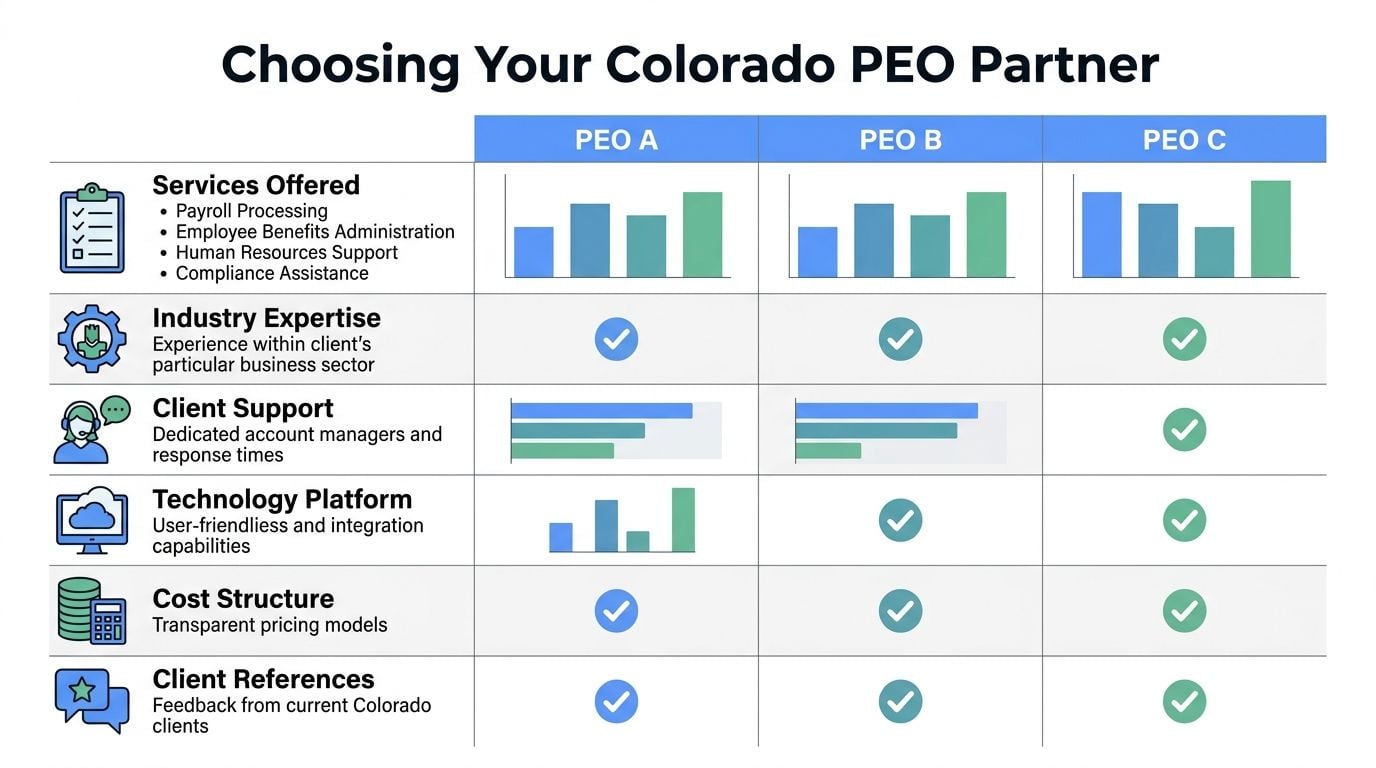
Use a scorecard, not a sales demo
A useful scorecard should test six areas.
| Category | What to look for |
|---|---|
| Service model | Dedicated account team versus pooled support. Buyers should ask who answers payroll, benefits, and HR questions after implementation. |
| Colorado depth | Providers should show real local operating knowledge, not generic national scripts. |
| Industry fit | Construction, cannabis, healthcare, tech, and professional services all create different risk profiles. |
| Technology | The HRIS, payroll, reporting, and employee self-service tools should be easy for both managers and employees to use. |
| Contract quality | Fee increases, service definitions, liability language, and exit terms matter as much as the rate. |
| References | Colorado clients in similar size bands usually reveal more than national logo slides. |
A formal PEO review framework for comparing providers can help normalize those criteria across bids.
The wrong way to compare PEOs is to ask who offers payroll, benefits, HR, and compliance. They all say they do. The right question is how those services are staffed, scoped, and enforced in the contract.
The CPEO question finance should ask early
One distinction belongs near the top of the scorecard. Is the provider an IRS-Certified PEO, or CPEO?
Under the IRS rules in 26 CFR § 301.7705-1, a CPEO is the only entity allowed to claim statutory employer status for federal employment taxes. If the provider is not a CPEO, the client may still retain residual liability for payroll taxes. If it is a CPEO, that tax liability shifts to the provider for wages it exclusively controls.
For a CFO, that changes the risk profile in a material way. It affects how comfortable the business should be with payroll tax delegation, how the agreement is reviewed, and how finance describes outsourced payroll risk internally.
This doesn’t mean every non-CPEO should be rejected. It does mean the buyer should understand exactly what risk remains and whether the price advantage, if any, justifies it.
What strong vendor interviews sound like
Good PEO interviews are less about presentations and more about operational proof. Useful prompts include:
- Ask for the post-sale service map. Who handles payroll exceptions, leave issues, benefits escalations, and tax notices?
- Ask for a Colorado example. The provider should be able to explain how it handles local compliance workflows without reverting to generic language.
- Ask to see reporting. Finance should review standard payroll, invoice, benefits, and liability reports before signing.
- Ask for contract redlines early. Waiting until selection is final diminishes your negotiating power.
- Ask for implementation ownership. Buyers need to know who manages data migration, employee communication, and first payroll readiness.
A provider that answers with specifics is usually worth deeper review. A provider that keeps answering with branding language usually isn’t.
Negotiating Your PEO Contract and Avoiding Pitfalls
The biggest pricing mistake in PEO buying is treating the proposal as the deal. The proposal is the invitation to the deal. The contract is where the economics live.
Colorado buyers need to negotiate with that reality in mind.

According to the U.S. Chamber’s Colorado PEO guidance, pricing can range from $125 to $200 per employee monthly, and vague contract language around fee increases and admin charges can inflate total costs by 25% or more if buyers don’t negotiate caps, clear definitions, and implementation credits in the agreement itself, as noted in the U.S. Chamber overview of Colorado PEO contracts and pricing.
Terms worth pushing on
A good negotiation starts with a short list of essential terms.
- Rate protection. Buyers should push for a defined pricing term and a clear renewal formula or notice standard.
- Fee definitions. Admin fees, technology fees, implementation fees, and special project charges should be named, not implied.
- Service scope. If compliance support, onboarding help, leave administration, or reporting support matters, it should be written into the agreement.
- Termination mechanics. Notice periods, transition support, and data delivery obligations should be explicit.
- Credits. Buyers often get more movement through implementation credits or waived setup charges than through headline rate changes.
A provider that says “we can work that out later” is usually protecting flexibility for itself.
Clauses that quietly increase spend
Contract problems usually hide in bland language. “Administrative fees may change based on services utilized.” “Additional compliance support may be billed separately.” “Technology licensing subject to vendor pass-through.” None of that looks dramatic during procurement. It becomes expensive after go-live.
A clean contract should let finance forecast the spend without guessing which support tasks will be treated as extras.
Buyers should also resist weak exit language. If the agreement makes termination possible but operationally painful, the provider still holds an advantage. Data transfer, final payroll responsibilities, benefit termination timing, and employee communication support should all be discussed before signature, not after dissatisfaction starts.
The goal in negotiation isn’t to win every clause. It’s to remove the clauses that create avoidable cost surprise and transition risk.
Guidance for Multi-State Employers and Next Steps
Colorado companies with remote employees in other states need a different level of scrutiny. The PEO decision is no longer just about Colorado administration. It becomes a map of payroll registrations, tax handling, benefits consistency, onboarding controls, and exit planning across a changing footprint.
That’s where many otherwise solid deals break down.
Why multi-state employers need a different contract
A provider may be competent in Colorado and still weak once the company adds employees elsewhere. Buyers should confirm how the PEO handles state registrations, payroll setup timing, leave administration, and employee support for each active state. The critical test is not whether the provider can support all states in theory. It’s whether the provider can do it without creating a patchwork of exceptions and extra fees.
Multi-state buyers should pressure-test four items early:
- Onboarding speed across states. Delays create payroll and compliance problems quickly.
- Benefits consistency. The provider should explain what changes by location and what stays uniform.
- Support ownership. Remote employers need a clear escalation path when issues cross state lines.
- Exit readiness. A company planning growth or acquisition activity should assume it may need to switch providers later.
The exit clause most Colorado buyers still miss
Benefit portability deserves more attention than it gets. According to PEO Blueprint’s Colorado PEO guide, 68% of SMBs switching PEOs cite benefit disruption as the primary pain point, while Colorado’s remote workforce is growing 22% annually. That combination makes portability an operating issue, not a legal footnote.
A weak exit clause can disrupt more than medical enrollment. It can complicate retirement plan continuity, employee communication, and the timing of a clean transition from one provider to another. For private equity-backed businesses, acquisitive firms, and rapidly growing remote employers, that’s a material deal risk.
Buyers should insist on written language covering:
- Benefit transition support. The outgoing provider’s obligations during the handoff should be specific.
- Data delivery timing. Census data, payroll files, deductions, and employee records should be deliverable in a usable format.
- Retirement plan coordination. The contract should address administrative cooperation during transition.
- Defined termination timeline. The business needs enough time to sequence payroll, benefits, and employee notices correctly.
The best time to negotiate an exit is before the relationship starts. After service quality drops, leverage usually drops with it.
A practical next-step plan
A disciplined buying process usually looks like this:
- Define the operating problem first. Decide whether the priority is benefits access, payroll control, compliance support, multi-state scaling, or all of the above.
- Model the cost structure. Compare percentage-based and PEPM pricing against current payroll and expected headcount moves.
- Screen for Colorado capability. Require provider-specific answers on local compliance operations and service ownership.
- Separate service quality from branding. Dedicated support, implementation depth, and contract clarity usually matter more than logo recognition.
- Negotiate the agreement before selection is emotionally final. Your negotiating position is strongest while the field is still competitive.
- Plan the eventual exit while the deal is still friendly. That includes benefit portability, data transfer, and transition support.
For most buyers, the takeaway is simple. A Colorado PEO can be a strong operating decision. But the value comes from the structure of the deal, not from the category label. The right provider with the wrong contract is still the wrong decision.
Companies that want an independent view before signing, renewing, or replacing a PEO can use PEO Metrics to compare providers side by side, benchmark pricing, review contract risk, and identify the trade-offs that matter before the sales process narrows the field.
