
Two PEO quotes can look nearly identical at first glance. Same per-employee number, same sales pitch, same promise to “simplify HR.” Then the first invoice lands, and the total is higher than expected because the contract adds onboarding, software access, workers’ compensation markup, or a renewal increase that wasn’t obvious in the original proposal. That’s where the actual PEO membership fee discussion starts, not with the headline rate, but with the full cost of the relationship.
For HR leaders, CFOs, and owners, the job is to separate the clean benchmark from the contract noise. A quote only helps if it can survive a budget review, a renewal review, and a board-level question about why costs changed. The sections below break down what belongs in the fee, how PEO pricing is commonly structured, what usually gets added later, and which negotiation points matter most when the goal is control, not just a lower sticker price.
Table of Contents
- Introduction to PEO Membership Fee
- Understanding PEO Membership Fee
- Common PEO Pricing Models
- Services Covered and Additional Fees
- Benchmark Ranges and Sample Cost Examples
- Contract Red Flags and Fee Traps
- Negotiation Levers and RFP Checklist
- Comparing ASO and Payroll Only Options and Next Steps
Introduction to PEO Membership Fee
A senior HR manager once gets two PEO proposals that look close enough to compare on paper. Both quotes list a similar monthly fee per employee, both promise payroll support and benefits administration, and both say compliance help is included. The difference shows up later, when one provider adds separate onboarding charges, a software line item, and a renewal clause that allows the price to move again unless notice is sent well before the deadline.
That is a central concern with a peo membership fee. The number that gets quoted first is often only the visible part of the cost. Buyers need to understand what is bundled, what is pass-through, and what can change after signature, because those details often decide whether the contract feels manageable or bloated by the second year.
Practical rule: if two proposals differ by only a few dollars per employee, the contract language matters more than the quote sheet.
The benchmark data gives a useful starting point, but it does not replace a line-by-line review. A buyer who understands the fee structure can ask sharper questions, compare vendors on equal footing, and avoid being trapped by a rate that looks competitive only until the add-ons arrive.
Understanding PEO Membership Fee
What belongs in the fee
A PEO membership fee is the service charge for the PEO’s bundled HR support. In practical terms, that usually covers payroll administration, basic HR processing, compliance support, and risk management functions tied to the co-employment arrangement. It is not the same thing as employee benefits premiums, workers’ compensation premiums, or statutory pass-through costs, which may appear on the same invoice but serve a different purpose.
That distinction matters because many buyers read a PEO quote as though it were one all-in number. It usually is not. A clean proposal should separate the service fee from items the PEO is collecting on behalf of third parties or charging separately for platform access, setup, or administration.
Why membership scales with wages
A useful analogy comes from the National Association of Professional Employer Organizations’ dues schedule. NAPEO’s dues schedule starts at a minimum of $5,000 per company and scales with annual wages, adding $184.50 per million in wages up to $150 million before stepping down in higher bands (NAPEO membership fees). That structure shows how pricing can be tied to payroll volume rather than just headcount.
That logic is also why vendors use either a per-employee fee or a percentage of payroll. A fixed fee is easier to forecast, while a payroll-based fee moves with wage growth and overtime. For a finance team, the right model depends on whether the company expects headcount stability, wage growth, or a mix of both.
The key point is simple. The fee line on the invoice should represent the service relationship itself, not every related employment cost. If the contract blurs that line, the buyer loses pricing visibility fast.
Common PEO Pricing Models
PEPM and payroll percentage structures
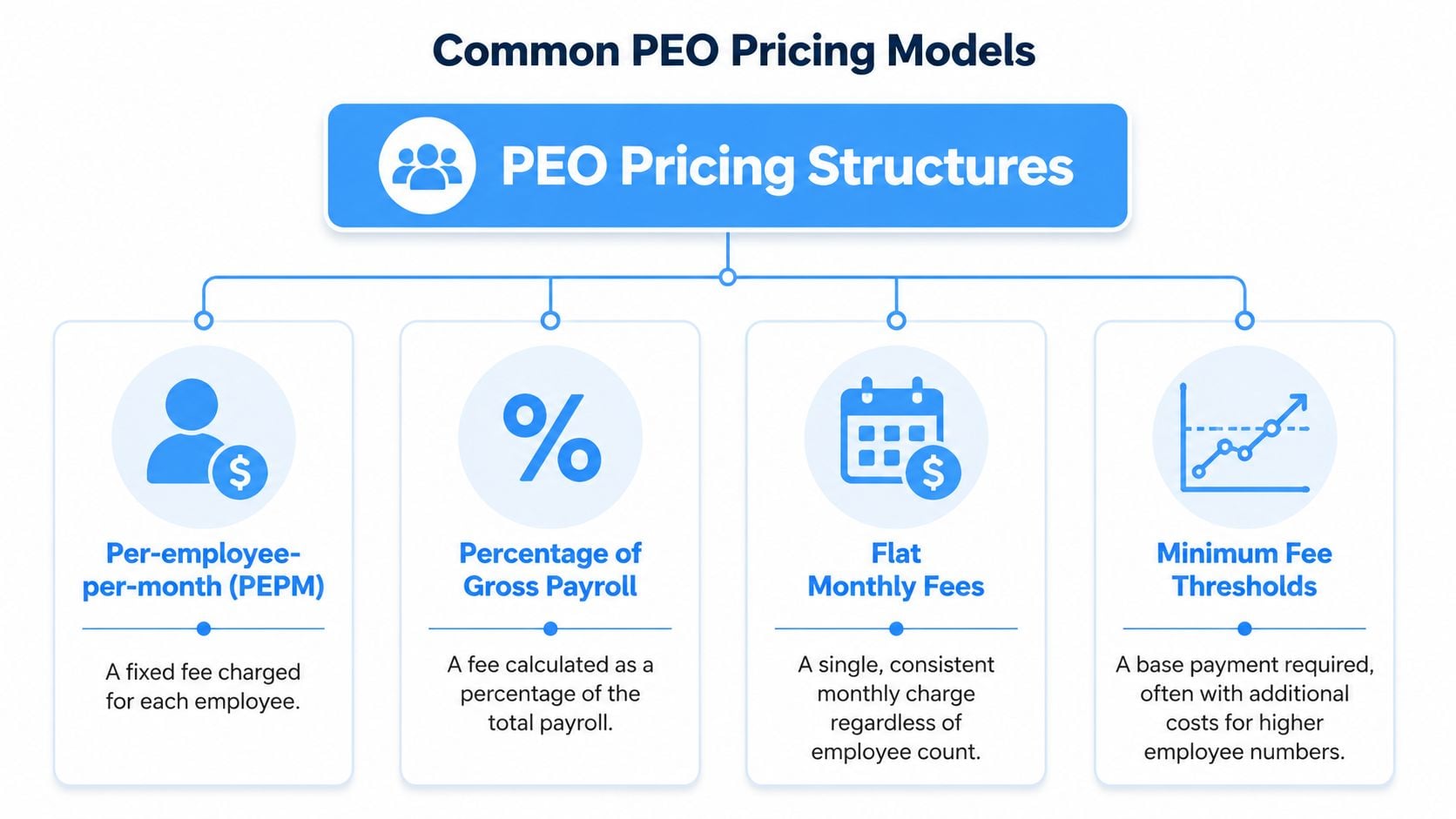
A CFO reviewing a PEO proposal usually sees two pricing models first, per-employee-per-month (PEPM) and percentage of gross payroll. Market guidance places administrative fees at about $40 to $160 PEPM or 2% to 12% of gross payroll (ADP). A commonly cited benchmark also places PEO membership fees around $1,395 per employee per year, which is roughly $116 per month.
PEPM is usually easier to forecast because the fee follows headcount. Payroll-based pricing is often easier to justify for lower-wage teams, but it rises with compensation, overtime, commissions, and bonuses. A company with a small staff and high payroll can see a percentage-based fee move past a flat per-employee structure faster than expected. That is one reason buyers should ask for a sample invoice tied to their actual payroll mix, not just the vendor’s standard rate card.
The contract wording matters as much as the model. A quote can look straightforward on the sales slide, then shift once the agreement defines what counts as gross payroll, which earnings are included, and whether the PEO bills on a pre-tax or post-tax base. Those details affect the final fee, and they are exactly where buyers lose influence if they do not press for definitions early.
Flat fees and minimum thresholds
Flat monthly fees appear less often, but they do show up in simpler or tightly packaged service arrangements. The attraction is predictability. The risk is that the flat number can hide the assumptions behind it, including headcount, wage levels, and the amount of support the provider is willing to deliver under the base fee.
Minimum fee thresholds are another place where deals drift. A PEO may advertise a low PEPM rate, then attach a floor that keeps the invoice higher for smaller teams or seasonal employers. For buyers comparing options, that floor can matter more than the headline rate because it changes the effective cost per worker. The best comparison is the total billed amount under the same staffing scenario, not the rate alone.
A quote that looks inexpensive under one model can become expensive under another once payroll, overtime, or service scope expands.
For employers comparing broader HR outsourcing options, the economics also overlap with outsourced HR cost structure, because many vendors combine service fees, software fees, and add-ons in ways that are easy to underestimate.
Services Covered and Additional Fees
Core services versus add-ons
A PEO proposal can look straightforward at first glance. Payroll processing, basic HR administration, compliance monitoring, and risk management usually sit in the base package, and that is the part the sales team is most likely to emphasize. The invoice changes fast once the agreement starts separating out benefits administration, onboarding, offboarding, software access, or workers’ compensation markup.
That is the point where a small base fee turns into a larger bill. Vague terms such as “administrative support” make that worse because they leave room for the provider to decide what counts as included and what gets billed separately. Buyers should insist on a written scope that leaves as little room for interpretation as possible. For a closer look at how vendors structure those charges, see PEO pricing and cost structure.
How to request itemized pricing
Employers should ask for a written quote covering the base service fee, benefits administration, workers’ comp markup, onboarding/offboarding charges, and any software fees (PEO Benefit Partners). That request forces the provider to split the core service from the extras before the deal is signed.
A buyer can use direct questions like these:
- Base service fee: “Show the monthly service fee and the exact basis for calculation.”
- Benefits administration: “List any separate charges for plan administration or enrollment support.”
- Workers’ comp: “Identify whether there is a markup, and how it is applied.”
- Implementation and exit costs: “Confirm any onboarding, offboarding, or termination fees in writing.”
- Technology: “Name all software or platform charges, including required modules.”
The same discipline should apply to benefit premiums and pass-through costs, because the quote only matters if the invoice matches it later. A base fee can look manageable while the final invoice grows through add-ons, minimums, and service-specific charges. Buyers who want a clean comparison often map vendor quotes into a pro forma cost model, which is why a pro forma cost model can be more useful than a glossy proposal.
Benchmark Ranges and Sample Cost Examples
Using market ranges
A buyer reviewing a peo membership fee should start with market bands, then ask where the quote sits inside them. A common benchmark is about $1,395 per employee per year, or roughly $116 per month, with many providers pricing at $40 to $160 PEPM or 2% to 12% of payroll (FirstHR). Those figures do not tell the whole story, but they do show whether a proposal looks normal or starts to drift into a higher-cost tier.
| PEO Membership Fee Benchmarks | Typical Range |
|---|---|
| Per-employee-per-month fee | $40 to $160 PEPM |
| Annual per-employee benchmark | $1,395 per employee per year |
| Payroll-based administrative fee | 2% to 12% of gross payroll |
Monthly pricing helps with operating budgets. Annual pricing is better for finance teams because it shows the full planning impact, especially when headcount stays flat but payroll rises during the year. It also gives buyers a cleaner way to compare PEPM pricing against payroll-based models without getting distracted by the invoice format.
Scenario-based comparisons
A 50-person company with steady wages can look inexpensive on a PEPM quote until the extras appear. At the benchmark level of roughly $116 per employee per month, the annual service cost lands in the range buyers should expect before add-ons are layered in. If the provider uses payroll-based pricing instead, the buyer needs to model the full payroll total, because the fee can rise with wage growth and bonus spikes.
A larger employer faces a different test. A 500-employee operation may see a lower per-employee rate because scale gives the provider room to adjust pricing, but the invoice still has to be tested against a percentage-of-payroll structure. Once payroll grows, a percentage-based fee can overtake a flat PEPM arrangement faster than many CFOs expect.
The right question is not just, “What is the monthly rate?” It is, “What is the all-in annual fee under each pricing model, and what happens if payroll, headcount, or plan complexity changes during the term?” That answer usually exposes which quote is competitive and which one only looks affordable at first glance.
Buyer takeaway: use the benchmark first, then model your own headcount and payroll before any sales call.
For teams building a side-by-side PEO cost analysis, a pro forma cost model helps frame the quote review, but true value arises from comparing the contract terms behind the number.
Contract Red Flags and Fee Traps
Renewals, notice periods, and vague scope
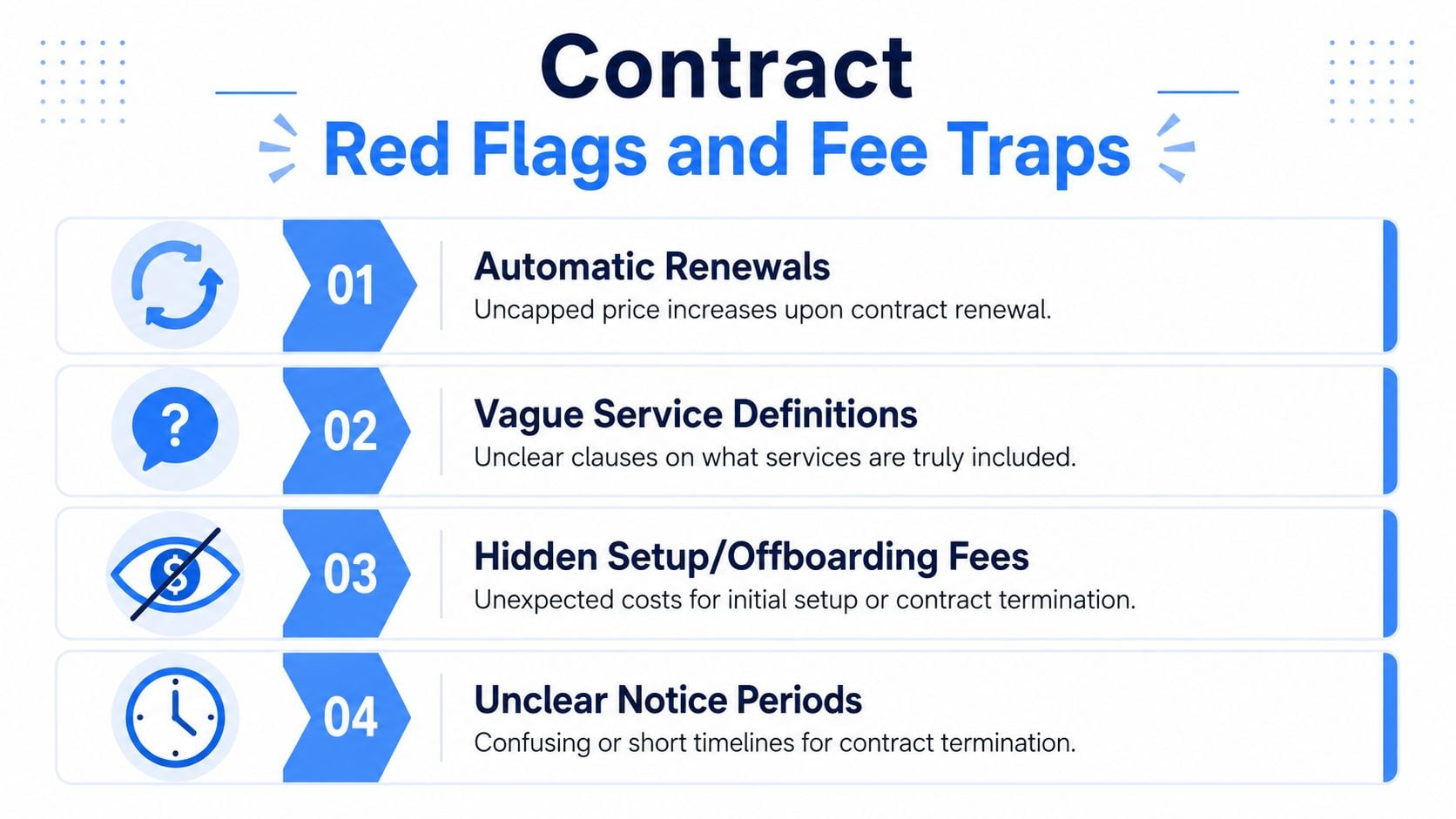
One of the biggest traps is automatic renewal. PEO agreements often renew automatically unless canceled 30 to 90 days in advance, and buyers are advised to cap fee increases and specify notice requirements to avoid unpleasant surprises (U.S. Chamber of Commerce). If that window is missed, the company can get locked into another term before anyone in finance realizes the deadline is approaching.
Vague service definitions create a second risk. If the contract says “covered services” without listing them, the provider has room to classify extra work as out of scope later. That is where small language differences become real dollars.
Hidden charges that change the deal
The other common problem is separate billing for setup or exit work. A buyer may see a strong base rate and assume the deal is under control, then discover that onboarding, offboarding, software, or benefit-plan administration all sit outside the quoted fee. That is why a sample invoice matters as much as the proposal itself.
A smart review includes these questions:
- Renewal timing: “When does the notice period start, and who receives it?”
- Price escalation: “Are annual increases capped, and where is that written?”
- Scope definition: “Which services are included automatically, and which are billed separately?”
- Exit costs: “What happens if the company leaves before term end?”
- Invoice proof: “Can the provider supply a 12-month fee projection and a sample invoice?”
Internal link: PEO contract negotiation red flags
The best contracts make fee movement visible before it happens. If the agreement hides escalation language in a renewal clause, the buyer is not negotiating price, only discovering it later.
Negotiation Levers and RFP Checklist
Questions that force clarity
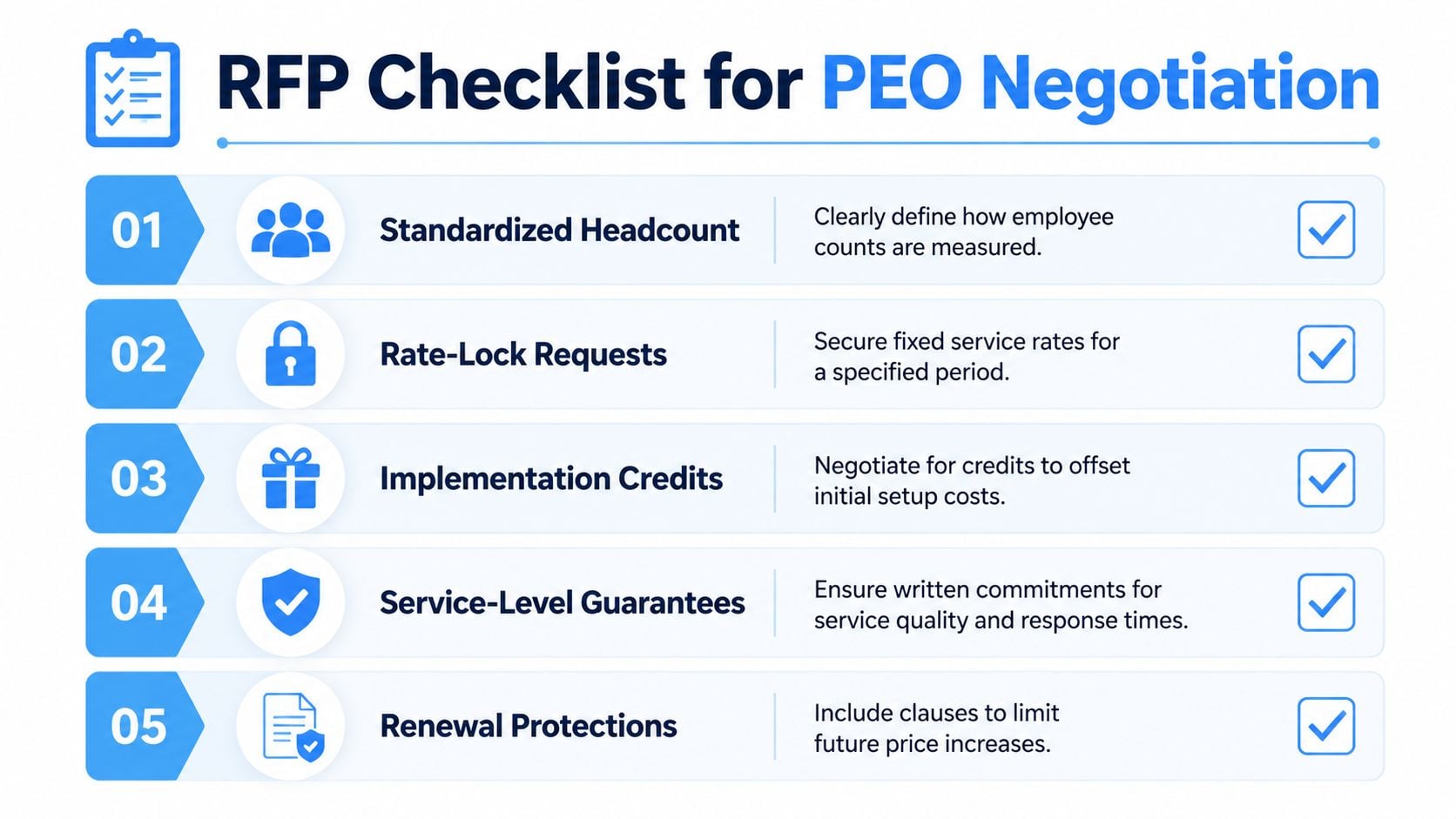
A disciplined RFP should start with headcount definitions. The provider needs to say whether pricing is based on active employees, full-time equivalents, seasonal staff, or something else. If that definition is loose, the fee can drift every time payroll changes.
The rest of the checklist should be equally specific:
- Standardized headcount. Require one counting method for all quotes.
- Rate-lock requests. Ask for a fixed service rate for a defined term.
- Implementation credits. Negotiate credits if setup work is material.
- Service-level guarantees. Put response times and service expectations in writing.
- Renewal protections. Limit future increases and define notice windows clearly.
A rate lock matters because it turns a moving target into a budgetable line item. Implementation credits matter because onboarding can be real work even when the provider frames it as standard. Service-level guarantees are worth asking for because support quality often becomes the primary pain point after signature.
Terms worth pushing back on
Competitor quotes help, but only if they are structured the same way. A payroll-based proposal should be normalized against a PEPM proposal before anyone compares the sticker price. That is where benchmark data offers an advantage, because a buyer can point to market ranges and ask the provider to explain why the quote sits above or below them.
The strongest negotiation move is not asking for “a better price.” It’s asking the vendor to define the price clearly enough that finance can audit it later.
In practice, that means requesting redline language on renewal caps, asking for a written sample invoice, and insisting on clear fee definitions before the final signature. Companies that do that tend to avoid the surprises that show up a year later when the invoice no longer matches the original conversation.
Comparing ASO and Payroll Only Options and Next Steps
PEO pricing makes more sense when the company seeks co-employment, bundled benefits access, and a single HR vendor. An ASO gives more control because the business remains the employer of record, while a payroll-only provider handles pay and tax filing without the broader HR bundle. The trade-off is simple. More control usually means more vendor management and more internal ownership.
That’s why the right choice depends on the company’s internal capacity. Smaller firms with no HR support often value the bundled simplicity of a PEO. Mid-market employers that already have internal HR may prefer an ASO or payroll-only model because it separates service fees from benefits shopping and leaves more room to customize the stack. A useful comparison is outlined in this PEO versus ASO guide.
The next step is to build a raw cost model with your own headcount, payroll, and service requirements. Then run the benchmark ranges against the quote, ask for a sample invoice, and test the renewal language before anyone signs. If the deal still looks ambiguous, an independent advisor can help compare proposals side by side and surface contract terms that sales teams usually gloss over.
For companies that want a structured comparison of pricing, services, and contract risk before committing, PEO Metrics is one option that reviews provider fit, projected cost, and negotiation points in the same package.
A clear PEO decision starts with the invoice, not the pitch deck. If the current quote still leaves questions about renewal timing, hidden fees, or which services are included, use those gaps to push for a redline before signing. A stronger contract now is worth far more than a slightly lower number that turns into a bigger bill later. A CTA for PEO Metrics.
