
A 180-person company with three legal entities, four states, salaried staff, hourly teams, and commission plans does not have a payroll “software” problem. It has a control problem. The finance team is reconciling separate EINs, different withholding rules, benefits held at the parent level, and a close that takes longer than anyone wants to admit because the payroll data lives in too many places.
That is the primary reason group management payroll becomes a board-level topic. Once payroll touches multiple entities, the question stops being whether checks go out on time and becomes who owns compliance risk, who can see the full labor cost, and who eats the cost when something breaks. Buyers who miss that distinction usually overpay for convenience in year one, then pay again in penalties, workarounds, and bad reporting in year two.
Table of Contents
- The Reality of Running Payroll Across Multiple Entities
- What Group Management Payroll Means
- Comparing PEO Pooled and ASO Single-Employer Models
- Multi-State Compliance and the Risk Surface
- What Drives Group Payroll Cost
- Technology, Integrations, and the Gray Space Between HR and Payroll
- Evaluating Vendors and Negotiating the Deal
- A Clear Decision Framework for Your Next Move
The Reality of Running Payroll Across Multiple Entities
A 180-employee business with three legal entities usually starts with a clean story. One entity handles sales, another runs operations, and a parent entity holds benefits or shared services. Then payroll has to make sense of four states, two pay frequencies, commission runs, retro pay, and employees who move across entities mid-quarter.
That is where the friction starts. HR keeps employee records in one system, finance keeps general ledger detail in another, and the payroll team is left stitching together reports at close because the parent company wants one view and the entities need separate treatment. If the company is using a PEO or considering one, the reporting question gets sharper, not softer, because labor cost needs to roll up cleanly without losing the entity-level detail that tax and audit teams still require. A practical example of that challenge sits in this PEO payroll consolidation for financial reporting discussion.
The hidden cost is not just admin time. It is the constant rework around earnings codes, deduction mapping, and approvals that never quite line up after an acquisition, a new state registration, or a compensation change. Teams often treat that as normal because they are used to surviving close.
Practical rule: if payroll data has to be rebuilt by finance every month, payroll is already operating as a risk center, not a back-office task.
Once a company hits this stage, the right question is no longer “Which payroll tool is easiest?” It is “Which operating model keeps payroll accurate across entities without forcing finance to clean up the mess every close?” That is the lens that matters for the rest of this guide.
What Group Management Payroll Means
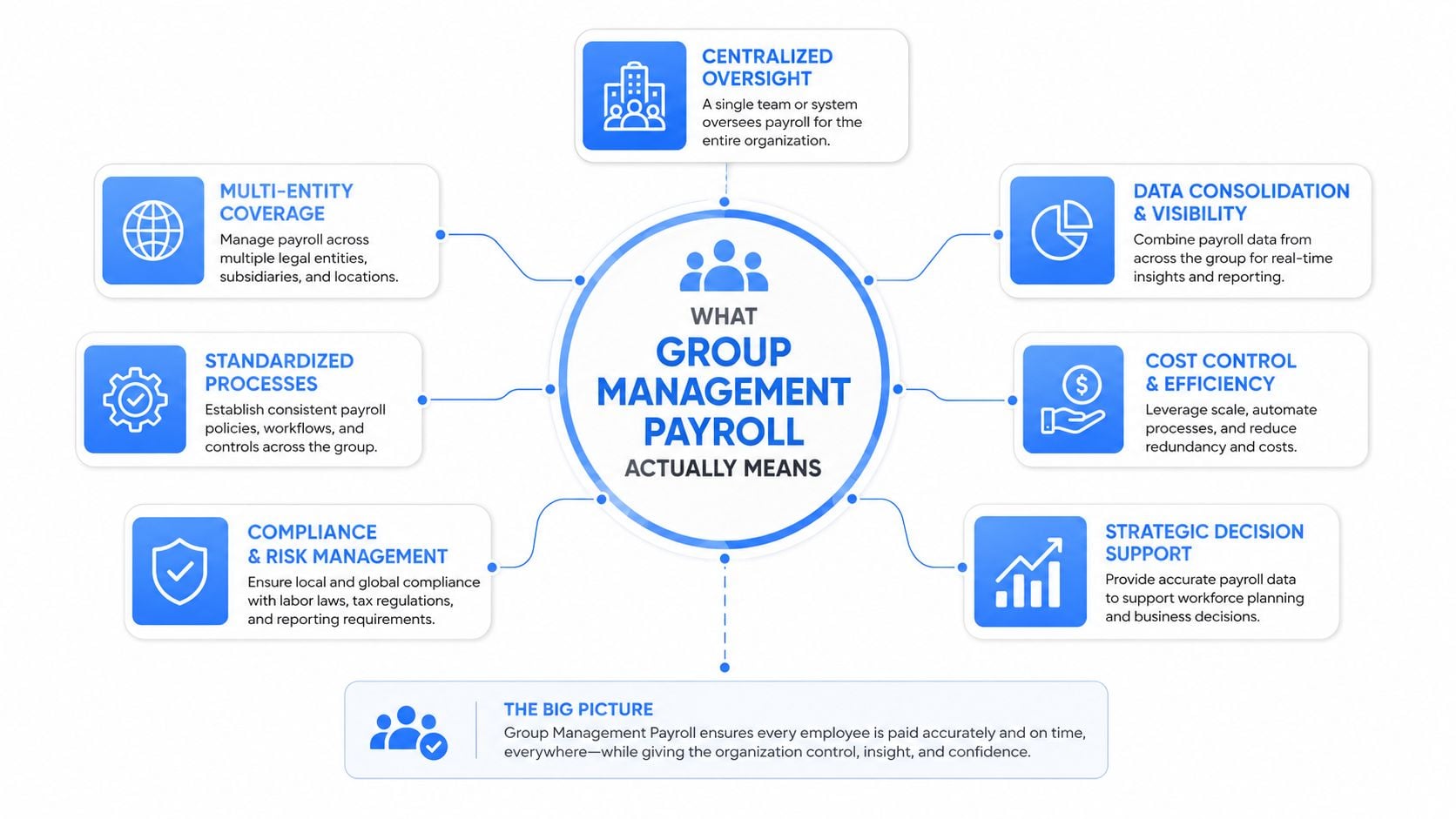
A company with one payroll process and multiple legal entities still needs clean boundaries. Group management payroll is the discipline of running pay across multiple entities, locations, or business units under one control model while preserving the legal separation each entity requires. The goal is not to merge everything into one bucket. The goal is to keep payroll governed the same way, measured as a process, and set up so it can handle growth without creating new control problems.
The operating metrics that matter
APQC’s payroll benchmark framing is useful because it treats payroll like any other managed process, with attention on cost to process payroll, cycle time in business days, and employees paid per payroll FTE (APQC payroll key benchmarks). That is the right lens. A company should care about throughput, speed, and cost per run, not just whether the system prints checks.
A vendor who only talks about features is missing the point. The better conversation is about how approvals, exceptions, and reporting work when the business spans multiple entities. That is why group payroll should be judged the way finance judges close, not the way HR judges a software demo.
How it differs from pay-group design and payroll tax grouping
These terms get mixed up all the time. Pay-group design is a system configuration layer inside the payroll engine. Oracle’s setup guidance says employees in the same pay group must share the same company, pay frequency, check date, period dates, country, bank, and other processing attributes (Oracle pay group setup). That is an operational sorting rule.
Payroll tax grouping is different. It is a tax concept that can aggregate businesses for payroll tax purposes, which changes liability. A company can have several pay groups inside one system and still face a separate payroll tax grouping issue at the state level. Those are not interchangeable ideas.
A clean payroll model separates system configuration, tax liability, and legal entity structure. If a vendor blurs those three, the contract is already sloppier than it should be.
The practical takeaway is simple. Group management payroll is the governance layer above payroll processing, not a synonym for tax grouping and not just a software setting. If a CFO cannot tell the difference after a vendor presentation, the vendor has not done enough to earn the shortlist.
For teams comparing operating models, the structure matters more than the label. A useful starting point is a clear explanation of how an ASO differs from a PEO arrangement, because the payroll model only makes sense once you know who owns the process and who absorbs the compliance burden.
Comparing PEO Pooled and ASO Single-Employer Models
The PEO versus ASO debate usually gets sold as a benefits story. That is too shallow. The core issue is who carries compliance risk, how much operational control stays with the employer, and where the hidden costs live once the company is past year one. For a buyer comparing a PEO model against ASO, the right lens is structure, not branding.
Group Payroll Models at a Glance
| Dimension | PEO Pooled Model | ASO / Single-Employer | Hybrid |
|---|---|---|---|
| Compliance risk ownership | Shared operating model, more provider involvement in payroll administration | Employer keeps more direct responsibility | Split by function, so risk depends on the contract |
| Cost structure | Often stronger benefits leverage, but fees can be harder to unpack | Easier to see payroll service costs, fewer bundled layers | Can be efficient if each vendor is used for its best function |
| Benefits leverage | Usually strongest because employees sit in a pooled structure | Depends on carrier access and broker power | Varies, often weaker than a true pooled model |
| Policy and reporting control | Less direct control, more standardized processes | More control over policy, reporting, and data flow | Control depends on which system owns the source data |
| Best-fit profile | Multi-state employers that value pooled benefits and centralized compliance support | Companies that want to keep legal and operating control in-house | Businesses with one clear reason to outsource only part of the stack |
A PEO pooled model usually makes the most sense when a company wants to trade some operational flexibility for simpler administration and stronger benefits access. The employer still needs to care about reporting and contract terms, but the model can reduce the burden of managing multiple payroll and benefits relationships across entities.
An ASO or single-employer model fits companies that want to keep the EIN, preserve more control, and separate payroll from employment co-ownership. It is often the cleaner choice when the company already has a capable HR and finance team and just needs execution support. The downside is obvious. If the internal team is weak on compliance or process discipline, the vendor can only do so much.
A hybrid model sounds attractive because it promises flexibility. Sometimes it works. More often it creates fragmentation, especially when payroll, benefits, and workers’ compensation live with different providers and each one blames the other for a data issue. That is manageable for a disciplined finance team, but it is a bad fit for a company that already struggles with handoffs.
For a concrete tax example, New South Wales says that from 1 July 2026 the payroll tax rate is 5.45% and the threshold is $1,200,000 (NSW payroll tax grouping). That matters because a business that looks safe on its own can cross the line once wages are aggregated across a group. This is exactly why the structure decision is not just about payroll processing.
Bottom line: choose the model that matches where the company wants compliance risk to sit, not the one with the slickest demo.
Multi-State Compliance and the Risk Surface
Multi-state payroll is where the spreadsheet fantasy dies. State income tax withholding, reciprocal agreements, state disability programs, paid family leave, local ordinances, and new hire reporting all stack up fast, and each rule creates a chance to miss a deposit, file the wrong return, or map a deduction incorrectly. For employers that have grown through expansion or acquisitions, the compliance load is usually heavier than the headcount number suggests.
A single payroll error is rarely a single payroll error. If a company misfiles withholding or misroutes a payment, it can face amended returns, late deposits, and penalties that take more than one close cycle to unwind. A representative $40,000 payroll tax error can easily become a five-figure problem once notices, correction work, and remediation time are counted, even before leadership starts asking why the control failed in the first place.
That is why compliance risk matters more than the software feature list. In group payroll tax grouping rules, shared employees and common control can push an entity over a threshold even when the business looked under the line on its own. ACT Revenue Office says grouped businesses are treated as one entity for payroll tax purposes, while members still lodge separate returns and only one member can claim the threshold (ACT grouping rules). NSW grouping rules also flag related corporations, common employees, common control, tracing of interests, phoenix operators, and subsuming smaller groups into larger ones as grouping triggers (NSW grouping rules).
For teams operating in Australia, the STP Phase 2 rules for SMEs show the direction of travel. Payroll reporting expectations keep tightening, not loosening. The more jurisdictions involved, the less tolerance there is for sloppy data ownership.
A useful reference point is multi-state payroll compliance under PEO, because that is where buyers usually start asking the right risk questions. The core decision is whether the employer wants the provider to own compliance execution or only help process payroll after the fact.
What Drives Group Payroll Cost
Buyers fixate on the quoted monthly fee because it is neat, simple, and often incomplete. The visible admin charge is only one piece of the total bill. The true cost also includes workers’ compensation pricing, benefits pass-throughs, off-cycle runs, conversion work, annual filings, and the time finance spends cleaning up exceptions after the contract is signed.
The cost stack that hides in plain sight
A serious proposal should separate out at least these buckets:
- Per-employee admin fee. This is the line item most buyers see first, but it rarely explains the full economics.
- Workers’ compensation pricing. Rates and experience modifiers can shift the cost materially, so buyers should pair payroll review with a find tailored compensation insurance search rather than treating comp as an afterthought.
- Benefits load and carrier pass-throughs. These often sit outside the headline payroll quote.
- Off-cycle and supplemental runs. Bonus cycles, corrections, and term payouts add cost when the business is active.
- Implementation and conversion. The first-year price usually understates this work.
- Year-end production. W-2 and 1095 work becomes more expensive when the data is fragmented.
- PTO and accrual management. If accruals differ by entity, the administrative load rises quickly.
The quoted admin fee buys processing. It does not buy clean data, fewer exceptions, or tighter internal controls.
A 220-employee, three-entity group can easily find that the visible fee looks like the entire proposal while the first-year cost is spread across everything else. In that setup, the admin line can look like the main expense while onboarding, compensation, and benefits friction carry a larger burden in the background.
What to benchmark before signing
APQC’s payroll benchmarks are the right baseline because they force the buyer to ask whether the process is efficient, not just cheap (APQC payroll key benchmarks). If a vendor cannot explain how its pricing maps to cost per pay run or payroll throughput, the contract is probably built for seller convenience.
Ask for unit economics, not a bundle. A bundled quote hides the places where costs will grow after implementation.
The better comparison is process cost, error cost, and ownership of compliance risk. That is what separate PEO and ASO proposals often obscure. The key question is who absorbs the mess when filings, data changes, or multi-entity rules go sideways, and whether the provider is pricing that risk transparently.
Technology, Integrations, and the Gray Space Between HR and Payroll
Buyers like to talk about platforms, but that is usually the wrong place to start. The key issue is whether the payroll engine, HRIS, benefits admin, general ledger, and retirement provider all move clean data with clear ownership. If they do not, the system just automates mistakes faster.
Payroll setup rules force that discipline. Employees in the same pay group need to share processing attributes such as company, pay frequency, check date, pay period begin and end dates, country, and bank details, as shown in the Oracle pay group setup guidance. That means segmentation has to be deliberate. A weekly warehouse group and a semi-monthly corporate group should not be squeezed into one template just because the demo looked cleaner.
The bigger operational issue is the gray space between HR and payroll. Manual handoffs, unclear ownership of job data, and late updates to deductions or locations are where payroll errors start. Many teams think they have a system problem when they really have a governance problem.
If your HRIS is the source of truth in name only, every downstream payroll run becomes a cleanup exercise. That is why PEO integration with HRIS platforms deserves more attention than glossy product tours. Integration quality decides whether the employer owns the process or just keeps retyping the same information into different systems.
What the vendor should prove, not promise
Performance and reliability need to be discussed at the batch-processing level, not the marketing level. Market materials describe very different expectations, from payroll calculation windows of up to 24 hours in one requirements spec to tighter targets in another that calls for payroll for up to 1,000 employees in 10 seconds and up to 10,000 employees in 60 seconds, plus payslip generation within 5 seconds (SRS requirements specification). Those are not comparable promises, and that is the point. Buyers need to know what their own volume and timing require.
Teams that want to automate financial workflows should start with payroll because the data touches finance, HR, and compliance at once. Automation only helps when upstream data is clean and the service-level commitments are real.
The platform matters. The architecture around it matters more. If a vendor cannot explain batch close, issue resolution, and data ownership in plain language, the implementation will be messy no matter how polished the demo looks.
Evaluating Vendors and Negotiating the Deal
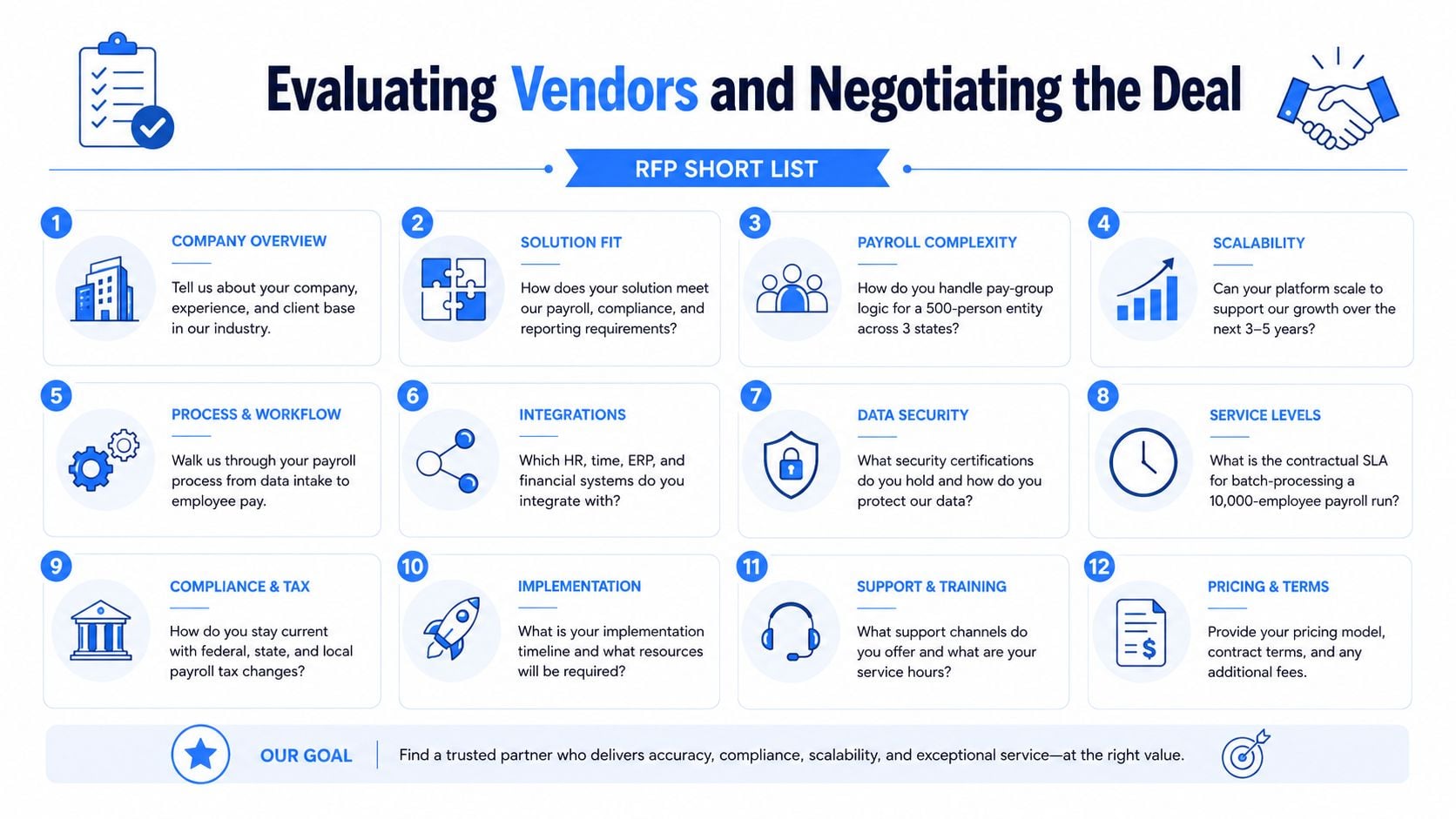
The smartest buyers do not ask vendors whether they can “handle payroll.” Every vendor says yes. The better question is whether they can handle a multi-entity environment without forcing the employer to become the integration layer.
The questions that expose weak operators
Use these in the first serious vendor meeting:
- How do you separate pay-group logic from legal-entity logic?
- What happens when an employee transfers between entities mid-cycle?
- How do you handle state withholding in multi-state jobs with common control?
- What is your process for off-cycle payroll and retro pay?
- Who owns deductions when benefits sit at the parent level?
- What reporting can finance export without manual cleanup?
- How do you document service-level commitments for batch close and issue resolution?
- What implementation credits are available if conversion runs long?
- How do you support year-end filings when entities have different setups?
- What contract terms govern fee increases at renewal?
- What exit rights exist if the service model fails?
- Can you provide references from multi-state employers with similar complexity?
A vendor that dodges these questions is telling on itself. If the answer sounds polished but never gets specific, the sales team is pitching convenience, not control.
The contract terms worth pushing for
The negotiation should focus on rate locks, implementation credits, service guarantees, renewal caps, exit rights, and liability language. Those terms matter more than a minor discount on the first invoice because the contract governs cost and risk after the first year, when the surprises usually show up.
A useful internal resource here is negotiation personality types, because the person leading the vendor call often shapes what concessions are even possible. Some buyers push on price too early and lose negotiating power. Others never ask for concessions at all.
Red flags: vague SLAs, take-it-or-leave-it paper, no multi-state references, and pricing that can’t be tied back to headcount or service scope.
Treat the agreement like a multi-year financial instrument. If the contract only looks cheap at signature, it is probably expensive later.
A Clear Decision Framework for Your Next Move
The right model depends on four things, entity count, state footprint, headcount trajectory, and the cost of a payroll error in the business. That is the cleanest way to separate a company that needs simple processing from one that needs a formal governance model.
A 60-person, single-state company usually does not need a pooled structure. If the team is stable, the payroll calendar is simple, and the finance leader can see every exception, an ASO or single-employer setup is usually the sensible move. The company gets control without dragging in unnecessary structure.
A 250-person, three-state company is where a PEO pooled model often starts to make sense, especially if benefits scale and compliance support are the pain points. The question is not whether the employer likes the idea of a pool. The question is whether the company wants to trade some control for cleaner administration and a more centralized risk posture.
A 900-person, ten-state company usually needs a more specialized conversation. At that point, a best-of-breed ASO model with a specialist workers’ compensation partner can outperform a bundled approach if the internal team wants tighter control over reporting and vendor management. The enterprise has usually outgrown “simple payroll” and needs architecture, not just processing.
The next move should be concrete. Pull the last 12 months of payroll errors, late filings, and correction work. If that log is thin, request a PEPM benchmark anyway and compare it against the actual operating burden. If the company is already evaluating providers, run a structured RFP across three options and score them on compliance ownership, reporting, and contract risk, not just monthly price.
If this topic is on your desk right now, PEO Metrics can help by comparing PEO options, surfacing contract risk, and showing where payroll, benefits, and compliance costs sit in the deal. Visit PEO Metrics to pressure-test your current model before you sign or renew.
