
Most advice on outsourced human resources starts in the wrong place. It starts with price. CFOs who follow that script usually end up comparing admin fees, then signing a contract that hands the vendor control over compliance timing, employee data, and exit terms. The smarter question is simpler: who owns the risk when the work is late, wrong, or hard to unwind?
That question matters because outsourced HR is no longer rare. One industry compilation places the global HR outsourcing market at US$32.8 billion in 2020 and expects it to reach US$45.8 billion by the end of 2027; another snapshot puts it at US$35.2 billion in 2025 with a US$45.8 billion projection for 2028 (Microsourcing HR outsourcing statistics). The market is big because the pain is real, payroll, benefits, compliance, and core HR operations are exactly where employers want outside help.
For a buyer, the decision is governance. Some work should move out because it’s repetitive and rules-heavy. Some work should stay internal because it shapes culture, hiring decisions, or employee relations. Treating every outsourced HR offer as interchangeable is how companies overpay for convenience and underbuy control.
Table of Contents
- The Outsourced HR Decision Is About Control, Not Just Cost
- Comparing PEO, ASO, HRO, and Internal HR Models
- Cost Drivers Behind Outsourced HR Pricing
- Vendor Selection and Benchmarking Framework
- Contract Negotiation Tactics and Exit Risk Flags
- Implementation Checklist for Multi-State Employers
- When to Outsource, When to Keep Internal, and When to Renegotiate
The Outsourced HR Decision Is About Control, Not Just Cost
The biggest mistake in outsourced human resources buying is assuming the lower monthly fee wins. It doesn’t. The key question is whether the provider absorbs the work that creates legal exposure, or whether the buyer just buys another layer of admin between the company and its own employees.
A 2023-based industry dataset says 68% of companies outsource at least one HR function, up from 52% in 2019, and 45% of Fortune 500 firms use full HR BPO services (Gitnux HR outsourcing statistics). That doesn’t mean every function should be outsourced. It means mainstream employers are already drawing a line between high-volume, rules-heavy tasks and strategic HR decisions.
Keep strategic control where judgment matters
Payroll, benefits administration, and compliance are natural candidates for external support. They’re repetitive, time-sensitive, and easy to measure. Recruiting strategy, performance decisions, and employee relations deserve tighter internal control because they shape the company’s culture and manager accountability.
Practical rule: outsource the work that becomes dangerous when it is late or wrong, keep the work that becomes dangerous when it is detached from leadership judgment.
The right boundary is not academic. A business can outsource payroll processing and still keep internal authority over policy, hiring priorities, and disciplinary decisions. That division preserves control where the company needs it most and offloads the most mechanical work.
Think in terms of risk transfer, not task transfer
Academic literature defines human resource outsourcing as having core and non-core HR work performed by external personnel rather than the company’s regular employees (PMC academic article). That distinction matters because the buyer is not just moving tasks, it’s moving execution boundaries. If the contract doesn’t say exactly which tasks transfer, the company may think it bought relief when it bought ambiguity.
For buyers comparing providers, the most important question is simple: does the arrangement reduce administrative burden without weakening the company’s ability to approve, audit, and exit cleanly? If the answer is no, the fee is too high even if the rate card looks attractive.
The vendor review process should start by mapping each HR function to two tests, compliance exposure and strategic importance. If a task scores high on compliance exposure and low on strategic importance, it belongs on the outsourcing list. If it scores high on strategic importance, keep it under direct control even if it takes more internal effort.
PEO Metrics’ human resources outsourcing resource is a practical starting point for buyers who want to compare providers without losing sight of contract structure and service scope.
Comparing PEO, ASO, HRO, and Internal HR Models
The wrong model creates expensive friction. A company that wants benefits access and payroll relief should not buy a structure built for co-employment. A company with mature internal HR should not hand over control just because the sales deck looks tidy. The model has to fit headcount, geography, systems, and the amount of authority the company is willing to give up.
The four models behave very differently
A PEO bundles HR services under a shared-employment structure, and the PEO becomes the employer of record for tax and insurance purposes. An ASO provides administrative HR services without creating co-employment. HRO is a broader services model that can include payroll, benefits, recruiting, or compliance support, again without automatically creating a co-employment relationship. Internal HR keeps everything in-house.
The buyer is not just purchasing service capacity. It is buying a governance model, and that is where the contract matters. A PEO can help a smaller employer get access to bundled infrastructure, but it also creates shared control and tighter process rules. An ASO or HRO preserves more direct control over people decisions, policy enforcement, and vendor exit rights.
A vendor that solves payroll but weakens policy control has only solved half the problem.
A side-by-side buyer view
| Model | Co-Employment | Compliance Ownership | Typical Cost Structure | Best For |
|---|---|---|---|---|
| PEO | Yes, shared-employment structure | Shared, with the PEO handling key employment administration | Bundled fees tied to headcount and service package | Smaller employers that need benefits access, payroll relief, and a defined operating model |
| ASO | No | Buyer retains employer responsibility, provider supports administration | Service fee plus selected add-ons | Companies that want outsourced administration without co-employment or shared-employer structure |
| HRO | No | Buyer keeps accountability, provider performs defined HR work | Modular fees by function or transaction | Companies that want flexible support for payroll, benefits, recruiting, or compliance work |
| Internal HR | No | Buyer owns all execution and oversight | Salaries, systems, and internal overhead | Firms with enough scale to justify direct control and in-house governance |
A company expanding into several states often leans toward a PEO when benefits consistency and workers’ compensation support matter more than full internal customization. A larger company with established HR infrastructure may prefer an ASO or HRO to handle payroll processing while keeping employee relations and recruiting decisions internal. For data-heavy teams that rely on existing HR systems, integrating with HR Cloud can show whether the service model fits the current stack or forces a rip-and-replace move that adds cost and risk.
For a cleaner comparison of where PEO and ASO differ in practice, this PEO vs ASO guide is useful because it separates administrative support from the shared-employment structure buyers often miss in vendor pitches.
Cost Drivers Behind Outsourced HR Pricing
Headline pricing hides the real bill. The monthly admin fee is the easiest number to quote, so vendors lead with it. The harder costs show up in implementation, integration, support overages, payroll corrections, and the price of cleaning up compliance mistakes. CFOs should treat the headline as the start of the review, not the answer.
The fee stack is where margin hides
HR outsourcing research summarized by High5 HR outsourcing statistics says administrative fees for HR outsourcing fell 21% over the last five years. That puts pressure on any vendor still quoting stale pricing without a clear technology offset. Buyers should push for lower per-employee charges, implementation credits, or hard fee caps when the proposal looks dated.
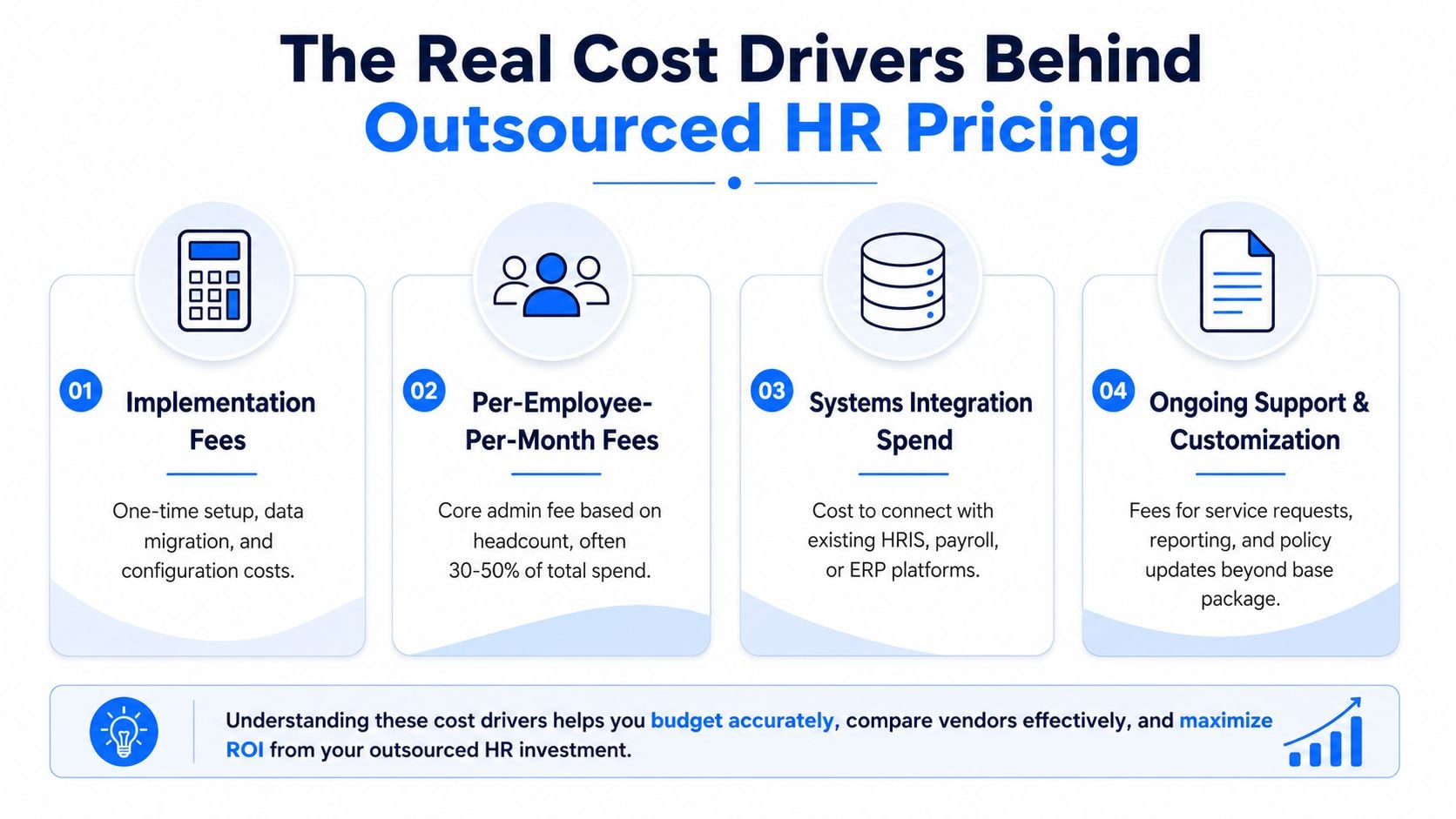
The practical cost drivers are easy to miss, and they are where contracts create an advantage for the vendor:
- Implementation fees. These cover setup, migration, and configuration, and they often show up before the first payroll cycle.
- Per-employee-per-month fees. These are the visible admin fees, and they rise with headcount.
- Systems integration spend. Connecting the provider to payroll, HRIS, or ERP systems often costs more than the sales team implies.
- Ongoing support and customization. Service requests, reporting, policy updates, and special handling add up fast.
The contract should spell out which of those items are included and which become change-order revenue. If the vendor wants open-ended language around support, the buyer is absorbing the risk.
Benchmark against workload, not just price
HRO Today’s buyer toolkit recommends collecting transaction volumes by service line, including headcount by location, payroll cycle frequency, year-end form counts, correction counts, manual checks, garnishments, and off-cycle runs, because those volumes drive staffing, configuration, and total cost (HRO Today data collection outline). That is the right benchmark. A vendor serving a high-correction, multi-state employer should not be compared with a simple single-state payroll book.
A better internal benchmark is cost per employee. Compare internal cost per employee with outsourced cost per employee, then separate the savings into two parts, lower labor hours and better output from the HR team. If the proposal only shifts work into a black box, the buyer has traded visible labor for hidden risk. That is not a clean savings story.
CFO rule: if the proposal does not explain what happens when corrections, filings, or integrations get messy, the price is incomplete.
For a more detailed buyer lens on pricing structure, this HR outsourcing cost guide is worth reviewing before any final vendor round.
Vendor Selection and Benchmarking Framework
The cheapest proposal often becomes the most expensive one. The vendors worth considering are the ones whose pricing, service rules, and control points match the company’s actual workload. Buyers should press for proof that the provider can absorb the company’s transaction volume, compliance load, and system environment without creating new manual work for finance or HR.
Start with the data, not the demo
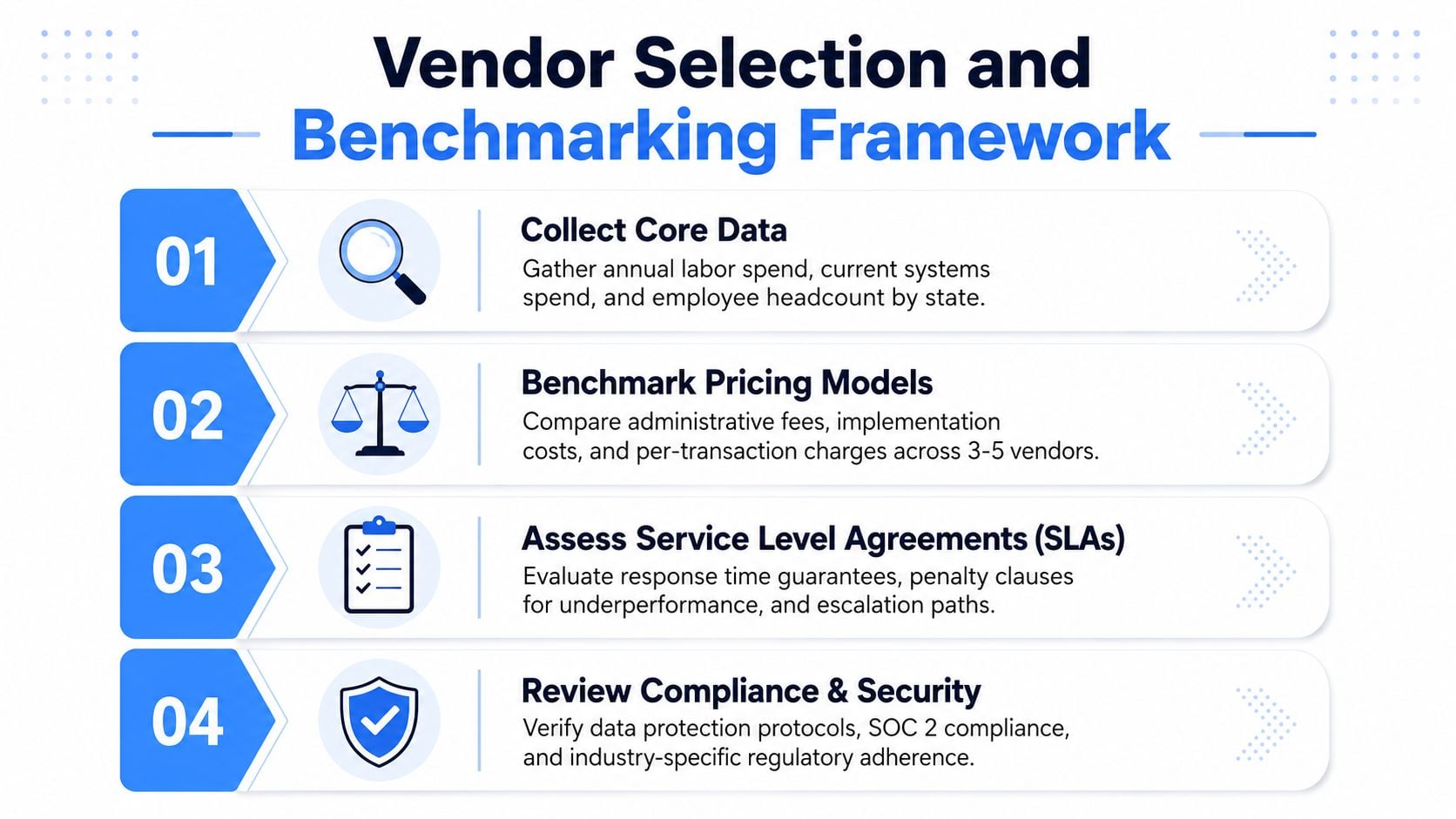
A serious benchmark starts with your own operating profile. Build the comparison from payroll volume, HR ticket volume, systems spend, third-party spend, labor cost by business unit, and operating cost by geography, then normalize the proposal against that workload. A vendor can look cheap in a sales deck and still be mispriced for a company with complex payroll corrections, multi-state exposure, or a messy systems stack.
A clean benchmark package should include four layers of data:
- Core workload data. Headcount by location, payroll cycle frequency, year-end forms, and correction history.
- Current spend data. Internal HR labor, systems, and third-party services.
- Risk data. Compliance misses, manual checks, garnishments, and off-cycle runs.
- Operating context. Union issues, multi-state work, seasonal staffing, and manager structure.
That package gives the buyer a fair basis for comparison. Without it, the vendor controls the frame and the buyer ends up comparing a custom operation to a generic service model.
Score service, not just responsiveness
Service quality has to be measured in operational terms. Track ticket acknowledgment time, average resolution time, first-contact resolution, on-time filing rates, correction speed for payroll errors, and compliance penalties, then compare those results against the service promise. A fast reply means little if the issue stays open, gets reopened, or creates downstream payroll damage.
Use a scoring rubric that forces discipline. Compare 3 to 5 vendors across four buckets, pricing, service quality, compliance support, and contract flexibility. That gives finance a cleaner read on trade-offs than a slide deck full of broad promises. References still matter, but only if they come from employers with similar size, complexity, and regulatory exposure. For teams that want a sharper read on vendor behavior, the negotiation profile guide at PEO Metrics on vendor negotiation personality types is a useful complement to the scorecard.
Ask one hard integration question
If the platform does not fit the current environment, the buyer pays twice, once for the vendor and once for the workaround. Ask whether the provider can integrate with existing payroll and HR systems without forcing manual re-entry, spreadsheet bridges, or side processes that shift work back onto the internal team. That question exposes whether the vendor is selling real operating relief or just rebranding internal labor.
The vendor should be able to explain the workflow in plain language. If service levels, integration steps, and escalation paths are hard to describe, the contract will probably be hard to live with. Good advisors know that detail matters, which is why a practical guide on how to write a business contract belongs in the buyer’s review stack before signature.
Use governance as the real benchmark
A vendor comparison is weak if it only checks features. Buyers should ask who owns escalations, who approves exceptions, how policy changes get documented, and what happens when the vendor’s process conflicts with the company’s internal controls. Those are the hidden points that drive cost after go-live.
The best selection process separates polished presentation from operating control. A vendor that can show clear governance, clear reporting, and clear accountability is usually the one that will protect margin later. A vendor that avoids those questions will protect its own revenue first.
Contract Negotiation Tactics and Exit Risk Flags
Most outsourced HR contracts are drafted to protect the vendor’s revenue, not the buyer’s flexibility. That’s not a scandal, it’s normal commercial behavior. The mistake is signing one without pushing back on the clauses that make switching painful.
Negotiate the money and the mechanics
There’s a useful analogy in general contract drafting guidance from Coto & Waddington’s business contract resource, clear terms prevent disputes, and vague terms create an advantage for the side that wrote the paper. That principle is especially true in HR outsourcing, where service scope and liability language can turn into expensive surprises.
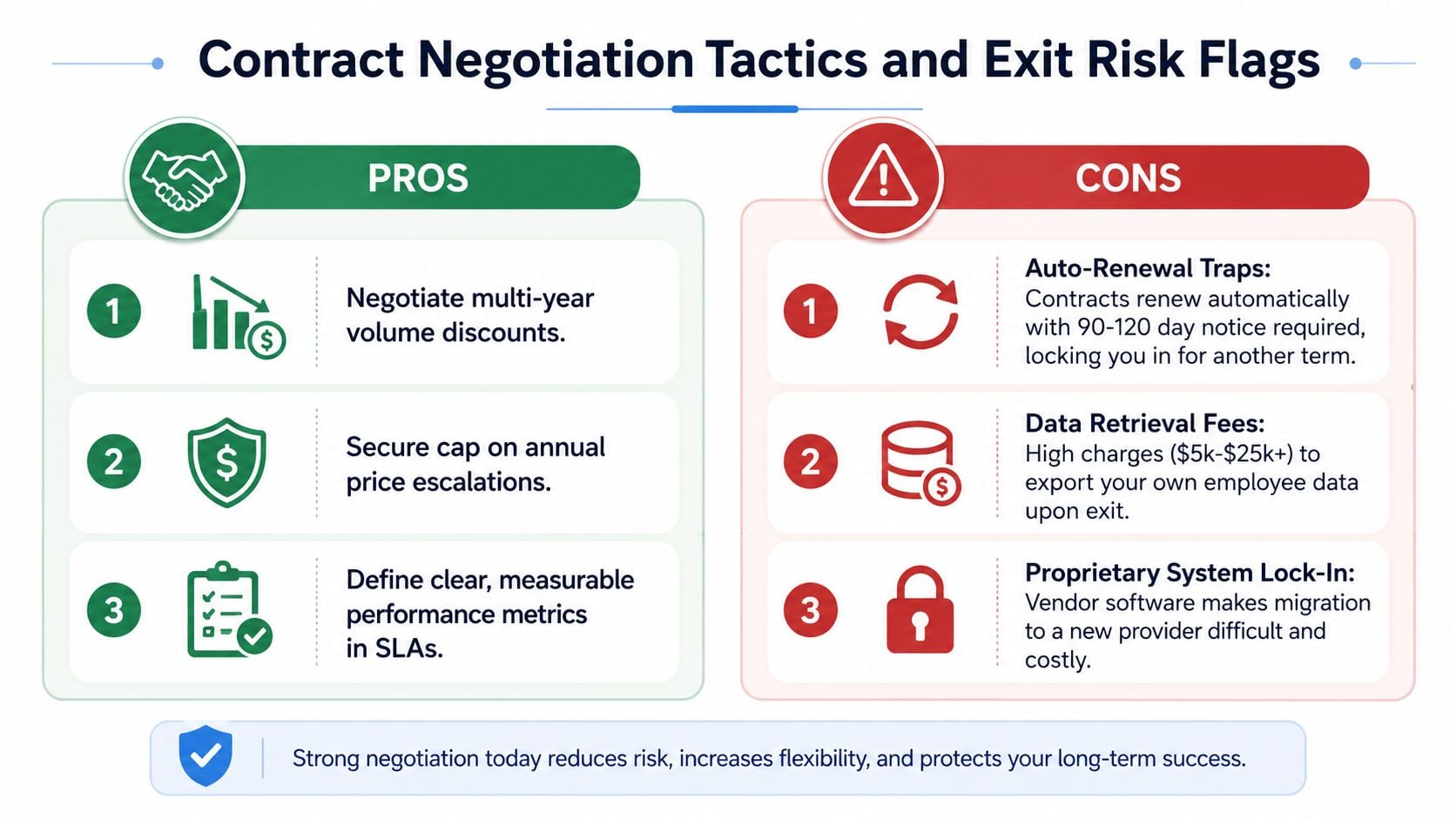
Buyers should press for three things immediately:
- Rate locks for 2 to 3 years. This prevents surprise escalations right after implementation.
- Implementation credits if go-live slips. If the vendor causes the delay, the buyer should not eat the extra cost.
- Financial remedies in the SLA. Service guarantees without penalties are just marketing language.
Watch the exit traps
The most common trap is automatic renewal with a short notice window. Another is data retrieval language that makes it expensive to export employee records when the relationship ends. Proprietary systems can also create lock-in, especially if the vendor makes migration slow, manual, or dependent on its own support team.
Hard rule: if the contract makes exit harder than entry, the vendor already has the stronger position.
Multi-state employers should be even more careful about liability language. If the contract is vague on who owns employment practices claims or how state-specific compliance is handled, the buyer is carrying more risk than the sales presentation suggests. For managers with strong negotiation instincts, this guide on negotiation personality types helps frame how different people react under contract pressure, which matters when legal, finance, and HR all have to agree on the terms.
A buyer should not accept a contract until it answers three questions in writing, how data gets out, how fees change, and what happens if service levels are missed. Anything less is an unfinished deal.
Implementation Checklist for Multi-State Employers
Implementation is where many outsourced HR decisions go sideways. The sales team closes the deal, then the buyer discovers the actual work starts with data cleanup, state registrations, system mapping, and employee communication. For a multi-state employer, that handoff has to be managed like a rollout, not a handoff email.
Build the cutover around validation
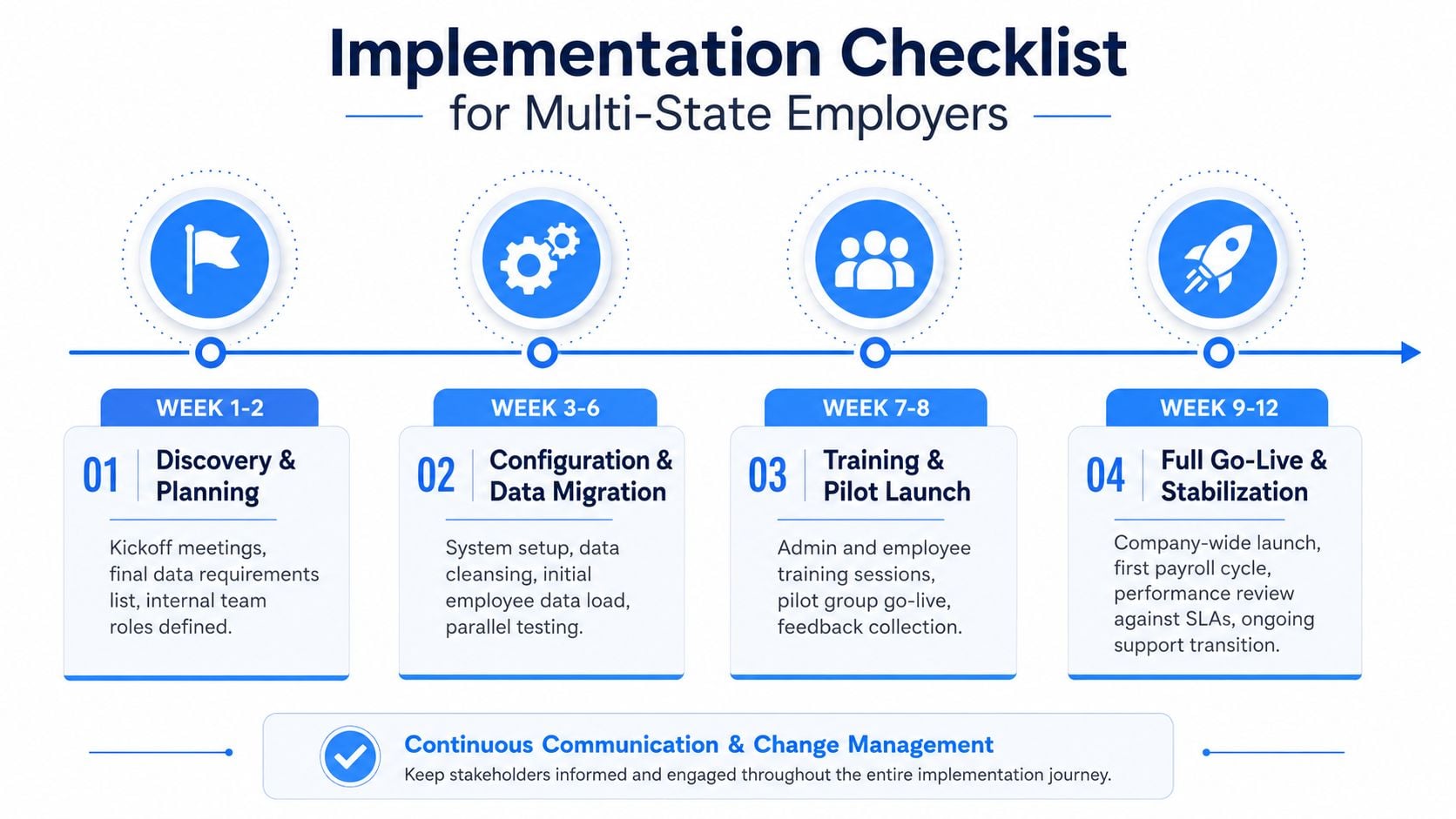
A 60 to 90 day transition window is typical for a serious outsourced HR move, and the buyer should use that time to validate employee tax elections, benefit deductions, garnishment orders, and PTO accruals. If those items are wrong, the first payroll cycle becomes the most expensive one.
A week-by-week rollout should look like this:
- Discovery and planning. Confirm scope, internal roles, and state-by-state requirements.
- Configuration and data migration. Clean the data, load the records, and test the system.
- Training and pilot launch. Train managers and admins, then run a small pilot group.
- Full go-live and stabilization. Monitor the first payroll cycle and track service levels closely.
Don’t skip the state setup work
Multi-state compliance tasks are not optional. The employer still needs proper unemployment insurance registration, state tax withholding setup, and workers’ compensation coverage that matches local requirements. If those items are delayed, the provider can’t paper over the gap with good service.
Implementation advice: parallel payroll runs catch problems before they become employee trust problems.
That’s the other reason to insist on a pilot. A well-run pilot surfaces the ugly issues early, bad mappings, missing deductions, and manager confusion. Once employees are live, every mistake feels personal, which is why the first two payroll cycles deserve disproportionate attention.
For teams expanding across states, this multi-state PEO support guide can help frame the operational questions that need answers before full launch.
When to Outsource, When to Keep Internal, and When to Renegotiate
Split the work by risk, not by habit. Repetitive payroll administration, filings, and other compliance-heavy tasks belong with the provider. Recruiting strategy, manager coaching, employee relations, and disciplinary calls should stay under direct leadership control.
Use geography and complexity as your trigger
State count changes the economics fast. If the company has employees in 5 or more states, payroll, withholding, unemployment insurance, and local compliance work usually deserve outsourcing. The more jurisdictions involved, the more room there is for missed filings, bad tax setup, and avoidable internal drag. Companies with fewer than 50 employees may still keep HR internal if the team can handle the workload cleanly and consistently.
Renegotiation belongs on the table as soon as the contract stops matching the market. If the admin fee has held steady while comparable offerings have gotten cheaper, if the company is paying for modules it does not use, or if service quality has slipped, the buyer has room to push back. Treat pricing, scope, and service levels as separate negotiations. Vendors often hide margin in unused features and vague support language.
Keep internal where judgment and culture matter
Some HR work should stay close to the CFO and the leadership team because the consequence of a bad call is too high. Recruiting strategy, manager coaching, employee relations, and disciplinary decisions affect trust, retention, and accountability. A provider can support the process, but it should not become the final authority on decisions that shape culture.
The clean test is whether the task can be measured clearly and executed consistently without giving up leadership control. If it can, outsource it. If the work depends on judgment, context, or direct accountability, keep it internal. in house vs outsourced controller guide uses the same control logic for finance functions, and the parallel is useful here.
Use a decision sequence, not a guess
A disciplined buyer works through the decision in order. Start with the workload and expense data. Then benchmark the company’s current setup against market rates and contract norms. Compare 3 to 5 vendors on pricing, service levels, implementation support, and exit terms. Finish by negotiating hard before signature, because the first draft always protects the vendor more than the buyer.
Governance matters. Ask who owns escalations, who approves changes to scope, and what happens if service quality drops after the first quarter. A weak contract leaves those answers vague, and vague ownership turns into hidden cost. Buyers who push on those points get better pricing discipline and fewer surprises later.
The right outsourced human resources decision is a control decision, and the contract should prove it. Buyers who treat it that way get better terms, cleaner accountability, and a less fragile operating model.
